EN
EN  ZH
ZH 


Stainless steels are a family of iron–chromium alloys. Five stainless steel families appear in fasteners, each behaving differently under load and in corrosive service. The stainless steel grades for bolts and screws you’ll specify most often come from these five families.
Austenitic grades are the workhorses. They contain 16–26% chromium and 6–14% nickel, stabilizing the face-centered cubic (FCC) austenite phase at room temperature. What that buys you is corrosion resistance, decent ductility, and strength you get from cold work rather than heat treatment.
304 (A2) is the default general-purpose grade: 18–20% Cr, 8–10.5% Ni, no molybdenum.
316 (A4) adds 2–3% molybdenum for chloride resistance.
321, 347, 303 cover high-temperature (Ti/Nb-stabilized) and free-machining (sulfur-added) needs.
201 trades nickel for manganese to cut cost but is not a 304 substitute in demanding service.
Martensitic grades (11.5–18% Cr, low nickel) harden by quenching and tempering like carbon steel. That makes them the choice when hardness and wear resistance matter more than corrosion: self-tapping screws, set screws, machine screws in mild environments. They are magnetic and noticeably less corrosion-resistant than 304.
Ferritic stainless (10.5–27% Cr, little nickel) is ferromagnetic and moderate in corrosion resistance. In fasteners it appears in cost-sensitive, mildly corrosive applications such as architectural trim, but it is seldom specified for structural stainless bolts. One procurement note worth flagging: because ferritic grades carry almost no nickel, their price is far less exposed to Ni-market volatility than 304/316. That is a legitimate reason to choose ferritic where the environment allows — not just a corrosion decision.
Duplex grades split their microstructure roughly 50/50 between austenite and ferrite. So a duplex fastener gives you roughly double the yield strength of 316. That same hybrid also lifts pitting resistance to PREN 30–35 (2205) and 38–42 (super-duplex 2507). They dominate offshore, desalination, and subsea service where 316 would be marginal.
PH grades combine a martensitic base with an aging heat treatment that precipitates copper- or nickel-rich phases for very high strength. 17-4 PH (Grade 630) reaches 1,310–1,380 MPa tensile in the H900 condition, far above any austenitic fastener, while keeping better corrosion resistance than 410. Aerospace, medical, and high-performance mechanical assemblies use them where strength-to-size is critical.
For a side-by-side look at how these families compare on strength, corrosion, and cost, see our stainless steel family comparison.
The word “stainless” is a misnomer. Stainless steels do corrode. They carry a built-in defense ordinary steel lacks: a passive film. Understanding it explains almost every grade decision that follows.
When chromium exceeds roughly 10.5%, the alloy spontaneously forms a nanoscopic layer of chromium oxide (Cr₂O₃). This film is only 1–3 nm thick. Invisible, but dense, adherent, and self-healing. If you scratch it, oxygen rebuilds it within milliseconds.
The catch: the film needs oxygen. In oxygen-starved crevices or where aggressive ions overwhelm it, protection fails locally, which is where grade selection becomes decisive.
Chromium (Cr) builds the passive film. More Cr means broader environmental tolerance.
Molybdenum (Mo) sharply improves resistance to pitting and crevice corrosion in the presence of chlorides (salt). This is the single biggest difference between 304 and 316.
Nickel (Ni) stabilises the austenitic structure, giving high formability and weldability. Low-nickel grades (ferritic/martensitic) trade some corrosion breadth for cost and hardenability.
Nitrogen (N), added to duplex grades, raises both strength and PREN.
Two more practical points. First, surface finish counts: a smoother finish (e.g., bright-annealed or 2B) resists fouling and corrosion better than a rough one, because deposits are harder to trap. Second, passivation to ASTM A967 (nitric or citric acid) removes free iron picked up during machining and thickens the protective film — a sensible step for critical assemblies.
Pitting starts when chloride ions (Cl⁻) punch through the passive film at a weak point: an inclusion, a scratch, a weld. Once a pit nucleates, the trapped chemistry turns acidic and eats inward, sometimes to failure in weeks.
Crevice corrosion is pitting’s cousin. It strikes under washers, in thread roots, and beneath gaskets where stagnant solution and low oxygen let the film collapse. It is the most common “mystery” failure on otherwise good stainless.
Tea staining is the mild, cosmetic end: a brown surface discoloration from iron contamination or shallow attack. It looks alarming but rarely threatens structure, though it signals the environment is at the edge of what the grade can handle. See why stainless steel fasteners still rust.
Real-world scenario: A coastal wastewater plant specified 304 (A2) hex bolts on handrail assemblies 800 m from the shoreline. Within 14 months the bolts showed tea staining and the first pits. The fix was switching to 316 (A4); the 304 had done exactly what its chemistry permitted, and the spec had asked for more.
The Pitting Resistance Equivalent Number (PREN) is the engineer’s shorthand for chloride resistance:
PREN = %Cr + 3.3 × %Mo + 16 × %N
Higher is better. Typical values: 304 ≈ 18–19, 316 ≈ 24–26, Duplex 2205 ≈ 30–35, super-duplex 2507 ≈ 38–42.
PREN explains the key fact: 316 resists chlorides roughly an order of magnitude better than 304. Field data puts 304 pitting onset near ~300 ppm chloride, while 316 holds to ~1,000–2,000 ppm.
For the full failure-mode breakdown: stress-corrosion cracking and intergranular attack, browse our Resources library on stainless steel corrosion mechanisms.
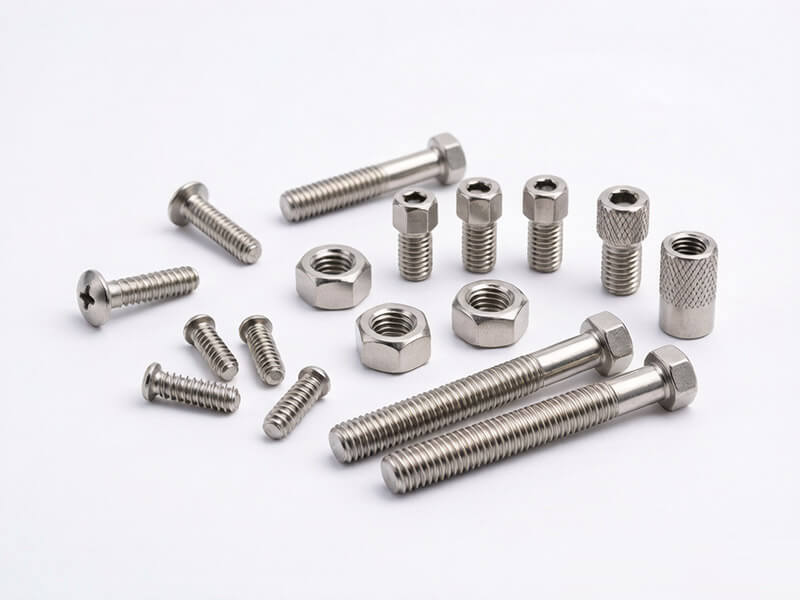
When it comes to stainless steel grades for fasteners, remember this above all: 304 and 316 are chosen for corrosion, not strength. Their mechanical properties are nearly identical. The molybdenum in 316 is the entire story.
| Element | 304 / A2 | 316 / A4 |
|---|---|---|
| Chromium (Cr) | 18.0–20.0% | 16.0–18.0% |
| Nickel (Ni) | 8.0–10.5% | 10.0–14.0% |
| Molybdenum (Mo) | None | 2.0–3.0% |
| Carbon (C), max | 0.08% | 0.08% |
| PREN (typical) | ~18–19 | ~24–26 |
In the ISO 3506 system, “A2” means austenitic grade 2 (the 304-family) and “A4” means austenitic grade 4. The dash number is the property class: a strength rating, not a corrosion rating:
A2-70 / A4-70: minimum tensile 700 MPa, 0.2% proof stress 450 MPa.
A4-80: minimum tensile 800 MPa, proof stress 600 MPa (tighter composition, more cold work).
So “A4-80” means a 316-family alloy at the 800-MPa strength class. It is not “more corrosion-resistant than A4-70”: just stronger.
| Attribute | 304 (A2) | 316 (A4) |
|---|---|---|
| Tensile strength (class 70) | ≥ 700 MPa | ≥ 700 MPa |
| 0.2% proof stress (class 70) | ≥ 450 MPa | ≥ 450 MPa |
| Chloride pitting threshold (ambient) | ~300 ppm | ~1,000–2,000 ppm |
| PREN | ~18–19 | ~24–26 |
| Magnetism (annealed) | Essentially none* | Essentially none* |
| Relative material cost | 1.00× (baseline) | +15–25% |
| Best use | Indoor, rural, mild urban | Coastal, marine, chemical, de-icing salt |
*Cold heading and thread rolling can induce weak magnetism even in austenitic grades (see Section 4).
The numbers show why “pay for 316 for strength?” is the wrong question. You pay for 316 for environment, accepting the premium as insurance against chloride-driven failure.
A piecemeal view says 316 costs 15–25% more than 304, so use 304 wherever possible. A total-cost-of-ownership (TCO) view asks a different question: what does a failure cost?
Consider a coastal walkway: 304 bolts at $1.00, 316 at $1.20. If the 304 needs replacement at year 8, plus labor and access, the savings evaporate. In chloride service, 316 typically pays back its premium within 3–5 years by avoiding one premature intervention. The decision is therefore economic, and the answer usually favors 316 wherever chlorides are present.
Real-world scenario — food processing: A dairy plant specified 304L for its stainless equipment frames. Indoors and regularly wash-down cleaned, 304L delivered years of maintenance-free service at the lowest alloy cost. When the same frames were later extended to an outdoor loading bay near a salted road, pitting appeared within 18 months — the grade, not the maintenance, was the limit.
Real-world scenario — offshore access platform: A North Sea maintenance walkway originally used 304 hardware. Within two seasons, bolt heads showed red rust and crevice pitting at the splash line. Re-specified to A4-80 (316L), with duplex 2205 in the submerged members, the same joints ran five years with only cosmetic inspection. The molybdenum content — not a higher strength class — was what changed the outcome.
For the exhaustive cost-and-performance model, see our 304 vs 316 stainless steel fasteners comparison. For payback math, see is 316 stainless steel worth the cost.
The table below consolidates representative minimum values from ISO 3506-1 (metric) and ASTM F593 (inch-series PH). For full property ranges, see typical mechanical properties of 316 stainless.
| Grade (family) | Property class | Min. tensile (MPa) | Min. 0.2% proof/yield (MPa) | Magnetic? | Typical use |
|---|---|---|---|---|---|
| A2 (304, austenitic) | 70 | 700 | 450 | Weakly, if cold-worked | General purpose |
| A4 (316, austenitic) | 70 | 700 | 450 | Weakly, if cold-worked | Marine, chemical |
| A4 (316, austenitic) | 80 | 800 | 600 | Weakly, if cold-worked | High-load chloride service |
| C1 (410, martensitic) | 70 | 700 | 410 | Yes | Hard, mildly corrosive |
| 17-4 PH (Grade 630) | H900 | 1,310–1,380 | 1,170–1,250 | Yes | Aerospace, high strength |
| 17-4 PH (Grade 630) | H1150 | 860–930 | 725–860 | Yes | High strength, less hard |
| Duplex 2205 | 100 | ≥ 1,000 | ≥ 800 | Yes (ferritic phase) | Offshore, subsea, desalination |
Two things stand out. First, austenitic fasteners top out near 800 MPa (class 80); if you need more, you leave the austenitic family for martensitic, PH, or duplex. Second, strength and corrosion resistance trade off across families: 410 is hard but corrosion-limited, while 316 is corrosion-proof but strength-limited without cold work.
“If it sticks to a magnet, it isn’t stainless.” This is the most repeated and most wrong rule on the shop floor.
Austenitic 304/316 are non-magnetic in the fully annealed state because their FCC structure has no net magnetic moment. But cold heading and thread rolling plastically deform the metal, partially transforming some austenite into strain-induced martensite. That transformed layer is magnetic. A perfectly genuine A2-70 bolt will often cling to a magnet simply because it was cold-formed.
An incoming inspector once rejected A2-70 socket-head capscrews as “counterfeit carbon steel” because they stuck to his magnet. The right test for “is this the right grade?” is a PMI analyzer or chemistry check, never a magnet.

Most guides stop at “pick a grade.” They skip the question a procurement engineer should ask: how was this part actually made? Manufacturing controls the properties you can’t see: grain flow, surface integrity, and the health of the passive film.
Production begins with stainless wire rod. The rod is drawn through hardened dies to the precise diameter the fastener requires. Drawing work-hardens the wire and reduces ductility, so it is annealed in a controlled (often low-oxygen) atmosphere furnace to restore the softness needed for forming. Get the atmosphere wrong and the surface oxidizes, compromising the passive layer itself.
The cut wire blank is forged into shape by a high-speed cold heading machine at room temperature. Cold heading beats machining because the grain flow follows the fastener shape, improving fatigue strength and eliminating waste.
Threads are almost always formed by thread rolling, not cutting. Hardened dies displace material to raise the thread form, leaving compressive residual stresses at the root that resist crack initiation. Rolled threads outperform cut threads in fatigue and finish.
Austenitic 304/316 are not quench-hardened; their strength comes from cold work, and heavily deformed parts may receive a solution anneal (≈1,050–1,150 °C). Martensitic (410) and PH (17-4 PH) grades, by contrast, are hardened by quench-and-temper or aging cycles.
Every forming step can smear free iron from tooling onto the surface. Left in place, that iron rusts and stains the part. Passivation re-establishes a dense, uniform passive film. Per ASTM A967 / AMS 2700, it means immersing the part in nitric or citric acid, which dissolves that free iron. Surface roughness (Ra) also matters: smoother finishes resist crevice attack better than rough ones.
We hold documented checkpoints at every stage of our own line. To see how specification translates into finished parts, explore our stainless steel fastener range. For the step-by-step plant tour, our guide on how stainless steel fasteners are made covers tooling, lubricants, and inspection in detail.
Standards exist so “A4-80” means the same thing everywhere. Three frameworks matter.
Per ISO 3506-1 standard (the 2020 edition adds 6%Mo austenitic and duplex grades, plus a “100” property class), the designation breaks down as:
Letter = steel group: A = austenitic, C = martensitic, F = ferritic, D = duplex.
Digit = grade within the group: A1–A5 (A2≈304, A4≈316 with Mo; A5 is a stabilized 316 variant).
Dash number = property class: 50, 70, 80 (and 100 for duplex), corresponding to minimum tensile strength in hundreds of MPa.
Bolts are normally marked on the head with the class; always confirm the marking matches the spec. See what A2-70 and A4-80 mean.
For inch-series stainless fasteners, ASTM F593 covers bolts, hex capscrews, and studs (including Grade 630 = 17-4 PH), with F594 for nuts and F738 for metric stainless. ASTM A193 / A320 cover high-temperature and low-temperature alloy-steel and stainless bolting for pressure equipment (B8 = 304, B8M = 316). DIN specs (933/931, 934, 125) align with the ISO property-class system; “A4-80 DIN 933” is simply the ISO grade-and-class in DIN form. EN 10204 3.1 Mill Test Certificates (MTC) document actual heat analysis and mechanical results for traceability.
For the clause-by-clause reference: including the duplex “100” class and marking requirements, see our ISO 3506 stainless steel grades explainer.
Selecting the right stainless steel grades for fasteners is ultimately an environmental decision. Map the service condition to a grade, then confirm strength with the property class. For a head-to-head against carbon and alloy steel, see our stainless vs carbon steel fasteners comparison.
| Environment / duty | Recommended grade | Why |
|---|---|---|
| Indoor, dry, mild outdoor | 304 / 304L (A2) | Cost-effective; enough corrosion margin |
| Marine, coastal, pool, de-icing salt | 316L (A4-70/80) | Mo resists chloride pitting |
| Submerged / splash / high strength in seawater | Duplex 2205 | PREN 34–36 + 2× yield strength |
| Chemical & petrochemical (mild) | 316L (A4) | Broad chemical resistance |
| Chemical, warm chlorides, high stress | Duplex 2205 | SCC and pitting resistance |
| Food & pharmaceutical | 304L / 316L | Hygienic, weldable, easy to clean |
| High temperature (≤650 °C), mild env. | 410 (heat-treated) | Hardenable strength + heat resistance |
| High-temp process (ASTM pressure equip.) | A193 B8 / B8M (304/316) | Specified for high-temp bolting |
| Decorative / budget / mild | 430 (F1) | Low-nickel cost stability |
| Strength / wear, dry | 410 / 431 | Hardenable, high strength |
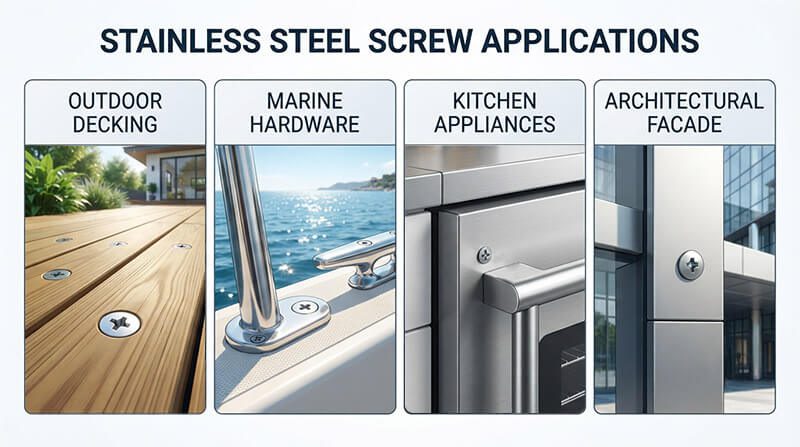
Dry interiors and mild urban atmospheres with no chlorides are 304 territory: furniture hardware, interior HVAC brackets, equipment never exposed to salt or chemical. It is the cost-optimal default.
Anything within splash zone of seawater, within a few kilometers of the coast, exposed to de-icing salts, or in contact with process chemicals should be 316. This includes marine hardware, coastal façades, food and pharmaceutical plants, and bridge expansion joints in cold climates.
Watch-out: Austenitic grades are vulnerable to chloride stress-corrosion cracking (SCC) above roughly 60 °C in the presence of chlorides. For hot, chloride-rich, high-stress duty, move to duplex 2205.
When the limiting factor is load rather than corrosion:
410 for hardness/wear in mildly corrosive settings (self-tapping, set screws).
17-4 PH where very high strength is required and corrosion is moderate (aerospace, precision mechanisms).
Duplex 2205 where you need both high strength and serious chloride resistance (offshore, desalination, subsea).
Real-world scenario — self-drilling roof screws: A metal-building manufacturer needed screws that could drill their own hole and hold high clamp load. Austenitic 304 could not reach the required hardness; 410 (heat-treated) delivered the wear resistance and torque strength. Specified only for inland, atmospheric duty — the same screw would have rusted on a coastal roof.
Real-world scenario — seawater pump station: A desalination intake used 316 bolts that suffered crevice corrosion at bolt–flange interfaces within three years. Switching to duplex 2205 raised PREN from ~25 to ~35 and doubled joint strength, extending the maintenance interval beyond the project’s design horizon.
START
  │
  ├─ Chlorides present (coastal air, de-icing salt, seawater, process chemicals)?
  │     ├─ YES ──> Very high strength (>800 MPa) also required?
  │     │            ├─ YES ──> Duplex 2205 (class 100) or 17-4 PH
  │     │            └─ NO  ──> 316 / A4 (class 70, or 80 if higher load)
  │     └─ NO ───> High hardness / wear resistance required?
  │                  ├─ YES ──> 410 (C1) or 17-4 PH
  │                  └─ NO  ──> 304 / A2 (class 70, or 80 if higher load)
  │
  ├─ Confirm property class meets design tensile/proof load.
  ├─ Confirm galvanic compatibility with joined materials (Section 8).
  └─ Specify passivation + finish (Ra) for demanding service.
For a downloadable one-page version with environment examples, our stainless steel fastener selection guide expands each branch.
Even the right grade fails if it is joined wrong. These are the errors we see most often in the field.
Specifying 304 in a coastal or de-icing environment. The most common error; PREN ~19 cannot hold against chlorides.
Assuming “stainless” means “non-magnetic” and rejecting good parts (Section 4), or accepting magnetic counterfeit.
Ignoring crevices. Even 316 pits under a trapped washer in stagnant brine. Specify sealed joints or non-absorbing isolators.
Over-specifying 316 where 304 suffices, inflating cost with no service benefit in benign interiors.
Forgetting the galvanic partner. A perfect 316 bolt can destroy an aluminum frame (below).
Thread galling. Austenitic stainless can cold-weld under high assembly torque, seizing the joint before the target clamp load is reached. Mitigate with proper lubrication, controlled torque, avoiding over-tightening, and pairing a harder nut with the bolt.
Chloride stress-corrosion cracking (SCC). 304 and 316 are vulnerable above ~60 °C when chlorides and tensile stress coexist. If the service environment is hot and chloride-rich, specify duplex or a higher alloy from the start.
Sensitization / weld decay. When carbon at weld zones precipitates chromium carbide, the adjacent area loses corrosion resistance. Always use low-carbon “L” grades (304L, 316L) for welded assemblies.
Galvanic corrosion needs three things at once: two dissimilar metals, electrical contact, and an electrolyte (moisture, salt spray, even humid air).
Follow a simple rule: keep the potential gap between coupled metals under ~0.25 V on the galvanic series. Past that point, the more “active” (anodic) metal sacrifices itself to protect the “noble” (cathodic) one. Stainless in its passive state is noble. So when you bolt it into aluminum or plain carbon steel, the other metal corrodes, not the stainless.
Real-world scenario — rooftop HVAC on a coastal hospital: A contractor used A4-80 stainless bolts to secure an aluminum structural frame, assuming “all stainless, all safe.” Within two seasons the aluminum pitted and chalked at every joint. The fix was dielectric isolation: nylon sleeves and washers breaking the conductive path, plus a film of dielectric grease on the threads.
Two more principles save assemblies:
Mind the area ratio. A small anode against a large cathode fails fast (aluminum rivets in a stainless panel = disaster); a small noble fastener in a large anodic structure is tolerable.
Isolate deliberately. Nylon, neoprene, or glass-reinforced-epoxy sleeves and washers, full coatings on both surfaces, or a sacrificial zinc anode all work. When two metals far apart on the series must meet, assume you need a deliberate break between them.
Where stainless meets galvanized steel, the zinc is the sacrificial anode and protects the steel substrate. Ensure drainage so electrolyte doesn’t pool.
A2-70 is a grade-plus-strength code stamped on stainless fasteners. A2 identifies the austenitic 304-family stainless; 70 is the property class, meaning a minimum tensile strength of 700 MPa and 0.2% proof stress of 450 MPa. It rates strength, not corrosion resistance.
In the fully annealed state, austenitic 304/316 are essentially non-magnetic. But cold heading and thread rolling induce measurable magnetism, so a formed bolt may attract a magnet. Martensitic (410), PH (17-4), ferritic (430), and duplex grades are magnetic. A magnet can’t confirm grade. Only chemistry can.
Yes, eventually. At ~300 ppm chloride (typical of coastal air and salt spray), 304 begins to pit and tea-stain. Within a few kilometers of the shore or where de-icing salts land, specify 316 for the chloride exposure.
In benign interiors, no: 304 is the economic choice. In chloride-exposed service, yes: the 15–25% premium typically pays back within 3–5 years by preventing one premature failure. Use a total-cost-of-ownership view, not unit price.
Cautiously. Zinc is anodic to passive stainless, so the galvanized coating sacrifices itself and protects the steel substrate. Ensure drainage so electrolyte doesn’t pool, and avoid the combination in aggressively marine settings without isolation.
Only when hardness or high strength is the limiting factor, not corrosion. 410 is hard but corrosion-limited; 17-4 PH reaches 1,300+ MPa tensile with better corrosion than 410. Neither replaces 316 for chloride service.
For chloride, marine, or chemical exposure — yes. For dry indoor or mild outdoor duty, 304 is fully sufficient and more cost-effective. “Better” depends on the environment, not the number.
“L” = low carbon (≤0.03%). It prevents sensitization during welding, keeping the weld zone corrosion-resistant. Always specify “L” grades for welded assemblies.
These are ISO 3506 property-class names: A2 = 304-type, A4 = 316-type. A4 adds molybdenum, so it resists chlorides that A2 cannot.
Usually surface iron contamination, the wrong grade for the environment, or crevice corrosion. Passivation (ASTM A967) plus the correct grade resolves the issue.
Among common grades, martensitic 410/431 (heat-treated) and duplex 2205 lead. Annealed 304 and 316 have similar moderate strength but gain substantially through cold working.

Choosing stainless steel grades for fasteners is less about memorizing alloy tables and more about answering one question well: what environment must this part survive? Map the environment, pick the family (304/A2 for benign, 316/A4 for chlorides, martensitic/PH/duplex for strength), confirm the property class for load, and respect the galvanic partner. Do those four things and most field failures disappear before they start.
The grade you specify is only as good as the process that makes it, so pair this knowledge with a supplier who controls wire, forming, heat treatment, and passivation at every checkpoint. To see how specification becomes a finished, documented part, explore our stainless steel fastener products, and keep our Resources library handy.
Social Chat is free, download and try it now here!