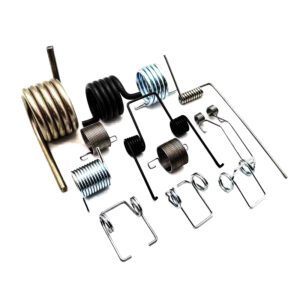
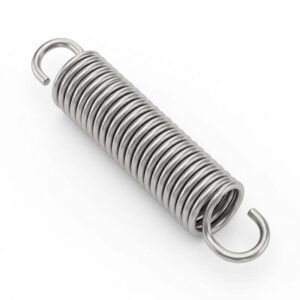
Guxiang supplies a complete spring range covering compression springs and extension springs in music wire, spring steel, stainless steel, phosphor bronze and chrome silicon alloy. Helical compression springs are manufactured to DIN 2098, EN 13906 and ISO 10243 with closed and ground, closed unground, open, and open and ground end configurations. Extension springs are produced with machine hooks, cross-over hooks, side hooks and swivel hooks for tensile load applications. Both product families are available from stock-standard dimensions through fully custom wire diameters, outer diameters, free lengths and end treatments for engineers and industrial buyers.
Springs are mechanical components that store elastic energy when deformed and release it when the deforming force is removed. In their simplest form, a spring is a wire coil that returns to its original shape after being compressed, stretched, twisted, or bent. This property comes from the elastic limit of the spring material: within the elastic range, deformation is fully reversible, and the stored energy is proportional to the displacement.
Industrial springs serve four core functions: absorbing shock and vibration, storing energy for later release, maintaining contact between two surfaces, and measuring or applying force. They appear in nearly every mechanical system—suspension systems absorb road impact, valves use springs to return to their seat, switches rely on spring contacts, and safety mechanisms trigger on spring release. In B2B procurement, springs are typically purchased in volume for integration into assemblies, which makes dimensional consistency, material traceability, and fatigue life the primary selection criteria.
How Springs Store and Release Energy
A spring converts mechanical work into elastic strain energy within the wire. When a compression spring is squeezed, the coils deflect and the wire is loaded in torsion; when an extension spring is pulled, the coils separate and the wire is again stressed in torsion along its length. The relationship between force and deflection is governed by Hooke’s law: F = k × x, where F is the applied force, k is the spring rate, and x is the deflection. The spring rate is constant within the elastic range, which is what makes spring behavior predictable for engineers.
The rate itself depends on four geometric factors: the wire diameter to the fourth power, the mean coil diameter to the third power, the number of active coils, and the shear modulus of the material. Doubling the wire diameter increases the rate by a factor of sixteen; doubling the coil diameter reduces the rate by a factor of eight. This sensitivity means small manufacturing tolerances have outsized effects on spring performance, and it is the reason precision springs are specified with rate tolerances of ±5% or tighter.
Energy is only recoverable while the material stays below its elastic limit. A spring compressed past its solid height—where all coils touch—takes a permanent set and loses its free length. The same applies when stress exceeds the material’s endurance limit under cyclic loading: fatigue cracks initiate and eventually propagate to fracture. Correct spring design keeps working stress within the material’s allowable range for the intended cycle count, and selects the material grade that matches the operating environment.
Springs Classification System
Industrial springs are classified by the direction of the applied load, and the two dominant families are compression springs and extension springs. Within each family, subtypes are defined by end configuration, coil geometry, and performance characteristics.
Compression springs resist axial compression: they are open-wound helical coils with space between adjacent coils at free length, and they exert force as the coils are squeezed together. They are the most widely used spring type in industry, found in automotive valve trains, injection mold ejection systems, appliance mechanisms, and industrial machinery. Compression springs are manufactured with flat, closed, or ground ends to create stable bearing surfaces, and the coil geometry can be cylindrical, conical, barrel, or hourglass to control buckling behavior and load characteristics. The wire is wound with a pitch that leaves clearance between coils; when the spring is compressed to solid height, all coils contact and the spring can carry no further load.
Extension springs resist axial tension: they are close-wound helical coils with adjacent coils touching at free length, and they exert force as the coils are pulled apart. Extension springs are fitted with hooks, loops, or threaded inserts at both ends for attachment to mating components. The hook configuration significantly affects performance—a machine hook offers economical attachment for light loads, while a German hook with its larger transition radius distributes bending stress and delivers three times the fatigue life. Extension springs also carry initial tension, a force wound into the coil during manufacture that must be overcome before the coils begin to separate and the spring rate takes effect.
The two families are not interchangeable. An extension spring cannot be compressed—its coils touch at free length, so compression would immediately reach solid height with zero travel. A compression spring cannot be pulled without end attachments, and even with end fittings, its open-wound construction does not deliver the controlled tension behavior of a close-wound spring.
Types of Springs
The twelve representative types below cover the two spring families. Each entry lists the key characteristic that defines its behavior and the typical application where it performs best.
Spring Family
Representative Type
Key Characteristic
Typical Application
Compression
Closed and Ground End
Flat ground bearing surface at both ends; stable upright seating
Valve springs, precision mechanisms, mold ejection
Compression
Open End
Coils unground; economical, no bearing surface
Light-duty mechanisms, toys, low-load guards
Compression
Cylindrical
Uniform coil diameter; constant rate across full travel
General industrial machinery, shock absorption
Compression
Conical
Tapered coil diameter; nests to short solid height
Limited-space assemblies, battery contacts
Compression
Barrel
Wider middle coils; resists buckling under load
Long-stroke applications without guide rods
Compression
Die Spring
Heavy-duty rectangular or round wire; high load capacity
Music wire (EN 10270-1 SH / ASTM A228) — the standard choice for general springs; high tensile strength, good fatigue resistance, and the lowest cost; operating range −40 to 120 °C; not corrosion-resistant without plating
Oil-tempered wire (EN 10270-2 / ASTM A229) — similar strength to music wire with better ductility; suited to larger wire diameters and automotive suspension applications
Stainless steel 302 (ASTM A313) — corrosion resistance with moderate strength; the default for food, medical, and marine environments where rust is unacceptable; operating range −50 to 290 °C
Stainless steel 316 — enhanced pitting resistance for saltwater and chemical exposure; lower strength than 302 but superior corrosion performance
Chrome silicon alloy (EN 10270-2 / ASTM A401) — highest fatigue strength and impact resistance of common spring alloys; specified for die springs and high-cycle shock applications; operating range −40 to 230 °C
Phosphor bronze — non-magnetic and electrically conductive; used for switch contacts, instruments, and corrosion-prone electrical assemblies
Surface Treatments
Zinc plating — standard corrosion protection for music wire springs; available in clear, yellow, and black finishes; thickness 5–8 µm
Black oxide — thin conversion coating for indoor use; minimal dimensional change; improves appearance and light corrosion resistance
Powder coating — thick polymer layer for outdoor and heavy-duty applications; color-matched to assembly requirements
Shot peening — mechanical treatment that compresses the surface layer and raises fatigue life by 30–50%; recommended for high-cycle die springs
Passivation — chemical treatment for stainless steel that restores the chromium oxide layer and maximizes corrosion resistance
Manufacturing Quality Indicators
Free length tolerance — precision springs hold ±1–2% of free length; commercial springs allow ±3–5%
Rate tolerance — precision spring rates hold ±5%; standard springs typically ±10%
End squareness — compression spring ends are ground flat within 1–2° of perpendicular to the axis
Material certification — EN 10204 3.1 certificates verify material chemistry and mechanical properties for traceable procurement
How to Choose the Right Spring
Step 1: Define the load direction and space envelope.
Determine whether the spring must resist compression or tension. Compression springs fit between a moving component and a fixed surface; extension springs connect two components that move apart. Measure the available installation space—the maximum outer diameter, the minimum inner diameter, and the free length the assembly can accommodate. The space envelope directly constrains the three geometric variables of the spring rate equation: wire diameter, coil diameter, and number of active coils.
Step 2: Specify load, deflection, and cycle life.
Define the working load at operating deflection and the deflection range the spring will travel in service. These two numbers determine the required spring rate. Estimate the expected cycle count: a door return spring may see 50,000 cycles, while a valve spring may see 10⁷ cycles. High cycle counts push the design toward chrome silicon or shot-peened music wire; low cycle counts allow standard music wire at lower cost. If the operating temperature exceeds 120 °C, stainless steel or chrome silicon becomes mandatory over music wire.
Step 3: Match environment and end configuration.
Select the material for the operating environment—standard indoor machinery accepts plated music wire; food, medical, and marine applications require stainless 302 or 316. Choose the end configuration for the assembly: ground ends for precision upright seating, conical or barrel shapes where buckling is a concern, German hooks for high-fatigue tension designs, and threaded inserts where adjustable preload is needed. Share the six critical dimensions with the manufacturer—wire diameter, outer diameter, free length, total coils, end type, and material—to obtain a rate-accurate quotation.
Frequently Asked Questions
What is the difference between compression and extension springs?Compression springs are open-wound and push back when squeezed shorter; extension springs are close-wound and pull back when stretched longer. Compression springs need no end fittings; extension springs require hooks, loops, or threaded inserts for attachment.
What materials are industrial springs made of?The four common materials are music wire for general use, oil-tempered wire for large diameters, stainless steel 302/316 for corrosion resistance, and chrome silicon for high fatigue life and shock loads. Each offers a different balance of strength, corrosion resistance, and cost.
How do I measure a spring for replacement?Record six dimensions: wire diameter, outer diameter (or inner diameter), free length, total number of coils, end configuration, and direction of coil winding. These six values allow a manufacturer to replicate the spring exactly and quote the correct rate.
What is spring rate and how is it calculated?Spring rate is the force required to compress or extend the spring by one unit of length, expressed in N/mm. It is calculated as k = Gd⁴/(8D³n), where G is the shear modulus, d the wire diameter, D the mean coil diameter, and n the number of active coils.
Can springs be manufactured to custom specifications?Yes. Custom springs are made from the six measured dimensions plus load, deflection, cycle life, and environmental requirements. Most manufacturers offer prototypes from stock wire in 2–4 weeks and production runs with material certificates and rate testing.
What surface treatments are available for springs?Zinc plating and black oxide protect music wire springs indoors; powder coating suits outdoor and heavy-duty use; shot peening improves fatigue life by 30–50% for high-cycle springs; passivation maximizes stainless steel corrosion resistance.
How do I choose the right spring for my application?Start with load direction and space envelope, then define working load, deflection, and cycle count to derive the rate, and finally match material and end configuration to the environment. Providing the manufacturer with six dimensions plus service conditions yields the correct spring.
What temperature range can springs withstand?Music wire operates from −40 to 120 °C; chrome silicon from −40 to 230 °C; stainless steel 302 from −50 to 290 °C. Above these limits, the material relaxes and the spring loses its set load. High-temperature service demands a heat-resistant grade and reduced working stress.
Why do springs fail and how can I prevent it?Springs fail from fatigue cracking at stress concentrations, permanent set from over-compression past solid height, corrosion pitting that reduces wire section, and buckling from excessive slenderness. Prevention combines correct material selection, shot peening, guide rods, and staying within rated deflection.
What standards apply to industrial springs?Compression springs follow ISO 10243, DIN 2095, and EN 13906; extension springs follow DIN 2097 and ISO 10243. Materials follow EN 10270-1/2 and ASTM A228/A229/A313/A401, with EN 10204 3.1 certificates available for traceable supply.