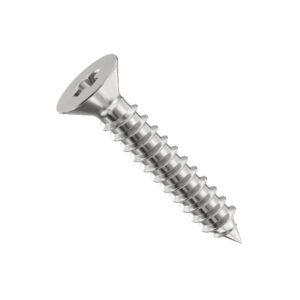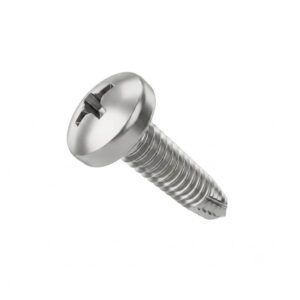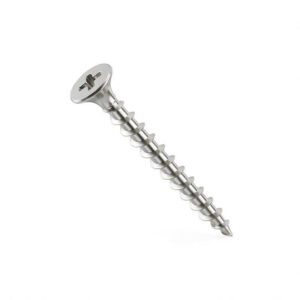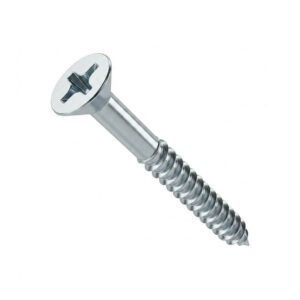






Our comprehensive selection of screws covers 11 specialized types across four engagement families, including self-tapping, machine-thread, manual-operation, and assembly types. Fully compliant with DIN, ISO, and ASME specifications, these high-quality fasteners are available in carbon steel, A2/A4 stainless, brass, and silicon bronze to suit any engineering, buying, or shop-floor requirement.
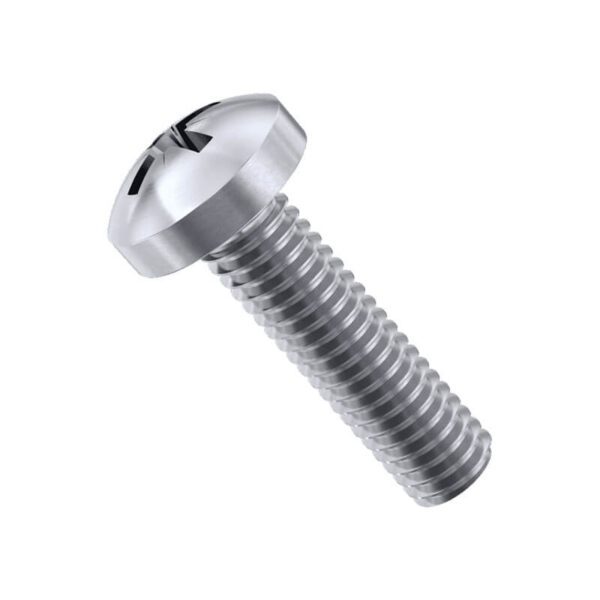

A screw is a threaded fastener that converts rotational force into linear clamping force. The helical thread wraps around a cylindrical or tapered shank; turning the head drives the thread into the mating material, creating tension along the screw axis that pulls joined parts together.
The thread is what distinguishes a screw from a nail. A nail holds by friction and material displacement. A screw holds by mechanical interlock—the thread flanks bear against the material, resisting both pull-out and loosening from vibration. This makes screws the default choice when a joint must survive cyclic loading, thermal expansion, or disassembly for maintenance. Screws span diameters from under 1 mm (M0.6 watch screws) to over 50 mm (anchor bolts), covering every engineered joint between.
Turning the head applies torque. The helical thread converts torque into axial force, pulling the fastener forward by one thread pitch per full rotation. The thread flanks wedge against the mating material at an angle—typically 60° for unified and metric threads—resisting loosening through mechanical interlock.
Clamping force comes from elastic stretch. As the head seats, further rotation stretches the body within its elastic limit. This stretch stores energy like a tensioned spring, maintaining clamp load even as the joint settles or material creeps. The engagement type determines selection: self-tapping fasteners cut or form their own mating thread; machine types mate with a pre-cut thread in a nut or tapped hole.
Screws are organized by how the thread mates with the workpiece. This single decision—self-tapping or pre-tapped—determines material compatibility, installation tooling, and joint design.
Self-tapping screws form or cut their own mating thread during installation. The screw creates the thread path as it advances. This family covers wood screws, self-tapping screws for metal and plastic, self-drilling screws, thread-rolling screws, chipboard screws, and drywall screws.
Machine screws mate with a pre-existing thread—either a tapped hole or a nut. The thread on the screw and the mating part are both pre-formed to a standard profile (ASME B1.1, ISO 68-1). This family covers machine screws, set screws, and shoulder screws.
Manual-operation screws are driven by hand and optimized for tool-free adjustment. Thumb screws with knurled or winged heads fall here.
Assembly fasteners join two sides of a pre-drilled panel from opposite faces. Binding posts—also called Chicago screws or sex bolts—are the primary type.
| Type | Thread Mechanism | Typical Materials |
|---|---|---|
| Wood Screws | Tapered shank, coarse thread, gimlet or Type 17 auger point | Solid wood, plywood, timber |
| Self-Tapping Screws | Thread-forming (displaces material) or thread-cutting (removes chips) | Sheet metal ≤1/4 in., plastic, aluminum |
| Self-Drilling Screws | Drill tip + self-tapping thread in one pass; no pilot hole | Sheet metal, steel framing, roofing |
| Thread-Rolling Screws | Zero-clearance thread-forming; no chips, no cutting | Ductile metals, plastic, die-cast alloys |
| Chipboard Screws | Coarse thread optimized for particle board and MDF | Engineered wood panels, MDF, OSB |
| Drywall Screws | Fine thread, bugle head, phosphate coating, case-hardened for brittleness | Gypsum board to wood or steel studs |
| Type | Thread Standard | Typical Application |
|---|---|---|
| Machine Screws | ASME B1.1 (UNF/UNC) or ISO 68-1 (M profile) | Tapped holes in metal, nuts, threaded inserts |
| Set Screws | Full thread, no head, driven by hex key | Shaft collars, pulleys, gears on shafts |
| Shoulder Screws | Precision-ground unthreaded shoulder between head and thread | Pivot points, linear bearings, stripper plates in dies |
| Type | Defining Feature | Typical Application |
|---|---|---|
| Thumb Screws | Knurled, winged, or lobed head for finger-tightening | Access panels, camera mounts, adjustable fixtures |
| Binding Posts | Two-piece: threaded barrel + mating screw, assembled from opposite sides | Leather goods, bookbinding, panel assemblies |
Most are steel—carbon steel or stainless—with a coating matched to the environment. The material selection rules apply across all types.
| Material | Corrosion Resistance | Typical Cost Multiplier vs. Zinc-Plated Steel | Where Used |
|---|---|---|---|
| Carbon Steel, Zinc-Plated | Indoor atmospheric only (5–8 µm electroplated zinc) | 1× (baseline) | Indoor furniture, cabinetry, general assembly |
| Carbon Steel, Hot-Dip Galvanized | Outdoor structural, UC4A ground contact | 1.5–2× | Deck framing, fence rails, pergolas |
| Carbon Steel, Black Oxide | Zero meaningful corrosion resistance | 1× | Aesthetic: dark woods, black hardware |
| Stainless Steel 304 / 305 | Outdoor general, rain, mild chemical | 2–3× | Deck boards, exterior trim, food equipment |
| Stainless Steel 316 | Coastal saltwater, marine splash zone | 3–4× | Boatbuilding, docks, saltwater piers |
| Brass | Indoor decorative, mild outdoor patina | 3–5× | Fine furniture, marine joinery below deck, architectural millwork |
| Silicon Bronze | Full saltwater immunity | 5–6× | Wooden boat hulls, saltwater docks |
Stainless grades in the 300 series are non-magnetic and work-harden during machining. 316 adds 2–3% molybdenum for chloride pitting resistance—the minimum grade for fasteners within 5 km of saltwater.
| Drive | Torque Transfer | Cam-Out | Production Suitability |
|---|---|---|---|
| Slotted | Lowest | Inherent—the driver walks out under torque | Restoration work only |
| Phillips | Moderate | Engineered to cam-out at controlled torque | General assembly |
| Pozi (PZ) | Better than Phillips | Reduced—extra ribs between cruciform arms | General assembly, Phillips upgrade |
| Square (Robertson) | High | Minimal—driver slips before recess strips | Production line |
| Torx / Star (T) | Maximum | None | Production line, impact drivers |
Square and Torx dominate production woodworking and metal assembly. Phillips remains the default in consumer hardware and general fastening where controlled cam-out prevents over-torquing. Slotted survives in restoration and reproduction work where period-correct fasteners carry aesthetic weight.
The selection path follows three decisions. Each step narrows the field.
Step 1: Thread engagement method
The first question eliminates half the catalog.
The fastener must create its own thread in the workpiece → Self-Tapping Family
The workpiece already has a tapped hole, or a nut will be used → Machine Thread Family
Hand-tightened and loosened repeatedly → Manual-Operation (thumb screws)
Two panels need joining from opposite sides → Assembly (binding posts)
Step 2: Workpiece material and environment
Within the chosen family, material compatibility and corrosion resistance narrow the options.
Wood, plywood, timber → Wood Screws
Sheet metal ≤1/4 in., plastic extrusions → Self-Tapping or Self-Drilling Screws
Engineered panels (MDF, OSB, particle board) → Chipboard Screws
Gypsum board on studs → Drywall Screws
Metal-on-metal with tapped holes → Machine Screws
Shaft-mounted components (pulleys, gears, collars) → Set Screws
Pivot joints requiring precision alignment → Shoulder Screws
Outdoor with saltwater exposure → 316 stainless or silicon bronze in the appropriate type
Step 3: Head style, drive, and size
The final step matches the fastener to the assembly conditions.
Hidden fastener → Flat countersunk head, filled after installation
Visible hardware → Oval, round, or pan head
Production line with impact drivers → Torx drive, fully threaded, coated for reduced driving torque
Hand assembly with limited access → Thumb screw
Size → Thread engagement ≥ half the lower piece thickness for wood; ≥ 1.5× diameter in metal for full thread strength
What is the difference between a screw and a bolt? A screw mates with a pre-formed or self-formed internal thread in the workpiece. A bolt passes through a clearance hole and mates with a nut. A bolt tightens by turning the nut; a screw tightens by turning its head.
Can I use a self-tapping screw in a tapped hole? No. A self-tapping screw will damage the pre-cut thread. The thread profiles are incompatible—machine screw threads have defined tolerance classes (e.g., 6g/6H), while self-tapping threads deform or cut material; they do not mate with a finished thread.
How do I choose between stainless 304 and 316? 304 for general outdoor use. 316 for coastal saltwater within 5 km of the ocean, chemical exposure, or anywhere chloride pitting is a risk. 316 costs about 30–40% more than 304. The cost difference is irrelevant compared to the labor of replacing rusted fasteners.
What drive type should I use for production? Torx. It transfers maximum torque with zero cam-out. The driver bit and recess wear together as a system. Square (Robertson) is the second choice—it holds the fastener on the bit without magnetism. Phillips is acceptable for low-volume assembly only.
Do all screws need a pilot hole? No. Self-drilling screws (Tek screws) drill their own hole. Wood screws with a Type 17 auger point skip the pilot in softwood for gauges #8 and smaller. All other wood screws and all machine screws require a pre-drilled or pre-tapped hole.
How do I prevent galvanic corrosion between stainless fasteners and aluminum? Isolate the threads with a anti-seize compound or nylon washer. Stainless steel and aluminum are far apart on the galvanic series. Without isolation, the aluminum acts as the anode and corrodes—the stainless fastener remains intact while the surrounding aluminum pits.
Social Chat is free, download and try it now here!