





Our comprehensive selection of washers covers flat, fender, structural, square, split lock, internal tooth, external tooth, Nord-Lock, Belleville, wave spring, curved spring, countersunk finishing and bonded seal washer types manufactured to DIN, ISO and ASTM standards. Available in carbon steel, stainless steel and brass for engineers, buyers and industrial manufacturers requiring reliable fastening solutions.
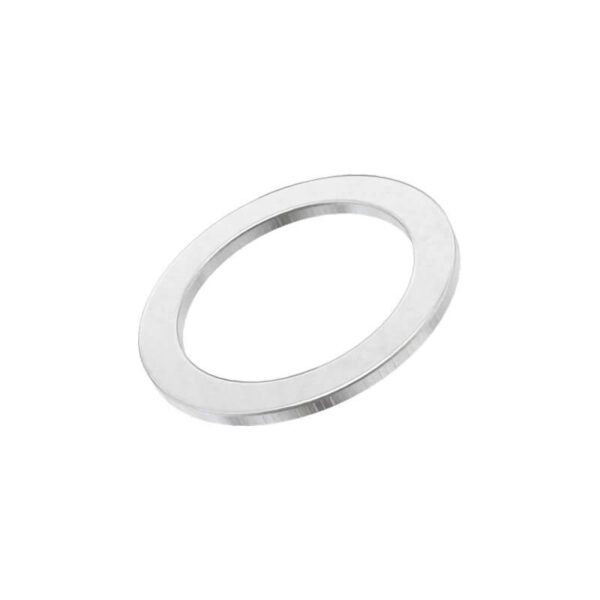

A washer is a thin annular plate placed between a fastener head and the workpiece. Its primary job is load distribution: by increasing the bearing area under the bolt head or nut, the washer reduces contact pressure and prevents the fastener from embedding into the substrate. This is critical when bolting into soft materials—aluminum, plastic, wood—where the concentrated clamp force of a hex head alone can crush the surface.
Beyond load spreading, washers serve three secondary functions. Spacing: a stack of flat washers adjusts grip length when a bolt is slightly too long for the joint. Surface protection: the washer sacrifices its own finish to prevent the turning nut from galling the workpiece. Friction modification: a hardened flat washer under the nut delivers a known, repeatable friction surface for torque-tension calibration, isolating the joint from the variable friction of the clamped part itself.
A flat washer works by the simplest mechanism in fastening: area multiplication. Clamp force divided by a larger area equals lower contact stress. A plain washer under an M12 bolt head increases the effective bearing diameter from roughly 13 mm to 24 mm, cutting surface pressure by over 70%. This is the basis for structural steel codes—AISC, Eurocode 3—mandate hardened flat washers under bolt heads in slip-critical connections.
Belleville washers operate on a different principle: elastic deflection. The cone compresses under preload, storing energy like a disc spring. As the joint settles, gasket relaxes, or thermal cycles shift dimensions, the washer expands back, restoring lost clamp. This passive compensation is why Bellevilles are standard in high-temperature flanged joints where gasket creep would otherwise cause leakage within hours of startup.
Lock washers resist loosening through mechanical interference. A split ring’s helical cut bites into the nut and workpiece as it flattens, creating a ratchet effect against reverse rotation. Tooth lock washers embed sharp prongs into both surfaces under full torque. The Nord-Lock system uses paired cams: the cam rise angle exceeds the thread helix, making the washer pair geometrically incapable of self-loosening.
Washers are classified by function—not by material, standard, or geometry. A flat washer and a Belleville may share the same outer diameter but serve opposite mechanical roles.
Flat / load-distribution washers increase bearing area. Plain flat washers (DIN 125) are the default. Fender washers have an oversized OD for thin sheet metal and composites—the name comes from automotive fender repair. Structural washers (ASTM F436) are thick, hardened, and chamfered for high-strength bolting in steel construction. Square washers, common in timber framing and slotted connections, have a larger footprint than round washers of equivalent OD and resist spinning in slots.
Lock / anti-loosening washers prevent rotation under vibration. Split lock washers (DIN 127) are the most common—a single helical cut creates spring tension and a biting edge. Tooth lock washers embed sharp teeth into both mating surfaces; internal teeth grip the fastener shank, external teeth dig into the workpiece. Nord-Lock wedge washers use paired cams with a rise angle steeper than the thread helix, making self-loosening geometrically impossible under any vibration amplitude.
Spring / tension washers act as compact disc springs. Belleville washers (DIN 6796) deliver high load capacity in a small axial space—ideal for flanged joints and bearing preload. Wave spring washers handle light loads where axial space is severely constrained. Curved spring washers, the simplest of the three, provide light spring force at minimal cost for non-critical assemblies.
Special-purpose washers serve niche but essential roles. Countersunk finishing washers give flat-head screws a clean, professional appearance in visible assemblies. Bonded seal washers combine a metal outer ring with a vulcanized rubber inner lip, forming a static seal at the fastener interface—common in hydraulic manifolds, engine oil pans, and fluid-line fittings.
The twelve washer types below cover the four functional groups. Flat washers and lock washers account for roughly 80% of industrial consumption; spring washers and special-purpose types address specific engineering constraints where a standard flat or lock washer is insufficient. For the design rationale behind each group, see the Washer Classification System section above.
| Type | Group | Key Feature | Key Standard | Typical Application |
|---|---|---|---|---|
| Plain Flat | Flat | Standard bearing area, chamfered or plain edge | DIN 125 / ASME B18.22.1 | General bolting, spacing, surface protection |
| Fender | Flat | Oversized OD, thin gauge | ASME B18.22.1 | Sheet metal, composites, oversized clearance holes |
| Structural | Flat | Thick, hardened, chamfered | ASTM F436 | High-strength bolting, steel construction, slip-critical connections |
| Square | Flat | Square plate, larger footprint than round | ASME B18.22.1 | Timber framing, slotted connections, machine bases |
| Split Lock | Lock | Helical cut, spring action, biting edges | DIN 127 | General vibration resistance, automotive, machinery |
| Internal Tooth | Lock | Teeth grip bolt shank, countersunk head compatible | DIN 6797 | Electrical grounding, small-head fasteners, PCB mounting |
| External Tooth | Lock | Teeth dig into workpiece surface | DIN 6797 | Sheet metal, painted or coated surfaces, wide-head screws |
| Nord-Lock Wedge | Lock | Paired cams, cam angle exceeds thread helix | — | Excavators, rail fastening, wind turbines, mining equipment |
| Belleville | Spring | Conical disc, high load in small space | DIN 6796 | Flanged joints, thermal cycling, bearing preload |
| Wave Spring | Spring | Multi-wave profile, light load | — | Ball bearing preload, electronics, tight axial envelopes |
| Curved Spring | Spring | Single-radius curvature, light load | — | Non-critical assemblies, low-cost spring preload |
| Countersunk Finishing | Special | Tapered ID matches flat-head screw angle | — | Visible assemblies, furniture, architectural hardware |
| Bonded Seal | Special | Metal OD + vulcanized rubber ID lip | — | Hydraulic manifolds, oil pans, fluid-line fittings |
Carbon Steel
Plain flat washers — low-carbon steel, zinc-plated for indoor general use, HDG for outdoor structural
Spring steel (C67S–C75S) — split lock, Belleville, wave, and curved spring washers; hardened to HRC 42–50 for elastic recovery
Structural steel — ASTM F436 structural washers, quenched and tempered, minimum hardness HRC 38
Stainless Steel
A2 / 304 — outdoor general, rain, mild chemical; food and architectural use
A4 / 316 — coastal and chloride-rich environments; chemical processing, offshore
Brass
Decorative and electrical applications; non-magnetic, corrosion-resistant in freshwater. Lower strength than steel—derate clamp load accordingly. Common in marine hardware and electrical grounding where low contact resistance matters.
Non-Metallic / Composite
Nylon — insulating washers for electrical isolation; shoulder washers for PCB standoffs
PTFE — chemical processing; gasketed washer faces for aggressive media
Vulcanized rubber (NBR / FKM) — bonded seal washers; NBR for oil, FKM for high-temperature and chemical resistance
Material choice depends on three factors: the chemical environment at the fastener interface, the required hardness for the washer’s mechanical role (a nylon washer cannot replace a hardened structural washer), and galvanic compatibility with the bolt, nut, and workpiece.
Step 1: Primary function
Distributing bolt load or protecting the surface → Flat washer. Match OD to the workpiece material: larger OD for soft substrates.
Preventing loosening under vibration → Split lock for general use; Nord-Lock for safety-critical or high-amplitude vibration where a backed-out fastener creates a hazard.
Compensating for gasket creep or thermal expansion → Belleville. Select load rating at 70–80% of flat position load.
Sealing a fluid interface → Bonded seal. Match the rubber compound to the fluid (NBR for oil, FKM for fuel and high temperature).
Step 2: Hardness matching
A washer that is softer than the fastener head will deform first, relaxing clamp load. Match or exceed the bolt hardness class: hardened flat washers (HRC 38–45) for Grade 8.8 and above, spring steel washers (HRC 42–50) for all lock and spring types. Never use a zinc-plated low-carbon flat washer under a Grade 10.9 bolt head—the washer will yield before the bolt reaches design preload.
Step 3: Galvanic and environmental match
Steel bolt + aluminum workpiece → stainless washer isolates the interface and slows galvanic attack.
Outdoor structural → HDG flat washer, same zinc coating system as the bolt, no mixed-metal couple.
Electrical isolation required → nylon or PTFE washer; verify dielectric strength for the voltage class.
Saltwater or chemical exposure → A4 (316) stainless; A2 (304) will pit within 12–18 months in direct salt spray.
Do I need a washer under every bolt head and nut? Not always. Flange bolts and flange nuts have an integral bearing face—a separate washer is redundant. In structural steel, hardened flat washers are required by code under the turned element. When bolting into soft materials, always use a flat washer under the bolt head.
What is the difference between a flat washer and a fender washer? A fender washer has a much larger OD relative to its ID—typically 2–3x the bolt diameter versus 1.5–2x for a plain flat washer. Fender washers are also thinner gauge. They spread load over thin or weak substrates like sheet metal, fiberglass, and composites.
Split lock washers: do they actually work? Under pure axial vibration, split lock washers lose effectiveness once the compressed split ring flattens beyond its spring range. They perform better in assemblies where the split edges create a mechanical bite. For critical applications, Nord-Lock wedge washers offer verifiable, test-documented locking performance.
How many Belleville washers can I stack? Parallel stacking (nested in the same direction) multiplies the load capacity—two washers double the force at the same deflection. Series stacking (alternating directions) multiplies the deflection—two washers double the travel at the same load. Practical limit: 4 washers per stack; beyond 4, friction between washers introduces unpredictable hysteresis.
Can I use stainless steel washers with carbon steel bolts? Yes, and it is often done intentionally. A stainless washer between a carbon steel bolt head and an aluminum workpiece isolates the aluminum from the more cathodic carbon steel, slowing galvanic corrosion. Matched materials are not always the best choice at the washer interface.
What is the correct orientation for a countersunk finishing washer? The tapered (countersunk) side faces the screw head. The flat side bears against the workpiece. Installing it backwards leaves a gap under the screw head and defeats the flush-finish purpose.
Social Chat is free, download and try it now here!