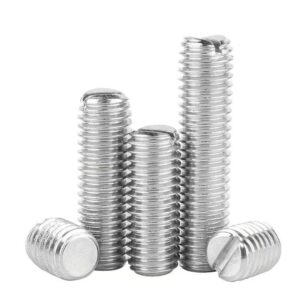
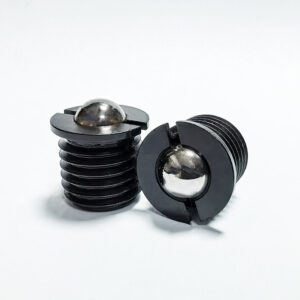
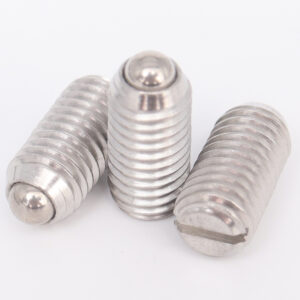
Our comprehensive selection of set screws covers cup point, knurled cup point, cone point, flat point, dog point, half dog point, oval point, extended dog point, nylon tip, brass tip, slotted drive and hex socket drive types manufactured to ISO 4026–4029 and DIN standards. Available in alloy steel and stainless steel for engineers, buyers and industrial manufacturers requiring reliable fastening solutions.
This product has multiple variations. Please choose the options on the product page.
Get a Quote for Services
What are Set Screws?
A set screw—also called a grub screw—is a headless, fully threaded fastener that secures one component inside or against another without a nut. Unlike bolts and screws that clamp parts together with external tension, a set screw works from within: it threads into a tapped hole in the outer part and its point presses against the inner part, locking the two together through friction and point penetration. The entire fastening force comes from the point-to-shaft interface.
This internal locking principle makes set screws the fastener of choice for securing pulleys to shafts, retaining collars on spindles, locking adjustment knobs, and holding bearing races in housings. Because the set screw sits flush with or below the surface of the outer component, the assembly remains compact with no protruding fastener head.
How Set Screws Work
A set screw generates holding force through two mechanisms: axial thrust from the threads and point penetration into the mating surface. When the screw is tightened, the helix of the thread converts rotational torque into a linear driving force that presses the point against the shaft or collar. The harder the point material relative to the shaft, the deeper the point can penetrate. A cone point on an alloy steel set screw tightened against a mild steel shaft will embed 0.2–0.5 mm into the surface, creating a mechanical shear interlock far stronger than friction alone.
Point geometry governs the holding mode. A cup point seats as a ring contact—the hollow center creates a circular cutting edge that bites into the shaft, resisting both axial slip and rotation. A cone point forms a point-contact indent: lower axial holding than cup but superior resistance to angular displacement in rotating assemblies. A dog point enters a pre-drilled hole in the shaft, forming a positive shear lock—the screw body itself becomes a dowel pin in shear, no longer relying on friction or point penetration to transmit torque.
The trade-off is always the same: deeper point penetration equals higher holding power but more shaft surface damage. For shafts that must be disassembled and reused, a flat point or nylon tip sacrifices some holding force in exchange for leaving the shaft surface intact.
Set Screw Classification System
Set screws are classified by point type—the tip geometry that contacts the mating surface—and secondarily by drive style. Point selection determines everything: holding mode, shaft damage, adjustability, and permissible misalignment.
Locking points sacrifice the shaft surface for maximum holding force. The cup point is the universal default: a concave recess creates a circular cutting edge that digs in under torque, forming a ring of deformed material around the point. The knurled cup point adds serrations inside the cup recess, creating a more aggressive bite with higher vibration resistance—the serrated edges cut into the shaft like a broach for a mechanical lock that resists both axial and rotational loosening. The cone point delivers a deep, centered indent. Its wedging action self-centers the screw and delivers excellent angular holding, making it the standard point for permanently positioned components in rotating assemblies.
Positioning points engage a feature in the shaft or bear flat against the surface. The flat point makes full-face contact with the mating surface—no cutting edge, no penetration. Holding force is purely frictional, but the shaft surface remains undamaged, ideal for frequent adjustment and disassembly. The dog point has a reduced-diameter cylindrical tip that enters a pre-drilled hole or slot in the shaft. Once seated, the shaft cannot move relative to the screw—the dog acts as a shear key. The half dog point is a shorter version where axial space limits the pilot length. The oval point has a rounded tip that accommodates angular misalignment between the screw axis and the contact surface, maintaining good contact on curved or angled shafts.
Extended dog point combats a specific failure mode: when the set screw’s threaded engagement length is limited by a thin-walled outer component, a longer dog extends through the wall and into the shaft hole, maintaining shear engagement when thread depth alone would strip under load. This variant is common in thin-wall tube assemblies and hollow shaft locking.
Protective points put a sacrificial soft material between the hardened screw body and the shaft. The nylon tip is a molded polymer insert that compresses against the shaft, providing moderate holding force while preventing any metal-to-metal marking—standard in precision adjustment mechanisms where the shaft finish is cosmetic or functional (e.g., optical stages, laboratory fixtures). The brass tip serves a dual purpose: non-marring contact and spark-free operation. Brass-tip set screws are specified in explosive-atmosphere equipment, fuel system components, and anywhere a steel-on-steel impact could generate an ignition source.
Drive types are a secondary but critical distinction. The hex socket (Allen) drive is the modern standard—compact, high torque capacity, and compatible with ball-end keys for angled access. The slotted drive, per DIN 551, is the traditional format. Its shallower engagement depth allows set screws to sit farther below the surface in cramped assemblies, but torque capacity is lower and the driver slips more easily.
Types of Set Screws
The twelve types below cover the four point-function groups plus the two main drive styles. Cup and cone points handle the majority of general locking applications; dog points solve positive-location problems; protective tips preserve shaft surfaces; and drive choice determines installation access and torque limits.
Type
Group
Point Feature
Key Standard
Typical Application
Cup Point
Locking
Concave recess, ring-contact cutting edge
ISO 4029 / DIN 916
Pulleys, gears, collars on shafts—universal default
Deep-set applications, cramped access, traditional machinery
Hex Socket Drive
Drive
Hex recess, high torque, ball-key compatible
ISO 4026–4029
Modern standard, all applications, angled-access installation
Materials
Alloy Steel
4140 / 42CrMo4, quenched and tempered — standard for cup, cone, and dog point set screws; surface hardness HRC 45–53 with a ductile core to prevent brittle fracture under point loading
Case-hardened low-carbon steel — surface hardness to HRC 58 for knurled cup points requiring maximum penetration; core remains at HRC 30–35 for toughness
Black oxide or zinc-plated finish — corrosion protection for indoor and general industrial use
Stainless Steel
A2 / 304 — food processing, cleanroom, and general outdoor applications; lower hardness (typically HRC 25–32) reduces point penetration and holding power by approximately 30–40% compared to alloy steel equivalents
A4 / 316 — coastal, offshore, and chemical environments with chloride exposure; match the grade to the shaft and housing materials to avoid galvanic couples
Non-Ferrous Tips
Nylon 6/6 — molded insert; maximum continuous temperature 85 °C; compression set can relax over time, so nylon-tip set screws are not recommended for permanent locking applications
Brass (CuZn39Pb3) — machined insert brazed or press-fit into the screw tip; spark-free rating per ATEX and IECEx for Zone 1 / Zone 2 hazardous locations
How to Choose the Right Set Screw
Step 1: Holding mode—friction, indent, or shear?
The first question determines the point family. If the shaft can be marked and permanent locking is required, a cup or knurled cup point gives the highest holding torque. If the shaft may need disassembly or surface finish must be preserved, a flat or nylon-tip point is required—accept the reduced holding force. If a pre-drilled hole exists or can be added, a dog point converts the connection from friction/indent to shear, the strongest and most predictable holding mode.
Step 2: Shaft hardness relative to screw point
The set screw point must be harder than the shaft to penetrate. Alloy steel (HRC 45–53) set screws penetrate mild steel shafts (HRB 70–90) effectively. Against a hardened shaft (HRC 40+), a cup point will barely scratch the surface and holding force drops to friction-only levels. In these cases, switch to a dog point with a pre-drilled hole, or use a knurled cup point at the upper hardness range.
Step 3: Drive access and installation tooling
Hex socket drives handle more torque and work with ball-end keys at up to 25° access angle—standard in modern machinery and automated assembly. Slotted drives are limited by driver slip and lower torque, but their shallow recess depth can be the deciding factor when the screw must sit deep below the surface in a narrow counterbore. Choose the drive that matches both the torque required for point penetration and the physical access constraints of the assembly.
FAQ
What is the difference between a set screw and a grub screw?
They are the same fastener. “Grub screw” is the term used in the UK, Australia, and Commonwealth countries; “set screw” is used in North America. Both refer to a headless, fully threaded screw tightened with an internal drive, typically a hex socket or slotted recess.
Which set screw point gives the highest holding torque?
Knurled cup point. The serrations inside the cup recess cut into the shaft like a broach, creating a mechanical interlock that resists both axial slip and rotational loosening. In back-to-back testing against a plain cup point on mild steel shafts, the knurled cup delivers 150–200% higher breakaway torque.
Can I reuse a set screw after removing it?
Cup and knurled cup points work-harden at the cutting edge during the first installation. The edge dulls with each reuse, reducing penetration and holding force. For safety-critical applications—flywheel retention, rotating pulley sets—replace set screws after a single removal.
Why does a dog point set screw need a pre-drilled hole?
The cylindrical pilot of a dog point enters a pre-drilled hole in the shaft. Without the hole, the pilot butts against the shaft and prevents the screw from seating—no threads engage, holding force drops to zero. Match hole diameter to pilot diameter with 0.05–0.15 mm clearance.
Nylon tip vs. brass tip: when is each the better choice?
Nylon tips are softer and protect cosmetic shaft finishes better. They are limited to temperatures below 85 °C. Brass tips are specified where spark prevention is the primary concern—fuel systems, explosive atmospheres, mining equipment. Brass also tolerates higher temperatures (up to 200 °C) than nylon.
How deep should a set screw engage the tapped hole?
Minimum engagement is 1× nominal diameter for steel housings and 1.5–2× for aluminium. The screw should sit at least 0.5 mm below the housing surface after tightening to prevent the point from backing out under vibration. Full thread engagement through the entire wall thickness is recommended for maximum holding.