






Our comprehensive selection of bolts covers hex, heavy hex, flange, carriage, structural, anchor, U, eye and stud bolt types manufactured to DIN, ISO, ASTM and ASME standards. Available in carbon steel, stainless steel and alloy steel for engineers, buyers and industrial manufacturers requiring reliable fastening solutions.
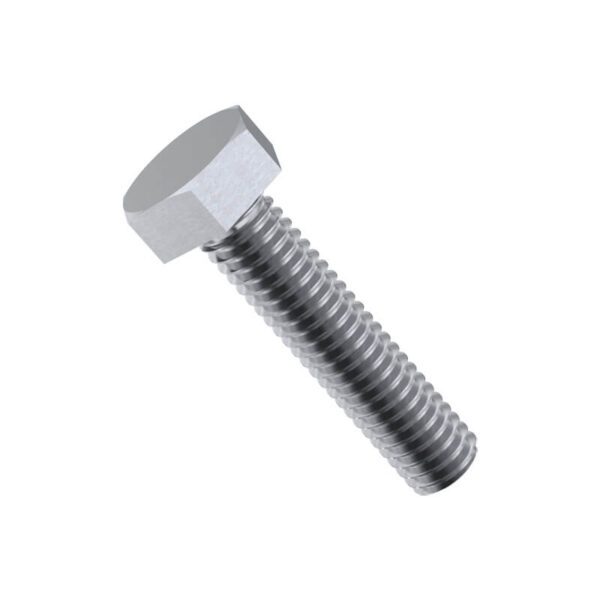

Hex bolts, or hexagonal bolts, are a type of precision fastener with a characteristic six-sided hexagonal head. Renowned for their robustness, hex head bolts are designed to be driven with a wrench or socket that can efficiently transfer greater torque than other drive types.
These bolts are engineered to provide a high degree of precision and strength, regardless of whether they are driven into tapped holes or hex bolts and nuts are used in conjunction to clamp components together. They play a crucial role in mechanical assemblies, ensuring that components are held together securely, with the hexagonal head offering an optimal grip for tightening and loosening.
Hexagonal bolts, including the popular M6 hex bolt, are indispensable in numerous industries, from automotive to architecture. Their unique design enables them to withstand high levels of torque, making them ideal for heavy-duty applications. A hexagonal-headed bolt is also one of the only drive types to be driven perpendicularly rather than parallel with the threaded shaft making it useful in scenarios with restricted space.
In use, hex bolts and nuts are commonly combined in machinery to ensure a tight, secure fit. In scenarios like automotive engines or architectural structures, hex flange bolts provide the necessary clamping force to keep components in place under stress without the explicit need for a washer.
The twelve bolt types below span three application families. Standard-head bolts are tightened with tools applied to the head—the hex geometry dictates socket or wrench fit. Round-head and low-profile bolts are turned from the nut side only; the head bears against the material and often locks rotation. Special-function bolts serve a dedicated mechanical role beyond simple clamping, from pipe support to concrete embedment. For design logic behind each family, see the Bolt Classification System section above.
| Type | Group | Key Feature | Key Standard | Typical Application |
|---|---|---|---|---|
| Hex Bolts | Standard-Head | Six-sided head, partial or full thread | DIN 931 / DIN 933 / ASME B18.2.1 | General structural steel, machinery assembly |
| Heavy Hex Bolts | Standard-Head | Oversized hex head, thicker than standard | ASME B18.2.1 | High-pressure flanges, bridge connections |
| Flange Bolts | Standard-Head | Integral washer face under hex head | DIN 6921 / ASME B18.2.3.4M | Automotive chassis, engine mounts |
| Square Head Bolts | Standard-Head | Square head for wrench or open-end spanner | ASME B18.2.1 | Legacy machinery, timber framing, agricultural equipment |
| Carriage Bolts | Round-Head | Domed round head, square neck under head | DIN 603 / ASME B18.5 | Wood-to-metal connections, guardrails, furniture |
| Plow Bolts | Round-Head | Flat countersunk head, square or keyed neck | ASME B18.9 | Agricultural plow blades, grader cutting edges |
| Elevator Bolts | Round-Head | Large flat countersunk head, square neck | ASME B18.2.2 | Conveyor belts, bucket elevators, grain handling |
| U-Bolts | Special-Function | U-shaped rod, threaded on both ends | DIN 3570 | Pipe clamping, leaf-spring axle mounts, exhaust systems |
| Eye Bolts | Special-Function | Looped or ring head for lifting | DIN 580 / DIN 444 | Rigging, hoisting, overhead lifting |
| J-Bolts | Special-Function | J-shaped bend, one threaded end | — | Concrete embedment, sill plate anchoring, foundation work |
| Anchor Bolts | Special-Function | L-bend or plate washer at embedded end | ASTM F1554 | Steel column base plates, light poles, structural foundations |
| Stud Bolts | Special-Function | Fully threaded rod, nut on each end | ASME B16.5 | Flanged pipe joints, pressure vessels, heat exchangers |
Carbon Steel
Grade 4.6 (400 MPa) — indoor dry only; low-stress general assembly, furniture
Grade 8.8 (800 MPa) — structural steel, machinery, automotive; zinc-plated for mild outdoor exposure
Grade 10.9 (1,000 MPa) — crane components, heavy equipment, high-stress joints
Grade 12.9 (1,200 MPa) — critical engine fasteners, aerospace ground equipment; indoor dry only
Alloy Steel
ASTM A193 B7 (860 MPa min) — high-temperature flanges, pressure vessels up to 450°C; moderate corrosion resistance with coating
Stainless Steel
A2 / 304 (500–700 MPa) — outdoor general, rain, mild chemical exposure; food equipment, architectural, exterior trim
A4 / 316 (500–700 MPa) — coastal saltwater, chloride-rich environments; marine hardware, chemical plants, offshore platforms
Coated Carbon Steel
Hot-Dip Galvanized (HDG) — outdoor structural, UC4A ground contact; deck framing, guardrails, transmission towers. Tensile strength follows the base grade.
Grade selection balances two independent requirements: tensile capacity for the design load and corrosion resistance for the service environment. A 12.9 bolt in a saltwater setting fails from stress corrosion cracking long before it exceeds its tensile limit. Grade 8.8 with HDG or 316 stainless often outperforms uncoated 12.9 outdoors, despite the lower tensile number.
Step 1: Load type
Tension-dominated joint (flanges, lifting lugs, column bases) → Hex, Heavy Hex, or Stud Bolt. Grade depends on design stress.
Shear-dominated joint (clevis pins excluded—use a bolt when disassembly is required) → Hex with grip length spanning the shear plane.
Clamping around a pipe or shaft → U-Bolt.
Embedded in concrete → Anchor Bolt or J-Bolt.
Step 2: Service environment
Indoor, dry, low load → Grade 4.6 carbon steel, bare or zinc-plated.
General outdoor, no salt → Grade 8.8 HDG or A2 stainless.
Coastal, saltwater, chemical exposure → A4 (316) stainless or Grade 8.8 HDG with periodic inspection.
High temperature (300–450°C) → ASTM A193 B7. Stainless bolts lose strength above 300°C; B7 holds to 450°C.
Step 3: Assembly constraints
Only one side accessible → Carriage bolt with square neck locking into the structural member.
Bolt head must sit flush, no snag risk in moving machinery → Plow bolt or elevator bolt.
Repeated lifting and removal required → Eye bolt with shoulder pattern (DIN 580), not straight pattern (DIN 444)—the shoulder resists bending at the thread root.
Flanged joint, both sides accessible, frequent disassembly → Stud bolt with two nuts; replacing a stud is cheaper than replacing a bolted joint after thread damage.
A: Bolts are hexagonal primarily for practicality and efficiency. The hexagon shape offers an ideal balance between ease of manufacturing and providing a large surface area for wrenches or sockets. This shape allows for better torque transfer, reducing slippage and wear during tightening or loosening.
A: The key point of difference is that socket screws have a hexagonal drive set into the head itself and are typically driven with a hex key or Allen wrench. They can have various head shapes and sizes. Hex bolts on the other hand have a hexagonal head which is their defining characteristic and are designed to be driven with a wrench or socket set.
A: Stud bolts are headless fasteners, also known as threaded bars which can be inserted into workpieces to allow other sections to align and rest onto while being fastened with a nut. Hexagon bolts however are commonly used for general fastening purposes without that added dimension of alignment and providing a resting point.
A: Hex bolts, including hexagon bolt and nut pairs, are the go-to fastener that offers high strength, ease of installation, and versatility in various applications. Their key advantage is high torque transfer and the ability to be installed with a wrench perpendicular to the threaded shaft.
A: Typically, a wrench or a socket set is used for hex bolts, with the size depending on the hex bolt head dimensions which range from 4mm to 55mm in our selection.
A: To determine the size of your hex bolt, measure the diameter and length of the threaded shaft. Then measure the diameter and height of the head. For specific types like an M6 hex bolt, the size of the thread is indicated by the M-number. Although the length and head size can differ.
High precision, bespoke manufacture of Hex Bolts to customer specification. State of the art facilities specializing in both small batch prototyping and large scale manufacture.
Social Chat is free, download and try it now here!