





A plastic fastener is a screw, bolt, nut, washer, rivet, spacer, standoff, or threaded component manufactured from a thermoplastic polymer instead of metal. Engineers choose plastic fasteners when a single metal solution cannot deliver the required combination of electrical insulation, non-magnetic behavior, corrosion resistance, chemical compatibility, low weight, low friction, and freedom from galvanic corrosion. This article is a material-selection document rather than a product list. It explains the engineering polymers used to make fasteners, how their mechanical, thermal, chemical, and electrical properties differ, where each material performs best, where plastic fasteners fail, and how to select a polymer for a real application.
What Are Plastic Fasteners?
Plastic fasteners are mechanical joining components molded or machined from polymer materials. They perform the same basic functions as metal fasteners — clamping, joining, spacing, sealing, and alignment — but their behavior depends on the polymer family, the reinforcement system, the manufacturing process, and the service environment.
A plastic screw looks similar to a steel screw, yet its thread engagement, stripping behavior, torque limits, thermal expansion, and creep response are fundamentally different. A plastic bolt can carry meaningful loads in the right application, but its strength-to-weight profile, chemical resistance, and insulation properties come from the polymer, not from hardness or yield strength in the steel sense.
Because polymer grades differ so widely, a single statement like “plastic fasteners are strong” or “plastic fasteners are chemical resistant” has little engineering value. The correct approach is to treat every plastic fastener as a system of material grade plus geometry plus application conditions. That is the logic behind the material-by-material sections in this guide.
Common Types of Plastic Fasteners
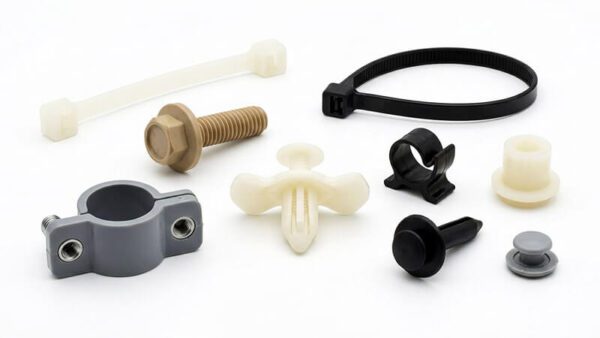
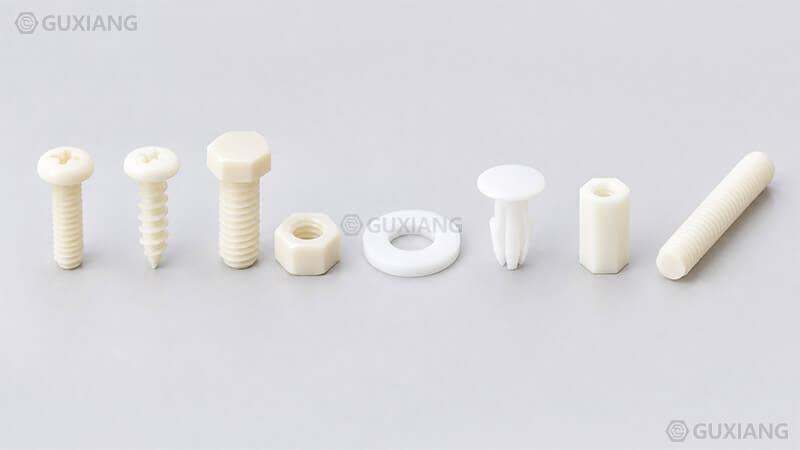
The same basic fastener geometries used in metal are available in plastic:
Plastic screws — machine screws, self-tapping screws, and thread-forming screws in nylon, POM, PEEK, and other grades.
Plastic bolts — hex head and socket head bolts for lighter structural and electrical duty.
Plastic nuts — hex nuts, wing nuts, cap nuts, and insert nuts for non-conductive assemblies.
Plastic washers — flat, shoulder, and insulating washers for spacing and load distribution.
Plastic rivets — push rivets, snap rivets, and blind rivets for panels and enclosures.
Plastic spacers and standoffs — board-to-board and board-to-chassis separators in electronics.
Plastic threaded components — threaded rods, inserts, and custom threaded parts.
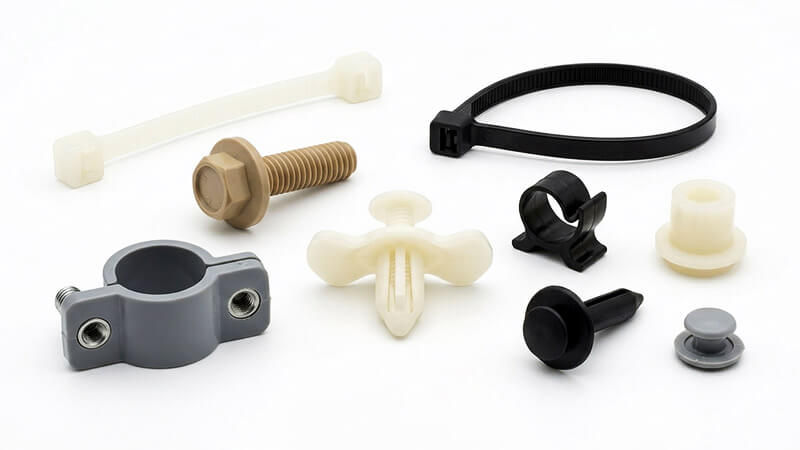
Custom plastic fasteners — geometries that cannot be produced economically in metal at low volume.
Different fastener geometries can be manufactured from different polymer grades. A snap-fit rivet needs flexibility and fatigue resistance, a precision threaded standoff needs dimensional stability and low friction, and a high-temperature bolt needs creep resistance and chemical inertness. The fastener type and the material grade must be selected together, not separately.
Why Use Plastic for Fastener Manufacturing?
Plastic replaces metal in fasteners when the application demands a combination of properties that metal cannot offer without expensive coatings, insulating sleeves, or secondary operations. The commercial value of a plastic fastener comes from the problems it removes: corrosion, galvanic coupling, electrical conductivity, magnetism, weight, and noise.
Lightweight
Polymers weigh roughly one-fifth to one-seventh as much as steel and about half as much as aluminum. Weight reduction matters in portable electronics, drones, electric vehicles, aerospace interior fittings, and consumer products where every gram affects energy consumption, handling, or shipping cost. A bag of 1,000 M3 nylon screws weighs a fraction of the equivalent steel pack, which also lowers logistics cost.
Electrical Insulation
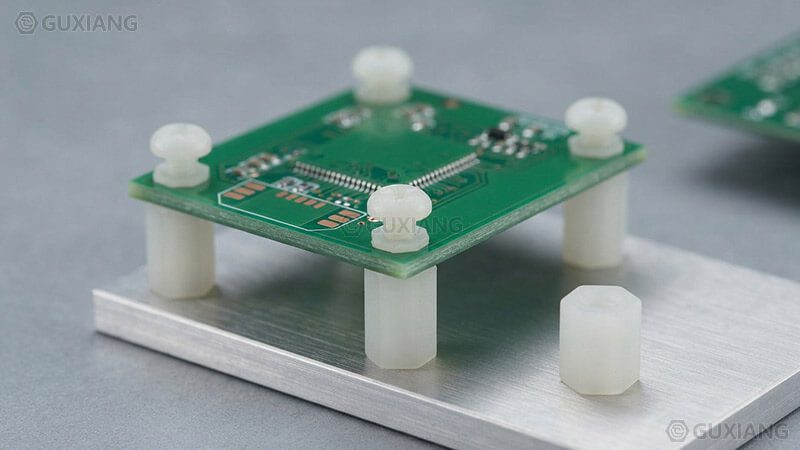
Most unfilled thermoplastics are excellent electrical insulators. Plastic fasteners isolate live components from grounded structures, separate PCB layers, support battery terminals without short circuits, and prevent arcing in telecom cabinets. Engineers use plastic screws and standoffs in electrical assemblies, electronic equipment, battery systems, telecom equipment, and sensitive electronic components where a conductive metal fastener would create a leakage path.
Corrosion Resistance
Polymers do not rust. Nylon, POM, PVDF, PTFE, PEEK, and PP remain unaffected by moisture, salt spray, and atmospheric corrosion that attack carbon steel fasteners. In humid, coastal, or chemical environments, plastic fasteners eliminate the need for plating, painting, or periodic replacement. This is a genuine design advantage in outdoor enclosures, marine fittings, and process equipment. The behavior is different from coated steel: a metal fastener relies on a sacrificial or barrier layer, while a polymer fastener is inherently corrosion-free through its entire cross-section. For a deeper view of why metal fasteners corrode and how coatings behave, see the why stainless steel still rusts guide and the galvanized vs zinc-plated fasteners guide.
Non-Magnetic Properties
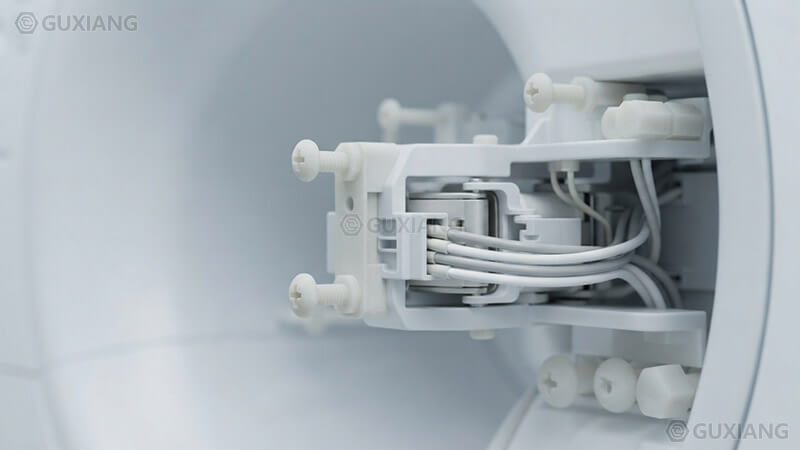
Plastic fasteners are non-magnetic and non-conductive, which makes them valuable in medical imaging equipment, laboratory instruments, electronic assemblies, and magnetic-sensitive systems. MRI rooms, particle analyzers, sensitive sensors, and navigation equipment cannot tolerate ferromagnetic hardware near the measurement zone. Non-metallic fasteners eliminate magnetic interference and eddy-current effects entirely.
Chemical Resistance
Chemical resistance depends on the specific polymer, the chemical species, its concentration, the temperature, and the exposure time. It is never safe to assume that “plastic” resists a given chemical. PVDF and PTFE resist aggressive acids and solvents that would destroy nylon; PP resists many bases and salts; nylon absorbs water and degrades in strong acids. The correct statement is always material-specific: “PVDF fasteners survive hot hydrochloric acid service,” not “plastic fasteners are chemical resistant.” Chemical compatibility tables and immersion test data, such as those based on ISO 175, provide the evidence engineers need.
Low Friction and Wear Resistance
POM, PTFE, and certain specialty polymers have low coefficients of friction and good wear behavior without lubrication. POM screws drive smoothly into molded threads, PTFE washers allow relative motion between mating parts, and polymer nuts can be tightened with controlled torque without galling. Low friction also reduces thread stripping during installation when the drive torque is managed correctly.
Design Flexibility
Thermoplastics can be injection molded into complex geometries that are difficult or impossible to machine in metal: snap-fit heads, integrated sealing lips, color-coded heads, threads with special profiles, and multi-material assemblies. Material modification extends the design space further — glass fiber, carbon fiber, mineral fillers, and internal lubricants tune stiffness, creep resistance, and friction. Custom geometries and custom polymer formulations make plastic fasteners a design tool rather than a commodity substitute.
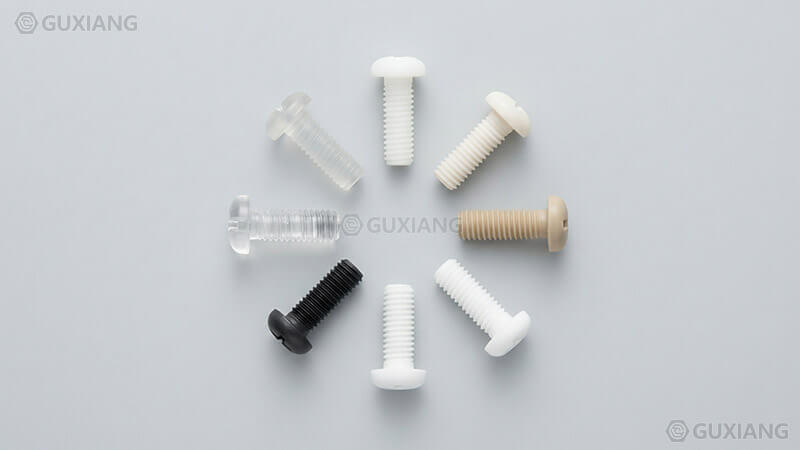
Common Plastic Materials Used for Fasteners
This is the core section of the article. Every material below has its own engineering identity, and each one is used for fasteners today.
Nylon / Polyamide (PA6 & PA66)
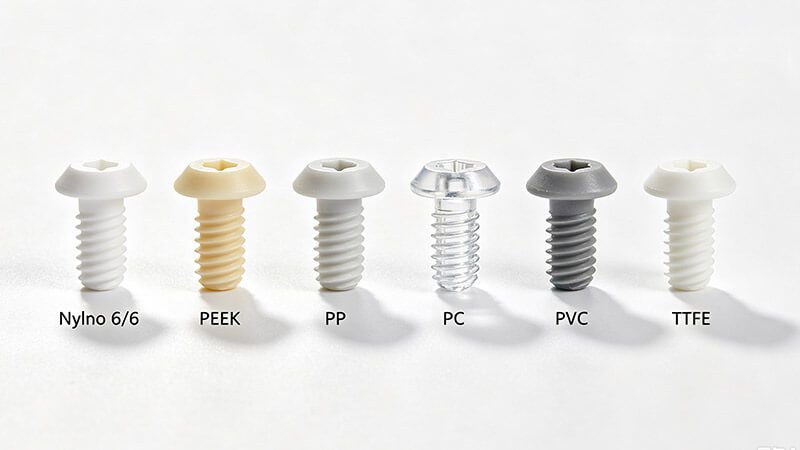
Nylon is the default engineering plastic for fasteners. Polyamide fasteners — commonly written as nylon fasteners, nylon screws, or nylon bolts — offer a balanced combination of mechanical strength, toughness, electrical insulation, wear resistance, and low cost.
PA6 and PA66 are not interchangeable. PA66 has higher melting temperature, higher stiffness, and better creep resistance than PA6; PA6 is tougher and easier to mold. Both absorb moisture from the atmosphere, which plasticizes the polymer: tensile strength and stiffness drop slightly, while impact toughness and ductility increase. Moisture absorption also changes dimensions, so precision nylon parts must account for equilibrium water content. The standard classification for nylon molding materials, ASTM D4066, defines the grades used for fastener production.
Typical nylon fastener applications: electronics chassis, cable management, appliance assembly, automotive interior fasteners, and general industrial equipment. PA66 fasteners are the first choice when engineers want a non-metallic fastener with proven mechanical performance at a reasonable price.
Polypropylene (PP)
Polypropylene fasteners stand out for chemical resistance, low density, and moisture resistance. PP screws and PP plastic screws resist many acids, alkalis, and salt solutions, and they do not absorb water in the way nylon does. Polypropylene is also flexible and fatigue-resistant, which suits snap-fit designs and hinged components.
The limitations are equally important: PP has low stiffness, low tensile strength, and poor resistance to elevated temperature and UV radiation. PP fasteners are not for load-bearing joints above roughly 80 °C, nor for long-term outdoor exposure without UV stabilization. They fit cost-sensitive applications in chemical equipment, water treatment, packaging machinery, and household products where a stronger polymer is unnecessary.
POM / Acetal
POM fasteners — also called acetal fasteners, POM screws, or acetal screws — are the precision workhorses of plastic fastening. Acetal homopolymer and copolymer offer high stiffness, excellent dimensional stability, very low moisture absorption, low friction, and good wear resistance. POM screws drive smoothly and hold thread engagement well because the material is strong in thin sections.
POM is the preferred material for precision mechanical applications: adjusting screws, optical instrument hardware, gear housings, pump components, and any fastener that must hold its dimensions through humidity changes. The standard classification system for POM molding materials, ASTM D6778, is the reference for grade selection. POM has moderate temperature resistance (continuous use to roughly 100 °C) and moderate chemical resistance, so it is not the right choice for hot acids or strong oxidizing agents.
PVDF
PVDF (polyvinylidene fluoride) fasteners are specified where chemical resistance and environmental durability matter more than strength. PVDF screws and PVDF bolts resist strong acids, halogens, and many solvents, absorb almost no moisture, and tolerate UV exposure far better than most thermoplastics. Electrical properties are stable across temperature and humidity.
The main applications sit in chemical processing, water treatment, semiconductor support equipment, and outdoor instrumentation. PVDF is a high-cost material, so it is chosen when the chemistry leaves no cheaper option. Its mechanical strength is moderate, and service temperature is typically limited to about 150 °C continuous.
PTFE
PTFE fasteners — often searched as PTFE screws, PTFE bolts, or Teflon fasteners — deliver chemical inertness and the lowest coefficient of friction of any solid polymer. PTFE resists virtually all chemicals except molten alkali metals and a few fluorinating agents, operates from cryogenic temperatures to about 260 °C, and never sticks to mating surfaces.
The trade-off is mechanical strength. Unfilled PTFE is soft, creeps under load, and strips easily in thin threads. Engineers use PTFE fasteners where contamination-free sealing, chemical compatibility, or non-stick behavior is the primary requirement — laboratory equipment, chemical pumps, semiconductor tools, and food processing hardware. The commercial name Teflon is widely used in the market, but PTFE is the correct material term.
PEEK
PEEK fasteners occupy the high-performance end of engineering plastic fasteners. PEEK screws and PEEK bolts combine high mechanical strength, very high continuous service temperature (about 250 °C), outstanding chemical resistance, excellent creep resistance, and low moisture absorption. PEEK is intrinsically flame-retardant and maintains its electrical insulation properties at elevated temperature.
These properties make PEEK the standard choice for semiconductor equipment, aerospace interior and system hardware, medical devices, oil and gas tooling, and high-performance industrial machinery. PEEK costs substantially more than nylon or POM, so it is selected only when the application demands it. For engineers comparing material options at different performance levels, polymer property databases such as MatWeb provide the numerical data needed for a first-pass screening.
PPS
PPS (polyphenylene sulfide) fasteners combine high-temperature resistance, chemical resistance, and inherent flame retardancy. PPS screws and PPS plastic fasteners maintain stiffness and electrical insulation at continuous temperatures near 200 °C and resist solvents and acids better than most crystalline polymers. Dimensional stability is good, and PPS does not burn easily, which suits electrical and electronic enclosures.
Typical PPS fastener applications: electrical connectors, transformer hardware, motor components, automotive underhood parts, and chemical process equipment. PPS is brittle compared with nylon, so impact and shock loads must be evaluated carefully.
Polycarbonate (PC)
Polycarbonate fasteners are chosen for impact resistance, transparency, and electrical insulation. PC screws and polycarbonate screws withstand impacts that shatter more brittle polymers, and transparent grades allow visual inspection of assemblies. Polycarbonate is used in consumer electronics, lighting, instrument housings, and display mounting.
The weaknesses of PC are poor chemical resistance to solvents and alkalis, susceptibility to stress cracking, and moderate temperature limits (roughly 120 °C continuous). PC fasteners work best in indoor, low-chemical environments where impact toughness and clarity are the priorities.
PVC
PVC fasteners offer chemical and corrosion resistance at low cost. PVC screws and PVC plastic bolts resist many acids, alkalis, and salt solutions, and provide good electrical insulation. The material is rigid, flame-resistant, and easy to machine.
Temperature is the main constraint: PVC softens well below 80 °C and should not be used in hot or load-bearing joints. PVC fasteners suit water treatment, chemical tanks, plating lines, and electrical boxes where economics and chemical compatibility matter and temperatures stay moderate.
Glass-Filled Nylon and Reinforced Plastics
Glass fiber reinforcement changes the performance class of plastic fasteners. Glass-filled nylon fasteners — commonly PA66 GF30 — offer significantly higher stiffness, tensile strength, creep resistance, and dimensional stability than unfilled nylon. Glass reinforced nylon fasteners hold torque better, resist vibration loosening better, and tolerate higher service temperatures.
The trade-offs are real: glass-filled materials are more abrasive to molds and tools, more brittle in impact, and more expensive. Thread details must be designed with the reinforcement in mind because glass fibers reduce elongation at break. Engineers choose PA66 GF30 and similar reinforced plastic fasteners when the load, temperature, or dimensional requirement exceeds what unfilled nylon can deliver but the application does not justify PEEK or PPS.
Plastic Fastener Material Comparison
The table below summarizes the key selection factors across the main fastener polymers. Use it as a first-pass filter, then read the material subsection for the details that matter in your application.
| Material | Strength | Temperature Resistance | Chemical Resistance | Electrical Insulation | Dimensional Stability | Typical Applications |
|---|---|---|---|---|---|---|
| Nylon | Medium | Medium | Good | Excellent | Medium | General industrial, electronics |
| PP | Low–Medium | Low–Medium | Excellent | Excellent | Medium | Chemical, electrical |
| POM | Medium | Medium | Good | Excellent | Excellent | Precision/mechanical |
| PVDF | Medium | High | Excellent | Excellent | Good | Chemical processing |
| PTFE | Low–Medium | High | Excellent | Excellent | Medium | Chemical, sealing, low-friction |
| PEEK | High | Very High | Excellent | Excellent | Excellent | Aerospace, medical, semiconductor |
| PPS | High | Very High | Excellent | Excellent | Excellent | Electrical, industrial |
| PC | Medium | Medium | Good | Excellent | Good | Electronics, transparent components |
| PVC | Low–Medium | Low | Good | Excellent | Medium | Electrical, chemical |
| Glass-filled nylon | High | Medium–High | Good | Good | High | Load-bearing, precision, automotive |
The table is a summary, not a substitute for the individual material sections. Each polymer has application-specific behavior that a single rating cannot capture, so always verify the critical property against the actual grade datasheet.
Key Properties to Consider When Selecting Plastic Fasteners
Material selection for plastic fasteners follows the same logic as metal fastener selection, but the property rankings are different and some failure modes do not exist in metal at all.
Mechanical Strength
Tensile strength, shear strength, compressive strength, and torque resistance define what a plastic fastener can carry. Unfilled nylon has tensile strength in the range of 60–90 MPa; PEEK reaches about 95–100 MPa; glass-filled PA66 reaches 120–180 MPa depending on fiber content. These values are well below steel, so the design must use larger diameters, more fasteners, or lower clamp loads. Torque resistance depends on thread engagement length, head style, and the polymer’s shear strength, not on the datasheet tensile value alone.
Temperature Resistance
Every polymer has a continuous-service temperature and a short-term peak temperature. Nylon and POM operate to roughly 100 °C continuous; PVDF and PTFE to 150–260 °C; PEEK and PPS to 200–250 °C. Short-term spikes above the continuous rating are tolerable, but thermal cycling accelerates creep and stress relaxation. The application’s normal operating temperature and its peak excursion must both be defined before material selection.
Chemical Resistance
Chemical compatibility is a polymer-by-polymer question. Acids, alkalis, solvents, oils, fuels, and water each interact differently with each polymer family. Concentration and temperature shift the results dramatically: dilute sulfuric acid may be acceptable for PP, while concentrated acid destroys it. Immersion testing to standards such as ISO 175 quantifies weight change and property retention under defined conditions. When the chemical environment is aggressive, select the polymer based on compatibility data, not on a general reputation.
Creep and Stress Relaxation
Creep is the gradual deformation of a polymer under sustained load, and stress relaxation is the gradual loss of clamping force in a tightened joint. Both are absent in steel at room temperature but dominant in plastics. A nylon screw tightened to a given torque loses a measurable fraction of its clamp load over weeks as the polymer relaxes. Glass reinforcement and crystalline polymers such as PEEK and PPS reduce creep significantly. Long-term clamping applications require either a low-creep polymer, a spring element, or a re-torque schedule.
Moisture Absorption
Nylon absorbs up to several percent water by weight, which changes dimensions and mechanical properties. POM, PEEK, PVDF, and PP absorb almost no water, so their dimensions remain stable in humid environments. For precision assemblies, choose low-absorption polymers or design for the moisture-conditioned dimensions of nylon parts.
Electrical Properties
Plastic fasteners are chosen for electrical insulation, dielectric strength, and surface resistivity. Unfilled thermoplastics have high dielectric strength and high surface resistivity, which suit insulating spacers, standoffs, and barrier fasteners. Glass-filled grades reduce insulation margins slightly. When tracking resistance or high-voltage performance matters, verify the specific grade’s electrical data rather than assuming all plastics behave identically.
UV and Weather Resistance
Outdoor exposure degrades many polymers through UV-initiated chain scission and oxidation. Unstabilized PP and nylon become brittle and fade; PVDF, PTFE, and UV-stabilized POM and PPS perform far better outdoors. Solar equipment, marine fittings, outdoor enclosures, and any application with continuous sunlight require a UV-stabilized or inherently UV-resistant grade.
Dimensional Stability
Thermal expansion of plastics is five to ten times higher than steel, and moisture-driven swelling adds another component in nylon. A plastic standoff that fits perfectly at 20 °C may bind or loosen at 80 °C. POM, PEEK, PPS, and glass-filled grades have the best dimensional stability; unfilled nylon and PP are the most sensitive. Design tolerances, clearances, and mating fits must account for both thermal and moisture-induced dimensional change.
Plastic Fasteners vs metal fasteners
The comparison between plastic and metal fasteners is an engineering trade-off, not a quality ranking. Each material family wins in the conditions where its properties match the requirements.
Plastic Fastener Advantages
Electrical insulation and non-magnetic behavior eliminate conductive and magnetic interference.
Corrosion resistance removes rust, plating failures, and galvanic corrosion in mixed-metal assemblies.
Chemical resistance in the right polymer family outlasts coated steel in aggressive media.
Weight reduction of 80–85% versus steel and 50% versus aluminum.
Low friction and self-lubricating behavior in POM and PTFE.
Design flexibility: molded heads, colors, threads, and integrated features.
No galvanic coupling with aluminum, copper, or stainless structures.
Plastic Fastener Limitations
Lower mechanical strength: larger diameters or more fasteners are needed for the same load.
Creep and stress relaxation reduce long-term clamp force.
Thermal expansion is much higher than metal, which affects joint stability over temperature.
Limited temperature range: most engineering polymers cannot exceed 100–150 °C continuous without special grades.
Thread stripping and over-tightening failures are more common when torque control is poor.
UV degradation without proper stabilization.
Some polymers absorb moisture and change dimensions.
When Should You Choose Plastic Instead of Metal?
Choose plastic fasteners when at least one application requirement cannot be met by metal without expensive secondary work: electrical isolation, non-magnetic behavior, chemical compatibility, corrosion-free operation, weight reduction, or galvanic isolation. Choose metal when the joint is highly loaded, hot, or subject to repeated disassembly with high torque, or when thin-wall thread strength is critical. The decision is a requirements-driven comparison, not a preference. A carbon steel fasteners guide explains the standard metal baseline, and the stainless steel fastener grades guide covers the corrosion-resistant metal alternative; comparing those baselines against the polymer data in this article is the correct way to decide. Where weight is the deciding factor, the aluminum fasteners guide provides the light-metal comparison point.

Plastic Fastener Applications
Plastic fasteners appear in nearly every industry where insulation, corrosion resistance, chemical compatibility, weight, or magnetic neutrality is part of the requirement.
Electronics and Electrical Equipment
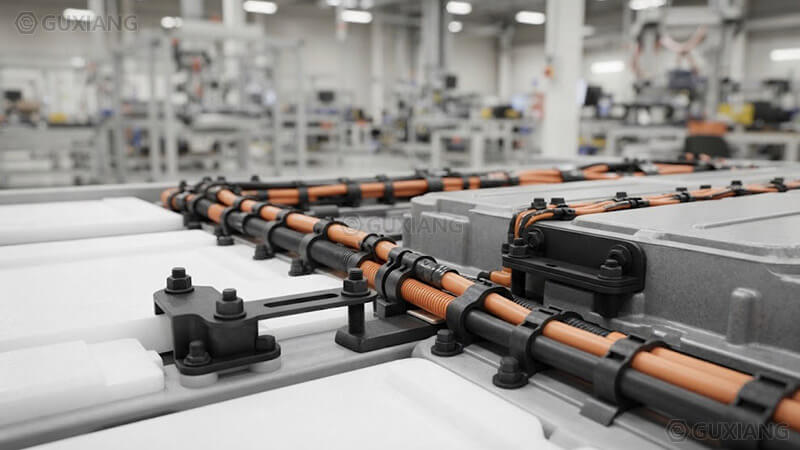
PCB spacers, insulating standoffs, plastic screws for enclosures, and battery terminal hardware. Non-conductive fasteners prevent short circuits and arcing.
Automotive and EV Components
Interior trim fasteners, battery pack insulation hardware, cable routing clips, and sensor mounting. Weight reduction and electrical isolation matter in EV battery systems.
Medical Equipment
MRI-safe non-magnetic fasteners, laboratory instrument hardware, and disposable device assemblies where sterilization and contamination control are required.
Chemical Processing Equipment
PVDF and PTFE fasteners in pumps, valves, tanks, and piping supports that contact aggressive acids and solvents.
Semiconductor and Cleanroom Equipment
PEEK and PVDF fasteners in wafer processing tools, chemical delivery systems, and cleanroom fixtures where purity, temperature, and chemical resistance are mandatory.
Aerospace Applications
Interior fittings, lightweight brackets, and system hardware where weight and non-conductive behavior justify high-performance polymers such as PEEK.
Marine Applications
Saltwater-resistant fasteners for deck hardware, instrumentation, and enclosures. Polymers eliminate rust and galvanic corrosion in the marine environment.
Renewable Energy Equipment
Solar panel frame hardware, inverter enclosures, and wind turbine auxiliary equipment where UV resistance and electrical insulation are required.
Consumer Products
Appliance fasteners, furniture hardware, toys, and electronic accessories where color, cost, and safety requirements favor molded polymers.
Industrial Machinery
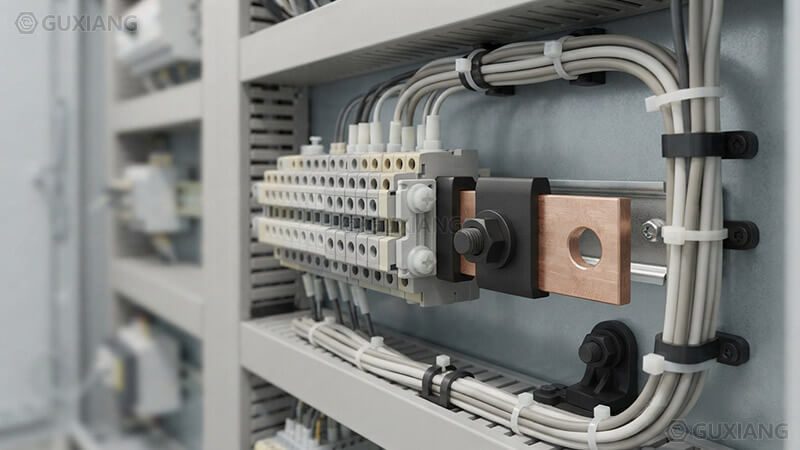
Guards, covers, sensors, and control panels where non-magnetic or non-conductive mounting is needed near electrical components.
For a product-level view of plastic fastener types used across automotive and industrial equipment, see the plastic fasteners guide already published on this site.
How to Choose the Right Plastic Fastener Material
Use this eight-step sequence to convert an application description into a defensible material decision.
Step 1 — Define the load. Identify the tensile, shear, compressive, and torque loads the fastener must survive, including safety factor. This sets the minimum strength class and often rules out PP or unfilled PVC.
Step 2 — Define operating temperature. Record both the normal continuous temperature and the peak excursion. This narrows the field to POM/nylon range or forces PEEK/PPS/PVDF.
Step 3 — Identify chemical exposure. List the chemicals, their concentrations, and the temperatures at which they contact the fastener. Use compatibility data to eliminate materials that degrade in the media.
Step 4 — Check electrical requirements. Determine whether the fastener must be insulating, non-magnetic, or rated for specific dielectric strength. Most unfilled thermoplastics qualify; glass-filled grades need verification.
Step 5 — Evaluate moisture and UV exposure. Decide whether the part operates indoors, outdoors, or submerged. Outdoors and submerged service point to PVDF, PTFE, PPS, or UV-stabilized grades.
Step 6 — Check creep and dimensional stability. For long-term clamping or precision spacing, favor POM, PEEK, PPS, or glass-filled nylon over unfilled nylon and PP.
Step 7 — Select the polymer. With the requirements ranked, match them against the material sections above. Choose the lowest-cost polymer that satisfies every critical requirement.
Step 8 — Select the fastener design. Pick the screw, bolt, nut, washer, rivet, or custom geometry that delivers the required function in that polymer, and confirm thread engagement, torque limits, and installation method.
When the application must also comply with global fastener standards, the fastener standards guide explains which DIN, ISO, ANSI, and ASME specifications apply to polymer and non-metallic hardware.
Common Problems When Using Plastic Fasteners
Most plastic fastener failures come from treating them like metal fasteners. The nine issues below are the ones engineers encounter most often.
Plastic Fastener Creep
Sustained load slowly deforms the polymer, and clamping force decays. Mitigation: choose PEEK, PPS, POM, or glass-filled grades, and use spring washers or periodic re-torque.
Thread Stripping
Plastic threads strip more easily than steel threads, especially with sharp thread profiles or short engagement. Mitigation: increase engagement length, use thread-forming designs, or switch to a stronger polymer.
Over-Tightening
Applying metal-style torque to a plastic fastener overstresses the head and threads. Mitigation: use polymer-specific torque values and controlled drivers.
Thermal Expansion
High expansion coefficients loosen or bind joints across temperature swings. Mitigation: design clearance for the temperature range and avoid metal-to-plastic press fits without compliance.
Moisture Absorption
Nylon parts swell and soften in humid environments. Mitigation: specify PA66 with proper conditioning, or switch to POM, PEEK, or PVDF for dimension-critical parts.
UV Degradation
Unstabilized polymers become brittle and discolored outdoors. Mitigation: UV-stabilized grades or inherently resistant materials such as PVDF and PPS.
Material Compatibility
Dissimilar polymers or polymer-to-metal contact can cause stress cracking or chemical attack. Mitigation: verify chemical compatibility with the mating materials.
Insufficient Mechanical Strength
Underestimating load leads to shear or tensile failure. Mitigation: increase fastener diameter, add fasteners, or select glass-filled or high-performance grades.
Incorrect Installation Torque
Too little torque leaves a loose joint; too much strips threads. For polymer fasteners the usable window is narrow. When metal torque values are used as a starting point, consult polymer-specific data such as the bolt torque chart only as a reference for geometry, then apply a polymer-specific derating factor.
Plastic Fastener Manufacturing Process
As a fastener manufacturer, Guxiang produces plastic fasteners through a controlled process that turns polymer pellets into dimensionally verified components.
Material Selection
The process starts with the application requirements and ends with a specific polymer grade, including filler content, lubricant package, UV stabilization, and color masterbatch.
Polymer Preparation
Raw polymer is dried to the correct moisture level. Nylon and PC are hygroscopic; molding wet material produces splay, voids, and weak parts.
Injection Molding
Most plastic fasteners are injection molded in multi-cavity tools. Gate position, cooling rate, and packing pressure determine thread fidelity, dimensional accuracy, and strength.
CNC Machining
Low-volume or high-precision plastic fasteners are CNC machined from rod or molded blanks. Machining suits prototypes, custom threads, and materials that do not mold well in small sizes.
Thread Forming / Thread Machining
Threads are formed directly in the mold or cut in a secondary machining operation. Thread profile, flank angle, and finish control installation torque and stripping resistance.
Deburring and Finishing
Molded and machined parts are deburred, cleaned, and finished. Color, laser marking, and surface treatments are applied when the customer requires them.
Dimensional Inspection
Critical dimensions — thread pitch, head height, overall length, and perpendicularity — are checked with calibrated gauges and optical measurement.
Performance Testing
Sample lots are tested for tensile strength, torque resistance, pull-out force, and, where relevant, chemical and temperature performance.
Custom Plastic Fastener Manufacturing
Custom programs start with a drawing or a sample, then move through material selection, tooling, prototyping, and production. Guxiang supports OEM/ODM projects with engineering review at every stage.
Custom Plastic Fasteners for OEM Applications
Custom plastic fasteners are manufactured when standard catalog parts cannot meet dimensional, material, or performance requirements. Typical custom requirements include non-standard dimensions, custom thread forms, special head designs, specific polymer grades, color matching, reinforced materials, tight tolerances, and production-volume targets.
The OEM process begins with a requirement definition: load, temperature, chemical environment, electrical constraints, and assembly method. From that baseline, the material is selected, the fastener geometry is designed or adapted, a prototype is produced, and the design is validated before tooling commitment. Guxiang supports prototype development and OEM/ODM production, including glass-filled materials, special thread profiles, and tight dimensional tolerances that standard plastic fasteners cannot hold.
Engineers searching for a plastic fastener manufacturer or plastic fastener supplier for custom work should look for a partner that controls both molding and machining, verifies material grades, and documents dimensional inspection. The combination of custom plastic screws, custom plastic bolts, and custom nylon fasteners with application-specific engineering support is what separates a capable OEM partner from a catalog reseller.
FAQs About Plastic Fasteners
What are plastic fasteners?
Plastic fasteners are screws, bolts, nuts, washers, rivets, spacers, and standoffs molded or machined from thermoplastic polymers such as nylon, POM, PEEK, and PVDF, used where insulation, corrosion resistance, or weight matters.
What materials are used to make plastic fasteners?
Common materials include nylon (PA6, PA66), polypropylene, POM, PVDF, PTFE, PEEK, PPS, polycarbonate, and PVC. Glass-filled grades such as PA66 GF30 provide higher strength and stiffness.
Are plastic fasteners strong?
Plastic fasteners are strong enough for many engineering applications but weaker than steel. Unfilled nylon reaches about 60–90 MPa tensile strength; PEEK and glass-filled PA66 are stronger. Load, thread engagement, and torque must be designed accordingly.
Are plastic fasteners suitable for high-temperature applications?
Some are. PEEK and PPS operate near 200–250 °C, PVDF and PTFE to 150–260 °C, while nylon, POM, and PP are limited to roughly 80–100 °C. Always check the specific grade’s continuous-service rating.
Are plastic fasteners chemically resistant?
Chemical resistance is polymer-specific. PVDF and PTFE resist most aggressive chemicals; PP resists many acids and bases; nylon degrades in strong acids. Verify compatibility with concentration, temperature, and exposure time before selection.
Are nylon fasteners waterproof?
Nylon does not dissolve in water, but it absorbs moisture, which softens the material and changes dimensions. For submerged or high-humidity service, POM, PEEK, or PVDF perform better.
Are plastic fasteners electrically insulating?
Yes. Most unfilled thermoplastics have high dielectric strength and surface resistivity, making plastic screws and standoffs effective insulators in electrical assemblies. Glass-filled grades reduce margins slightly and need verification.
Are plastic fasteners suitable for outdoor applications?
Only with the right material. PVDF, PPS, and UV-stabilized POM resist weathering; unstabilized nylon and PP become brittle under UV. Match the grade to the exposure before outdoor use.
What is the difference between nylon and PEEK fasteners?
Nylon is low-cost, tough, and easy to mold but absorbs moisture, creeps under load, and is limited to about 100 °C. PEEK is far stronger, creep-resistant, chemically resistant, and operates near 250 °C at much higher cost.
What is the best plastic for fasteners?
No single polymer wins every application. Nylon suits general purpose, POM suits precision, PVDF and PTFE suit chemicals, PEEK suits high temperature and high load. Select by load, temperature, chemistry, and electrical requirements.
Conclusion
The correct plastic fastener material depends on the combination of mechanical load, temperature, chemical exposure, electrical requirements, environmental conditions, dimensional stability, and cost. No polymer is universally better than another; each engineering plastic wins in the application window where its property set matches the requirements. The selection method described in this guide — define load, temperature, chemistry, electrical constraints, moisture and UV exposure, creep and dimensional stability, then choose the polymer and fastener design — turns a generic material discussion into a defensible engineering decision.
Guxiang supplies custom plastic fasteners with material selection support, CNC machining, injection molding, and OEM/ODM manufacturing. The engineering team works from application requirements to validated hardware, covering standard polymers, glass-filled grades, and high-performance materials such as PEEK and PPS. For a fastener project that starts from a load case or a drawing rather than a catalog, contact Guxiang with the operating conditions and let the material and geometry be specified together.