 EN
EN  ZH
ZH 

Machine screws are uniformly threaded fasteners designed for use with pre-tapped holes or nuts. Unlike self-tapping types, they rely on existing internal threads and are supplied to DIN 912 (socket head), DIN 7991 (flat head), and DIN 7985 (pan head) specifications. Available in metric M1.6–M10 and imperial #0–#12, with carbon steel zinc-plated, stainless A2/A4, and brass options to suit mechanical assemblies, electronics enclosures, and industrial equipment.
For instance, a countersunk machine screw is ideal for applications requiring a flush surface finish, whereas a pan head machine screw provides excellent tool grip, making it well-suited for manual adjustments. Their ability to securely join components makes them indispensable in everything from small-scale DIY projects to large-scale industrial applications.
Filter By
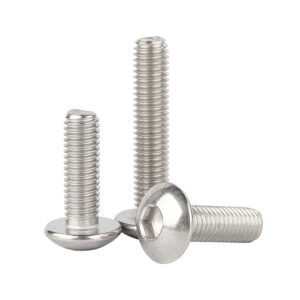

A machine screw threads into a pre-tapped hole or a nut—it does not cut, form, or drill its own thread. The thread is a standard machine thread (UNC, UNF, or metric ISO) precision-ground to fit a matching internal thread. Remove a machine screw from an assembly and the threaded hole is unchanged—no cold-worked material, no stripped chips.
The difference between a machine screw and a bolt comes down to size and tool engagement. Machine screws typically range from #0 to 3/8 in. (M1.6 to M10), driven by a driver bit engaging a recess in the head. Bolts are larger, use external wrenching, and carry structural design codes. In practice, a 1/4-20 fastener can be either—the naming depends on how the designer calls it out.
Head shape dictates the load distribution, clearance profile, and tool access. Thread is standardized; the head is where machine screws differentiate.
Pan Head The general-purpose workhorse. A flat underside and a slightly domed top provide a clean finished look without countersinking. Bearing surface is wider than a round head at the same diameter. In electronics, a #4-40 or M3 pan head is the default for mounting PCB standoffs and bracket assemblies.
Flat Head (Countersunk) The 82° or 90° conical underside sits flush or below the surface. Standard countersink angle is 82° for imperial sizes, 90° for metric per DIN 965. Over-torque a flat head in aluminum and the countersink deforms, pulling the screw head below flush—depth control matters more here than with any other head type. For thin sheet metal under 1.5 mm, switch to an undercut flat head; the reduced bearing cone seats without breaking through.
Button Head A low dome with a wider bearing surface than pan head, driven by a hex socket (Allen). Common in tooling, fixtures, and consumer products where a smooth, snag-free exterior matters. The hex socket recess limits the torque ceiling—a 4 mm button head strips at roughly 10–12 N·m, below the 15–18 N·m a comparable pan head Phillips #2 can take.
Truss Head An extra-wide, low-profile dome that spreads load across a larger area. Use truss head screws when the mounting hole is oversized, the substrate is soft (plastic, wood, composite), or the assembly needs maximum clamp distribution without a washer. One trade-off: the wide head catches on clothing and cables in tight enclosures.
Socket Head Cap Screw (SHCS) Technically a machine screw in the #0–3/8 in. range. The cylindrical head with a hex socket drive handles the highest torque of any machine screw head—an alloy steel #10-32 SHCS torqued to 55 in-lb without stripping is routine. These live in machine tools, bicycle components, and anywhere clamp force matters more than cosmetics. The head sits proud of the surface; if flush is required, use a flat head instead.
Fillister Head Taller than pan, narrower than truss, with a deep slot or cross recess. The added height gives a screwdriver more engagement depth before camming out. Used in older machinery and aerospace where slotted drive is specified and a standard round head does not provide enough driver bite.
Oval / Raised Countersunk Head A flat countersunk base with a slightly domed top that sits proud of the surface. It is the “decorative countersunk”—flush enough to avoid snagging, raised enough to add a finished look. Common in furniture hardware and architectural trim.
Set Screws (Grub Screws) Headless machine screws with an internal hex or slot drive, threaded full length. They lock a collar, pulley, or knob onto a shaft. The tip geometry determines holding power: flat point for frequent adjustment, cup point for biting into a soft shaft, cone point for permanent placement. A cup-point M6 set screw at 5 N·m generates roughly double the holding force of a flat point at the same torque.
Machine screws are defined by their thread—everything else follows. Get the thread wrong and the screw jams, strips, or rattles loose.
Metric (ISO 68-1) Coarse pitch is the default. An M4 has a 0.7 mm pitch; M4 fine drops to 0.5 mm. Fine threads provide roughly 10–15% more tensile stress area at the same diameter—use them in thin-walled sections, tapped holes in hard materials, and anywhere vibration loosening is a concern. Metric threads carry a 6g tolerance class for external threads (screw) and 6H for internal (nut/tapped hole). The 6g/6H pair gives 0.05–0.15 mm of clearance; tight enough for precision, loose enough for assembly at speed.
Unified (UNC / UNF) UNC threads prioritize assembly speed and chip clearance. A 1/4-20 (¼ in. diameter, 20 threads per inch) is the most common machine screw thread in North America—every hardware store stocks it. UNF threads (1/4-28) increase thread engagement per inch by roughly 40%, trading assembly speed for vibration resistance. Use UNC for general assembly, UNF for automotive and aerospace where joints must survive cycling without loosening.
BA (British Association) A fine-pitch small-screw standard still found in older British instrumentation, model engineering, and some legacy aerospace. 0BA is 6 mm diameter; 10BA is 1.7 mm. Unless you are restoring a vintage instrument, avoid BA—metric equivalents are cheaper and stocked deeper.
Thread Fit Classes at a Glance
| Fit | Imperial (UNC/UNF) | Metric (ISO) | Clearance | Use Case |
|---|---|---|---|---|
| Loose | 1A / 1B | — | High | Quick assembly, zinc-plated threads |
| Standard | 2A / 2B | 6g / 6H | Normal | 90% of machine screw applications |
| Precision | 3A / 3B | 5g / 5H | Tight | Aerospace, instrumentation, high vibration |
Carbon Steel (Grade 2 / Class 4.8) Low-carbon steel, no heat treatment beyond basic forming. Tensile ~400 MPa. Bright zinc or black oxide finish. Suitable for indoor, low-stress assembly. Cost is the driver—Grade 2 #8-32 screws in bulk run under $0.01 each. Any application with shear or tensile loads above 200 MPa should step up to Grade 5 or 8.8.
Alloy Steel (Grade 5 / Class 8.8) Medium-carbon steel, quenched and tempered. Tensile ~800 MPa for 8.8 metric, ~830 MPa for Grade 5 imperial. The go-to for machinery, automotive brackets, and structural joints where a screw failure stops production. Zinc, HDG, or black oxide finish. Grade 8 (Class 10.9) pushes tensile to 1,040 MPa—use where bolt replacement would require teardown.
Stainless Steel 304 (A2) Tensile 500–700 MPa. Resists oxidation in urban and inland environments. In ASTM B117 salt spray, red rust appears at 200–400 hours. 304 machine screws are standard in food equipment, medical devices, and electronics enclosures where magnetic interference from carbon steel is unacceptable. One catch: 304 galling—cold-welding between screw and nut threads under friction—is a known failure mode. Use a nickel-based anti-seize or switch to 316 for frequent assembly/disassembly threads.
Stainless Steel 316 (A4) The 2% molybdenum content blocks chloride pitting. Salt spray exceeds 1,000 hours before red rust. Tensile matches 304 at 500–700 MPa. Use 316 machine screws on marine deck hardware, chemical processing equipment, and coastal HVAC installations. Price premium over 304: about 40%. On a $0.15 screw, that is noise. On a $50,000 assembly line downtime call, it is the cheapest insurance available.
Brass (CuZn39Pb3) Tensile 300–450 MPa. The soft metal conforms to mating threads, reducing vibration loosening. Naturally corrosion-resistant in fresh water and non-oxidizing environments. Brass machine screws are electrically conductive and non-magnetic, making them standard in electrical terminals and instrument panels. Do not use brass machine screws in structural joints or anywhere shear loads exceed 150 MPa—the threads cold-flow under sustained load.
Nylon / Plastic Tensile ~80 MPa for nylon 6/6. Electrically insulating, chemically inert, and weightless compared to steel. Use for PCB standoffs, panel mounting where electrical isolation is mandatory, and light-duty covers. Nylon 6/6 holds up to about 85°C continuous; above that, switch to PEEK (260°C) at 20× the cost. Note: nylon absorbs moisture and swells—a dry-fit nylon M4 screw can seize in a tight tapped hole after weeks at 60% relative humidity. Allow 0.1–0.2 mm radial clearance for nylon hardware.
| Parameter | Metric | Imperial |
|---|---|---|
| Diameter | M1.6, M2, M2.5, M3, M4, M5, M6, M8, M10 | #0, #1, #2, #3, #4, #5, #6, #8, #10, 1/4, 5/16, 3/8 in. |
| Length | 3 mm to 100 mm | 1/8 in. to 4 in. |
| Thread | Coarse & fine per ISO 68-1 | UNC & UNF per ASME B1.1 |
| Pitch (coarse) | M3=0.5, M4=0.7, M5=0.8, M6=1.0, M8=1.25 | #6=32, #8=32, #10=24, 1/4=20, 5/16=18 |
| Strength class | 4.8, 8.8, 10.9, 12.9 (ISO 898-1) | Grade 2, 5, 8 (SAE J429) |
| Tolerance | 6g external / 6H internal | 2A external / 2B internal |
| Standards | DIN 84, 85, 963, 7991, 912, ISO 7045–7047 | ASME B18.6.3, ANSI B18.3 |
Drive Types
| Drive | Torque Capacity | Cam-Out Resistance | Best For |
|---|---|---|---|
| Slotted | Low | None | Restoration, low-torque trim |
| Phillips | Medium | Low (designed to cam out) | General assembly, DIY |
| Pozi (Pozidriv) | Medium-High | Medium | European manufacturing, wood screws |
| Hex Socket (Allen) | High | Very High | Machine tools, bicycle, high-torque |
| Torx (Star) | High | Very High | Automotive, production lines |
| Robertson (Square) | High | Very High | Canadian construction, electrical panels |
Head Markings on hex socket and SHCS heads identify the alloy and strength class: 8.8, 10.9, 12.9 for metric; three radial lines for Grade 5, six for Grade 8. Unmarked screws are Grade 2 / Class 4.8—do not use them in load-bearing assemblies.
Electronics and PCB Assembly M2.5 and M3 pan head machine screws secure PCB standoffs, connectors, and enclosure lids. Stainless 304 or brass prevents magnetic interference with sensitive circuits. One critical detail: screw length must not protrude past the standoff by more than one full thread—a protruding steel screw tip contacting a PCB trace creates a dead short. Plastic shoulder washers are cheap insurance.
Consumer Appliances A washing machine cabinet has roughly 20–30 #8 or #10 sheet metal and machine screws holding panels, motor brackets, and pump mounts. Vibration is the primary failure driver—self-loosening screws rattle loose over thousands of wash cycles. Nylon patch fasteners or spring lock washers on the motor mount screws cost pennies and eliminate callbacks.
Machine Tools and Fixtures Socket head cap screws (SHCS) in alloy steel 10.9 or 12.9 clamp jigs, fixtures, and tool holders. Torque values are specified, not guessed: an M8 12.9 SHCS torqued to 40 N·m develops roughly 24 kN of clamp force. Undershoot and the work-piece shifts during a machining pass. Overshoot and the fixture body cracks.
Automotive Brackets and Trim Engine bay accessory brackets use M6 and M8 flange-head machine screws in 8.8 or 10.9, with prevailing-torque nuts to prevent loosening from thermal cycling. Interior trim uses smaller M4–M5 pan or oval head screws—thread-forming screws are preferred here to avoid tapping cost, but machine screws remain where parts are replaced during service.
Medical and Laboratory Equipment 316 stainless and electropolished finishes are baseline requirements for cleanroom and autoclave environments. Threads must not trap bacteria—rolled threads with a smooth root radius are specified over cut threads. Nylon machine screws appear in MRI equipment where even non-magnetic stainless can cause eddy-current artifacts in imaging.
Furniture and Architectural Hardware Brass and zinc-plated machine screws fasten handles, hinges, and decorative plates. Oval head screws with a polished finish are the furniture standard—countersunk enough to avoid catching, domed enough to look intentional. For knock-down (flat-pack) furniture, confirm machine screw with factory-installed threaded inserts rather than wood screws into particle board, which strip after 2–3 reassembly cycles.
| Decision | What to Ask | Guidance |
|---|---|---|
| 1. Thread standard | What is the tapped hole or nut spec? | Match the existing thread: M4×0.7, 1/4-20 UNC, etc. Never guess—a UNC screw will cross-thread into a UNF nut within the first turn. For new designs, metric coarse for general use; UNF or metric fine where vibration resistance matters. |
| 2. Head style | Flush or proud? Tool access? | Countersunk hole → flat head (82° imperial, 90° metric). Surface mount, no clearance issue → pan head. High torque → socket head cap screw. Soft substrate → truss head to spread the load. Decorative visible surface → oval head or polished button. |
| 3. Material and strength | Load, environment, corrosion risk? | Indoor low-load → carbon steel Grade 2 / 4.8. Machinery/brackets → alloy steel 8.8 or 10.9. Outdoor inland → 304 stainless. Coastal/chemical/marine → 316 stainless. Electrical isolation → nylon. Marine electrical → brass. |
| 4. Drive type | Assembly volume and torque? | Hand assembly, low volume → Phillips or slotted. Production line → Torx or Robertson (zero cam-out). High torque → hex socket (Allen). One-handed overhead work → hex washer head with magnetic driver. |
Thread engagement is the hidden variable. A standard rule: minimum 1× diameter of thread engagement in steel, 2× in aluminum, and 2.5× in brass or plastic. Less than that and the internal threads strip before the screw reaches rated tensile. If the tapped hole depth limits engagement, drop to a fine-pitch thread—the shallow thread profile packs more engagement into the same hole depth.
What is the difference between a machine screw and a bolt? Machine screws are smaller (typically #0 to 3/8 in., M1.6 to M10), driven by a recess in the head (slotted, Phillips, hex socket), and assembled into a tapped hole or nut. Bolts are larger, use an external wrenching head, and carry structural specifications. A 1/4-20 or M6 can be either—the distinction is in the application, not the dimensions.
What does 8.8 mean on a machine screw head? The first digit is the ultimate tensile strength in hundreds of MPa: 8 = 800 MPa. The second digit is the yield-to-tensile ratio as a percentage: 8 = yield is 80% of tensile, so 640 MPa yield. Class 10.9 means 1,000 MPa tensile, 900 MPa yield. Grade 8 imperial is roughly equivalent to Class 10.9 metric.
When should I use a fine thread versus coarse thread? Fine threads carry 10–15% more tensile area and resist vibration better because the helix angle is shallower—less tendency to back-drive under axial load. Use fine threads in thin-walled tapped holes, hard materials (where tapping coarse threads is difficult), and high-vibration assemblies. Coarse threads assemble faster, strip less easily in soft materials, and handle dirty or plated threads better.
Why do stainless steel screws gall and how do I stop it? Galling is cold-welding between two stainless surfaces under pressure and friction. As the screw threads slide against the nut threads, microscopic high points fuse. The joint seizes before reaching target torque. Prevention: slower driving speed (below 500 RPM), nickel-based anti-seize compound, or mixing alloys (304 screw into 316 nut). For assemblies that must be repeatedly serviced, a prevailing-torque locking insert avoids galling entirely.
Can I use machine screws in wood or plastic? Not directly. Machine screws need a mating thread—either a metal threaded insert pressed into the wood/plastic, a T-nut on the back side, or a tapped metal bracket. Driving a machine screw into an untapped hole in plastic or wood shreds the hole. Use a thread-forming screw or a wood screw instead.
What drive type should I use on a production line? Torx (star) or Robertson (square). Both have near-zero cam-out, which eliminates the most common assembly-line stoppage: stripped recesses. Phillips was designed to cam out at a specific torque to prevent over-tightening on assembly lines in the 1930s—modern torque-limiting drivers make that feature obsolete. The tooling cost difference between Phillips and Torx bits is under $0.50 per bit at volume.
Are zinc-plated machine screws suitable for outdoor use? No. Standard zinc electroplate (5–12 µm, ASTM B633) provides 96–120 hours of neutral salt spray—roughly equivalent to a few months of outdoor exposure before rust appears. For outdoor use, step to hot-dip galvanized (45–85 µm, 500+ hours salt spray) or stainless steel. “Zinc plated” and “galvanized” are not interchangeable.
How long should a machine screw be relative to the nut? At least 1.5 to 2 full threads should protrude past the nut. Fewer than 1.5 threads and the first load-bearing thread in the nut carries a disproportionate share of the load, increasing the risk of thread stripping. More than 5 protruding threads wastes length and increases weight without adding strength. For tapped blind holes, aim for 1× diameter of thread engagement minimum, 1.5× preferred.
Our machine screw inventory spans M1.6 to M10 and #0 to 3/8 in., with UNC, UNF, and metric coarse/fine threads on the shelf at typical volumes of 100,000+ pieces per size. Head styles: pan, flat countersunk, button, truss, socket cap, fillister, oval, and set screws in cup/cone/flat point. Materials stocked: carbon steel (zinc, black oxide, HDG), alloy steel 8.8/10.9/12.9, stainless 304 and 316, brass, and nylon 6/6.
Specify the thread callout, head style, material, and length. We match the tolerance class to your assembly method—6g/6H for standard, 5g/5H for precision. Free samples ship within 48 hours. Same-day quotes on production volumes. Trial orders from 1,000 pieces accepted.
Social Chat is free, download and try it now here!