





A brass fastener is a bolt, screw, nut, washer, or rivet made from a copper-zinc alloy — most commonly C260 cartridge brass, C360 free-cutting brass, or C464 naval brass — specified not for maximum strength, which it does not offer, but for three properties no steel fastener can match simultaneously: electrical and thermal conductivity, complete non-magnetism, and spark-free behavior in explosive atmospheres. Brass fasteners cost more than carbon steel, less than titanium, and roughly the same as stainless steel depending on copper prices, which makes the material decision a question of what the application demands rather than a simple strength ranking.
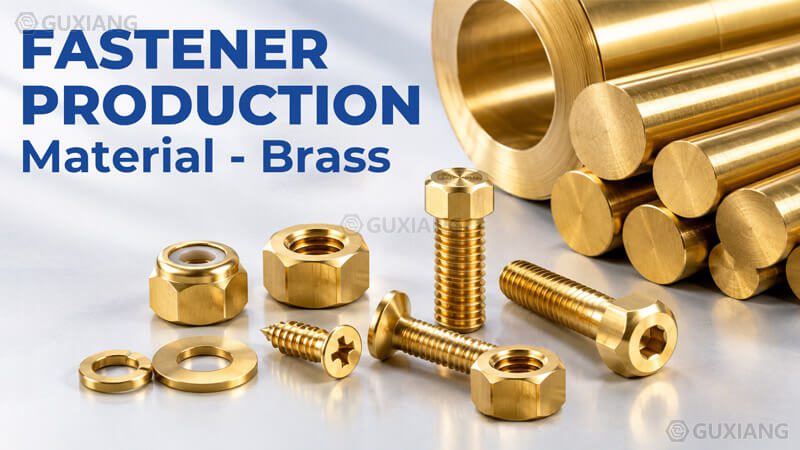
What Are Brass Fasteners
Brass fasteners are mechanical joining components manufactured from wrought copper-zinc (Cu-Zn) alloys. The copper-zinc ratio controls nearly every engineering property: strength, corrosion resistance, conductivity, color, and machinability.
| Property | Brass (C260) | Carbon Steel | Stainless (304/316) | Aluminum (7075) | Why It Matters |
|---|---|---|---|---|---|
| Density | 8.53 g/cm³ | 7.85 g/cm³ | 7.9–8.0 g/cm³ | 2.70 g/cm³ | Brass is heavy, ~9% denser than steel |
| Tensile strength | 350–540 MPa | 1030 MPa (Grade 8) | 860 MPa (125 ksi) | 572 MPa (83 ksi) | Brass is not a high-strength material |
| Electrical conductivity | 28% IACS | ~10% IACS | ~2.4% IACS | 30–40% IACS | Brass conducts, steel does not |
| Magnetism | Non-magnetic | Ferromagnetic | Mostly non-magnetic | Non-magnetic | Brass is reliably non-magnetic |
| Spark behavior | Non-sparking | Sparks on impact | Non-sparking | Non-sparking | Brass is explosion-safe |
Two defining characteristics separate brass from the other fastener metals covered in this series. First, brass is one of the few fastener materials that is simultaneously a structural component and an electrical conductor — a brass screw can carry current while holding a joint. Second, brass is intrinsically safe in explosive atmospheres: it contains no iron and does not produce impact sparks, which is why brass fasteners appear in mines, chemical plants, and fuel handling areas where steel is prohibited.

The Cu-Zn Alloy System and Grade Selection
Brass fasteners are made from a small number of wrought brass grades whose identity is defined by the copper-zinc ratio and small additions of tin or lead. Because the alloy family is large — the ASTM and UNS systems list dozens of wrought copper-zinc compositions — the practical fastener specification space is deliberately narrow: three grades carry nearly all production, and a fourth group appears only in specialty work.
The full Cu-Zn system extends from red brasses (85% copper, C23000) through yellow brasses (65–70% copper, C26000 and C27200) to Muntz metal (60% copper, C28000) and the leaded and tinned variants derived from them. For fasteners, the production economics are decisive: a fastener manufacturer machines, forms, or heads components in high volume, and the grade must deliver consistent chip-breaking behavior, cold formability, or corrosion performance at scale. That requirement filters the family down to the three grades examined here.
The Two-Digit Copper-Zinc Logic
The copper content dominates the properties. High-copper brasses (85–70% Cu) are soft, ductile, and corrosion-resistant; low-copper brasses (60–65% Cu) are harder, stronger, and cheaper. The three grades that matter for fasteners are:
| UNS Grade | Common Name | Composition | Character |
|---|---|---|---|
| C26000 | Cartridge brass | 70 Cu / 30 Zn | Ductile, cold-formable, best corrosion resistance of the common brasses |
| C36000 | Free-cutting brass | 61.5 Cu / 35.5 Zn / 3 Pb | Leaded, superb machinability, the machine-screw workhorse |
| C46400 | Naval brass | 59 Cu / 40 Zn / 1 Sn | Tin addition resists dezincification, marine-grade |
Why These Three Grades Dominate Fastener Production
C36000 accounts for the majority of machined brass fasteners. The 3% lead addition breaks chips during turning and thread cutting, allowing high-speed production of screws, bolts, and nuts with tight tolerances and clean threads. If a brass fastener is machined rather than formed, it is almost certainly C360.
C26000 is the cold-forming choice. With 70% copper it is ductile enough to be cold-headed into rivets and formed screws without cracking, and it offers the best atmospheric corrosion resistance of the three.
C46400 is the specification for service where dezincification is a risk — seawater, brackish water, and aggressive aqueous environments. The 1% tin addition suppresses zinc leaching, which is why naval brass is the standard for marine brass fasteners.
The grade decision is therefore a manufacturing-method decision as much as a material decision: machined production favors C360, formed production favors C260, and corrosive service favors C464.
Mechanical Properties
Brass fastener mechanical properties are governed in North America by ASTM F467/F468 (nonferrous fasteners). Typical and minimum strength values for the three common grades are listed below.
| Grade | Tensile Strength (typical) | Yield Strength (typical) | Hardness | Character |
|---|---|---|---|---|
| C26000 (H02) | 350–540 MPa | 240–450 MPa | 80–100 HB | Ductile, work-hardening |
| C36000 (H02) | 340–470 MPa | 240 MPa | 80–90 HB | Free-machining, stable |
| C46400 (H02) | 380–520 MPa | 170–250 MPa | 75–95 HB | Marine grade |
The Strength Reality
The honest headline is that brass is a moderate-strength fastener material. Its tensile range of roughly 350–540 MPa places it below alloy steel (860+ MPa), below stainless steel (515–860 MPa), and only marginally above aluminum (572 MPa in 7075-T6). In load-bearing structural service, brass is eliminated by strength alone — the alloy steel fasteners guide covers the materials that carry structural loads.
What brass lacks in absolute strength it offsets in other dimensions that no strength table captures:
Conductivity — brass carries 26–28% IACS, roughly ten times the conductivity of steel. A brass fastener is an electrical component.
Non-magnetism — brass is paramagnetic to a negligible degree, usable in MRI rooms and near magnetic sensors.
Non-sparking — brass impact produces no incendive sparks, qualifying it for explosive atmospheres.
Gall resistance — brass self-lubricates in sliding contact and does not gall or seize like titanium, stainless, or aluminum threads.
Specification Practice Under ASTM F467/F468
ASTM F467 covers nonferrous nuts and ASTM F468 covers nonferrous bolts, screws, and studs; together they define the dimensional, mechanical, and marking requirements for brass fasteners in North American practice. The standards reference the same property classes and marking conventions used for steel fasteners, which lets engineering teams specify brass on existing drawings with minimal rework. Threads are rolled or cut, and the mechanical values in the standards are conditioned on the product’s temper — a fastener cut from cold-worked bar carries higher strength than one from annealed stock. A specification that names only the alloy without a temper or strength class leaves the supplier free to ship the softer condition, which is a common source of field complaints about brass fasteners.
Temperature and Low-Temperature Behavior
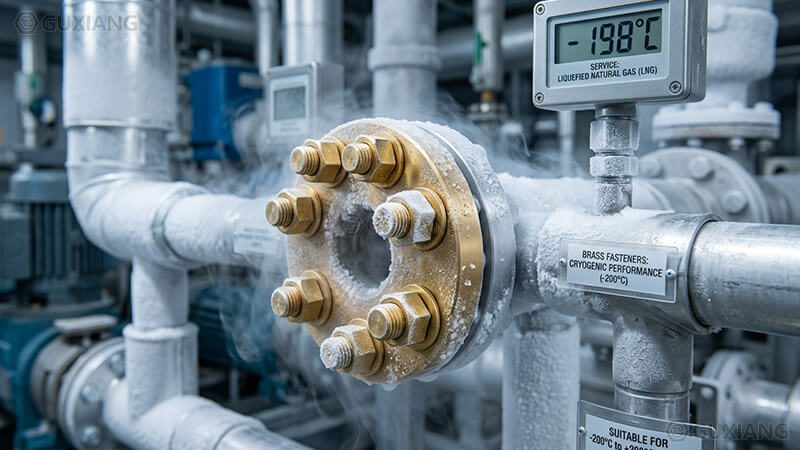
Brass loses strength at elevated temperature and is typically limited to continuous service below roughly 200°C. At cryogenic temperatures, however, brass retains toughness and does not embrittle — a useful property in liquefied-gas service that few fastener materials share. The practical envelope for brass fasteners is approximately -200°C to 200°C, which covers most industrial service but excludes hot-process equipment.
Corrosion Resistance and Galvanic Behavior
Brass occupies an unusual corrosion position: excellent in atmospheric and many aqueous environments, vulnerable in specific water chemistries, and galvanically complex against other metals.
General Corrosion Performance
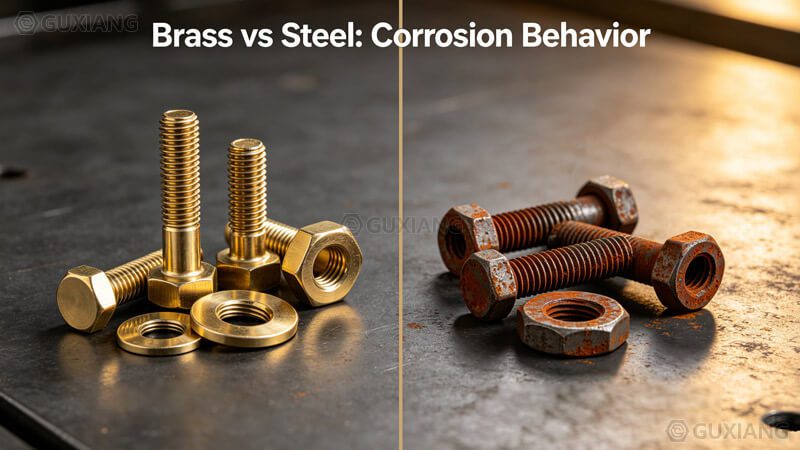
Brass resists atmospheric corrosion, fresh water, and neutral industrial environments well. It does not rust — the iron-oxide failure mode of steel is impossible in a copper-zinc alloy — and its corrosion products (the familiar green patina) are largely protective rather than destructive.
The two brass-specific failure modes deserve explicit attention.
Dezincification. In certain waters — soft water, acidic water, and chloride-bearing water — the zinc component of brass leaches selectively from the alloy, leaving behind a porous, copper-rich structure with a fraction of the original strength. Dezincification is the most common cause of premature brass fastener failure, and it is why plain yellow brass is not specified for aggressive aqueous service. The remedy is alloy selection: naval brass (C464, with 1% tin) and the dezincification-resistant brasses suppress the mechanism.
Season cracking (stress-corrosion cracking). Brass in the presence of ammonia and moisture, under residual or applied tensile stress, can crack intergranularly. This old failure mode — historically observed in brass cartridge cases stored near ammonia — matters for fasteners in agricultural, fertilizer, and cleaning environments where ammonia vapor is present. Low residual stress, annealing, or a change of alloy is the standard mitigation.
Galvanic Corrosion: The Direction Rule
Brass sits near the middle of the galvanic series for seawater, at approximately -0.25 to -0.35 V versus the saturated calomel electrode (SCE). That position produces two opposite behaviors depending on the coupled metal:
| Metal | Potential in Seawater (V vs SCE) | Brass’s Role in the Couple |
|---|---|---|
| Aluminum alloys | -0.76 to -0.90 | Brass is cathodic — aluminum corrodes |
| Carbon steel | -0.60 to -0.70 | Brass is cathodic — steel corrodes |
| Brass | -0.25 to -0.35 | Reference |
| Stainless steel (passive) | -0.05 to -0.45 | Brass is anodic — brass corrodes |
| Titanium (passive) | -0.05 to -0.15 | Brass is anodic — brass corrodes |
Three practical conclusions follow:
Brass fasteners on aluminum structure — the common case of brass screws in aluminum frames — accelerate corrosion of the aluminum around the joint, because the aluminum is the anode. The mechanism is identical in direction to titanium-on-aluminum, covered in the aluminum fasteners guide: any noble metal coupled to aluminum makes the aluminum the sacrificial component.
Brass fasteners on carbon steel structure — brass is cathodic, so the steel corrodes preferentially around the joint, though the potential difference is smaller and the attack slower than the aluminum case.
Stainless fasteners on brass structure — the reversal: stainless steel is more noble than brass, so the brass component corrodes. In a stainless-to-brass couple, the brass is the victim, and brass fasteners in a stainless assembly fail first.
The general rule for any dissimilar-metal joint is the same: the metal higher in the galvanic series survives and the lower metal corrodes. Selecting compatible couples, insulating the metals, or excluding the electrolyte is mandatory wherever brass meets aluminum, steel, or stainless in wet service. When the service environment is uncertain, a short salt-spray or immersion test under ISO 9227 conditions offers a faster and more defensible answer than a material handbook guess, because the galvanic behavior of a specific couple depends on surface finish, area ratio, and water chemistry as much as on the base metals.
Surface Finishes
Brass fasteners receive surface treatment for appearance, tarnish control, and corrosion resistance in specific environments. The options are fewer and simpler than for steel or aluminum.
| Finish | Purpose | Notes |
|---|---|---|
| Bare / polished | Decorative appearance | Requires lacquer or wax for tarnish control indoors |
| Lacquered | Tarnish prevention | Standard for architectural and decorative brass |
| Clear or colored anodize (bronze tones) | Appearance + mild protection | Chromate-free alternatives preferred in some markets |
| Nickel plating | Wear + appearance | Converts the surface to a harder, brighter metal |
| Chromate conversion | Corrosion + tarnish | Thin, conductive, preserves electrical contact |
The critical procurement distinction is conductive versus non-conductive finishes. A clear lacquer is electrically insulating and ruins a brass fastener intended for grounding; chromate conversion and thin passivation treatments preserve conductivity. For electrical service, specify “conductive finish” explicitly and reject lacquered or thick organic coatings. The broader logic of matching a finish to a service environment is covered in the galvanized vs zinc-plated fasteners guide.
The Non-Sparking, Conductive, Antimicrobial Advantage
This section covers the three properties that no steel, aluminum, or titanium fastener can replicate — the reason brass exists in the fastener catalog at all.
Non-Sparking Behavior
Brass and other non-ferrous alloys do not produce incendive sparks when struck, scraped, or dropped against hard surfaces. In explosive atmospheres — mines, petrochemical plants, fuel storage, grain handling — tools and fasteners in the zone must be spark-safe, and brass is the standard non-sparking fastener material. Steel fasteners are prohibited in these zones; brass fasteners are specified because a dropped wrench or a struck bolt cannot ignite the atmosphere.
Electrical Conductivity
At roughly 26–28% IACS, brass is a functional conductor. Brass fasteners serve as grounding screws, bonding clamps, bus-bar fasteners, and switchgear components where the fastener must carry current while providing mechanical retention. Copper is a better conductor (100% IACS), but pure copper fasteners lack the strength and thread quality of brass; brass is the practical compromise for threaded current-carrying components.
Antimicrobial Surface
Copper and its alloys carry an EPA-registered antimicrobial claim: copper alloy surfaces kill more than 99.9% of bacteria within two hours of contact. Brass fasteners therefore appear in food-processing equipment, medical device housings, hospital hardware, and public-transportation fittings where surface hygiene is a design requirement. This is a niche but real specification driver that steel, stainless, and aluminum fasteners cannot match.
For applications requiring electrical isolation rather than conduction, the plastic fasteners guide covers the non-metallic alternative.

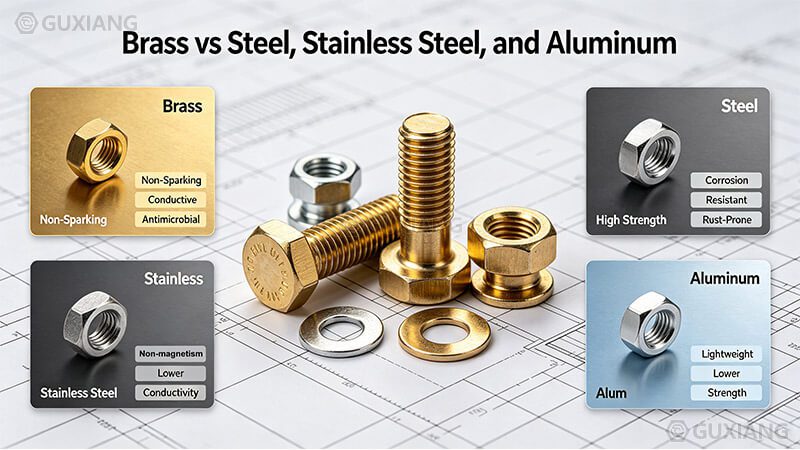
Brass vs Steel, Stainless Steel, and Aluminum
| Dimension | Brass (C360) | Carbon Steel | Stainless (316) | Aluminum (7075) |
|---|---|---|---|---|
| Density (g/cm³) | 8.50 | 7.85 | 8.0 | 2.70 |
| Tensile strength (MPa) | 340–470 | 860–1030 | 515–860 | 572 |
| Electrical conductivity (% IACS) | 26 | ~10 | ~2.4 | 30–40 |
| Magnetism | Non-magnetic | Magnetic | Mostly non-magnetic | Non-magnetic |
| Spark behavior | Non-sparking | Sparking | Non-sparking | Non-sparking |
| Seawater corrosion | Good (C464) | Rusts | Pits | Pits |
| Antimicrobial | Yes (copper) | No | No | No |
| Relative cost per part | 2–3× steel | 1× | 3–5× | 1–2× |
The Three Comparisons in Plain Terms
Brass vs carbon steel: steel wins on strength and cost; brass wins on conductivity, non-magnetism, spark safety, and corrosion resistance. Choose brass for electrical, explosion-safe, or decorative service; choose steel for load-bearing joints — the carbon steel fasteners guide covers that domain.
Brass vs stainless steel: the two compete for corrosion-service fasteners. Stainless is stronger and its cost is similar; brass wins on conductivity, non-magnetism, and spark safety, and loses on strength and seawater corrosion (brass is good in seawater with C464, but stainless is stronger and galvanically safer with most structure). For a pure corrosion decision, stainless usually wins; for a conductivity or spark-safety decision, brass is the only choice. The material comparison framework is developed further in the stainless steel vs galvanized fasteners guide.
Brass vs aluminum: aluminum is lighter, cheaper, and slightly more conductive; brass is stronger (except against 7075), denser, and more decorative. Where weight matters, aluminum wins; where spark safety or antimicrobial properties are required, brass is the choice. And the galvanic interaction between the two — brass is cathodic to aluminum — must be managed whenever they are joined.
Brass vs titanium: the two share the non-magnetic and corrosion-resisting profile, but the economics differ sharply. Titanium offers far higher strength and passivity in the most aggressive chloride service, at a cost of 5–8× steel, while brass is a fraction of that price. Brass wins where moderate corrosion resistance and conductivity are needed; titanium wins where strength-to-weight and extreme chemical resistance justify the premium. For saltwater bolting with a budget, naval brass remains the pragmatic choice, and for the highest-performance marine and chemical service, titanium is the specification.
Cost Considerations
Brass fastener pricing is dominated by the price of copper, which is volatile and historically 3–4 times the price of steel scrap per kilogram. The practical cost position of brass fasteners is:
| Material | Relative Cost per Part |
|---|---|
| Carbon steel | 1× |
| Aluminum | 1–2× |
| Brass | 2–3× |
| Stainless steel | 3–5× |
| Titanium | 5–8× |
Brass is not the cheapest corrosion-service option — stainless steel is often comparable or slightly higher depending on the copper cycle — but brass sits below stainless on the cost scale in most periods. The cost argument for brass is rarely about price alone; it is about the value of the properties steel and stainless cannot deliver.
| Cost View | Brass | Steel | Stainless |
|---|---|---|---|
| Initial purchase | Moderate | Low | Moderate-high |
| Corrosion service (atmospheric) | Good | Poor | Excellent |
| Electrical function | Yes | No | Poor |
| Spark safety | Yes | No | Yes |
| Replacement in explosion zones | Not required | Prohibited | Alternative |
For explosion-safe and conductive service, brass is effectively the only threaded-metal option, so its price premium is bought for a mandatory property rather than an optional upgrade.
Procurement Notes for Brass Fasteners
Three practices keep a brass fastener buy cost-effective. First, consolidate the copper-price exposure: because brass prices track the London Metal Exchange copper contract, large orders should be priced against a fixed copper quote and a defined validity window, or the buyer accepts market movement between quote and delivery. Second, verify the temper class, as described in Section 3, because a soft-condition shipment defeats the strength purpose of the specification at no visible cost saving. Third, confirm the finish specification before quoting — a lacquered decorative fastener and a bare conductive grounding fastener are different products from the same alloy, and the wrong finish in either direction creates a field failure. These are commercial details, but they determine whether the technical advantages of brass survive contact with procurement.
| Industry | Dominant Requirement | Recommended Grade | Note |
|---|---|---|---|
| Explosive atmospheres (mines, petrochemical) | Non-sparking | C36000 | Prohibited zones; brass is standard |
| Electrical and grounding | Conductivity | C36000 | Specify conductive finish |
| Switchgear and bus-bar | Conductivity + strength | C36000, C46400 | Current-carrying fasteners |
| Marine hardware | Seawater corrosion | C46400 | Naval brass resists dezincification |
| Architectural and decorative | Appearance + corrosion | C26000, C36000 | Lacquered for tarnish control |
| Food processing and medical | Antimicrobial + corrosion | C26000, C36000 | EPA-registered copper surface |
| Cryogenic / LNG service | Low-temperature toughness | C26000 | No embrittlement to -200°C |
| Instruments and MRI environments | Non-magnetic | C26000 | No magnetic interference |
Four-Step Selection Framework
Step 1: Establish the Strength Requirement
If the joint requires tensile strength above roughly 540 MPa, brass is eliminated — specify steel or stainless. Below that, brass is structurally viable, and the decision moves to the non-strength requirements.
Step 2: Identify the Non-Negotiable Requirements
Ask whether the application demands conductivity, spark safety, non-magnetism, or antimicrobial surface. If none of these applies, brass has no advantage over cheaper stainless or steel, and the specification should probably change.
Step 3: Assess the Corrosion and Coupling Environment
| Environment | Recommended Grade |
|---|---|
| Atmospheric, indoor | C36000 or C26000, lacquered if decorative |
| Fresh water, neutral | C36000 |
| Seawater / brackish water | C46400 (naval brass) |
| Ammonia presence | Avoid brass; use stainless |
| Contact with aluminum or steel structure in wet service | Insulate or coat; brass will cathodically attack the other metal |
Step 4: Verify Finish Compatibility
If the fastener must conduct current, require a conductive finish (chromate conversion or bare passivated) and reject lacquer. If it must resist tarnish in decorative service, require lacquer or clear coating and accept the loss of conductivity.
Quick-Reference Selection Table
| Application | Grade | Finish | Key Reason |
|---|---|---|---|
| Explosion zone fasteners | C36000 | Bare / passivated | Non-sparking |
| Grounding screws | C36000 | Conductive chromate | Conductivity |
| Marine bolting | C46400 | Bare | Dezincification resistance |
| Decorative hardware | C26000 | Lacquered | Appearance |
| Food-contact fasteners | C26000, C36000 | Bare / passivated | Antimicrobial copper surface |
| Cryogenic equipment | C26000 | Bare | Low-temperature toughness |
Worked Example: Specifying a Grounding Bolt
A switchgear panel needs a bolt that clamps a grounding cable lug to a bus-bar in a humid industrial hall. Step 1 settles the strength question: the joint carries no structural load, so any of the brass grades qualifies. Step 2 identifies the driver: the fastener is a current path, so conductivity is the non-negotiable requirement, and spark safety is a bonus. Step 3 assesses the environment: humid indoor air is mildly corrosive, and the coupled metal is copper bus-bar — a compatible, non-galvanic couple for brass, so no insulating treatment is required. Step 4 fixes the finish: the bolt must be bare or chromate-passivated, never lacquered, because the coating would break the electrical path. The specification lands on C36000 brass, conductive chromate finish, with the temper class named. Every step eliminated a common failure — a steel bolt would rust and add resistance, a lacquered brass bolt would look correct but fail electrically, and an aluminum bolt would galvanically conflict with the copper bus-bar.
Frequently Asked Questions
1. Do brass fasteners rust?
No. Brass contains no iron, so it cannot rust in the steel sense. It tarnishes and forms a green patina, and it can dezincify in aggressive water, but atmospheric rusting does not occur.
2. Are brass fasteners magnetic?
No. Brass is effectively non-magnetic, which is why brass fasteners are used in MRI rooms, near magnetic sensors, and in instruments where a steel fastener would interfere.
3. Are brass fasteners strong enough for structural use?
Generally no. Brass ranges from 340 to 540 MPa, below alloy steel and stainless. Use brass for corrosion, conductivity, or spark-safety reasons, not for load-bearing structural joints.
4. Can brass fasteners be used with aluminum?
Mechanically yes, but galvanically risky. Brass is cathodic to aluminum and accelerates corrosion of the aluminum around the joint. Insulate the metals or coat the brass to break the couple.
5. Why do brass fasteners turn green?
The green patina is copper oxide and carbonate compounds formed during atmospheric corrosion. It is largely protective and harmless, though it indicates surface tarnish rather than structural loss.
6. What is dezincification in brass?
A corrosion process where zinc leaches selectively from brass in soft, acidic, or chloride water, leaving a weak porous copper structure. Naval brass with tin addition resists it.
7. Are brass screws suitable for electrical grounding?
Yes, with one condition: specify a conductive finish. Bare or chromate-passivated brass carries current well; lacquered brass is insulated and unsuitable for grounding.
8. Are brass fasteners suitable for marine use?
Yes, if specified correctly. Use naval brass (C46400), which resists dezincification in seawater. Ordinary yellow brass will dezincify in prolonged marine service.
9. What is the strongest brass alloy for fasteners?
C46400 naval brass reaches roughly 520 MPa in work-hardened condition, the highest of the three common fastener grades. No brass grade approaches steel strength.
10. Are brass fasteners cheaper than stainless steel?
Generally yes. Brass typically runs 2–3× carbon steel versus stainless at 3–5×, though copper price swings can narrow or reverse the gap in some periods.
References
ASTM International. “ASTM F467/F467M — Standard Specification for Nonferrous Nuts for General Use.” https://www.astm.org/f0467-13.html
ASTM International. “ASTM F468/F468M — Standard Specification for Nonferrous Bolts, Hex Cap Screws, Socket Head Cap Screws, and Studs for General Use.” https://www.astm.org/f0468-06.html
ASTM International. “ASTM B16/B16M — Standard Specification for Free-Cutting Brass Rod, Bar, and Shapes for Use in Screw Machines.” https://www.astm.org/b0016-20.html
ASTM International. “ASTM B21/B21M — Standard Specification for Naval Brass Rod, Bar, and Shapes.” https://www.astm.org/b0021-20.html
International Organization for Standardization. “ISO 9227 — Corrosion Tests in Artificial Atmospheres — Salt Spray Tests.” https://www.iso.org/standard/56534.html
MatWeb Material Property Data. “Copper and Brass Alloy Property Data.” http://www.matweb.com/
ASM International. ASM Handbook Volume 2: Properties and Selection: Nonferrous Alloys and Special-Purpose Materials. 10th Edition. (Print reference — mechanical and corrosion data for copper-zinc alloys.)
United States Environmental Protection Agency. “Copper Antimicrobial Registrations.” https://www.epa.gov/