






Chipboard screws are engineered for particle board, MDF, and engineered-wood panels, featuring a coarse thread pitch and a countersunk head that seats flush. DIN 7505 and equivalent specifications apply. The reduced shank below the head limits splitting, while the deep thread grips composite material where standard wood screws pull out. A Type 17 notch cuts driving torque. Sizes #6–#10 (3.5–5.0 mm) with yellow zinc, black phosphate, and ceramic finishes.
Filter By
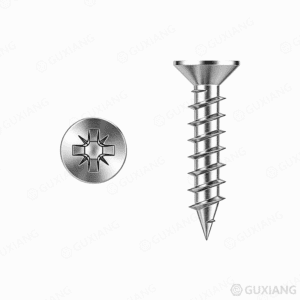

A chipboard screw is a wood screw engineered for engineered wood—particle board, MDF, OSB, and other composite panels whose internal structure is glued chips or fibers, not continuous grain. A standard wood screw in particle board tears the material. A chipboard screw grips it.
The key differences from a general-purpose wood screw: a narrower core diameter to reduce splitting in low-density panels, a full thread from tip to head for maximum engagement along every millimeter of embedment depth, self-countersinking ribs under the head that mill a clean seat into the board surface, and a case-hardened shank that survives the higher driving torque of dense composite panels without snapping or cam-out.
The narrow core shank and sharp gimlet point let the screw enter particle board and MDF without a pilot hole—the thread pushes material aside rather than splitting it. As the head nears the surface, four to six raised ribs on the countersunk underside mill a conical recess, seating the head flush without a pre-drilled countersink.
The thread flanks are asymmetric: a steep load flank resists pull-out in low-density board (600–700 kg/m³); a shallow clearance flank reduces driving friction. A double-start thread halves the rotations to full seating—on a cabinet line installing 30 screws per unit, the time saved compounds.
| Type | Description | Best For |
|---|---|---|
| Single Thread | One continuous thread at the full pitch | Maximum grip in low-density board; slower to drive |
| Double Thread (Twin-Start) | Two independent threads at double the effective lead | Faster driving in medium-density board; balance of speed and grip |
| Hi-Lo Thread | Alternating high and low thread crests | Gripping thin panels (12 mm and under) without splitting |
| Serrated Thread | Fine notches along the thread crest that saw through the material during driving | Dense MDF and HDF where a smooth thread struggles to cut its own path |
The double thread is the default for furniture assembly: it drives faster than single-start without sacrificing enough grip to matter in standard 15–18 mm particle board. Hi-Lo thread variants are reserved for thin shelving panels and drawer bottoms where every cubic millimeter of retained material counts.
| Style | Features | Use |
|---|---|---|
| Countersunk with Ribs | Tapered underside with raised self-countersinking ribs | Standard for flat-pack furniture, cabinet assembly |
| Countersunk without Ribs | Clean taper, no ribs | Pre-countersunk holes; the ribs would mar a finished surface |
| Pan Head | Flat underside, domed top | Mounting hardware brackets and hinges where a flush seat isn’t needed |
| Washer Head / Flange Head | Countersunk with an integral washer face | Thin sheet-metal brackets sitting on particle board; the washer face distributes clamp load |
The self-countersinking rib pattern matters more than it looks. Four ribs are common on smaller diameters (3.0–4.0 mm). Six ribs appear on 4.5–6.0 mm screws where more material must be displaced to seat the larger head.
| Drive | Characteristics |
|---|---|
| Pozi (PZ) | Dominant in European furniture hardware. PZ2 is the standard for 4.0–5.0 mm chipboard screws. Better engagement than Phillips; still cams out under high torque if the bit wears. |
| Torx (T) | Growing share in premium furniture. T15 and T20 are common. No cam-out: the drive transfers torque until the screw snaps or the bit shatters. |
| Phillips (PH) | Legacy, declining. PH2 slips under the high driving torque of dense MDF. Still common on consumer blister packs sold at retail. |
Production furniture lines have moved to Torx. The cost difference per screw is fractions of a cent, but the elimination of cam-out reduces assembly-line stoppages, stripped screws, and rework.
Case-Hardened Steel The base material is medium-carbon steel with a carburized case. The core stays ductile to resist snapping. The case hardness provides thread wear resistance and prevents the drive recess from rounding under torque. Surface hardness typically in the range where a file skates—roughly 450 HV minimum.
Zinc Plating Yellow zinc (yellow passivated) is the industry standard. It provides indoor corrosion resistance for furniture that lives in climate-controlled rooms. White zinc and blue zinc variants exist for decorative hardware where the yellow tint is undesirable. Salt-spray life of standard zinc plating without supplementary coating is limited—roughly 48–96 hours to white corrosion, depending on plating thickness.
Galvanized (Hot-Dip) For outdoor particle board and MDF screws used in garden sheds, outdoor furniture, and construction hoardings. The coating is thicker than electroplated zinc, typically 45–85 µm, and provides outdoor corrosion resistance measured in years rather than hours. The trade-off: the thick coating changes the effective thread diameter, so screws must be manufactured undersized to compensate.
Stainless Steel A2/A4 Available for outdoor furniture and marine-grade MDF applications. Stainless chipboard screws are less common than steel due to cost and the higher failure rate of the self-countersinking ribs—stainless work-hardens faster than carbon steel during the heading process, and the ribs can crack if the forming die isn’t conditioned frequently.
Wax Coating Most chipboard screws carry a wax or dry-film lubricant. The wax reduces driving torque on dense MDF by reducing friction between the thread flank and the panel material. Without wax, the screw can seize partway and the drive cam-out strips the recess. A screw with wax drives smoothly to final seating; the same screw without wax might stop with 2 mm of head still above the surface, requiring a finishing turn with a manual screwdriver.
| Diameter (mm) | Length Range (mm) | Common Drive | Typical Panel Thickness |
|---|---|---|---|
| 3.0 | 12–40 | Pozi PZ1, Torx T10 | Thin MDF (6–12 mm), drawer bottoms, back panels |
| 3.5 | 16–50 | Pozi PZ2, Torx T15 | Standard shelving (12–18 mm), cabinet components |
| 4.0 | 20–70 | Pozi PZ2, Torx T20 | Main cabinet assembly (15–18 mm), hinge mounting |
| 4.5 | 25–80 | Pozi PZ2, Torx T20 | Heavy shelving (18–25 mm), bed frames |
| 5.0 | 30–100 | Pozi PZ2, Torx T25 | Structural joints, post-to-rail connections |
| 6.0 | 40–200+ | Pozi PZ3, Torx T30 | Timber-to-particle-board, heavy-duty framing |
Length selection rule for particle board: The screw should penetrate at least two-thirds of the panel thickness in edge-to-face joints. For a 18 mm panel, that means a 16–18 mm embedment length. The screw length equals the penetration depth plus the thickness of the attached piece plus 2–3 mm for the self-countersink.
Flat-Pack Furniture The near-universal fastener in RTA (ready-to-assemble) furniture: bookcases, wardrobes, desks, TV units, and bed frames. A typical six-drawer chest uses roughly 60–80 chipboard screws. The cam-and-dowel connection handles alignment; the chipboard screw handles structural clamping between panels. Both are needed—a cam without a screw leaks racking stiffness; a screw without a cam leaves panels misaligned.
Kitchen Cabinets Face frames, hinge mounting plates, drawer slides, and corner gussets are assembled with chipboard screws. The wax coating is mandatory here—kitchen cabinet MDF and chipboard run dense (typically 680–750 kg/m³ for moisture-resistant board), and an unwaxed screw galls before seating. Cabinetmakers switching from manual screwdriver to impact driver on unwaxed screws learn this in the first ten minutes of assembly.
Exhibition and Shopfitting Trade-show booths, retail display units, and pop-up-shop fixtures are assembled and disassembled repeatedly. Chipboard screws with Torx drive survive multiple assembly cycles where Pozi recesses strip. A reusable display unit assembled four times a year over five years logs 20 screw cycles—Pozi fails at roughly 8–12 cycles in particle board; Torx survives the full run.
DIY and Home Improvement Consumer blister-pack chipboard screws are stocked at every hardware retailer. The typical pack: 200-piece assortment of 3.5–4.5 mm yellow zinc with Pozi drive. For the consumer market, Pozi dominates because Pozi bits ship with every flat-pack furniture kit and every consumer drill.
| Decision | What to Ask | Guidance |
|---|---|---|
| 1. Panel density | MDF or particle board? | Dense MDF (700+ kg/m³) needs a sharp point and wax coating to seat fully. Low-density particle board (600 kg/m³) is forgiving—standard zinc-plated screws work. |
| 2. Thread type | Speed or grip? | Double thread for production speed on standard panels. Single thread where grip matters more than cycle time. Hi-Lo for panels under 15 mm. |
| 3. Drive | Production or one-time assembly? | Torx for production and repeated assembly. Pozi for one-time DIY. The difference is reusability. |
| 4. Coating | Indoor or outdoor? | Yellow zinc for indoor furniture. Galvanized for outdoor sheds and garden furniture. Stainless A2 for coastal or high-humidity outdoor use. |
| 5. Length | Panel thickness and joint type? | Face joint: penetration ≥ two-thirds panel thickness. Edge joint: screw length ≤ panel thickness to avoid breakout. |
Do I need a pilot hole for chipboard screws? Not for standard particle board and MDF with screws up to 5.0 mm. For 6.0 mm screws, drill a 3.0–3.5 mm pilot to prevent splitting. For melamine-faced board, a pilot hole prevents the surface layer from lifting ahead of the screw thread.
Can chipboard screws be removed and reinserted? Once or twice in particle board. The formed thread in the panel crumbles with each removal cycle. After 2–3 cycles, the hole is oversized and the screw spins. Fill the hole with wood glue and a toothpick, let cure, and re-drive the screw—or use a threaded insert for reusable joints.
What is the difference between a chipboard screw and a drywall screw? A chipboard screw has a narrower core, sharper point, and self-countersinking ribs; a drywall screw has a bugle head that compresses drywall paper without tearing, and a phosphate finish for drywall compound adhesion. Swap them and the chipboard screw rips drywall paper while the drywall screw splits particle board.
Are stainless steel chipboard screws worth the cost? For outdoor furniture and coastal installations—yes. For indoor furniture—no. The cost premium of roughly 3–5× over yellow zinc is wasted on a wardrobe that never sees moisture. Use stainless only where the environment demands it.
Why do some chipboard screws have a cutting notch at the tip? The notch, often called a Type 17 point or a saw-tooth tip, cuts a clean entry hole in the panel surface. This reduces the wedging action of the screw entering the panel and lowers the risk of splitting, especially near the edge of the board.
What torque should I use for chipboard screws? Set the clutch on the drill low—position 6–10 on a standard 20-position clutch for 4.0 mm screws in particle board. The correct torque seats the head flush with a single self-countersink rotation. If the clutch clicks and the head is still proud, increase by one position and try again. Impact drivers without a clutch easily bury the screw 3–5 mm below the surface.
Social Chat is free, download and try it now here!