





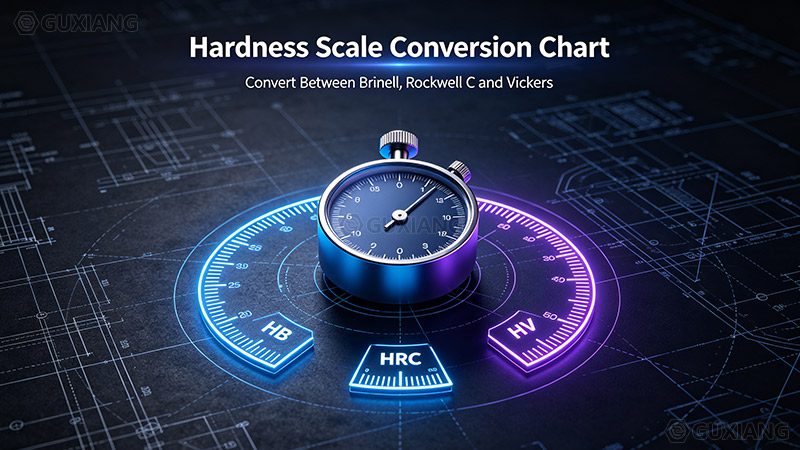
कठोरता स्थानीयकृत प्लास्टिक विरूपण के लिए एक सामग्री के प्रतिरोध को मापता है। फास्टनर, machined भागों, और हीट-ट्रीटेड स्टील्स के लिए, तीन सबसे व्यापक रूप से इस्तेमाल किए गए तराजू Brinell (HB), रॉकवेल सी (HRC), और विकर्स (HV) हैं। क्योंकि प्रत्येक परीक्षण एक अलग शारीरिक प्रतिक्रिया को मापता है, पैमाने के बीच रूपांतरण हमेशा एक अनुमान है। यह पृष्ठ ASTM E140 / ISO 18265 संदर्भ डेटा के आधार पर एक पूर्ण HB-HRC-HV रूपांतरण चार्ट प्रदान करता है, साथ ही साथ एक इंटरैक्टिव कठोरता कनवर्टर और तन्य शक्ति अनुमान।.
एक नज़र में तीन कठोरता स्केल
कठोरता कनवर्टर उपकरण
कठोरता रूपांतरण तालिका
दो संदर्भ तालिकाएं प्रदान की जाती हैं: पहला एचआरसी को एचवी और एचबी प्रति ASTM E140 (गैर-ऑस्टेनिटिक स्टील्स) में परिवर्तित करता है; दूसरा एचबी को HRC, HRB, HV और लगभग तन्य शक्ति प्रति ISO 18265-आधारित डेटा में परिवर्तित करता है। एचबीएस एक स्टील बॉल इंडेंटर को संदर्भित करता है, एचबीडब्ल्यू को टंगस्टन कार्बाइड बॉल इंडेंटर को संदर्भित करता है। Parentheses में मूल्य मानक परीक्षण रेंज के बाहर संदर्भ मूल्यों को अतिरिक्त रूप से अलग किया जाता है।.
सामग्री कठोरता संदर्भ रेंज
सामान्य सामग्री परिवारों के लिए विशिष्ट कठोरता मूल्यों को समझना संदर्भ में रूपांतरण परिणामों की व्याख्या करने में मदद करता है, खासकर जब कटिंग टूल्स और गर्मी उपचार लक्ष्य का चयन करता है।.
| सामग्री / टूल श्रेणी | कठोरता रेंज (HV) | विशिष्ट अनुप्रयोग |
|---|---|---|
| हीट-ट्रीटेड स्टील | ~1,000 तक | क्वेंच्ड एंड टेम्पर्ड मशीन भागों, उच्च शक्ति फास्टनर |
| टंगस्टन कार्बाइड - हार्ड ग्रेड | 1,700 – 1,900 | स्थिर परिस्थितियों में निरंतर मोड़ |
| टंगस्टन कार्बाइड - संतुलित ग्रेड | 1,500 – 1,700 | कम अनुकूल परिस्थितियों में टर्निंग, grooving |
| टंगस्टन कार्बाइड - कठिन ग्रेड | 1,300 – 1,500 | मिलिंग, पार्टिंग ऑफ, बाधित कट मोड़ |
| सिरेमिक आवेषण | 2,100 – 2,400 | 55 एचआरसी तक मशीनिंग स्टील हीट ट्रीटेड, उच्च तापमान मिश्र धातु |
| CBN आवेषण | 4,500 – 5,000 | Machining steel heat treated to 50-70 HRC |
| PCD inserts | 5,000 – 6,000 | High-speed machining of aluminum and non-ferrous alloys |
Understanding the Hardness Scales
Brinell (HB / HBS / HBW)
Presses a 10 mm ball under a 3000 kgf load and measures the indentation diameter. The advantage is that the whole hardness range is covered on one scale. HBS uses a steel ball (softer materials), HBW uses a tungsten carbide ball. Values from 100 HB (soft) to 650 HB (heat-treated steel) are common for machined materials.
रॉकवेल सी (एचआरसी)
Presses a diamond cone under a 150 kgf load and measures penetration depth. The most common scale for listing hardness of machined and heat-treated steel, typically 10-65 HRC. Below about 180 HB you must switch to the Rockwell B (HRB) scale. Fast and repeatable, ideal for production quality control.
विकर्स (एचवी)
Presses a square-based diamond pyramid under a light load and measures the indentation area. The HV number equals force divided by area. Because the indentation is tiny, HV suits thin sections, surface layers, and very hard materials. Standard scale for carbide grades (1,300-2,000 HV) and advanced cutting materials.
Hardness and Tensile Strength
For carbon and alloy steels, tensile strength approximates 3.45 x HB (N/mm²). The HB-to-tensile column in the second table follows this relationship. This approximation is widely used in fastener specifications and material selection, but should be validated by tensile testing for final certification.
Hardness Conversion Tips
सर्वश्रेष्ठ अभ्यास
- State the reference standard (ASTM E140 / ISO 18265) whenever you quote a converted hardness value
- Conversion is an approximation — typical tolerance is +/-2 HRC or +/-10 HB between charts
- Use HRC for production testing of hardened steel; switch to HRB below ~180 HB equivalent
- Use HV for thin parts, surface-hardened layers, coatings, and carbide/cutting materials
- Use HB for softer materials and when a single continuous scale is preferred
- Do not apply steel-based conversion tables to aluminum, copper, austenitic stainless, or cast iron
- For fasteners, verify both hardness and tensile/proof load per ISO 898-1, not hardness alone
- Round converted values sensibly — reporting 40 HRC as 392 HV is more honest than 391.7 HV
अक्सर पूछे जाने वाले प्रश्न
HB (Brinell) presses a steel or tungsten carbide ball into the material and measures the indentation diameter. HRC (Rockwell C) measures the depth of penetration of a diamond cone indenter under a 150 kgf load. HV (Vickers) measures the surface area of a square-based diamond pyramid indentation. Brinell covers the whole scale and suits softer materials, Rockwell C is most common for hardened steels (10-65 HRC), and Vickers is preferred for thin materials, hard coatings, and carbide grades.
Use the conversion tables on this page. For example, 40 HRC corresponds to approximately 371 HB and 392 HV per ASTM E140 reference data. Because hardness scales measure different physical responses, conversion is always an approximation with a tolerance of about +/-2 HRC or +/-10 HB. Use the interactive converter on this page for any value between 21 and 68 HRC.
Hardness conversion values depend on the reference standard (ASTM E140, ISO 18265, SAE J417) and on the material family being tested. Different standards use different empirical datasets and fitting methods, so small differences of a few HV or HB units between charts are normal. For critical specifications, always state which standard the conversion is based on.
For carbon and alloy steels, tensile strength can be approximated from Brinell hardness: Tensile Strength (N/mm²) ≈ 3.45 x HB. For example, 300 HB corresponds to approximately 1020 N/mm². This approximation is widely used in fastener and steel specifications, but becomes less accurate for heat-treated, cold-worked, or non-ferrous materials.
No. The tables on this page apply to non-austenitic carbon and alloy steels (and to a lesser extent cast iron). Austenitic stainless steels, aluminum alloys, copper alloys, and other non-ferrous metals follow different conversion relationships and require material-specific tables from the applicable standard.
प्रति ISO 898-1, आम बोल्ट संपत्ति वर्गों में विशिष्ट कठोरता रेंज हैं: कक्षा 8.8 लगभग 22-32 HRC (लगभग 238-302 HV), कक्षा 10.9 लगभग 32-39 HRC (लगभग 310-370 HV), और कक्षा 12.9 लगभग 39-44 HRC (लगभग 375-430 HV)। कठोरता परीक्षण उच्च शक्ति फास्टनर के लिए तन्यता और प्रूफ लोड परीक्षण के साथ एक महत्वपूर्ण स्वीकृति मानदंड है।.
Use Vickers when testing thin sections, surface-hardened layers, coatings, or very hard materials such as carbide (1,300-2,000 HV), ceramics (2,100-2,400 HV), CBN (4,500-5,000 HV), and PCD (5,000-6,000 HV). Vickers uses a light load and produces a tiny indentation, making it suitable for finished parts. Rockwell C is faster and preferred for bulk hardness of machined and heat-treated steel components.