



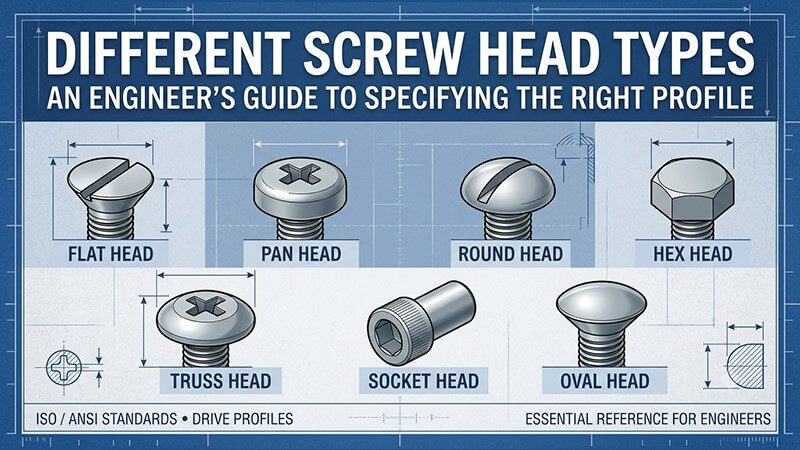
एक नज़र में स्क्रू हेड टाइप - क्विक-रिफरेंस तुलना चार्ट
स्क्रू हेड प्रकार एक फास्टनर के बाहरी प्रोफाइल हैं - जैसे पैन, फ्लैट (काउंटर्संक), बटन, ट्रस, हेक्स और सॉकेट कैप - जो फ्लश फिट, असर क्षेत्र, टोक़ क्षमता और कंपन प्रतिरोध को निर्धारित करते हैं। नीचे दिए गए चार्ट प्रोफाइल, कॉमन ड्राइव, ठेठ अनुप्रयोग और शासी द्वारा 16 सामान्य प्रकारों की तुलना करता है। DIN/ISO/ANSI मानक.
यदि आप इस पृष्ठ से केवल एक चीज को याद करते हैं, तो यह तालिका बनाती है। यह “स्क्रू हेड टाइप चार्ट” के लिए चित्रित स्निपेट जीतने के लिए बनाया गया है और डिजाइन समीक्षा के दौरान डेस्क संदर्भ के रूप में सेवा करने के लिए बनाया गया है। प्रत्येक पंक्ति जोड़े हेड टाइप अपने प्रोफ़ाइल वर्ग के साथ, आप जो ड्राइव आमतौर पर देखेंगे, एक ठेठ अनुप्रयोग, और शासी मानक। इसे बुकमार्क करें।.
| हेड टाइप | प्रोफ़ाइल | कॉमन ड्राइव | विशिष्ट अनुप्रयोग | मानक (मानक)DIN/ISO/ANSI) |
|---|---|---|---|---|
| पैन | Non-countersunk | फिलिप्स, Pozi, Torx, Slotted | सामान्य प्रयोजन शीट धातु, उपकरण | DIN 7985 / ISO 7045 / ASME B18.6.3 |
| फ्लैट / काउंटरसंक | काउंटरसंक | फिलिप्स, Torx, Slotted | एयरोस्पेस, फ्लश फिट की आवश्यकता वाली सतहों | DIN 965 / ISO 7046 (90°); ASME B18.6.3 (82°) |
| ओवल / उठाया काउंटरसंक | काउंटरसंक | फिलिप्स, Slotted | सजावटी ट्रिम, अलमारियाँ | DIN 964 / ISO 7719 |
| बुगल | काउंटरसंक | फिलिप्स, Torx | ड्राईवॉल, सॉफ्टवुड सेल्फ-सेटिंग | मालिकाना (कोई सार्वभौमिक std) |
| बटन | Non-countersunk | हेक्स (Allen), Torx | कम प्रोफ़ाइल सौंदर्य, साइकिल, फर्नीचर | ISO 7380-1 / DIN 7380 |
| हेक्स / हेक्स कैप | Non-countersunk | बाहरी रिंच | स्ट्रक्चरल, उच्च प्रीलोड | DIN 933 / 931 / ASME B18.2.1 |
| सॉकेट कैप (Allen) | Non-countersunk | आंतरिक हेक्स | सटीकता मशीनरी, तंग जगह | DIN 912 / ISO 4762 |
| ट्रस / मशरूम | Non-countersunk | फिलिप्स, Torx | पतली शीट, पुल-थ्रू प्रतिरोध | मालिकाना / DIN 7982 परिवार |
| फ्लैंज / हेक्स वॉशर | Non-countersunk | बाहरी रिंच, Torx | कंपन जोड़ों, एकीकृत वॉशर | DIN 6921 / ISO 4162 |
| गोल | Non-countersunk | Slotted, फिलिप्स | पारंपरिक, बहाली | ASME B18.6.3 |
| फिलर | Non-countersunk | स्लॉटयुक्त | उच्च-टॉर्क, गहरी स्लॉट | DIN 84 / ISO 1207 |
| पनीर | Non-countersunk | स्लॉटयुक्त | उपकरण, उथले हेडरूम | DIN 84 परिवार / ISO 1207 |
| बाइंडिंग | Non-countersunk | Slotted, फिलिप्स | विद्युत टर्मिनल, तार क्लैंप | ASME B18.6.3 |
| कैरिज | Non-countersunk | बाहरी रिंच (वर्ग गर्दन) | लकड़ी से धातु, विरोधी स्पिन | DIN 603 / ISO 8677 |
| कंधे | Non-countersunk | हेक्स सॉकेट | पिवट, गाइड, धुरी | DIN 7379 / ISO 7379 |
| सुरक्षा (पिन-टोरेक्स, त्रि विंग) | विशेषता | छेड़छाड़ प्रतिरोधी | सार्वजनिक उपकरण, विरोधी चोरी | मालिकाना / ANSI |
क्यों सिर आकार संयुक्त प्रदर्शन Dictates
प्रत्येक स्क्रू सिर दो मैक्रो-क्लास में से एक है: काउंटरसंक (सतह के साथ नीचे की ओर या फ्लश) या गैर-countersunk (The head protrudes). वह एकल द्विआधारी पांच संयुक्त व्यवहार को चलाता है, और उन्हें समझने के लिए एक संयुक्त के बीच अंतर है जो रहता है और एक जो विफल रहता है।.
स्क्रू हेड्स के विभिन्न प्रकार क्या हैं?
विभिन्न प्रकार के स्क्रू हेड चार परिवारों में आते हैं - काउंटरसंक (फ्लैट, अंडाकार, बकल), गैर-काउंटरंक (pan, बटन, ट्रस, हेक्स, सॉकेट कैप), बाहरी ड्राइव (hex, फ्लैंज) और विशेषता (कैरिज, कंधे, सुरक्षा, grub)। प्रत्येक परिवार के व्यापार क्षेत्र, टॉर्क क्षमता, या छेड़छाड़ प्रतिरोध के लिए फ्लश फिट होते हैं, इसलिए सही विकल्प यह निर्भर करता है कि संयुक्त क्या करना चाहिए।.
पांच व्यवहार इस द्विआधारी नियंत्रण:
लोड असर - एक काउंटरसंक हेड एक शंक्वाकार सीट के माध्यम से क्लैंप बल को स्थानांतरित करता है, रिम पर लोड को केंद्रित करता है; एक पैन या ट्रस हेड एक फ्लैट नीचे की ओर क्लैंप करता है, जो व्यापक पदचिह्न पर लोड को फैलाता है।.
क्लीयरेंस और स्नैग - फ्लश हेड भागों को एक दूसरे के पास स्लाइड करते हैं और हाथ या चलती घटकों पर पकड़ने से बचने, कन्वेयर किनारों और चलने वाली सतहों पर महत्वपूर्ण होते हैं।.
दिखावट - उपभोक्ता और वास्तुशिल्प उत्पाद अक्सर एक स्वच्छ, अदृश्य फास्टनर की मांग करते हैं।.
विधानसभा की गति - प्रोट्रूडिंग हेड तेजी से ड्राइव करते हैं क्योंकि कोई काउंटरसिंक ऑपरेशन या गहराई नियंत्रण नहीं है।.
कंपन प्रतिरोध - नीचे अनुप्रयोग अनुभाग में कवर किया गया।.
जब इंजीनियर पूछते हैं zस्क्रू सिर के विभिन्न प्रकार, वे वास्तव में पूछ रहे हैं कि इन पांच व्यवहारों में से कौन सा प्राथमिकता है। कोई भी सिर हर संयुक्त में बाकी को हराता है - सही पिक वास्तव में आपके संयुक्त के बारे में निर्भर करता है। एक सिर जो एक स्ट्रक्चरल स्टील बेस प्लेट ( हेक्स कैप) के लिए एकदम सही है, एक पतली एल्युमिनियम बाड़े (ट्रस या बटन) के लिए गलत है, और दोनों एक फ्लश विमान त्वचा (काउंटर्संक) के लिए गलत हैं।.
काउंटरसंक (फ्लश) हेड टाइप
ये काउंटरसंक स्क्रू सिर प्रकार - फ्लैट, अंडाकार, और बकल - एक शंक्वाकार सीट साझा करते हैं लेकिन गुंबद और अनुप्रयोग में भिन्न होते हैं। परिभाषित पैरामीटर है काउंटरसिंक कोणASME B18.6.3 (इंच / यूएस श्रृंखला) बनाम 90 ° (और पतली शीट के लिए 100 °) के तहत DIN/ISO मीट्रिक मानकों के तहत।. एक 90 डिग्री छेद के साथ एक 82° स्क्रू मिलाने से सिर पर गर्व हो जाता है और आसपास के सामग्री को क्रैक करता है; कोण विनिमेय नहीं होते हैं, एक बिंदु जिसे हम मानकों अनुभाग में संशोधित करते हैं।.
फ्लैट / काउंटरसंक हेड
फ्लश फास्टनिंग का वर्कहॉर्स। एक फ्लैट हेड सीट फ्लश, जो वायुगतिकीय सतहों, चलने वाली सतहों और मूविंग-पार्ट इंटरफेस के लिए एक चिकनी विमान आदर्श छोड़ देता है। DIN 965 / ISO 7046 मीट्रिक स्लॉट / फिलिप्स संस्करण को कवर करता है; DIN 7991 / ISO 10642 मीट्रिक सॉकेट (Allen) काउंटरसंक हेड को कवर करता है। एक “फ्लैट अंडरकट” संस्करण पतली सामग्री के लिए सिर मोटाई को कम करता है।.
कमजोरी: कम असर वाले क्षेत्र का मतलब है कि नरम सब्सट्रेट में खराब पुल-थ्रू प्रतिरोध - हमारी उद्घाटन कहानी में सटीक विफलता मोड। जब सब्सट्रेट पतली प्लाईवुड या मुलायम एल्युमिनियम होता है, तो एक फ्लैट हेड एक पैन या ट्रस हेड से पहले लंबे समय तक फाड़ देगा।.
ओवल / उठाया काउंटरसंक हेड
एक ओवल हेड सतह के ऊपर कम सजावटी गुंबद के साथ एक काउंटरसंक हेड है। यह कैबिनेटरी और विंटेज हार्डवेयर (DIN 964 / ISO 7719) में आम एक समाप्त शीर्ष के साथ नीचे एक फ्लश देता है। जब उपस्थिति मायने रखती है, लेकिन आपको अभी भी सामने से भाग में गायब होने के लिए सिर की जरूरत है। उठाया प्रोफ़ाइल एक परिष्कृत रूप को रखते हुए एक शुद्ध फ्लैट हेड की तुलना में थोड़ा अधिक असर वाला क्षेत्र भी देता है।.
Bugle हेड
एक बकल हेड में एक घुमावदार, स्वयं-सेटिंग शंकु है जो एक काउंटरसिंक ऑपरेशन के बिना लोड को वितरित करता है। यह मानक ड्राईवॉल स्क्रू सिर है और सॉफ्टवुड और प्लास्टरबोर्ड में काम करता है क्योंकि वक्र अधिक मेहनत और फाड़ को रोकता है। कोई सार्वभौमिक मानक इसे नियंत्रित नहीं करता है; आयाम बड़े पैमाने पर निर्माताओं के लिए मालिक हैं। बगले का लाभ यह है कि यह सही गहराई तक स्वयं सेट होता है, यही कारण है कि ड्राईवॉल चालक पूर्व ड्रिलिंग के बिना सैकड़ों घंटे ड्राइव कर सकते हैं।.
गैर-Counterunk (Protruding) प्रमुख प्रकार
काउंटरसंक बनाम पैन हेड क्लासिक फ्लश बनाम-प्रोट्रूडिंग ट्रेड-ऑफ है: एक काउंटरसंक हेड फ्लश बैठता है लेकिन कम असर वाले क्षेत्र प्रदान करता है, जबकि एक पैन हेड प्रोट्रूड अभी तक एक व्यापक पदचिह्न को दबाता है और पतली सामग्री में बेहतर पुल-थ्रू का विरोध करता है। यह सबसे बड़ा परिवार है और अक्सर गलत-निर्दिष्ट होता है। असर क्षेत्र, गति और टॉर्क क्षमता के लिए प्रोट्रूडिंग हेड ट्रेड फ्लश फिट। अधिकांश वाणिज्यिक उत्पाद के लिए, एक गैर-काउंटरसंक हेड सुरक्षित डिफ़ॉल्ट है।.
पैन हेड
सामान्य उद्देश्य “workhorse”। एक पैन हेड में थोड़ा गोल शीर्ष और एक फ्लैट असर वाले चेहरे के साथ एक कम डिस्क आकार होता है। यह उपकरणों, शीट धातु और इलेक्ट्रॉनिक्स के लिए डिफ़ॉल्ट है क्योंकि यह डूबने के बिना एक व्यापक क्षेत्र को क्लैंप करता है। DIN 7985 / ISO 7045 (मीट्रिक) और ASME B18.6.3 (इंच) इसे कवर करते हैं। पैन हेड बनाम फ्लैट हेड स्क्रू बहस आमतौर पर पैन के पक्ष में हल होती है जब भी सतह को फ्लश करने की आवश्यकता नहीं होती है - और अधिकांश सतह नहीं होती है।.
बटन हेड
एक बटन हेड एक कम, चौड़ा, गोल गुंबद है - एक साइकिल स्टेम या लैपटॉप बाड़े पर स्क्रू का विचार। यह साफ दिखता है और snagging का विरोध करता है। ISO 7380-1 / DIN 7380 सॉकेट बटन हेड को कवर करता है। जब आप एक दृश्यमान लेकिन अविभाज्य फास्टनर चाहते हैं तो यह सौंदर्य विकल्प है, और सॉकेट वेरिएंट अपने निम्न प्रोफाइल के तात्पर्य की तुलना में कहीं अधिक टोक़ रखता है।.
राउंड हेड
एक slotted या फिलिप्स ड्राइव के साथ एक पारंपरिक गुंबददार सिर, बहाली और विरासत विधानसभाओं में आम (ASME B18.6.3)। यह अच्छा असर क्षेत्र और एक क्लासिक देखो प्रदान करता है लेकिन नए डिजाइनों में पैन और बटन हेड्स द्वारा विस्थापित किया जा रहा है क्योंकि स्लॉट ड्राइव्स पावर टूल्स के तहत कैम आउट करते हैं।.
ट्रस / मशरूम हेड
ट्रस हेड पतली शीट असेंबली का नायक है। इसके अतिरिक्त, कम प्रोफ़ाइल गुंबद किसी भी मानक सिर के सबसे बड़े पदचिह्न में क्लैंप लोड फैलता है, नाटकीय रूप से पुल-थ्रू प्रतिरोध को बढ़ाता है। यदि आपने कभी पतले गेज स्टील के माध्यम से एक स्क्रू को फाड़ दिया है, तो आपको एक ट्रस हेड की आवश्यकता है। यह एचवीएसी डक्टवर्क, इलेक्ट्रिकल बॉक्स और किसी भी छिद्रित और फोल्डेड बाड़े के लिए पहली पसंद है।.
फिलर और बेलनाकार हेड
दोनों उच्च टॉर्क के लिए गहरे स्लॉट के साथ लंबे सिर हैं। एक fillister एक बेलनाकार पक्ष और एक गोल शीर्ष (DIN 84/ISO 1207) है; एक बेलनाकार हेड एक फ्लैट शीर्ष के साथ एक छोटा सिलेंडर है, जिसका नाम इसके व्हील-ऑफ-चेज़ सिल्हूट के लिए रखा गया है। दोनों सूट इंस्ट्रूमेंट्स और स्थानों के साथ उथले अक्षीय हेडरूम लेकिन उच्च कसने की मांग - गहरी स्लॉट एक फ्लैट ब्लेड ड्राइवर को स्ट्रिपिंग के बिना हार्ड काट देता है।.
बाइंडिंग हेड
एक बाध्यकारी सिर एक कम, चौड़ा पैन संस्करण है जिसमें सिर के नीचे एक छोटा सा अंडरकट होता है, मूल रूप से तार बंडलों और विद्युत टर्मिनलों को क्लैंप करने के लिए। यह सिर को इन्सुलेशन काटने से रोकता है और अभी भी पैनल और टर्मिनल ब्लॉक असेंबली में निर्दिष्ट है जहां एक फंसे हुए कंडक्टर को nicked नहीं होना चाहिए।.

हेक्स और बाहरी ड्राइव हेड प्रकार
जब टॉर्क प्राथमिकता है, तो आप आंतरिक ड्राइव को पीछे छोड़ देते हैं और बाहरी होते हैं। ये सिर किनारे से एक रिंच या सॉकेट लेते हैं और कैटलॉग में उच्चतम प्रीलोड तक पहुंचते हैं।.
हेक्स हेड / हेक्स कैप स्क्रू
A [hex cap screw](/hex-cap-screws) takes a wrench or socket from the side, delivering the highest achievable preload of any standard head. DIN 933 (full thread) / DIN 931 (partial thread) and ASME B18.2.1 govern hex cap screws. Hex cap screws are the structural default for steel frames, machinery bases, and any joint where preload defines the design. The partial-thread DIN 931 variant keeps the unthreaded shank in the shear plane for maximum strength.
Hex Washer / Flange Head
A flange head integrates a built-in washer, widening the bearing face and resisting loosening under vibration. DIN 6921 / ISO 4162 covers serrated flange bolts. Specify flange heads where you want a washer captive and a joint that survives dynamic load — the serrations bite into the clamped surface and add a mechanical lock.
Socket Cap (Allen) Head
The socket cap head carries an internal hex and reaches high strength in a small envelope — DIN 912 / ISO 4762. It is the precision-machinery standard: maximum clamp in minimum radial space, with no side clearance needed for a wrench. Where pan head vs flat head screw is about flush fit, socket cap vs hex is about space and strength: socket cap fits where a wrench cannot swing.
Specialty & Security Head Types
These heads solve narrow problems: anti-spin, pivot, captive retention, or tamper resistance. They rarely appear in a general catalog but are decisive in their niches.
Carriage / Square Undercut Head
A carriage screw has a round head and a square neck that bites into wood or punched metal, preventing rotation during tightening (DIN 603 / ISO 8677). Classic for wood-to-metal and gate hardware, where you can tighten from one side only.
Shoulder Screw
A shoulder screw has a precision ground shoulder beneath the head acting as a pivot, axle, or guide (DIN 7379 / ISO 7379). The head is usually a small hex socket; the shoulder — not the thread — carries the locating function. These are the unsung heroes of hinges, pulleys, and linear guides.
Captive Screw
A captive screw is retained in a panel so it cannot drop into sensitive equipment — required in aerospace and medical devices. The head is often a slotted or hex socket with a retaining feature under the head that snaps into a threaded insert.
Security (Tamper-Resistant) Heads
Pin-Torx, Tri-Wing, and Spanner heads defeat standard drivers to stop public tampering of enclosures and fixtures. They trade serviceability for theft and vandalism resistance — a deliberate penalty you accept on public infrastructure.
Grub / Set Screw
A grub screw is headless, driven by an internal hex or Torx, and used to lock collars, pulleys, and shafts by point pressure. There is no head profile to speak of — its job is pure clamping, not bearing.
Matching Screw Head Types to Applications
heory is useless until it meets a real joint. Here is the field guide, with the measured numbers that settle arguments.
Thin Sheet & Metal Fabrication
Thin gauge tears easily. Use truss for maximum pull-through area, hex washer/flange for vibration-prone panels, or pan for general closure. Avoid flat heads — they punch through. For sourced product, see our sheet metal screws range. In 0.8 mm steel, a truss head’s wide footprint can triple the pull-through load of a flat head of equal diameter.
Woodworking & Joinery
Wood needs a head that sits flush or self-sets. Flat countersunk for face frames, bugle for drywall and softwood, raised/oval countersunk for visible trim. A mini-test from Prince Fastener measured a Pan #8 screw holding 18–22% more pull-through resistance in ½” plywood than a Flat head of the same size — useful when the wood is thin and the clamp must not break out. The pan head’s flat underside simply grabs more wood.
High-Torque & Structural Assembly
Maximum preload demands hex cap (wrench access) or socket cap (tight space). There is no substitute; internal-drive protruding heads cap out far below hex torque limits. A 12.9 socket cap in M10 reaches preloads that would twist the head off a pan screw.
Exposed / Aesthetic Components
Clean visible fasteners mean button, raised countersunk/oval, or socket cap with a finished cap. Avoid slotted round heads in consumer products unless the look is intentional — they read as dated and strip easily.
Vibration-Prone Joints
This is where our opening failure came from. For vibration, specify socket cap + thread-locking या flange head with serrations. A flush countersunk head in a vibrating joint is the wrong call unless the surface truly must be flush — and even then, add a locking element. The countersunk seat gives the screw nothing to grip against rotational slip.
Building a bill of materials for a vibration-sensitive product? Our engineering desk will recommend head, drive, and locking scheme together — [0].
| [0] | First Choice | Backup | Avoid |
|---|---|---|---|
| Thin sheet metal | ट्रस | Hex washer | Flat / countersunk |
| Hardwood joinery | Bugle / Flat countersunk | Oval countersunk | गोल |
| स्ट्रक्चरल इस्पात | Hex cap | Socket cap | पैन |
| Aesthetic enclosure | बटन | Socket cap | Slotted round |
| Vibrating machinery | Flange / Socket cap + Loctite | Nyloc nut | Plain countersunk |
Engineering Selection Framework — How to Choose the Right Screw Head
Six criteria govern every head decision. Rank them for your joint, then apply the rules. Most spec errors happen because one criterion — usually appearance — silently outweighs the others.
Load & torque — How much preload must the head survive? High → hex or socket cap.
Flush / clearance — Must the surface be planar? Yes → countersunk.
दिखावट — Is the fastener visible? Yes → button or raised countersunk.
विधानसभा की गति — Manual, high-volume? Protruding heads drive faster.
Security / tamper — Public access? → Pin-Torx or Tri-Wing.
Material compatibility — Soft substrate? → wide-bearing truss or pan; hard steel? → hex/socket.
“If X → choose Y” rules
If you need a flush surface और no snag → choose countersunk (82° ASME / 90° DIN).
If the substrate is thin and you fear pull-through → choose truss.
If you need high torque और tight radial space → choose socket cap (Allen, DIN 912).
If you need maximum preload और easy field service → choose hex cap (DIN 933 / ASME B18.2.1).
If the joint sees vibration → choose flange or socket cap + thread locker.
If the equipment is publicly accessible → choose Pin-Torx / Tri-Wing security head.
If you need a pivot or guide axis → choose shoulder screw (ISO 7379).
Standards & Materials Quick Reference
| हेड टाइप | DIN | ISO | एएनएसआई / ASME | नोट्स |
|---|---|---|---|---|
| Socket Cap | DIN 912 | ISO 4762 | — | Internal hex, high strength |
| Hex Cap (full/partial) | DIN 933 / 931 | — | ASME B18.2.1 | Max preload |
| Countersunk (slotted/Ph) | DIN 965 | ISO 7046 | — | 90° metric |
| Countersunk (socket) | DIN 7991 | ISO 10642 | — | 90° socket countersunk |
| पैन | DIN 7985 | ISO 7045 | ASME B18.6.3 | 82° drive angle (inch) |
| Button (socket) | DIN 7380 | ISO 7380-1 | — | Flange: ISO 7380-2 |
| फ्लैंज / हेक्स वॉशर | DIN 6921 | ISO 4162 | — | Serrated variant |
| कैरिज | DIN 603 | ISO 8677 | — | Square neck anti-spin |
| कंधे | DIN 7379 | ISO 7379 | — | Precision shoulder |
| Round / Binding | — | — | ASME B18.6.3 | Inch series |
For the authoritative standards library, Engineers Edge maintains the full ISO/DIN/ANSI hardware specification index. The countersink angle convention is the trap: US drawings at 82° (ASME B18.6.3) will not seat in a 90° DIN hole. Always state the angle on the drawing, and confirm it with your supplier before the first production run.
Material quick notes: A2-70 / A4-70 stainless for corrosion resistance (A4 = marine grade), 4.8 / 8.8 / 10.9 / 12.9 carbon and alloy steel by property class (12.9 = highest strength, typical for socket caps), and brass/bronze for decorative or non-sparking service. Head profile and material are independent variables — you can get a socket cap in A4-70 or a pan head in 12.9. See our guide to stainless steel & carbon steel fasteners for grade selection and how class interacts with head geometry.
सामान्य
Q: Can an 82° countersunk screw be used in a 90° (or 100°) countersink hole? No. The 82° angle (ASME B18.6.3, inch series) and the 90°/100° angle (DIN/ISO metric) are not geometrically compatible. An 82° head in a 90° hole sits proud and concentrates stress at the rim, often cracking thin material. Always match the screw angle to the countersink angle called out on the drawing, and state the angle explicitly in your spec. See our countersink angle guide for the full comparison.
Q: Pan head vs flat head screw — which should I choose? Choose a flat (countersunk) head when the surface must be flush and snag-free — aerospace skins, walking surfaces, moving parts. Choose a pan head when you need a larger bearing face, faster assembly, or better pull-through resistance in thin or soft material. In ½” plywood, a Pan #8 held 18–22% more pull-through than a Flat head in measured tests, so pan wins whenever flush fit is not mandatory.
Q: Which screw head type resists vibration best? Socket cap (Allen) heads combined with thread-locking compound, or flange (serrated hex washer) heads, perform best under vibration because they maximize clamp load and add mechanical anti-loosening. A plain flush countersunk head is the weakest choice for a vibrating joint unless a locking element is added, because the conical seat offers little resistance to rotational slip.
Q: What is the difference between a countersunk and a non-countersunk head? A countersunk head seats flush with or below the surface through a conical seat; a non-countersunk head protrudes above the surface. Countersunk heads give a flush finish but less bearing area; non-countersunk heads (pan, button, truss, hex) give more clamping footprint and faster assembly. The choice hinges on whether the surface must be planar.
Q: Do head type and drive type need to be specified together? Yes. Head profile controls fit, load, and appearance; drive type controls how much torque you can apply before cam-out. A beautiful button head paired with a slotted drive will fail automated assembly. Specify them as a pair — see our screw drive types guide for drive selection and the torque data that justifies Torx over Phillips.