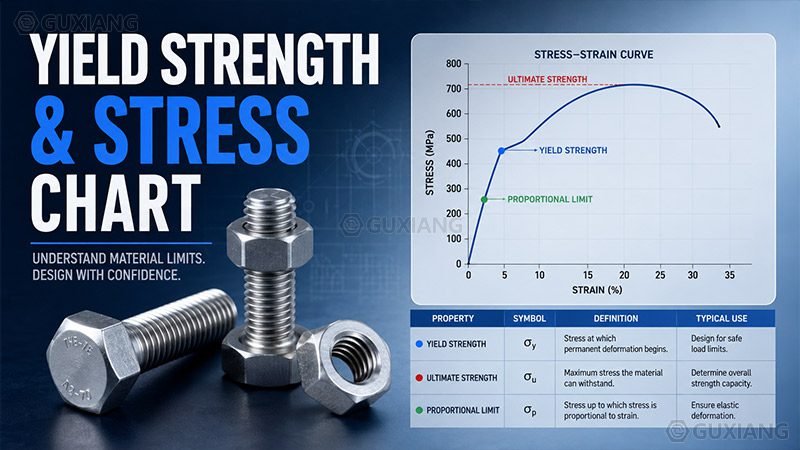
A comprehensive yield strength and tensile stress comparison for 30+ engineering materials including carbon steel, stainless steel, aluminum, titanium, and copper alloys. Use the lookup tool below to quickly compare yield strength (YS) and ultimate tensile strength (UTS) in both MPa and PSI.
Material Lookup
Yield Strength
—
Tensile Strength (UTS)
—
YS / UTS Ratio
—
Understanding Yield Strength
📐
Yield Strength (σy)
The maximum stress a material can withstand before it begins to deform permanently. Below this point, deformation is elastic and reversible.
💪
Ultimate Tensile Strength
The maximum stress a material can withstand before fracture. UTS is always higher than yield strength for ductile metals.
⚖️
YS/UTS Ratio
A higher ratio indicates less safety margin between initial yielding and fracture. Structural steels typically have ratios of 0.6–0.85.
🔄
Elastic vs Plastic
In the elastic region, the material returns to its original shape when unloaded. In the plastic region, deformation is permanent and irreversible.
Yield Strength & Tensile Strength by Material
The table below lists yield strength and ultimate tensile strength for common engineering materials used in fasteners, structural components, and mechanical assemblies. Values are typical ranges — actual properties depend on grade, temper, heat treatment, and test standard.
Material
Grade / Condition
Yield Strength (MPa)
Yield Strength (PSI)
UTS (MPa)
UTS (PSI)
Visual Comparison: Top Materials by Yield Strength
Yield Strength Tensile Strength (UTS)
Fastener Material Selection Guide
Determine the required strength. Calculate the maximum service load and select a material whose yield strength exceeds this value with an appropriate safety factor (typically 2–4× for structural applications).
Consider the operating environment. For corrosive or outdoor environments, choose stainless steel (304/316) or titanium. For general indoor use, carbon steel with plating is cost-effective.
Account for weight constraints. Aluminum offers ~60% weight savings over steel. Titanium provides steel-level strength at ~45% less weight. Magnesium is the lightest structural metal.
Check temperature requirements. High-temperature applications (>400°C) require nickel alloys (Inconel) or titanium. Cryogenic service favors austenitic stainless steels (304/316) or aluminum.
Balance cost vs. performance. Carbon steel (A36, 1045) is the most economical. Stainless steel costs 3–5× more. Titanium and nickel alloys cost 10–20× more than carbon steel.
Frequently Asked Questions
Yield strength is the maximum stress a material can withstand before it begins to deform permanently (plastic deformation). It matters because it defines the upper load limit for any structural or mechanical application — if the yield strength is exceeded, the part will not return to its original shape when unloaded, leading to failure or dimensional inaccuracy.
Yield strength is the stress at which a material begins to deform permanently, while tensile strength (UTS) is the maximum stress the material can withstand before fracture. For ductile metals like steel, UTS is always higher than yield strength. The gap between the two values represents the material's safety margin beyond initial yielding.
Among common engineering materials, 18Ni maraging steel has the highest yield strength at 1,500–1,900 MPa (218,000–276,000 PSI), followed by hardened tool steel (D2/A2) at 700–1,700 MPa. For non-ferrous metals, titanium Grade 5 (Ti-6Al-4V) leads at 825–880 MPa yield strength.
Multiply the MPa value by 145.038 to get PSI. For example, A36 steel with a yield strength of 250 MPa equals 250 × 145.038 = 36,260 PSI (commonly rounded to 36,000 PSI). Conversely, divide PSI by 145.038 to get MPa.
304 stainless steel has a typical yield strength of 205–300 MPa (29,700–43,500 PSI) and an ultimate tensile strength of 515–750 MPa (74,700–108,800 PSI). The wide range depends on the temper (annealed vs. cold worked) and manufacturing process.
6061-T6 aluminum has a typical yield strength of 240–275 MPa (34,800–39,900 PSI) and an ultimate tensile strength of 290–310 MPa (42,100–45,000 PSI). It is one of the most widely used aluminum alloys for structural applications due to its good strength-to-weight ratio and corrosion resistance.
Brittle materials like cast iron, glass, concrete, and epoxy resin do not exhibit significant plastic deformation before fracture. They break suddenly without a clear yield point, so yield strength is not typically defined for these materials. Instead, their mechanical properties are characterized by ultimate tensile or compressive strength alone.
For materials that do not have a clear yield point (such as aluminum, stainless steel, and titanium), the 0.2% offset yield strength is used. It is defined as the stress at which the material has undergone 0.2% permanent (plastic) strain. This is determined by drawing a line parallel to the elastic modulus from the 0.2% strain point on the stress-strain curve.
Heat treatment can dramatically increase yield strength. For example, AISI 4140 alloy steel in the annealed condition has a yield strength of ~415 MPa, but after quenching and tempering, it can reach 900 MPa or more. Maraging steel achieves its extraordinary 1,500–1,900 MPa yield strength through a specialized aging heat treatment. However, increased strength often comes at the cost of reduced ductility.
For general structural bolting, ASTM A36 steel (250 MPa yield) is the baseline. High-strength structural bolts use ASTM A514 (690 MPa yield) or Grade 8 fasteners (approximately 1,000 MPa tensile). For aerospace and critical applications, alloy steel fasteners (AISI 4140, A574) with yield strengths of 900+ MPa are common. Always apply a safety factor of at least 2× the expected service load.
Disclaimer: The data provided in this yield strength chart is for general reference purposes only. Values are approximate and depend on alloy composition, grade, temper, heat treatment, manufacturing method, and test standard. Always verify material properties against ASTM, ISO, or the original material manufacturer's certifications before engineering design or procurement. GUXIANG does not guarantee the accuracy or completeness of this data and assumes no liability for errors or omissions.
 EN
EN  ZH
ZH