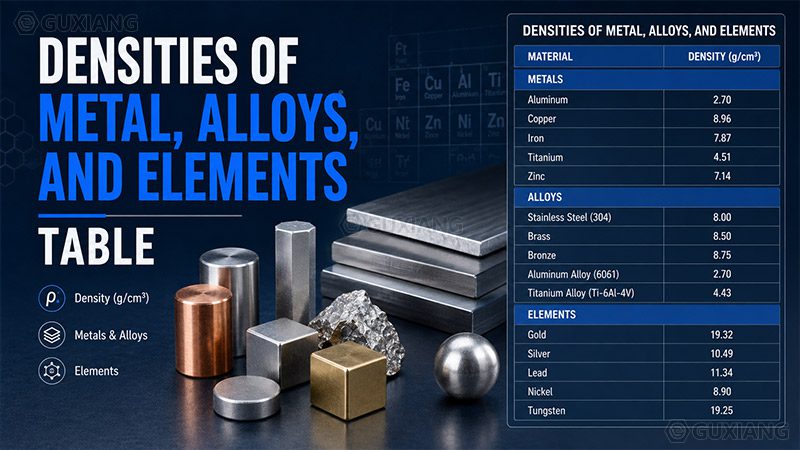
A comprehensive density reference table for 60+ metals, alloys, and elements in g/cm³ and kg/m³. Organized by material family for quick comparison. Use the lookup tool and unit converter below for instant calculations.
Material Density Lookup
Density
—
Density
—
Density
—
Category
—
Density Unit Converter
⇄
Metal & Alloy Density Table
The table below lists densities for commonly used metals, alloys, and pure elements. Values are typical at room temperature (20°C). Materials with ranges indicate composition-dependent variation. Data is organized by material family for easy comparison.
Metal / Alloy / Element
Density (g/cm³)
Density (kg/m³)
Density (lb/ft³)
Visual Density Comparison (Top Materials)
Understanding Material Density
⚛️
What Is Density?
Density is mass per unit volume (ρ = m/V). It determines how heavy a part will be for a given size. In fastener selection, density affects weight-critical applications in aerospace, automotive, and portable equipment.
🔄
Unit Conversions
1 g/cm³ = 1,000 kg/m³ = 62.43 lb/ft³. Water's density is 1.000 g/cm³ — metals denser than water sink; lighter metals like magnesium (1.74) and aluminum (2.70) are still far heavier than water.
🏆
Densest & Lightest
Iridium (22.56 g/cm³) is the densest natural element. Osmium is close at 22.59. Lithium (0.53 g/cm³) is the lightest metal — less dense than water. For structural use, magnesium (1.74) and aluminum (2.70) are the lightest engineering metals.
⚖️
Why Density Matters
In fastener and structural design, density directly affects part weight, shipping cost, and structural load. Titanium (4.50 g/cm³) offers steel-level strength at ~43% less weight — a key advantage in aerospace applications.
Quick Weight Calculator
Estimate Part Weight from Volume & Density
Enter volume and density to calculate weight
Material Selection by Density
Lightweight applications (ρ < 3 g/cm³). Choose aluminum alloys (2.70–2.83) or magnesium (1.74). Ideal for aerospace, drones, portable devices, and weight-sensitive assemblies where every gram counts.
Medium-weight, high strength (ρ 4–5 g/cm³). Titanium (4.50) offers the best strength-to-weight ratio of any structural metal. Use for aerospace fasteners, marine hardware, and medical implants.
General structural (ρ 7–8 g/cm³). Carbon steel (7.85), stainless steel (7.70–8.00), and cast iron (6.90–7.80) are the workhorses of industry. Cost-effective with excellent strength and machinability.
Corrosion-resistant (ρ 8–9 g/cm³). Copper (8.96), brass (8.40–8.83), bronze (8.70–9.30), and nickel alloys (8.40–9.22) provide excellent corrosion resistance for marine, chemical, and electrical applications.
High-density / radiation shielding (ρ > 11 g/cm³). Lead (11.34), tungsten (19.25), and depleted uranium (18.95) are used for radiation shielding, counterweights, and vibration damping where maximum mass in minimum volume is required.
Frequently Asked Questions
Carbon steel has a density of approximately 7.85 g/cm³ (7,850 kg/m³ or 490 lb/ft³). Stainless steel varies by grade: 304 stainless is 7.93 g/cm³, 316 is 8.00 g/cm³, and 410 is 7.75 g/cm³. Tool steel ranges from 7.70 to 8.00 g/cm³ depending on alloy content.
Magnesium (1.74 g/cm³) is the lightest structural metal, about 35% lighter than aluminum (2.70 g/cm³). However, magnesium is highly reactive and flammable in fine chip or powder form, limiting its use in some applications. For structural use where fire risk is a concern, aluminum alloys (2.70–2.83 g/cm³) are the preferred lightweight choice.
Multiply by 1,000. Since 1 cm³ = 0.000001 m³ and 1 g = 0.001 kg, the conversion is: density in kg/m³ = density in g/cm³ × 1,000. For example, steel at 7.85 g/cm³ = 7,850 kg/m³. To convert to lb/ft³, multiply g/cm³ by 62.43.
Pure aluminum has a density of 2.70 g/cm³ (2,700 kg/m³). Aluminum alloys vary slightly: 6061 is 2.70 g/cm³, 7075 is 2.81 g/cm³, and 2024 is 2.78 g/cm³. The variation is due to alloying elements like zinc, copper, and magnesium.
Commercially pure titanium has a density of 4.50 g/cm³ (4,500 kg/m³ or 281 lb/ft³). This is about 57% of steel's density (7.85 g/cm³), making titanium ideal for applications where strength-to-weight ratio is critical, such as aerospace fasteners and airframe components.
Osmium has the highest density of any natural element at 22.59 g/cm³, followed closely by iridium at 22.56 g/cm³. Both are about twice as dense as lead (11.34 g/cm³). For practical engineering applications, tungsten (19.25 g/cm³) is the densest commonly used metal, often used for counterweights and radiation shielding.
Stainless steel density varies with alloy composition. Austenitic grades (304: 7.93, 316: 8.00 g/cm³) contain nickel which increases density. Ferritic and martensitic grades (410: 7.75, 430: 7.70 g/cm³) have less nickel and more chromium, resulting in slightly lower density. The differences are small but matter in weight-critical calculations.
Density directly impacts fastener weight, which affects shipping cost, structural load, and assembly ergonomics. In aerospace, titanium fasteners (4.50 g/cm³) save ~43% weight vs. steel (7.85 g/cm³). In general industry, steel fasteners are preferred for cost. For marine environments, silicon bronze (8.80 g/cm³) or monel (8.80 g/cm³) provide corrosion resistance.
Brass density ranges from 8.40 to 8.83 g/cm³ depending on composition — higher zinc content lowers density. Bronze (copper-tin alloys) ranges from 8.70 to 9.30 g/cm³. Leaded bronze (8.90–9.30) is denser due to lead (11.34 g/cm³) content. These densities make brass and bronze significantly heavier than steel (7.85 g/cm³).
Weight = Volume × Density. First calculate the part's volume in cm³ (for a cylinder: V = π × r² × h). Then multiply by the material's density in g/cm³ to get mass in grams. For example, a steel block (7.85 g/cm³) with volume 100 cm³ weighs 785 g or 0.785 kg. Use the weight calculator above for quick estimates.
Disclaimer: The density data provided on this page is for general reference purposes only. Actual density values may vary by specific alloy composition, temper, heat treatment, and manufacturing process. Always verify material properties against ASTM, ISO, or the material manufacturer's certifications for critical engineering applications. GUXIANG does not guarantee the accuracy or completeness of this data and assumes no liability for errors or omissions.