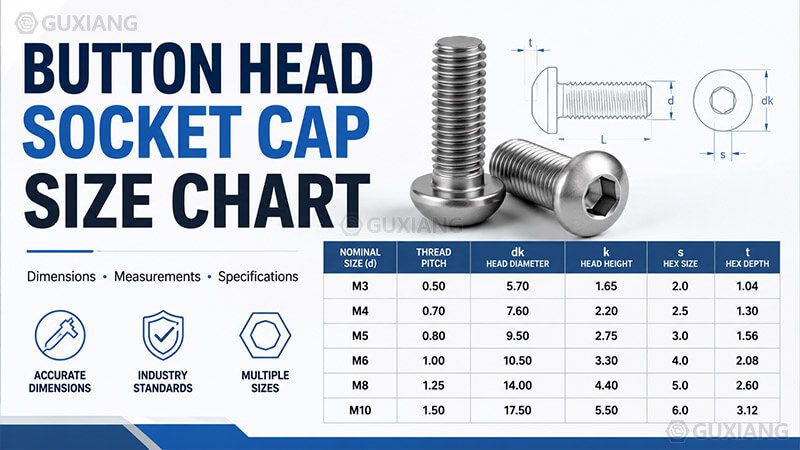
Button Head Socket Cap Size Chart

Button Head Socket Cap Size Chart

This comprehensive size chart covers button head socket cap screws (also known as button head Allen bolts) per ISO 7380 in both US inch and metric sizes. Button head screws feature a low-profile domed head with an internal hexagonal socket drive, providing a smooth, snag-free appearance ideal for machinery guards, enclosures, and consumer products. Use the interactive lookup tool below for quick reference, or browse the full dimension tables for engineering data including head diameter, head height, hex socket size, and key engagement depth.

Button Head Size Lookup Tool

Select a screw size to view its complete head and drive dimensions.

Quick Size Lookup

Button Head Dimension Reference

The diagram below illustrates the key dimensions specified in ISO 7380 for button head socket cap screws.

A (Head Dia.) C d B (Hex)
A = Head Diameter
C = Head Height
d = Body Diameter
B = Hex Socket Size

US Button Head Socket Cap Screw Dimensions

All dimensions in inches. Data per ASME B18.3 / ISO 7380 equivalent sizes.

Size Screw Dia. d Head Dia. A
Max
Head Dia. A
Min
Head Height C
Max
Head Height C
Min
Hex Socket B Key Engage E
Min
Numbered Sizes (#1 – #10)
#10.07300.1390.1290.0390.0310.0500.028
#20.08600.1640.1540.0460.0380.0500.028
#30.09900.1880.1760.0520.0441/160.035
#40.11200.2130.2010.0590.0511/160.035
#50.12500.2380.2260.0660.0585/640.044
#60.13800.2620.2500.0730.0635/640.044
#80.16400.3120.2980.0870.0773/320.052
#100.19000.3610.3470.1010.0911/80.070
Fractional Sizes (1/4" – 7/8")
1/4"0.25000.4370.4190.1320.1225/320.087
5/16"0.31250.5470.5270.1660.1523/160.094
3/8"0.37500.6560.6360.1990.1857/320.122
1/2"0.50000.8750.8510.2650.2455/160.175
5/8"0.62501.0000.9700.3310.3113/80.210
7/8"0.87501.3751.3390.4640.4381/20.280

Metric Button Head Socket Cap Screw Dimensions

All dimensions in millimeters (mm). Data per ISO 7380.

Size Pitch Head Dia. A
Max
Head Dia. A
Min
Head Height C
Max
Head Height C
Min
Hex Socket B Key Engage E
Min
Small Sizes (M2 – M6)
M20.43.803.501.100.951.30.67
M30.55.705.401.651.432.01.04
M40.77.607.242.201.952.51.30
M50.89.509.142.752.503.01.56
M61.010.5010.073.303.004.02.08
Medium & Large Sizes (M8 – M20)
M81.2514.0013.574.404.105.02.60
M101.517.5017.075.505.206.03.12
M121.7521.0020.486.606.248.04.16
M162.028.0027.488.808.4410.05.20
M202.535.0034.4011.0010.5712.06.24

Button Head vs. Socket Head Cap Screw Comparison

Understanding the dimensional differences between button head (ISO 7380) and standard socket head cap screw (ISO 4762) helps you choose the right fastener for your application.

Head Height

Button head height is approximately 50% of SHCS height for the same nominal size. M6 button head: 3.30 mm vs M6 SHCS: 6.00 mm. This lower profile reduces snag hazard and provides a cleaner appearance.

Head Diameter

Button head diameter is wider than SHCS for the same size. M6 button head: 10.50 mm vs M6 SHCS: 10.00 mm. The wider bearing surface distributes clamp load better on thin or soft materials.

Hex Socket Size

Button heads use a smaller hex socket than SHCS of the same diameter. M6 button head: 4.0 mm hex vs M6 SHCS: 5.0 mm hex. The smaller drive limits maximum torque, making button heads unsuitable for high-strength structural joints.

Torque Capacity

Due to the smaller hex socket and lower head height, button head screws can accept approximately 40–50% less torque than equivalent SHCS. This is the primary reason button heads are not used for structural applications.

Application Selection Guide

When to Use Button Head vs. Other Fastener Types

  1. Choose button head (ISO 7380) when you need a low-profile, smooth, snag-free appearance. Ideal for machine guards, enclosures, consumer products, furniture, and medical devices. The domed head is easy to clean and presents no sharp edges.
  2. Choose socket head cap screw (ISO 4762) when you need maximum torque capacity and head strength in a confined space. The taller cylindrical head accepts larger hex keys and higher tightening torque. Use for structural joints, engine components, and precision machinery.
  3. Choose flat/countersunk head (ISO 10642) when the fastener must sit completely flush with or below the surface. Use for sliding surfaces, track systems, and applications where zero protrusion is required.
  4. Choose flanged button head (ISO 7380-2) when assembling to soft materials (aluminum, plastic, wood) where the standard button head bearing surface might cause indentation. The integrated flange distributes load over a wider area and eliminates the need for a separate washer.
Frequently Asked Questions

What is a button head socket cap screw?
A button head socket cap screw (also called a button head Allen bolt or ISO 7380) is a fastener with a low-profile, domed (rounded) head and an internal hexagonal (Allen) socket drive. The head height is approximately half that of a standard socket head cap screw (ISO 4762), providing a sleek, low-profile appearance while still allowing hex key drive. Button head screws are commonly used in machinery guards, enclosures, consumer products, and applications where a smooth, unobtrusive fastener head is desired.
What is the difference between button head and socket head cap screws?
The key differences are head height and profile. Socket head cap screws (ISO 4762) have a cylindrical head with height approximately equal to the nominal diameter, providing maximum head strength and torque capacity. Button head screws (ISO 7380) have a domed head with height roughly half the nominal diameter, offering a lower profile and smoother appearance but lower torque capability. For a 1/4 inch screw: SHCS head height is 0.132 in while button head is approximately 0.066 in. Use button heads where appearance and clearance are priorities; use SHCS where maximum torque and head strength are needed.
What hex key size do I need for a button head screw?
Button head socket sizes differ from standard socket head cap screws of the same diameter. Common sizes: M3 (or #4/#5) uses 1/16 in or 2.0 mm, M4 (or #6/#8) uses 5/64 in or 2.5 mm, M5 (or #10) uses 3/32 in or 3.0 mm, M6 (or 1/4 in) uses 1/8 in or 4.0 mm, M8 (or 5/16 in) uses 5/32 in or 5.0 mm, M10 (or 3/8 in) uses 7/32 in or 6.0 mm. Always use the exact size to avoid rounding the hex socket.
What standard covers button head socket cap screws?
Button head socket cap screws are covered by ISO 7380, which has two parts: ISO 7380-1 covers the standard button head with a plain bearing surface, while ISO 7380-2 covers the button head with an integrated flange (flanged button head). The flanged version provides a larger bearing surface for better load distribution on soft materials and eliminates the need for a separate washer. In the US, ASME B18.3 also covers socket head cap screws including button head types.
Can button head screws be used for structural applications?
Button head socket cap screws are generally not recommended for primary structural applications. Their lower head height means less material in the head, which limits the maximum torque that can be applied and reduces the clamp force compared to a standard SHCS. For structural steel connections, use A325 or A490 hex bolts or ISO 4762 socket head cap screws. Button heads are best suited for: machine guards, enclosures, fixtures, jigs, consumer products, and non-critical mechanical assemblies where a low-profile appearance is important.
What is the head diameter of a button head screw compared to the nominal size?
The head diameter of a button head screw is approximately 1.75 times the nominal diameter. For example: M4 has a head diameter of about 7.60 mm (vs 4.0 mm nominal), M6 has about 10.50 mm (vs 6.0 mm nominal), M8 has about 14.00 mm (vs 8.0 mm nominal), 1/4 inch has about 0.437 in (vs 0.250 in nominal). The wide, domed head provides a larger bearing surface than the nominal size would suggest, which helps distribute clamp load on thin or soft materials.
What are button head socket cap screws typically used for?
Button head socket cap screws are ideal for applications requiring a smooth, low-profile fastener with no exposed sharp edges. Common uses include: machine guards and safety enclosures (no snag hazard), consumer electronics and appliances (aesthetic appearance), furniture and architectural hardware (smooth domed head), bicycle and sporting equipment (lightweight, low profile), 3D printers and CNC machines (clean appearance on visible joints), and medical devices (smooth, easy-to-clean surface).
How do I determine the correct button head screw length?
Button head screw length is measured from under the head to the tip of the screw. The length should provide adequate thread engagement in the mating material: for steel, use at least 1x nominal diameter of engagement; for aluminum, 1.5x; for brass or plastic, 2x. Standard lengths per ISO 7380 typically range from 3 mm (for M2) to 60 mm (for M16). Not all lengths are available for every diameter. Always verify that the screw does not protrude through the back of the assembly.
What is the difference between ISO 7380-1 and ISO 7380-2?
ISO 7380-1 specifies the standard button head socket cap screw with a plain cylindrical bearing surface under the head. ISO 7380-2 specifies the flanged button head variant, which adds an integrated flange (washer face) under the head. The flange increases the bearing surface diameter by approximately 20 to 30 percent compared to the standard version, providing better load distribution on soft materials like aluminum or plastic, and eliminating the need for a separate washer. The flanged version also provides better resistance to vibration loosening due to the larger clamp area.
What material grades are available for button head socket cap screws?
Button head socket cap screws are commonly available in: Alloy steel Class 12.9 (the most common, tensile strength 1220 MPa) for general engineering; A2-70 stainless steel (AISI 304, tensile 700 MPa) for corrosion resistance; A4-70 stainless steel (AISI 316) for marine and chemical environments. Some manufacturers also offer Class 10.9 for applications where slightly lower strength is acceptable. The property class marking appears on the head of metric screws M5 and above.
Disclaimer: The data provided in this button head socket cap size chart is for general reference purposes only. Dimensions and tolerances may vary by manufacturer and applicable standards revision. Always verify critical dimensions against ISO 7380, ASME B18.3, or the original equipment manufacturer's specifications before procurement or installation. GUXIANG does not guarantee the accuracy or completeness of this data and assumes no liability for errors or omissions.

Related Engineering Resources

Table of Contents

Send Your Inquiry
Share: