





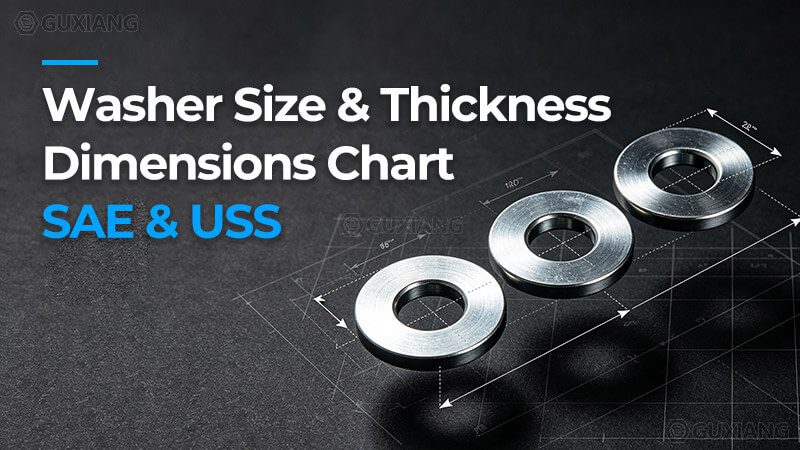
Selecting the correct washer size is essential for proper load distribution, vibration resistance, and secure fastening. This chart provides complete dimensions for SAE and USS flat washers (hardened and low carbon), split lock washers, and beveled washers, with inside diameter, outside diameter, and thickness in both inches and millimeters.
Washer Anatomy
Washer Size Lookup
Flat Washer Dimension Tables
SAE vs USS Washer Comparison
For the same bolt size, USS washers have a larger outside diameter and greater thickness than SAE washers. This comparison shows the key differences at common sizes.
| Bolt Size | SAE OD (in) | USS OD (in) | SAE Thickness (in) | USS Thickness (in) | OD Difference |
|---|---|---|---|---|---|
| 1/4" | 5/8 | 3/4 | 1/16 | 1/16 | 1/8 |
| 3/8" | 13/16 | 1 | 1/16 | 5/64 | 3/16 |
| 1/2" | 1-1/16 | 1-3/8 | 3/32 | 7/64 | 5/16 |
| 5/8" | 1-5/16 | 1-3/4 | 3/32 | 9/64 | 7/16 |
| 3/4" | 1-1/2 | 2 | 9/64 | 5/32 | 1/2 |
| 7/8" | 1-3/4 | 2-1/4 | 9/64 | 11/64 | 1/2 |
| 1" | 2 | 2-1/2 | 9/64 | 11/64 | 1/2 |
| 1-1/4" | 2-1/2 | 3 | 5/32 | 11/64 | 1/2 |
| 1-1/2" | 3 | 3-1/2 | 5/32 | 3/16 | 1/2 |
Split Lock Washer Dimensions
Spring steel and hardened steel split lock washers (helical spring washers) prevent fastener loosening due to vibration. Dimensions per ASME B18.21.1.
| Bolt Size | Outside Diameter (in) | Inside Diameter (in) | Mean Thickness (in) | Section Width (in) | Outside Diameter (mm) | Inside Diameter (mm) |
|---|
Hardened Beveled Washer Dimensions
Beveled (tapered) washers compensate for angled surfaces in structural steel connections, typically with a 1:6 slope. Used with structural bolts on sloped flanges.
| Bolt Size | Outside Diameter (in) | Inside Diameter (in) | Mean Thickness (in) | Slope / Taper | Outside Diameter (mm) | Inside Diameter (mm) |
|---|
Understanding Washer Types
SAE Flat Washers
SAE (Society of Automotive Engineers) washers have a smaller outside diameter and thinner profile. Designed for precision automotive, machinery, and confined-space applications. Available in hardened steel (for high-load) and low carbon steel (for general use).
USS Flat Washers
USS (United States Standard) washers have a larger outside diameter and greater thickness. Ideal for structural steel, construction, and general applications where broad load distribution is needed. The larger OD protects softer base materials from damage.
Split Lock Washers
Helical spring washers with a split design that creates spring force to maintain bolt preload under vibration. Made from spring steel or hardened steel. Essential in automotive, machinery, and any application subject to dynamic loads.
Beveled Washers
Tapered washers with a 1:6 slope that compensate for angled surfaces in structural steel connections. When bolting to sloped I-beam flanges, beveled washers ensure the bolt bears against a flat surface for proper load transfer.
Washer Selection Tips
Best Practices
- Match washer inside diameter to bolt diameter — ID should be slightly larger than the bolt
- Use SAE washers for precision/automotive applications where space is limited
- Use USS washers for structural/construction applications requiring broad load distribution
- Choose hardened washers for high-load or high-strength bolt applications (Grade 5, Grade 8)
- Use split lock washers where vibration resistance is critical
- Use beveled washers when bolting to sloped or angled surfaces in structural steel
- Never substitute a smaller OD washer — it may not distribute the load adequately
- Check washer thickness against available clearance in the assembly
Frequently Asked Questions
SAE (Society of Automotive Engineers) washers have a smaller outside diameter and are thinner than USS (United States Standard) washers for the same bolt size. SAE washers are designed for precision automotive and machinery applications where space is limited. USS washers have a larger outside diameter and greater thickness, making them suitable for structural and general construction applications where broader load distribution is needed.
The washer inside diameter should match or be slightly larger than the bolt diameter. For example, a 1/2" bolt requires a washer with an inside diameter of approximately 9/16" (USS) or 17/32" (SAE). Choose SAE washers for precision/automotive applications and USS washers for structural/construction applications. Always verify the washer thickness is appropriate for the load requirements.
A 1/2" USS flat washer (hardened) has an inside diameter of 9/16" (0.5625"), outside diameter of 1-3/8" (1.375"), and thickness of 0.109". For low carbon USS washers, the dimensions are: ID 9/16", OD 1-3/8", thickness 7/64" (0.1094").
Split lock washers (helical spring washers) are used to prevent bolt/nut loosening due to vibration. The split design creates a spring force that maintains tension in the fastener joint. They are commonly used in automotive, machinery, and structural applications where vibration resistance is critical. The washer deflects when compressed, providing a continuous load on the fastener.
Washer thickness affects load distribution, clamping force, and joint stiffness. Thicker washers (USS) distribute loads over a larger area and are used in structural applications. Thinner washers (SAE) are used where space is limited or in precision assemblies. The thickness also determines how much the washer can compress under load, affecting the preload retention of the bolted joint.
A beveled (tapered) washer has a sloped surface that compensates for angled surfaces in structural steel connections. When bolting to sloped flanges (like I-beam flanges), beveled washers ensure the bolt head and nut bear against a flat surface. The taper is typically 1:6 slope. They are hardened steel and are essential for proper load transfer in structural steel framing.
In many cases yes, but with considerations. A USS washer has a larger outside diameter and greater thickness than an SAE washer for the same bolt size. Using a USS washer provides broader load distribution but requires more space. In confined areas or precision assemblies designed for SAE washers, a USS washer may not fit. Always check clearance requirements and load specifications before substituting.
Common conversions: 1/4" bolt ≈ M6 (SAE washer OD 5/8" ≈ 15.88mm, USS OD 3/4" ≈ 19.05mm); 3/8" bolt ≈ M10 (SAE OD 13/16" ≈ 20.64mm, USS OD 1" ≈ 25.40mm); 1/2" bolt ≈ M12 (SAE OD 1-1/16" ≈ 26.99mm, USS OD 1-3/8" ≈ 34.93mm); 3/4" bolt ≈ M20 (SAE OD 1-1/4" ≈ 31.75mm, USS OD 2" ≈ 50.80mm).