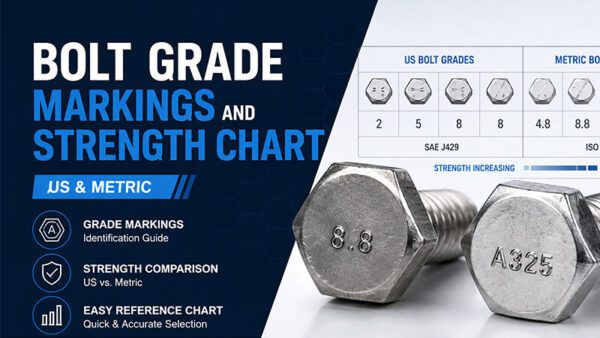






This chart provides a quick reference for converting metric wrench sizes (millimeters) to their closest standard SAE (inch-based) equivalents. It includes decimal equivalents and the difference between the exact metric size and the nearest SAE fraction, helping you determine interchangeability for your fastener applications.
Metric to Standard Wrench Conversion Chart
| Metric Size (mm) | Closest Standard Size | Decimal Equivalent | Difference |
|---|---|---|---|
| 3.18mm | 1/8″ | 0.125″ | +0.000″ |
| 4mm | 5/32″ | 0.156″ | -0.001″ |
| 5mm | 3/16″ | 0.188″ | -0.009″ |
| 6mm | 7/32″ | 0.219″ | -0.017″ |
| 7mm | 1/4″ | 0.250″ | -0.025″ |
| 8mm | 5/16″ | 0.313″ | -0.002″ |
| 9mm | 11/32″ | 0.344″ | -0.010″ |
| 10mm | 3/8″ | 0.375″ | -0.019″ |
| 11mm | 7/16″ | 0.438″ | -0.005″ |
| 12mm | 15/32″ | 0.469″ | +0.003″ |
| 13mm | 1/2″ | 0.500″ | -0.012″ |
| 14mm | 9/16″ | 0.563″ | -0.012″ |
| 15mm | 19/32″ | 0.594″ | +0.003″ |
| 16mm | 5/8″ | 0.625″ | -0.005″ |
| 17mm | 21/32″ | 0.656″ | +0.013″ |
| 18mm | 11/16″ | 0.688″ | +0.021″ |
| 19mm | 3/4″ | 0.750″ | -0.002″ |
| 20mm | 25/32″ | 0.781″ | +0.006″ |
| 21mm | 13/16″ | 0.813″ | +0.014″ |
| 22mm | 7/8″ | 0.875″ | -0.009″ |
| 23mm | 29/32″ | 0.906″ | -0.000″ |
| 24mm | 15/16″ | 0.938″ | -0.007″ |
| 25mm | 1″ | 1.000″ | -0.016″ |
| 26mm | 1-1/32″ | 1.031″ | -0.007″ |
| 27mm | 1-1/16″ | 1.063″ | +0.001″ |
| 28mm | 1-1/8″ | 1.125″ | +0.023″ |
| 29mm | 1-5/32″ | 1.156″ | +0.014″ |
| 30mm | 1-3/16″ | 1.188″ | +0.006″ |
| 31mm | 1-7/32″ | 1.219″ | -0.002″ |
| 32mm | 1-1/4″ | 1.250″ | -0.010″ |
| 33mm | 1-19/64″ | 1.297″ | -0.002″ |
| 34mm | 1-5/16″ | 1.313″ | -0.026″ |
| 35mm | 1-3/8″ | 1.375″ | +0.003″ |
| 36mm | 1-7/16″ | 1.438″ | +0.020″ |
| 38mm | 1-1/2″ | 1.500″ | +0.004″ |
| 39mm | 1-9/16″ | 1.563″ | +0.027″ |
| 40mm | 1-9/16″ | 1.563″ | -0.012″ |
| 41mm | 1-5/8″ | 1.625″ | +0.011″ |
| 46mm | 1-13/16″ | 1.813″ | +0.001″ |
| 50mm | 2″ | 2.000″ | +0.032″ |
| 51mm | 2″ | 2.000″ | -0.008″ |
| 54mm | 2-1/8″ | 2.125″ | +0.000″ |
| 55mm | 2-5/32″ | 2.156″ | -0.009″ |
| 57mm | 2-1/4″ | 2.250″ | +0.006″ |
| 58mm | 2-9/32″ | 2.281″ | +0.000″ |
| 60mm | 2-3/8″ | 2.375″ | +0.014″ |
| 63mm | 2-1/2″ | 2.500″ | +0.020″ |
Important Notes
- Differences: The difference column shows how much larger (+) or smaller (-) the standard SAE size is compared to the metric size, measured in inches.
- Interchangeability: Sizes with differences under ±0.005″ are generally interchangeable for most applications. These include 3mm ≈ 1/8″, 8mm ≈ 5/16″, 19mm ≈ 3/4″, 23mm ≈ 29/32″, 54mm ≈ 2-1/8″, and 58mm ≈ 2-9/32″.
- Precision: Always use the exact size when possible for critical applications or when working with precision fasteners to avoid rounding bolt heads or damaging tools.
- Tool Quality: Higher quality tools typically have tighter tolerances and better fit, reducing the risk of damage when using close-but-not-exact conversions.
- Material Considerations: Softer materials (brass, aluminum, plastic) require more precise fits to avoid damage. Use exact sizes whenever working with these materials.
How to Use This Conversion Chart
Quick Reference Guide
- Find your metric size: Locate the metric wrench size (in mm) in the first column of the table.
- Read the SAE equivalent: The second column shows the closest standard (SAE) fractional inch size.
- Check the difference: The fourth column shows the tolerance difference. Values under ±0.005″ indicate good interchangeability.
- Consider the application: For general-purpose work, close matches are acceptable. For precision or critical applications, use the exact size specified by the fastener manufacturer.
- Verify fit: When in doubt, test the wrench on the fastener before applying torque. A properly fitting wrench should seat fully without wobbling.
Understanding Wrench Size Systems
Metric System (mm)
Metric wrench sizes are measured in millimeters and use whole numbers or simple decimals (6mm, 10mm, 13mm). This system is used in most countries worldwide and is standard for European and Asian vehicles and machinery.
Standard SAE System (Inches)
SAE (Society of Automotive Engineers) wrench sizes use fractional inches based on powers of 2 (1/16, 1/8, 1/4, 1/2 inch). This system is primarily used in the United States for American-made vehicles and equipment.
Decimal Equivalents
The decimal equivalent column converts fractional SAE sizes to decimal inches for easier comparison. For example, 3/8 inch = 0.375 inch. This helps you understand the exact size difference between metric and SAE.
Tolerance Differences
The difference column shows how much the SAE size deviates from the exact metric conversion. Positive values mean the SAE size is larger; negative values mean it is smaller. Smaller differences indicate better interchangeability.
Frequently Asked Questions
Metric wrench sizes are measured in millimeters (mm), while standard (SAE) wrench sizes are measured in inches using fractional notation (e.g., 1/2 inch, 3/4 inch). Metric sizes are whole numbers or simple decimals (6mm, 10mm, 13mm), while SAE sizes use fractions based on powers of 2 (1/16, 1/8, 1/4, 1/2, etc.). The two systems are not directly equivalent, so conversion charts show the closest matching size.
In many cases, yes, but with caution. The conversion chart shows which metric size is closest to each SAE size. Sizes with differences under ±0.005 inches are generally interchangeable for most applications. However, using the wrong size can round off bolt heads or damage the wrench. For critical applications or precision fasteners, always use the exact size specified.
The difference column shows how much larger (+) or smaller (-) the standard SAE size is compared to the metric size, measured in inches. For example, if 10mm converts to 3/8 inch (0.375 inch) with a difference of -0.019 inch, it means the SAE size is 0.019 inch smaller than the exact metric equivalent. Positive values mean the SAE size is larger; negative values mean it is smaller.
Sizes with differences under ±0.005 inches are generally considered interchangeable for most applications. Examples include: 3mm ≈ 1/8 inch (+0.000), 8mm ≈ 5/16 inch (-0.002), 19mm ≈ 3/4 inch (-0.002), 23mm ≈ 29/32 inch (-0.000), and 54mm ≈ 2-1/8 inch (+0.000). For precision work or critical applications, always use the exact size.
The metric and SAE systems were developed independently and use different base units (millimeters vs. inches). Since 1 inch equals exactly 25.4mm, most metric sizes do not convert to clean fractional inch values. The conversion chart shows the closest practical SAE size, but there will always be some difference. This is why professional mechanics often carry both metric and SAE tool sets.
To convert metric millimeters to inches, divide the metric size by 25.4 (since 1 inch = 25.4mm). For example, 10mm ÷ 25.4 = 0.3937 inches. Then find the closest fractional inch equivalent: 0.3937 is closest to 3/8 inch (0.375). The conversion chart provides these conversions pre-calculated with the exact difference shown.
Common metric wrench sizes include: 6mm, 7mm, 8mm, 10mm, 11mm, 12mm, 13mm, 14mm, 15mm, 16mm, 17mm, 18mm, 19mm, 21mm, 22mm, 24mm. These cover most automotive and industrial fasteners. Smaller sizes (3mm, 4mm, 5mm) are used for electronics and precision instruments, while larger sizes (27mm, 30mm, 32mm, 36mm, 41mm, 46mm, 50mm) are used for heavy machinery and large bolts.
Common SAE wrench sizes include: 1/4 inch, 5/16 inch, 3/8 inch, 7/16 inch, 1/2 inch, 9/16 inch, 5/8 inch, 11/16 inch, 3/4 inch, 13/16 inch, 7/8 inch, 15/16 inch, 1 inch. Smaller sizes (1/8, 3/16, 7/32) are used for small fasteners, while larger sizes (1-1/8, 1-1/4, 1-1/2, 2 inch) are used for heavy-duty applications.