EN
EN  ZH
ZH 

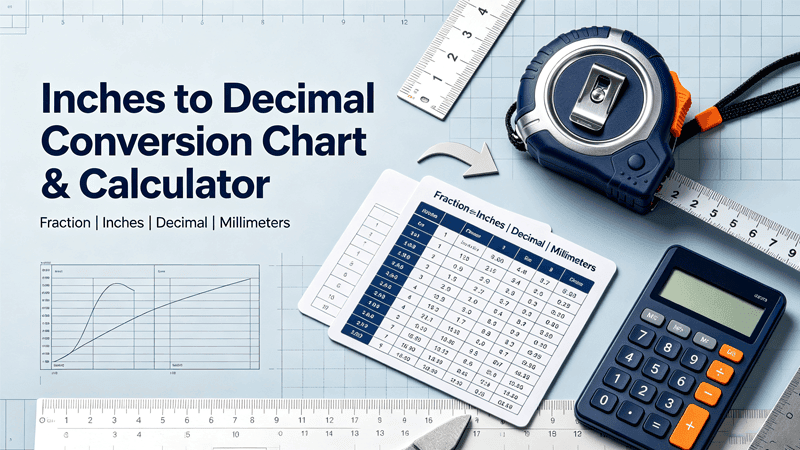
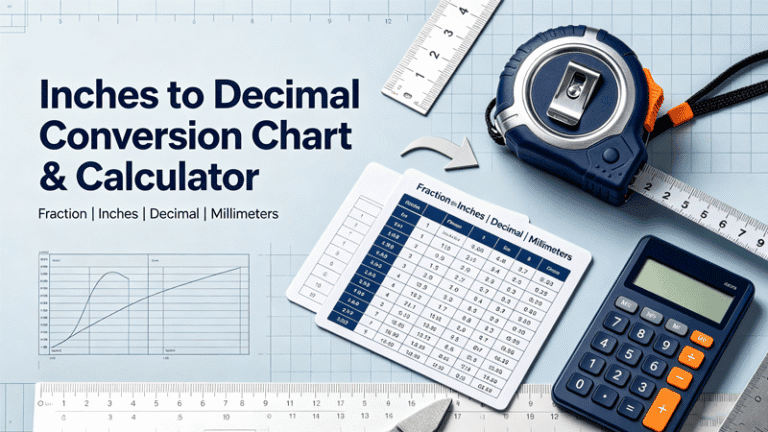
Converting decimals to inches, and inches to decimals is extremely important in many areas of manufacturing and industrial machine parts. Knowing something as simple as a 1/8 inch size in decimal (0.1250), or what 0.5938 decimal equals in fractional inches can have important effects on the outcome of a project. This page provides a comprehensive conversion table from 1/128 to 1 inch, along with an interactive calculator for fast and easy reference.
Complete reference table from 1/128 to 1 inch, organized by fraction denominator. Values rounded to 4 decimal places for practical use.
| Fraction (inches) | Decimal (inches) | Millimeters (mm) |
|---|
The imperial fractional inch system divides inches into halves, quarters, eighths, sixteenths, thirty-seconds, sixty-fourths, and 128ths. Each level doubles the precision. This system is standard in US manufacturing, construction, and woodworking.
Decimal inches express measurements as decimal fractions of an inch (e.g., 0.375 instead of 3/8). This format is preferred in CNC machining, precision engineering, and CAD software where decimal calculations are more practical.
One inch equals exactly 25.4 millimeters. This conversion factor was internationally standardized in 1959. To convert any inch measurement to mm, multiply by 25.4. The result is exact with no rounding error.
Common precision levels: 1/16" (0.0625) for general construction, 1/32" (0.03125) for woodworking, 1/64" (0.015625) for metalworking, and 1/128" (0.0078125) for precision machining and gauge measurements.
To convert a fraction to decimal inches, divide the numerator by the denominator. For example, 3/8 inch = 3 ÷ 8 = 0.375 inches. For mixed numbers like 2 3/8, convert the fraction first (0.375) then add the whole number (2 + 0.375 = 2.375 inches). Use our calculator above for instant conversion.
1/8 inch as a decimal is 0.1250 inches. In millimeters, 1/8 inch equals 3.1750 mm. This is a common measurement in manufacturing, woodworking, and metalworking applications. It's also a standard drill bit and fastener size.
3/16 inch as a decimal is 0.1875 inches. In millimeters, 3/16 inch equals 4.7625 mm. This size is commonly used in drill bits, fasteners, and sheet metal work. It falls between 1/8" (0.125) and 1/4" (0.25).
To convert decimal inches to millimeters, multiply the decimal value by 25.4 (since 1 inch = 25.4 mm exactly). For example, 0.375 inches × 25.4 = 9.525 mm. This conversion factor is exact and internationally standardized since 1959, so there is no rounding error.
5/64 inch as a decimal is 0.0781 inches (rounded to 4 decimal places). The exact value is 0.078125 inches. In millimeters, 5/64 inch equals 1.9844 mm. This is a common drill bit size used in metalworking and precision applications.
Fractional inches remain common in the United States manufacturing industry, especially in construction, woodworking, and legacy machinery. Many tools, drill bits, and fasteners are still sized in fractions (1/64, 1/32, 1/16 increments). However, decimal inches and metric measurements are increasingly used in precision manufacturing and CNC machining.
1/64 inch = 0.015625 decimal inches (0.3969 mm), while 1/128 inch = 0.0078125 decimal inches (0.1984 mm). The 1/128 increment is half the size of 1/64, providing finer precision. 1/128 increments are used in high-precision machining and gauge block measurements where extremely tight tolerances are required.
For general manufacturing and construction, 4 decimal places (0.0001 inch) is standard and provides accuracy to 0.00254 mm. For precision machining, 4-5 decimal places are common. For gauge blocks and high-precision work, up to 6 decimal places may be needed. Most fractional conversions to 1/64 inch are exact at 4 decimal places.
Social Chat is free, download and try it now here!