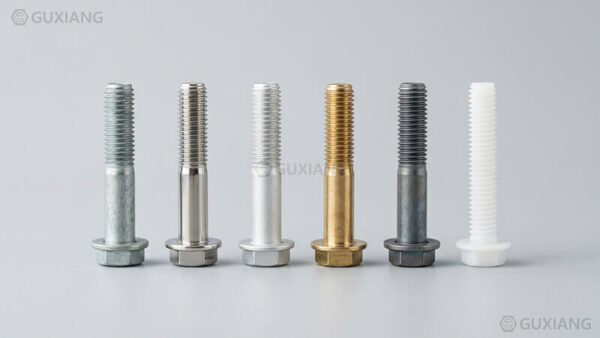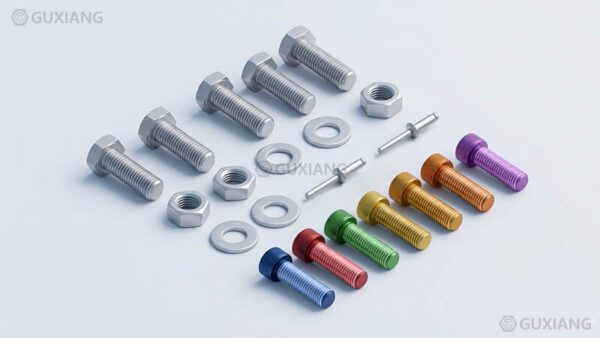






Verbindungselemente aus Kohlenstoffstahl bilden das Rückgrat der industriellen Montage in nahezu jedem Fertigungssektor. Aus dem Chassis Schrauben in landwirtschaftlichen maschinen zu den strukturellen verbindungen in energiespeichergehäusen, kohlenstoffstahl bleibt die am weitesten verbreitete Befestigungsmaterial auf dem Planeten - etwa 65% des gesamten industriellen Verbindungsverbrauchs nach Volumen.
Warum Kohlenstoffstahl? Die Antwort liegt in einem unübertroffenen Gleichgewicht der Immobilien. Wenn ein Maschinenbauingenieur einen Bolzen für eine nicht korrosive Arbeitsumgebung auswählt, eine Hochlastanwendung, liefert Kohlenstoffstahl hohe zugfestigkeit zu einem bruchteil der kosten aus legiertem Stahl oder rostfreien Alternativen. Ein richtig wärmebehandelter mittelkohlenstoff-bolzen der klasse 8,8 kann eine zugfestigkeit von 800 mpa erreichen, was vielen niedriglegierten stählen Konkurrenz macht, während er 40-60% weniger pro einheit kostet.
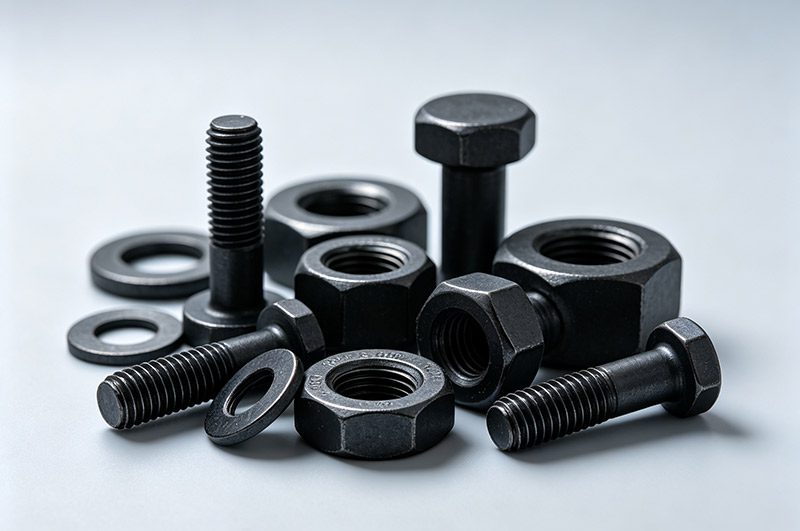
Die Vielseitigkeit des Materials zementiert seine Position weiter. Durch die Anpassung des Kohlenstoffgehalts - typischerweise zwischen 0.05% und 0.95% - können Hersteller Befestigungselemente herstellen, die von weichen, duktilen, kohlenstoffarmen Nieten für die Blechmontage bis hin zu ultrahochfesten, abgeschreckten und gehärteten Bolzen reichen, die für kritische strukturelle Verbindungen geeignet sind.
Für OEM-Lieferkettenmanager ist das Verständnis von Kohlenstoffstahl keine akademische Übung - es ist ein Hebel zur Kostenkontrolle. Der Unterschied zwischen der Angabe von C1035 und C1045 für einen bestimmten Bolzen kann die Stückkosten um 151TP7 ändern T bei nahezu identischer Leistung bei optimierter Wärmebehandlung. Dieser Leitfaden existiert, um Beschaffungsexperten und Konstrukteuren die technische Tiefe zu geben, die sie benötigen, um diese Entscheidungen mit Zuversicht zu treffen.
Kohlenstoffgehaltsklassifizierung und repräsentative Qualitäten
Kohlenstoffstahl für Verbindungselemente wird nach dem Kohlenstoffanteil in drei große Familien eingeteilt. Jede Familie diktiert Formbarkeit, Schweißbarkeit, Härtbarkeit und die praktische Festigkeitsgrenze, die durch Wärmebehandlung erreichbar ist.
| Klassifizierung | Kohlenstoffgehalt (wt%) | Repräsentative Klassen (ASTM / ISO / EN) | Typische Verbindungsanwendungen |
|---|---|---|---|
| Kohlenstoffarmer Stahl | ≤ 0,25% | ASTM A307 Grad A, ISO 898-1 Klasse 4.6/4.8, EN 10263-1 C4C | Maschinenschrauben, Schlittenschrauben, Nichtbaumuttern, Unterlegscheiben |
| Mittelkohlenstahl | 0.25% – 0.55% | ASTM A325 Typ 1, ISO 898-1 Klasse 8.8/10.9, SAE J429 Grad 5/8 | Bauschrauben, Befestigungen für Kraftfahrzeugmotoren, landwirtschaftliche Geräte |
| Kohlenstoffreicher Stahl | 0.55% – 0.95% | ASTM A574, ISO 898-1 Klasse 12.9, SAE J429 Klasse 8.2 | Hochfeste Kopfkappenschrauben, Federscheiben, Passstifte |
Kohlenstoffarmer Stahl: Duktilität über Stärke
Kohlenstoffarme Verbindungselemente werden leicht kaltgeformt und weisen eine ausgezeichnete Duktilität auf - typische Dehnungswerte von 20–30%. Ihr niedriger Kohlenstoffgehalt begrenzt jedoch die Reaktion auf die Wärmebehandlung stark. Die Oberflächenhärtung durch Aufkohlen kann die Verschleißfestigkeit verbessern, aber der Kern bleibt weich. Diese Verbindungselemente überschreiten selten die Zugfestigkeit von 400 MPa und sind für strukturelle Anwendungen ungeeignet.
Ein Beschaffungsmanager, der Befestigungselemente für HLK-Gehäuse oder leichte Elektroschränke spezifiziert, wird kohlenstoffarmen Stahl für völlig ausreichend halten. Der Kostenvorteil ist erheblich: kohlenstoffarmer Walzdraht wird bei etwa 20–251TP7 gehandelt T unter mittleren Kohlenstoffäquivalenten.
Mittelkarbonstahl: Das Arbeitspferd
Bei mittlerem Kohlenstoffstahl wird die industrielle Befestigung ernst. Grade wie C1035 (0,32–0,38% C), C1040 und C1045 (0,43–0,50%) C) reagieren dramatisch auf Abschrecken und Tempern. Ein C1045-Bolzen, nach dem Abschrecken von Öl von 850°C und dem Tempern bei 450°C, liefert eine gehärtete Martensit-Mikrostruktur mit einer Zugfestigkeit von 800-1.000 MPa und einer Streckgrenze von über 640 MPa - direkt im Gebiet der ISO 898-1 Klasse 8.8.
Diese Klasse dominiert OEM-Beschaffung aus einem Grund. Es bietet den Sweet Spot, an dem die inkrementellen Kosten für Legierungselemente (Chrom, Molybdän, Nickel) noch nicht benötigt werden, aber die mechanischen Eigenschaften erfüllen die anspruchsvollen Spezifikationen von Baumaschinen, Triebwagenuntergestellen und Gondelbaugruppen von Windkraftanlagen.
Kohlenstoffreicher Stahl: Stärke zu einem Preis
Kohlenstoffreiche Verbindungselemente drücken die Zugfestigkeit über 1.200 MPa hinaus (Klasse 12.9). Der Kompromiss ist eine stark reduzierte Duktilität und Kerbempfindlichkeit. Diese Befestigungselemente werden selten für Anwendungen mit Aufprallbelastungen oder Ermüdungszyklen angegeben, es sei denn, das Design enthält großzügige Sicherheitsfaktoren. Typische Anwendungsfälle sind Buchsenkopfkappenschrauben in Spritzgusswerkzeugen und gehärtete Unterlegscheiben in verschraubten Verbindungsbaugruppen, bei denen die Oberflächenpressung extrem ist.
Chemische Zusammensetzung und mechanische Eigenschaften nach Grad
Das Verständnis des chemischen “Rezepts hinter jeder Klasse ist für Ingenieure, die Materialaustauschanträge bewerten oder Lieferantenzertifizierungen prüfen, unerlässlich.
Chemische Zusammensetzung von Common Carbon Steel Verbindungstypen
| Gradbezeichnung | C (%) | Mn (%) | P (max. %) | S (max. %) | Si (%) | Gleichwertige Normen |
|---|---|---|---|---|---|---|
| C1010 / 1.0301 | 0.08–0.13 | 0.30–0.60 | 0.040 | 0.050 | ≤ 0,10 | ASTM A307 Gr. A, ISO 4.6 |
| C1018 / 1.0419 | 0.15–0.20 | 0.60–0.90 | 0.040 | 0.050 | 0.15–0.30 | ISO 4.8, SAE J429 Gr. 1 |
| C1035 / 1.0501 | 0.32–0.38 | 0.60–0.90 | 0.040 | 0.050 | 0.15–0.30 | ISO 8.8, SAE J429 Gr. 5 |
| C1045 / 1.0503 | 0.43–0.50 | 0.60–0.90 | 0.040 | 0.050 | 0.15–0.30 | ISO 10.9, ASTM A325 |
| 10B21 | 0.18–0.23 | 0.70–1.00 | 0.030 | 0.035 | ≤ 0,10 | ISO 8.8/10.9 (Bor-behandelt) |
| SWRCH45K | 0.42–0.48 | 0.60–0.90 | 0.030 | 0.035 | 0.15–0.35 | JIS G3507 (Qualität der Kaltposition) |
Anmerkung: 10B21 ist ein Bor-behandeltes Niedrig-Kohlenstoffstahl, das eine Härtbarkeit erreicht, die mit mittleren Kohlenstoffqualitäten nach dem Abschrecken vergleichbar ist und in Automobil Befestigungselemente weit verbreitet ist.
Mechanische Eigenschaften unter ISO 898- 1
| Immobilienklasse | Nominal Zugfestigkeit (MPa) | Mindest-Streckgrenze (MPa) | Dehnung nach Fraktur (min %) | Typisch Kohlenstoffstahl Festigkeitsklasse | Härte (HRC) |
|---|---|---|---|---|---|
| 4.6 | 400 | 240 | 22 | C1010 | 52–67 HRB |
| 4.8 | 400 | 320 | 14 | C1018 | 67–80 HRB |
| 5.6 | 500 | 300 | 20 | C1022 | 60–75 HRB |
| 5.8 | 500 | 400 | 10 | C1022 (kaltbearbeitet) | 80–95 HRB |
| 8.8 | 800 | 640 | 12 | C1035 / 10B21 (Q&T) | 22–32 |
| 10.9 | 1,000 | 900 | 9 | C1045 / 10B21 (Q & T) | 32–39 |
| 12.9 | 1,200 | 1,080 | 8 | C1050 / Legierungsstahl (Q&T) | 39–44 |
Diese Tabelle wird häufig von Konstrukteuren konsultiert, die Schraube-Klassen für neue Baugruppen auswählen. Die Dehnsäule ist kritisch: Ein Ingenieur, der die Klasse 12.9 Befestigungselemente für eine dynamisch belastete landwirtschaftliche Erntemaschine angibt, muss die reduzierte Duktilität berücksichtigen.
Wärmebehandlung und ihre Auswirkungen auf die Leistung von Befestigungselement
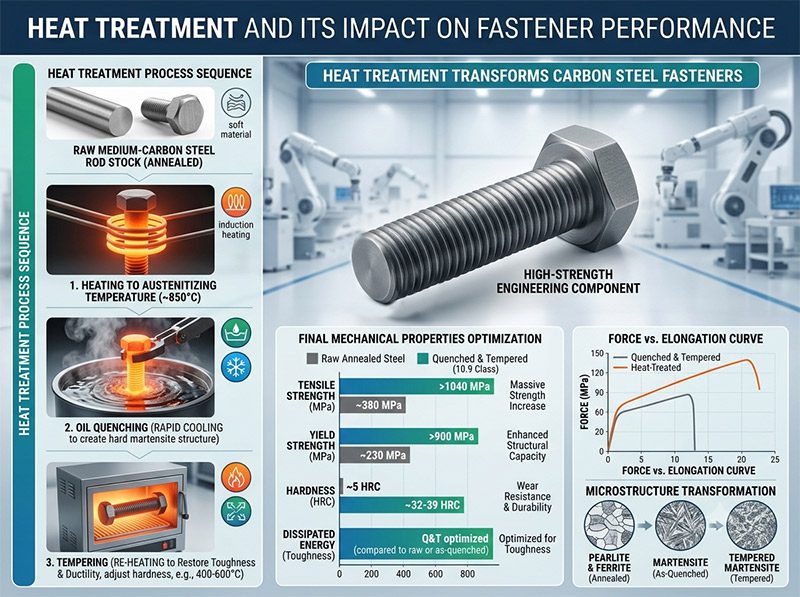
Die Wärmebehandlung verwandelt Kohlenstoffstahl von einem relativ weichen, formbaren Werkstoff in ein hochfestes technisches Bauteil. Für Befestigungselemente mit mittlerem und hohem Kohlenstoffgehalt ist die Abfolge des Abschreckens und Temperns die größte Einzeldeterminante der endgültigen mechanischen Eigenschaften.
Der Quench-und-Temper-Zyklus
Der Norm-Zyklus für einen C1045 Schraube, der auf ISO Class 8.8-Eigenschaften abzielt:
| Prozessschritt | Temperatur | Dauer | Mikrostrukturelle Ergebnisse |
|---|---|---|---|
| Austenitisierung | 830–860°C | 30-60 min | Vollständige Umwandlung in Austenit (FCC γ-Fe) |
| Abschrecken (Öl) | Umgebungsölbad | Schnell | Martensitbildung (BCT-Struktur) |
| Temperierung | 450-550°C | 60–120 min | Temperierter Martensit: reduziertes Härte, wiederhergestellte Duktilität |
Die Temperiertemperatur ist der primäre Bedienknopf. Das Tempern bei 350°C ergibt eine hohe Härte (~48 HRC), aber eine geringe Zähigkeit - ungeeignet für Struktur Befestigungselemente. Die Erhöhung der Temperierungstemperatur auf 520°C opfert eine gewisse Härte (Tropfen auf ~ 30 HRC), verbessert jedoch die Schlagzähigkeit, eine Voraussetzung für Bolzen, die bei erdbewegenden Ausrüstung verwendet werden, die Stoßbelastungen ausgesetzt sind.
Häufige Wärmebehandlungsfehler und Prävention
| Defekt | Wurzelursache | Präventionsstrategie |
|---|---|---|
| Quench-Risse | Übermäßige Abkühlrate; scharfe Gewinde-Wurzelradien | Verwenden Sie Öl anstelle von Wasser Quenchen für mittlere Kohlenstoffstahl; großzügige Radien pro ASME B1.1 sicherstellen |
| Entkohlung | Exposition gegenüber oxidierender Atmosphäre beim Austenitisieren | Ofen mit kontrollierter Atmosphäre (endothermes Gas bei 0,40% Kohlenstoffpotential) |
| Unzureichend Härte | Unzureichende Quench-Schwere oder geringe Härtbarkeit | Überprüfen Sie die Jominy-Härtungskurve für die Hitze; Wechseln Sie zu Bor-behandeltem Festigkeitsklasse für größere Durchmesser |
| Temperamentversprödung | Halten im Bereich von 250-400°C (für bestimmte Stähle) | Vermeiden Sie dieses Temperaturfenster; fügen Sie Molybdän für anfällige Grade hinzu |
Oberflächenveredelung und Korrosionsbeständigkeit
Die Hauptschwäche von Kohlenstoffstahl ist die Korrosionsanfälligkeit. Ohne Oberflächenschutz zeigt ungeschütztes C1045 Schrauben, das der Außenfeuchtigkeit ausgesetzt ist, innerhalb von 48-72 Stunden roten Rost. Ingenieure müssen einen Endbearbeitungsprozess angeben, der Korrosionsschutz, Kosten und alle funktionalen Anforderungen wie konsistentes Drehmoment-Spannungsverhalten in Einklang bringt.
Gemeinsame Finishing-Prozesse für Verbindungselemente aus Kohlenstoffstahl
| Fertig | Korrosionsschutz (Salzspray, ASTM B117) | Typische Dicke | Drehmoment-Spannungsaufprall | RoHS konform | Best Suited für |
|---|---|---|---|---|---|
| Zinkplatin (elektrogalvanisiert) | 72-120 stunden zum weißen rost | 5–12 μm | Minimal — Reibungskoeffizient μ ≈ 0,14–0,20 | Ja (dreiwertige Passivierung) | Indoor Maschinen, allgemeine Industrie |
| Feuerverzinken | 500–1000+ stunden | 45–85 μm | Erfordert Schmiermittel, um Drehmoment zu normalisieren; Fäden müssen überstrichen werden | Ja | Außenbauten, Übertragungstürme, Solarmontage |
| Zinkflocke (Dacromet/Geomet) | 480–1.000+ stunden | 5–15 μm | Konsistente μ ≈ 0,10–0,14; kein Wasserstoffrisiko | Ja | Automobil, Windenergie, hochfeste Schrauben |
| Zink-Nickel-Legierung Plating | 500-1.500 stunden | 8–15 μm | μ ≈ 0,12–0,16; gute konsistenz | Ja | Unterfahrwerk Automobil |
| Phosphat + Öl | 24-72 stunden (nur drinnen) | 3–15 μm | Ausgezeichnet — μ ≈ 0,12–0,14 | Ja | Motoreinbauten, Waffenbauteile |
| Schwarzoxid | Minimal (4-8 Stunden) | < 1 μm | Gut; dekorativ | Ja | Erscheinungsbildkritische Innenwerkzeuge |
Salt Spray Performance in der Praxis
Eine europäische Bauwesen Ausrüstung OEM hat kürzlich ihre Befestigungselement-Lieferkette auditiert und festgestellt, dass Standard-Elektroverzinkungsbolzen an Radlader-Zugangsteilen nach 18 Monaten unter nordischen Winterbedingungen (Straßensalzbelastung) versagten. Die Umstellung auf die Zinkplättchenbeschichtung Geomet 500 – mit zusätzlichen Kosten von etwa $0,012 pro M12-Schraube – beseitigte Garantieansprüche im Zusammenhang mit Befestigungselement-Korrosion über einen Beobachtungszeitraum von drei Jahren.
Für Ingenieure mit Angabe Verbindungselemente aus Kohlenstoffstahl in outdoor-anwendungen ist die faustregel klar: Verzinkung ist für Fabrik Boden Ausrüstung; Zinkflocken oder Heißtauchverzinken ist für alles, was Regen sieht.
Wasserstoffvermehrung: Mechanismen, Risikoszenarien und Prävention
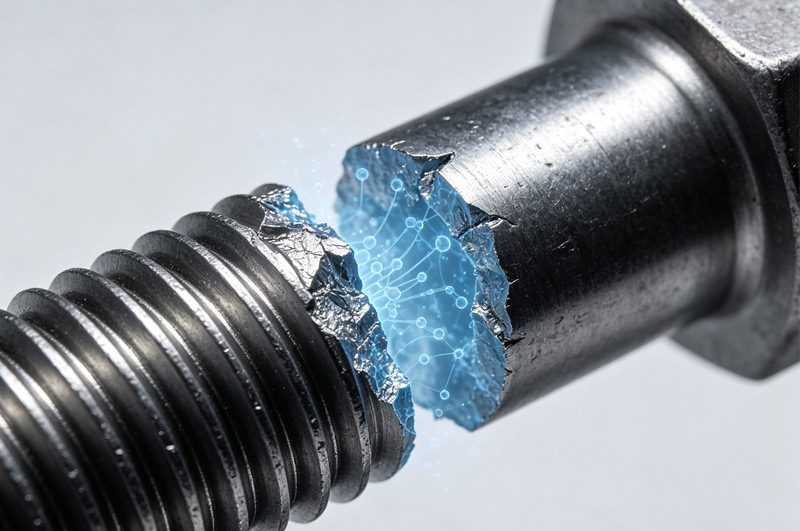
Wasserstoffversprödung (HE) ist der stille Fehlermodus, der Ingenieure, die mit hoher Festigkeit arbeiten, erschreckt Verbindungselemente aus Kohlenstoffstahl. Der Mechanismus ist heimtückisch: atomarer Wasserstoff diffundiert in das Stahlgitter, sammelt sich an Korngrenzen und Spannungskonzentrationen an und verursacht plötzliche Sprödbrüche – oft Tage oder Wochen nach der Installation, bei Lasten, die weit unter dem Kapazität der Schraube liegen.
Wie Wasserstoff in den Stahl gelangt
Es gibt drei primäre Eindringpfade:
| Ingress Path | Mechanismus | Risk Level for Verbindungselemente aus Kohlenstoffstahl |
|---|---|---|
| Electroplating | Cathodic hydrogen evolution during acid pickling and electroplating processes | Hoch — especially for hardness ≥ 32 HRC (ISO 898-1 Class 10.9 and above) |
| Service Environment | Cathodic protection systems, acidic process fluids | Moderate — more relevant to petrochemical and marine environments |
| Fertigung | Steelmaking moisture, wire drawing lubricant decomposition | Low — typically diffuses out during subsequent heat treatment |
Risk Thresholds and Susceptibility
The industry consensus, codified in ISO 15330 und ASTM F1940, establishes a clear hardness threshold:
Below 32 HRC (~1,050 MPa tensile) : Low susceptibility — hydrogen bake-out is generally not required
32–39 HRC (Class 10.9) : Moderate susceptibility — post-plating bake-out mandatory (typically 190–210°C for 4–8 hours within 1 hour of plating)
Above 39 HRC (Class 12.9) : High susceptibility — bake-out mandatory; some OEM specifications prohibit electroplating altogether in favor of zinc flake coatings
Prevention Strategies
The most robust approach is a multi-barrier strategy:
Process substitution : Where design permits, specify mechanical zinc plating or zinc flake coating (Geomet, Dacromet) instead of electroplating. These processes introduce negligible hydrogen.
Bake-out protocol : When electroplating cannot be avoided, enforce a documented bake-out cycle per ISO 9588: 190–210°C, 4 hours minimum for Class 10.9, 8 hours minimum for Class 12.9. The clock starts within 1 hour of removal from the plating bath.
Materialauswahl : For fasteners in hydrogen-charging service environments, consider specifying ASTM A193 B7 (a chromium-molybdenum alloy steel) rather than carbon steel. The alloying elements improve resistance to hydrogen-induced cracking.
Design practices : Reduce notch sensitivity by specifying generous fillet radii at the head-to-shank transition and rolled threads (not cut threads), which introduce compressive residual stresses at the thread root.
Real-World Failure: Wind Turbine Tower Bolts
In 2018, a North American wind farm operator reported multiple bolt fractures at tower flange connections within 12 months of commissioning. The fasteners were ISO 898-1 Class 10.9 electrogalvanized M36 bolts. Failure analysis confirmed hydrogen embrittlement as the root cause. The corrective action — switching to zinc flake coating with documented bake-out — resolved the issue at a per-turbine cost increase of approximately $180, representing less than 0.02% of a turbine’s total installed cost.
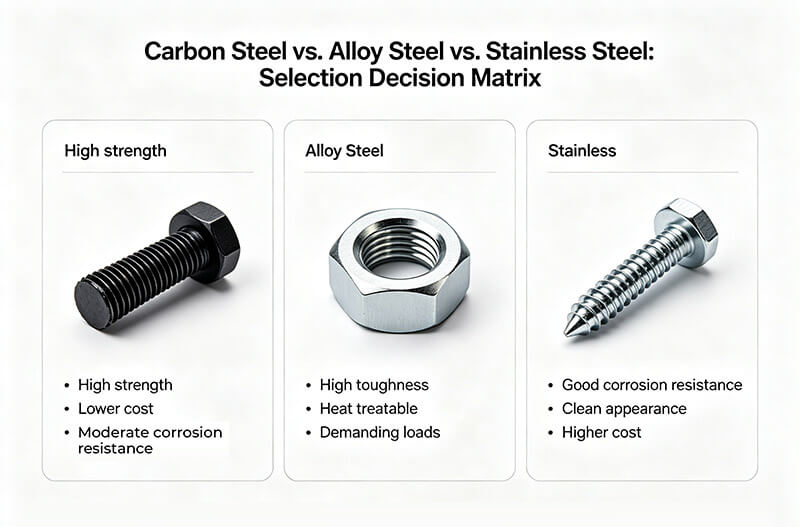
Carbon Steel vs. Alloy Steel vs. Stainless Steel: Selection Decision Matrix
OEM engineers routinely face the “which material?” question at the design review stage. The table below provides a structured comparison across the dimensions that matter most in procurement-driven decisions.
| Selection Criterion | Carbon Steel (C1045, Class 8.8) | Alloy Steel (SCM435, Class 10.9/12.9) | Stainless Steel (A2-70 / A4-80) |
|---|---|---|---|
| Base Material Cost (Index) | 1.0 | 1.8–2.5 | 4.0–6.0 |
| Achievable Tensile Strength | 800–1,000 MPa | 1,000–1,400 MPa | 500–800 MPa |
| Korrosionsbeständigkeit | Requires coating | Moderate (Cr-Mo content) | Hervorragend |
| Low-Temperature Toughness | Fair — brittle below −20°C | Good — usable to −50°C with correct grade | Hervorragend |
| High-Temperature Strength | Poor above 250°C | Good to 400–500°C | Good to 600°C+ |
| Hydrogen Embrittlement Risk | Moderate at Class 10.9+ | Lower (alloying improves resistance) | Niedrig |
| Magnetic Properties | Ferromagnetisch | Ferromagnetisch | Austenitic grades (A2/A4): non-magnetic |
| Recyclability | 100% | 100% | 100% |
| Lead Time for Custom Parts | Shortest | Mäßig | Longest |
When Carbon Steel Is the Right Choice
Total installed cost is the primary constraint and the application environment is controlled (indoor, dry, or coated).
Tensile requirements fall within 400–1,000 MPa — the sweet spot where carbon steel delivers without the alloying premium.
The assembly process involves high-volume automated torquing where consistent friction coefficients matter — zinc flake-coated carbon steel excels here.
The design does not involve sustained elevated temperatures above 200°C.
When to Upgrade to Alloy or Stainless
Cyclic fatigue loading at stress amplitudes exceeding 50% of yield strength — alloy steel’s better hardenability provides more uniform cross-sectional properties in larger diameters.
Service temperature excursions above 250°C — carbon steel’s tempered martensite will continue to soften.
Corrosive environments where coating failure would be catastrophic — food processing, marine, chemical processing plants.
RoHS and REACH Compliance for Verbindungselemente aus Kohlenstoffstahl
European OEMs operating under the RoHS Directive 2011/65/EU und REACH Regulation (EC 1907/2006) impose strict substance restrictions on every component entering their supply chain — including Verbindungselemente aus Kohlenstoffstahl.
RoHS Compliance Checklist for Carbon Steel Fasteners
| Substance | Limit (% by weight in homogeneous material) | Carbon Steel Relevance | Compliance Strategy |
|---|---|---|---|
| Lead (Pb) | 0.1% | Relevant to free-machining steel grades (e.g., 12L14) containing lead as machinability additive | Avoid specifying leaded free-machining grades for EU-bound fasteners |
| Mercury (Hg) | 0.1% | Negligible in carbon steel | Not applicable |
| Cadmium (Cd) | 0.01% | Historically used in plating; now rare | Prohibit cadmium plating; specify zinc or zinc flake alternatives |
| Hexavalent Chromium (Cr⁶⁺) | 0.1% | Highly relevant — Cr⁶⁺ passivation was standard in zinc plating for decades | Mandate trivalent chromium (Cr³⁺) passivation per REACH Annex XVII Entry 47 |
| PBB / PBDE (flame retardants) | 0.1% | Not relevant to steel | Not applicable |
| DEHP / BBP / DBP / DIBP (phthalates) | 0.1% | May be present in thread-locking patch materials (nylon) | Specify RoHS-compliant pre-applied thread lockers (e.g., Loctite Dri-Loc series) |
The Hexavalent Chromium Sunset
Hexavalent chromium passivation — the “yellow zinc” finish familiar to every hardware buyer — has been effectively banned for most industrial applications in the EU since September 2017 under REACH Annex XVII (Entry 47 sunset date). Trivalent chromium passivation (Cr³⁺) has become the default replacement, offering comparable corrosion resistance with a silver-white or blue-tinted appearance.
For engineers writing procurement specifications, the correct call-out is critical. Instead of the legacy “Zinc Plated per ASTM B633, Type III” (which historically implied yellow hexavalent chromate), specify:
“Zinc electroplated per ASTM B633, Type V (trivalent chromium passivate), Fe/Zn 5AN per ISO 4042.”
REACH Substances of Very High Concern (SVHC) Monitoring
Carbon steel itself — iron with less than 2% carbon — is not an SVHC candidate. However, supply chain transparency matters. European OEMs increasingly require full material declarations (FMD) under the IMDS (International Material Data System) framework. A responsible fastener supplier provides:
Mill test certificates (EN 10204 Type 3.1) for each heat of steel
Surface treatment chemistry declarations identifying all process chemicals
REACH SVHC compliance statement updated to the latest candidate list (currently 241 substances as of January 2026)
Chinese Grade to International Standard Cross-Reference
Many equipment OEMs source Verbindungselemente aus Kohlenstoffstahl from Chinese manufacturers. Understanding the equivalence — and the gaps — between GB (Chinese national standards) and international systems is essential for quality assurance.
Carbon Steel for Fasteners: GB to ASTM / ISO / EN / DIN Cross-Reference
| GB/T Grade | Carbon Content Range | Closest ASTM | Closest ISO 898-1 | Closest EN | Closest DIN | Anmerkungen |
|---|---|---|---|---|---|---|
| Q235 (GB/T 700) | 0.14–0.22% | ASTM A307 Gr. A | Class 4.6 | EN 10263-1 C4C | DIN 1.0301 | General structural; not for heat-treated fasteners |
| ML08Al (GB/T 6478) | ≤ 0.10% | — | Class 4.8 (cold-heading) | EN 10263-2 C2C | — | Aluminum-killed low-carbon cold-heading steel |
| ML35 (GB/T 6478) | 0.32–0.39% | SAE J429 Gr. 5 | Klasse 8.8 | EN 10263-3 C35 | DIN 1.1181 | Medium-carbon cold-heading quality |
| ML40Cr (GB/T 6478) | 0.38–0.45% (+Cr) | SAE J429 Gr. 8 | Klasse 10.9 | EN 10263-4 34Cr4 | DIN 1.7033 | Alloy cold-heading steel; technically alloy steel, not plain carbon |
| SWRCH35K (JIS-derived) | 0.32–0.38% | SAE J429 Gr. 5 | Klasse 8.8 | — | — | Cold-heading wire rod; widely used in Asia-Pacific fastener production |
| SWRCH45K (JIS-derived) | 0.42–0.48% | ASTM A325 Type 1 | Klasse 10.9 | — | — | Medium-carbon; suitable for quench-and-temper |
| C1035 (GB/T 699) | 0.32–0.38% | ASTM A29 1035 | Klasse 8.8 | EN 10083-2 C35 | DIN 1.0501 | Direct equivalent across GB/ISO/EN systems |
| C1045 (GB/T 699) | 0.43–0.50% | ASTM A29 1045 | Klasse 10.9 | EN 10083-2 C45 | DIN 1.0503 | Direct equivalent across GB/ISO/EN systems |
Critical Equivalence Gaps to Watch
Three areas require particular scrutiny when qualifying Chinese-supplied carbon steel fasteners against international specifications:
Phosphorus and Sulfur limits : GB/T standards historically permitted slightly higher P and S ceilings (0.035–0.040%) than some ASTM specifications (0.030% max for certain grades). For critical applications, specify “GB/T 699 high-quality structural carbon steel” which tightens the limits.
Entkohlung : Thread decarburization is the most common non-conformance found in third-party inspection of imported fasteners. Specify “no complete decarburization, partial decarburization depth ≤ 1.5% of thread pitch” and require micro-hardness traverse testing per ISO 898-1 Annex B.
Traceability : EN 10204 Type 3.1 certification is not universally standard practice in all Chinese mills. It must be explicitly requested in the purchase order for EU-bound shipments.
Real-World OEM Case Studies
Case 1: Agricultural Equipment Manufacturer — Grade Migration to Reduce Cost
Context : A Midwestern US manufacturer of combine harvesters had been specifying SAE J429 Grade 8 (alloy steel, quenched and tempered) bolts for non-critical chassis panel attachments — over 180 fasteners per machine, 22,000 machines annually.
Challenge : The engineering team conducted a joint-by-joint load analysis and identified 140 of the 180 locations where the actual clamp load requirement was below 60% of an SAE J429 Grade 5 (medium-carbon steel, C1035 equivalent) bolt’s proof load.
Solution : The 140 locations were downgraded from Grade 8 (alloy steel) to Grade 5 (C1035 carbon steel) with Geomet 500 zinc flake coating. The remaining 40 locations at high-stress engine mount and axle connections retained Grade 8.
Ergebnis : Annual fastener cost reduction of $187,000 — a 38% decrease — with zero field failures attributable to the grade migration over a two-year monitoring period.
Key Takeaway : Verbindungselemente aus Kohlenstoffstahl are not a compromise; they are the correct material when the application’s load requirements are well-matched to the grade.
Case 2: European Energy Storage OEM — Hydrogen Embrittlement Elimination
Context : A German manufacturer of utility-scale battery energy storage system (BESS) enclosures experienced in-field bolt fractures on outdoor cabinet door hinges after 8 months in a North Sea coastal installation.
Challenge : The M8 socket head cap screws were ISO 898-1 Class 12.9, electrogalvanized (zinc-plated). Failure analysis at an independent German laboratory (MPA Stuttgart) confirmed hydrogen-induced stress corrosion cracking. The coastal chloride environment accelerated crack propagation after hydrogen had been introduced during electroplating.
Solution : The specification was revised to:
Downgrade from Class 12.9 to Class 10.9 (reducing hardness from 42 HRC to 36 HRC — below the HE danger zone)
Switch from electrogalvanized to Geomet 321 zinc flake coating
Mandate a documented bake-out protocol per ISO 9588 (200°C, 4 hours)
Ergebnis : Zero fractures reported across 1,200 cabinets over a subsequent 24-month monitoring period. The material cost change was neutral — the coating cost increase was offset by the lower base material cost of Class 10.9 vs. 12.9.
Key Takeaway : Hydrogen embrittlement prevention is a systems problem requiring coordinated decisions across grade selection, coating specification, and process control.
Case 3: Italian Rail Component Supplier — Surface Finish Optimization for Automated Assembly
Context : A Northern Italian Tier-1 supplier of railway interior components (seat frames, luggage racks, partition panels) operates fully automated assembly cells with multi-spindle torque tools.
Challenge : The automated cells experienced a 4.2% rejection rate due to torque-angle monitoring alarms — some joints fell outside the ±15% target torque window. Root cause analysis identified inconsistent friction coefficients (μ = 0.09 to 0.19) on electrogalvanized M10 carbon steel bolts from the incumbent supplier.
Solution : The supplier was required to switch to a zinc flake coating (Geomet 500) with an integrated topcoat lubricant that delivers a controlled coefficient of friction of μ = 0.12 ± 0.02. The specification now reads: “Zinc flake coating per ISO 10683 with integral lubricant; coefficient of friction μ = 0.10–0.14 per ISO 16047.”
Ergebnis : Torque rejection rate dropped to 0.3%. Annual rework cost savings of approximately €94,000. The assembly line throughput increased 2.1% due to reduced station stoppages.
Key Takeaway : Fastener surface finish is a hidden variable in automated production economics. A few cents per bolt in finishing cost can return orders of magnitude more through reduced assembly rework.
Häufig gestellte Fragen
Q: What is the difference between C1035 and C1045 for fastener production?
A: The primary difference is carbon content — C1035 contains 0.32–0.38% carbon, while C1045 contains 0.43–0.50%. This translates to a higher achievable hardness and tensile strength for C1045 after quenching and tempering (typically 800–1,000 MPa vs. 700–900 MPa for C1035 under comparable heat treatment). However, C1045 is more prone to quench cracking in complex geometries. For ISO Class 8.8 bolts, C1035 is almost always sufficient. C1045 is normally reserved for Class 10.9 fasteners.
Q: Can Verbindungselemente aus Kohlenstoffstahl be used outdoors?
A: Yes — with the correct surface protection. Uncoated carbon steel will rust within days of outdoor exposure. Hot-dip galvanizing (per ASTM A153 or ISO 10684) or zinc flake coating (per ISO 10683) can provide 15–30 years of outdoor service life in non-marine environments. The key is matching the coating system to the expected corrosivity category (ISO 9223 C1 through C5).
Q: Are carbon steel bolts magnetic?
A: Yes. All carbon steels are ferromagnetic. This can be an advantage or disadvantage depending on the application. MRI equipment and certain sensor assemblies require non-magnetic fasteners (austenitic stainless steel A2/A4). Conversely, magnetic carbon steel fasteners are useful in automated assembly where magnetic bit-holding is needed.
Q: What is the maximum recommended service temperature for carbon steel fasteners?
A: Tempered carbon steel fasteners begin to lose strength at sustained temperatures above approximately 200°C, as the tempering process effectively continues in service. For applications above 250°C, alloy steels containing chromium and molybdenum (such as ASTM A193 Grade B7 or B16) are strongly recommended.
Q: How do I verify that a Chinese supplier’s carbon steel meets my specification?
A: Require three documents as a minimum package: (1) EN 10204 Type 3.1 mill test certificate for each heat, (2) an ISO 17025-accredited third-party test report covering chemical composition, tensile properties, and hardness on a sample from the shipment lot, and (3) a surface treatment certificate of conformance listing the process chemistry and salt spray test results. For critical applications, specify thread decarburization micro-hardness testing per ISO 898-1 Annex B.
Q: Does RoHS apply to carbon steel fasteners?
A: Carbon steel itself is RoHS-compliant. The compliance risk lies in the surface treatment — specifically, hexavalent chromium (Cr⁶⁺) passivation, which is restricted under both RoHS and REACH. Always specify trivalent chromium (Cr³⁺) passivation for zinc-plated fasteners destined for the EU market. Additionally, avoid free-machining carbon steel grades containing lead (e.g., 12L14) for EU shipments.
Q: What is boron-treated carbon steel (10B21), and when should I use it?
A: 10B21 is a low-carbon steel (0.18–0.23% C) microalloyed with a small addition of boron (5–30 ppm). Boron dramatically increases hardenability, allowing 10B21 to achieve mechanical properties comparable to medium-carbon C1045 after quenching and tempering — while retaining the superior cold formability of low-carbon steel. It is particularly well-suited for complex cold-headed geometries (flange bolts, special-head fasteners) that would crack if formed from C1045 wire. 10B21 is widely used in automotive fasteners and is a cost-competitive alternative for Class 10.9 bolts.
Fazit
Verbindungselemente aus Kohlenstoffstahl are not an afterthought in the OEM parts bin. They are an engineered component whose performance depends on an interlocking chain of decisions: carbon content → heat treatment parameters → surface finishing chemistry → quality verification. Get any link wrong, and the consequences range from nuisance corrosion to catastrophic brittle fracture.
Guxiang Metalwork specializes in custom Verbindungselemente aus Kohlenstoffstahl for equipment OEMs — from prototype development through annual frame contracts. If you have a drawing or specification you would like quoted, submit it through our inquiry form for a response within 24 hours.