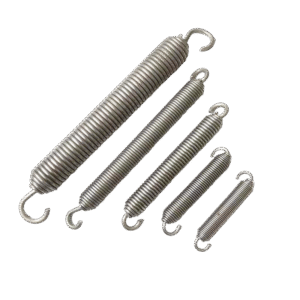
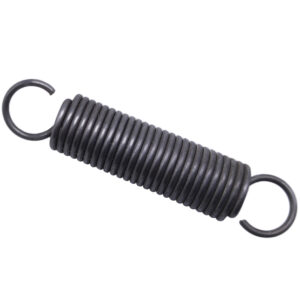
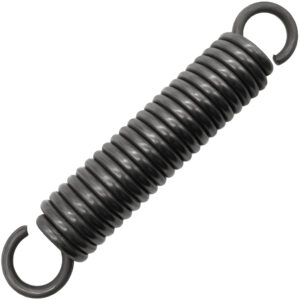
Our extension spring range covers machine hook, crossover center hook, side hook, extended hook, German hook, double full loop, threaded insert end, swivel hook, cylindrical, conical, high-temperature and micro extension springs manufactured to ISO 10243 and DIN 2097. Available in music wire, stainless steel 302/316 and chrome silicon alloy for engineers and industrial buyers.
Dieses Produkt gibt es in mehreren Varianten. Die Optionen können auf der Produktseite ausgewählt werden
Holen Sie sich ein Angebot für Dienstleistungen ein
What are Extension Springs?
An extension spring—also called a tension spring—is a close-wound helical spring that resists axial tensile force. Unlike a compression spring that pushes back when squeezed, an extension spring pulls back when stretched. The coils are wound tightly together at free length with initial tension built in: a force must be applied just to begin separating the coils before the spring’s rated rate takes over. The ends are formed into hooks, loops, or threaded fittings that connect the spring to the components it holds together.
This pulling mechanism makes extension springs the fastener of choice for applications where two parts must be drawn together and held under tension. Garage door counterbalance systems, trampoline mats, automotive brake return mechanisms, pliers and gripper tools, washing machine suspension, and agricultural gate hinges all depend on extension springs to store energy on extension and return components to their original position.
How Extension Springs Work
An extension spring stores energy as the wire is twisted in torsion when the coils are pulled apart. Unlike a compression spring where all coils are active, an extension spring has every coil wound in contact with its neighbors at free length. The spring exerts no force at free length—a property unique to extension springs among the major spring families. The initial tension, typically 10–25% of the maximum safe load, must be overcome before any deflection occurs.
The hook or end fitting is the critical stress point. As the spring stretches, the bending stress concentrates where the hook transitions from the coil body. A standard machine hook is simply the end coil bent out and up, creating a radius that is half the coil diameter—this tight bend is the most common fatigue failure point. Specialized end types like the German hook (which rises straight up from the coil body) and the threaded insert (which eliminates the hook bend entirely) reduce stress concentration and extend cycle life by factors of three to five compared to a standard machine hook.
The spring rate of an extension spring—like a compression spring—is linear once initial tension is exceeded. The total force at any extension equals the initial tension plus the spring rate multiplied by the deflection distance. Initial tension is a manufacturing variable controlled by the coiling process: the tighter the coils are wound against each other, the higher the initial tension.
Extension Spring Classification System
Extension springs are classified primarily by end type—the hook or fitting style—and secondarily by coil geometry. The end type determines stress distribution, cycle life, and how the spring connects to its mating components. The coil body follows standard cylindrical geometry in most cases, with conical variants solving specific spatial constraints.
Standard hook endscover the majority of industrial applications. The machine hook—also called a regular or English hook—is the simplest and most common: the end coil is bent out and up to form a U-shaped loop aligned with the spring axis. The crossover center hook positions the loop directly over the centerline of the spring body by crossing the hook wire across the coil face, giving centered loading that reduces side thrust on the mating pin. The side hook bends the end coil out to the side rather than up, allowing the attachment point to sit beside the spring body instead of inline—useful when axial space is tight. The extended hook adds a straight shank between the coil body and the hook loop, keeping the hook clear of obstructions or reaching through a panel to an attachment point.
Special endsaddress fatigue, alignment, and connection requirements beyond what a bent-wire hook can deliver. The German hook rises straight up from the end coil rather than bending out, creating a larger transition radius that distributes bending stress over a longer path. A double full loop end forms a complete 360° circle at each end, distributing the load across two wire cross-sections and halving the contact stress on the mating pin. A threaded insert end replaces the hook with a machined fitting—typically a threaded stud or socket—pressed or screwed into the spring body. This eliminates the hook bend entirely and transfers load through the fitting’s thread shear rather than wire bending. The swivel hook end adds a rotating fitting that allows the spring to twist freely during extension, preventing the torsional wind-up that can snap a fixed hook.
Geometric typesaddress space and buckling. The cylindrical extension spring is the universal default: constant diameter and pitch throughout. A conical extension spring tapers in diameter from one end to the other. When stretched, the smaller-diameter coils reach their yield point first, creating a progressive rate that stiffens as extension increases—this limits over-extension in applications where the load varies unpredictably.
High-temperature and microvariants push the operating envelope. High-temperature extension springs use Inconel or chrome silicon alloy for continuous service above 250 °C. Micro extension springs with wire diameters from 0.1 mm and free lengths under 10 mm serve medical devices, precision instruments, and micro-electromechanical systems.
Types of Extension Springs
The twelve types below cover the four classification groups: standard hook ends, special ends, geometric variants, and performance/specialty. The end type is the primary specification layer—every extension spring, regardless of geometry or material, must have a defined end fitting.
Typ
Gruppe
End Feature
Schlüsselstandard
Typische Anwendung
Maschinenhaken
Hook End
End coil bent out and up, U-loop aligned with axis
DIN 2097
General purpose—trampolines, screen doors, light industrial
Medical catheters, microswitches, precision instruments, watch movements
Materialien
Music Wire (ASTM A228)
High-carbon steel, cold-drawn—the standard for general-purpose extension springs
Tensile range 1,600–2,400 MPa depending on wire diameter; limited to 120 °C continuous
Hook bends are the fatigue weak point; specify a larger hook radius or a German hook for cycle-critical applications
Edelstahl 302/304 (ASTM A313)
Corrosion-resistant and non-magnetic after cold working; operating range −200 °C to 290 °C
Lower tensile strength than music wire at equivalent diameter—spring rate reduced by approximately 15%
Standard for food processing, marine hardware, medical devices, and outdoor equipment
Edelstahl 316
Molybdenum-alloyed for chloride pitting resistance; coastal, offshore, and chemical environments
Etwas geringere Festigkeit als 302 bei gleichem Drahtdurchmesser
Chromsilizium (ASTM A401, AISI 9254)
Alloy steel with high fatigue life under alternating stress; quenched and tempered to HRC 47–51
Maximum operating temperature 250 °C; preferred for high-cycle extension springs in automotive and industrial machinery
Inconel 718 / Inconel X-750
Nickel-chromium superalloys for continuous service to 450 °C in corrosive atmospheres
Maintain spring force at temperatures where stainless steel anneals and music wire loses temper
Specified for turbine seals, exhaust valves, gas turbine linkages, and downhole petroleum tools
How to Choose the Right Extension Spring
Step 1: Load at extended length—what force is required and where?
Define the force needed at the installed (preloaded) length and at the fully extended length. The difference divided by the extension travel gives the required spring rate. Remember that initial tension must be included: if the design requires 10 N at a 5 mm extension and the spring has 3 N of initial tension, the rate must deliver the remaining 7 N over 5 mm, giving a rate of 1.4 N/mm.
Step 2: End type—how does the spring connect and how many cycles?
If the spring cycles more than 10⁵ times, standard machine hooks will fail at the bend transition. Upgrade to a German hook (3× fatigue life) or a threaded insert end (eliminates the bend entirely). If the load applies a twisting moment as the spring extends, a swivel hook prevents torsional wind-up from adding shear stress to the hook bend. For safety-critical connections where a hook failure would release stored energy, a double full loop distributes load across two wire sections.
Step 3: Environment and material
For outdoor or wet environments, stainless steel 302 avoids the stress-corrosion cracking that affects music wire. For temperatures above 120 °C, abandon carbon steel and move to chrome silicon (to 250 °C) or Inconel (to 450 °C). Always derate published fatigue limits by 20% for stainless steel operating in cyclic tension—the combination of corrosion pitting and alternating stress accelerates crack initiation at the hook bend.
Häufig gestellte Fragen
What is initial tension in an extension spring?Initial tension is the force wound into the spring during coiling that holds the coils together at free length. A force equal to the initial tension must be applied before the coils begin to separate and the spring rate takes effect. It is controlled by the coiling mandrel setup.
How do I calculate the spring rate of an extension spring?Spring rate k = Gd⁴/(8D³n), where G is shear modulus, d wire diameter, D mean coil diameter, and n active coils. In service, measure force at two extended lengths and divide the force difference by the deflection difference, after deducting initial tension.
What is the difference between a machine hook and a German hook?A machine hook bends out and up from the coil, forming a tight radius at the transition. A German hook rises straight up from the end coil, creating a larger transition radius. The German hook distributes bending stress over a longer path and typically offers three times the fatigue life.
Why do extension spring hooks break first?The hook bend is the highest-stress point. Wire bending during hook forming introduces residual tensile stress on the inside of the bend, and the radius is only half the coil diameter. Under cyclic loading, fatigue cracks initiate at the inside bend and propagate through the wire.
What is the difference between stainless steel 302 and 316 for extension springs?Both resist corrosion, but 316 adds molybdenum for superior chloride and saltwater resistance. 302 offers slightly higher strength and lower cost. Choose 316 for marine and chemical exposure; choose 302 for general food, medical, and outdoor use where cost matters.
How many cycles can an extension spring withstand?A properly designed extension spring in music wire can reach 10⁷ cycles when hook stress stays below the endurance limit. Chrome silicon reaches 10⁶ cycles under heavy load. German hook ends extend life threefold over machine hooks; threaded inserts eliminate hook fatigue entirely.
What is the maximum extension of an extension spring?Extension is limited by the elastic limit of the wire, not by coil contact—unlike compression springs. Exceeding roughly 30–40% of free length on standard designs causes permanent set. Conical springs with a progressive rate and swivel hooks help protect against over-extension.
Can I use an extension spring as a compression spring?Extension springs are close-wound with coils touching—they cannot compress. Using one in compression would immediately reach solid height with zero travel and likely buckle. The two spring types are not interchangeable.
How do I measure the free length of an extension spring?Free length is measured inside the hooks—from the inside of one hook loop to the inside of the opposite hook loop. This is the length the spring occupies when no external force is applied, and it is the baseline for all extension and rate calculations.
Can extension springs be connected in series?Yes—connecting two extension springs end to end halves the effective spring rate and doubles the available travel, identical to compression springs in series. A rigid link between the springs is recommended. Springs in parallel double the rate for the same travel.