EN
EN  ZH
ZH 

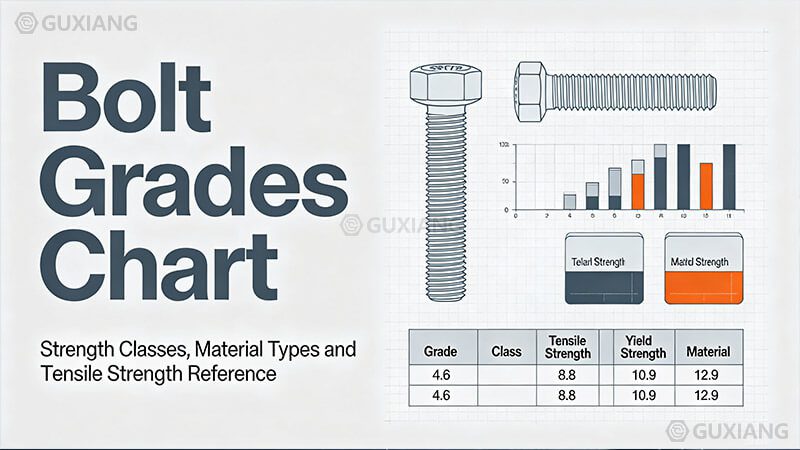
Bolt grades determine the strength, material composition, and appropriate applications for every fastener. This chart organizes US bolt grades (SAE J429) and metric bolt classes (ISO 898-1) with their head identification marks, size ranges, proof load, yield strength, and tensile strength. Use the interactive lookup tool below to quickly compare any grade, or browse the full specification tables for engineering reference.
Select a bolt grade to view its complete mechanical properties and material specifications.
Quick Grade Lookup
US and metric bolts use different marking systems to identify their grade. Learning to read these markings allows quick visual identification in the field.
No radial lines on head. Low-carbon steel for general-purpose, non-critical applications.
3 radial lines at 72° intervals. Heat-treated medium carbon steel for general machinery.
6 radial lines at 36° intervals. Heat-treated alloy steel for high-strength structural use.
Numeric stamp "10.9" on head. Alloy steel, heat-treated. Most common metric high-strength grade.
Numeric stamp "12.9" on head. Highest standard metric grade. Alloy steel, high strength.
US bolt grades per SAE J429. All strength values in PSI. Size ranges shown where different values apply to different diameter ranges within the same grade.
| Head Marking | Grade | Material | Size Range | Proof Load (PSI) |
Yield Strength (PSI) |
Tensile Strength (PSI) |
|---|---|---|---|---|---|---|
| Carbon & Alloy Steel Grades | ||||||
| None | 307A | Low-carbon steel | 1/4" – 4" | N/A | N/A | 60,000 |
| None | Grade 2 | Low/medium-carbon steel | 1/4" – 3/4" Over 3/4" – 1-1/2" | 55,000 33,000 | 57,000 36,000 | 74,000 60,000 |
| 3 lines | Grade 5 | Heat-treated medium-carbon steel | 1/4" – 1" Over 1" – 1-1/2" | 85,000 74,000 | 92,000 81,000 | 120,000 105,000 |
| 6 lines | Grade 8 | Heat-treated alloy steel | 1/4" – 1-1/2" | 120,000 | 130,000 | 150,000 |
| A325 | A325 | Carbon/alloy steel (with/without boron) | 1/2" – 1-1/2" | 85,000 | 92,000 | 120,000 |
| Corrosion-Resistant & Specialty Alloys | ||||||
| Mfr. marks | 18-8 / 316 SS | Stainless steel (Cr + Ni) | All sizes thru 1" | N/A | 30,000 min 65,000 typical | 65,000 min 80,000–90,000 typ. |
| Mfr. marks | 651 Silicon Bronze | Cu-Sn-Si alloy | 1/4" – 3/4" 7/8" – 1-1/2" | N/A | 55,000 40,000 | 70,000 55,000 |
| Mfr. marks | 2024 Aluminum | Al-Cu-Mg-Mn alloy, heat treated | All sizes | N/A | 36,000 | 55,000 |
Metric property classes per ISO 898-1. All strength values in MPa (N/mm²). The class number encodes tensile and yield strength: first digit = 1/10 of tensile (MPa), second digit = 10x yield/tensile ratio.
| Head Marking | Class | Material | Size Range | Proof Load (MPa) |
Yield Strength (MPa) |
Tensile Strength (MPa) |
|---|---|---|---|---|---|---|
| Carbon & Alloy Steel Classes | ||||||
| 8.8 | Class 8.8 | Heat-treated medium-carbon steel | Below 16mm 16mm – 72mm | 580 600 | 640 660 | 800 830 |
| 10.9 | Class 10.9 | Heat-treated alloy steel | 5mm – 100mm | 830 | 940 | 1040 |
| 12.9 | Class 12.9 | Heat-treated alloy steel, high strength | 1.6mm – 100mm | 970 | 1100 | 1220 |
| Corrosion-Resistant | ||||||
| A2 / A4 | A-2 / A-4 SS | Stainless steel (Cr + Ni) | All sizes thru 20mm | N/A | 210 min 450 typical | 500 min 700 typical |
While US (SAE) and metric (ISO) bolt grades are not directly interchangeable, the following approximate cross-references help when converting between systems. These matches are based on similar tensile strength ranges only; thread forms, dimensions, and torque values differ.
Low/medium carbon steel. Tensile: 60–74 ksi (US) vs 400 MPa (metric). General-purpose, non-critical fastening.
Medium carbon steel, Q&T. Tensile: 120 ksi (US) vs 800 MPa (metric). General machinery and automotive.
Alloy steel, heat-treated. Tensile: 150 ksi (US) vs 1040 MPa (metric). High-stress structural applications.
No direct US SAE equivalent. Tensile: 1220 MPa. Highest standard metric grade. Used in precision machinery and tooling.
Social Chat is free, download and try it now here!