Bolt Grades Chart

Bolt-Grades-Chart

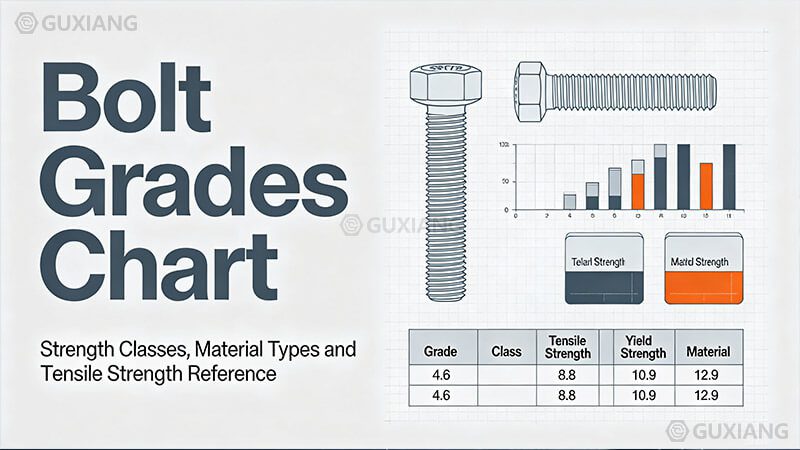
Bolt grades determine the strength, material composition, and appropriate applications for every fastener. This chart organizes US bolt grades (SAE J429) and metric bolt classes (ISO 898-1) with their head identification marks, size ranges, proof load, yield strength, and tensile strength. Use the interactive lookup tool below to quickly compare any grade, or browse the full specification tables for engineering reference.

Bolt Grade Lookup Tool

Select a bolt grade to view its complete mechanical properties and material specifications.

Quick Grade Lookup

How to Read Bolt Head Markings

US and metric bolts use different marking systems to identify their grade. Learning to read these markings allows quick visual identification in the field.

No marks

Grade 2 / 307A

No radial lines on head. Low-carbon steel for general-purpose, non-critical applications.

Grade 5

3 radial lines at 72° intervals. Heat-treated medium carbon steel for general machinery.

Grade 8

6 radial lines at 36° intervals. Heat-treated alloy steel for high-strength structural use.

10.9ISO

Class 10.9

Numeric stamp "10.9" on head. Alloy steel, heat-treated. Most common metric high-strength grade.

12.9ISO

Class 12.9

Numeric stamp "12.9" on head. Highest standard metric grade. Alloy steel, high strength.

US Bolt Grades — Complete Specification Table

US bolt grades per SAE J429. All strength values in PSI. Size ranges shown where different values apply to different diameter ranges within the same grade.

Head Marking Grade Material Size Range Proof Load
(PSI)
Yield Strength
(PSI)
Tensile Strength
(PSI)
Carbon & Alloy Steel Grades
None307ALow-carbon steel1/4" – 4"N/AN/A60,000
NoneGrade 2Low/medium-carbon steel1/4" – 3/4"
Over 3/4" – 1-1/2"
55,000
33,000
57,000
36,000
74,000
60,000
3 linesGrade 5Heat-treated medium-carbon steel1/4" – 1"
Over 1" – 1-1/2"
85,000
74,000
92,000
81,000
120,000
105,000
6 linesGrade 8Heat-treated alloy steel1/4" – 1-1/2"120,000130,000150,000
A325A325Carbon/alloy steel (with/without boron)1/2" – 1-1/2"85,00092,000120,000
Corrosion-Resistant & Specialty Alloys
Mfr. marks18-8 / 316 SSStainless steel (Cr + Ni)All sizes thru 1"N/A30,000 min
65,000 typical
65,000 min
80,000–90,000 typ.
Mfr. marks651 Silicon BronzeCu-Sn-Si alloy1/4" – 3/4"
7/8" – 1-1/2"
N/A55,000
40,000
70,000
55,000
Mfr. marks2024 AluminumAl-Cu-Mg-Mn alloy, heat treatedAll sizesN/A36,00055,000

Metric Bolt Classes — Complete Specification Table

Metric property classes per ISO 898-1. All strength values in MPa (N/mm²). The class number encodes tensile and yield strength: first digit = 1/10 of tensile (MPa), second digit = 10x yield/tensile ratio.

Head Marking Class Material Size Range Proof Load
(MPa)
Yield Strength
(MPa)
Tensile Strength
(MPa)
Carbon & Alloy Steel Classes
8.8Class 8.8Heat-treated medium-carbon steelBelow 16mm
16mm – 72mm
580
600
640
660
800
830
10.9Class 10.9Heat-treated alloy steel5mm – 100mm8309401040
12.9Class 12.9Heat-treated alloy steel, high strength1.6mm – 100mm97011001220
Corrosion-Resistant
A2 / A4A-2 / A-4 SSStainless steel (Cr + Ni)All sizes thru 20mmN/A210 min
450 typical
500 min
700 typical

US vs. Metric Grade Cross-Reference

While US (SAE) and metric (ISO) bolt grades are not directly interchangeable, the following approximate cross-references help when converting between systems. These matches are based on similar tensile strength ranges only; thread forms, dimensions, and torque values differ.

Grade 2 ≈ Class 4.6

Low/medium carbon steel. Tensile: 60–74 ksi (US) vs 400 MPa (metric). General-purpose, non-critical fastening.

Grade 5 ≈ Class 8.8

Medium carbon steel, Q&T. Tensile: 120 ksi (US) vs 800 MPa (metric). General machinery and automotive.

Grade 8 ≈ Class 10.9

Alloy steel, heat-treated. Tensile: 150 ksi (US) vs 1040 MPa (metric). High-stress structural applications.

— ≈ Class 12.9

No direct US SAE equivalent. Tensile: 1220 MPa. Highest standard metric grade. Used in precision machinery and tooling.

How to Select the Right Bolt Grade

Grade Selection Guide

  1. Determine the load type — Static tensile loads require proof load capacity; dynamic or shock loads require higher fatigue strength (typically Grade 8 or Class 10.9+). Shear loads depend on cross-sectional area and material shear strength (approximately 60% of tensile strength for steel).
  2. Consider the environment — Indoor, dry environments can use any carbon steel grade with appropriate plating. Outdoor or corrosive environments require stainless steel (18-8, 316), silicon bronze, or hot-dip galvanized Grade 5/8. Marine applications should use 316 stainless or silicon bronze.
  3. Match the original specification — For replacement fasteners, always match the original grade. Never downgrade. Upgrading is acceptable if the joint design can accommodate the higher clamp force and the head marking won't cause confusion during future maintenance.
  4. Account for temperature — Carbon steel grades lose strength above 500°F (260°C). For high-temperature applications, consider alloy steel (Grade B7 / Class 8.8+) or stainless steel. Below -50°F, carbon steel becomes brittle; use austenitic stainless or nickel alloy fasteners.
  5. Verify galvanic compatibility — When joining dissimilar metals, select a bolt material that is noble relative to both joined materials to prevent galvanic corrosion. For example, use stainless steel bolts in aluminum structures (stainless is cathodic to aluminum, but the small bolt area minimizes corrosion).

Frequently Asked Questions

How do I identify bolt grade by head markings?
US bolt grades are identified by radial lines on the bolt head: Grade 2 has no markings, Grade 5 has 3 radial lines spaced 72 degrees apart, Grade 8 has 6 radial lines spaced 36 degrees apart. Metric bolts use a numerical class stamped on the head: 8.8, 10.9, or 12.9. The first digit represents one-tenth of the nominal tensile strength in MPa (so 10 means approximately 1000 MPa), and the second digit after the decimal represents ten times the ratio of yield strength to tensile strength.
What is the strongest standard bolt grade?
In the US SAE system, Grade 8 is the strongest standard hex bolt with minimum tensile strength of 150,000 psi (1034 MPa). In the metric ISO system, Class 12.9 is the strongest with minimum tensile strength of 1220 MPa (177,000 psi). For structural applications, ASTM A490 (US) is comparable to Grade 8 with minimum tensile strength of 150 ksi. Above these, aerospace-grade fasteners like NAS bolts can reach 180 ksi and beyond, but they follow different standards.
What is the difference between Grade 5 and Grade 8 bolts?
Grade 5 bolts are made from heat-treated medium carbon steel with minimum tensile strength of 120,000 psi and minimum yield of 92,000 psi (for sizes up to 1 inch). Grade 8 bolts are made from heat-treated alloy steel with minimum tensile strength of 150,000 psi and minimum yield of 130,000 psi. Grade 8 is approximately 25 percent stronger in tension and 41 percent stronger in yield. Grade 5 is identified by 3 head lines; Grade 8 by 6 head lines. Grade 8 is used in high-stress structural and automotive applications where Grade 5 suffices for general machinery.
What does the metric bolt class 10.9 mean?
The metric property class 10.9 encodes two mechanical properties: the first digit (10) represents one-tenth of the minimum ultimate tensile strength in MPa, so 10 means 1000 MPa (approximately 145,000 psi). The second digit after the decimal (9) represents ten times the ratio of yield strength to tensile strength, so 0.9 means yield is 90 percent of tensile, giving a yield strength of 940 MPa. Class 10.9 is made from heat-treated alloy steel and is the most common grade for automotive and machinery applications in metric markets.
Can I mix different bolt grades in the same assembly?
In general, you should not mix bolt grades in the same joint. All bolts in a joint should be the same grade, size, and material to ensure uniform clamp load distribution. If one bolt is stronger than the others, it will carry a disproportionate share of the load, potentially leading to sequential failure. The exception is when an engineer specifically designs a joint with mixed grades for a controlled failure mode. Always replace a failed bolt with the same grade as the original, never upgrade a single bolt in an otherwise lower-grade joint.
What is the difference between proof load and tensile strength?
Proof load is the maximum load a bolt can withstand without permanent deformation (yielding). It is essentially the practical working limit: if you apply a proof load and release it, the bolt returns to its original length. Tensile strength (ultimate tensile strength) is the load at which the bolt fractures. Proof load is always lower than tensile strength. For example, a Grade 8 bolt (up to 1-1/2 inch) has a proof load of 120,000 psi but a tensile strength of 150,000 psi. In practice, bolts are tightened to approximately 75 percent of proof load to ensure elastic behavior.
Are stainless steel bolts weaker than Grade 5 steel bolts?
Yes, standard austenitic stainless steel bolts (18-8 / 304 / A2-70) are generally weaker than Grade 5 steel bolts. An 18-8 stainless bolt has minimum yield of 30,000 psi and typical tensile of 65,000 to 80,000 psi, compared to Grade 5 at 92,000 psi yield and 120,000 psi tensile. However, stainless steel offers superior corrosion resistance. For applications requiring both strength and corrosion resistance, consider A4-80 stainless (316 alloy, 80,000 psi yield) or cadmium/zinc-plated Grade 5 or Grade 8 bolts.
How do I convert between US bolt grades and metric property classes?
Approximate cross-references: Grade 2 is similar to Class 4.6 (low strength, low/medium carbon steel). Grade 5 is similar to Class 8.8 (medium carbon steel, quenched and tempered). Grade 8 is similar to Class 10.9 (alloy steel, heat-treated). These are approximate matches in tensile strength only; thread forms, head dimensions, and torque specifications differ between US and metric systems and should never be interchanged in critical applications. Always specify the correct standard for your application.
What bolt grade should I use for automotive applications?
Most automotive applications use Grade 5 (SAE) or Class 8.8 (metric) for general fastening, and Grade 8 (SAE) or Class 10.9 (metric) for critical structural joints such as suspension components, engine mounts, and steering linkages. High-performance and racing applications may use Class 12.9 or aerospace-grade fasteners. Always follow the vehicle manufacturer's specification for replacement fasteners. Upgrading to a higher grade is acceptable if space permits, but never downgrade from the original specification.
What is the purpose of the numbering system in metric bolt classes like 8.8, 10.9, and 12.9?
The metric property class numbering system per ISO 898-1 encodes two key mechanical properties in a compact format. The number before the decimal point represents one-tenth of the nominal ultimate tensile strength in MPa. The number after the decimal point represents ten times the ratio of yield strength to ultimate tensile strength (as a percentage divided by 10). For example, 8.8 means tensile strength is 800 MPa and yield is 80 percent of tensile (640 MPa). Class 12.9 means tensile is 1200 MPa and yield is 90 percent of tensile (1100 MPa). This system allows engineers to quickly identify bolt strength from the head marking.
Disclaimer: The data provided in this bolt grades chart is for general reference purposes only. Mechanical properties may vary by manufacturer, production lot, and applicable standards revision. Always verify specifications against SAE J429, ISO 898-1, ASTM standards, or the original equipment manufacturer's requirements before procurement or installation. GUXIANG does not guarantee the accuracy or completeness of this data and assumes no liability for errors or omissions.

Related Engineering Resources

Table of Contents

Send Your Inquiry
Share: