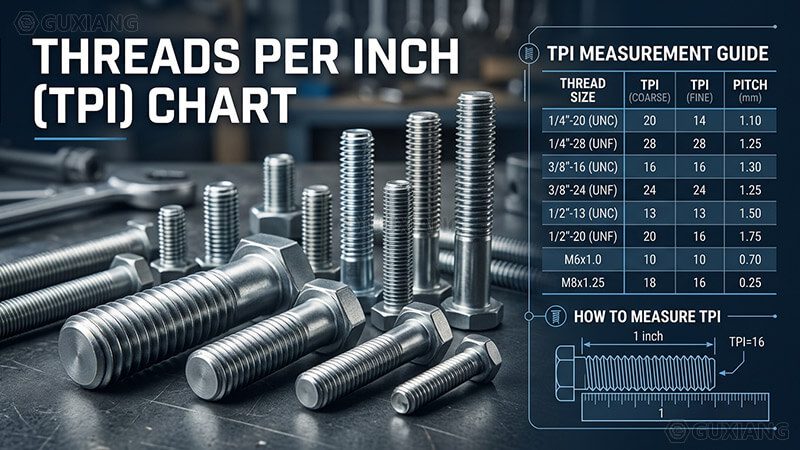
A complete threads-per-inch reference for US fasteners from #0000 to 2 inch. Use the lookup tool below to find UNC (coarse) and UNF (fine) TPI values along with metric pitch equivalents in millimeters.
The table below lists every standard US fastener size with its coarse (UNC) and fine (UNF) threads-per-inch values, plus the corresponding metric pitch in millimeters. Sizes #0000 through #000 are used in miniature electronics and instrument screws; #0 through #12 cover machine screws; fractional sizes 1/4″ through 2″ cover bolts and studs.
Bolt Size
Decimal ⌀ (in)
UNC TPI
UNF TPI
UNC Pitch (mm)
UNF Pitch (mm)
Understanding Thread Series
🔩
UNC (Coarse)
Unified National Coarse — the default thread series for general-purpose fasteners. Fewer threads per inch means faster assembly and better resistance to nicking and galling.
⚙️
UNF (Fine)
Unified National Fine — more threads per inch than UNC for the same diameter. Provides higher tensile strength, finer adjustment, and better vibration resistance.
📏
8UN (Extra Coarse)
8-thread-per-inch series for large-diameter bolts (3/4″ and above). Used in heavy structural and pressure-vessel applications where coarse adjustment is needed.
🔄
Metric Equivalents
Metric threads use pitch (distance between crests in mm) instead of TPI. Divide 25.4 by the TPI value to convert. For example, 20 TPI = 1.27 mm pitch.
How to Count Threads Per Inch
Align a ruler with the bolt axis. Place a standard inch ruler parallel to the bolt so you can see the thread crests clearly along the shank.
Count thread peaks over 1 inch. Starting from a thread crest, count each peak (crest) within exactly one linear inch. That count is the TPI.
Use the 1-inch method for coarse threads. For UNC bolts (e.g., 1/4″-20), you should count exactly 20 peaks in one inch.
Measure multiple inches for fine threads. For UNF or high-TPI sizes, count over 2–3 inches and divide by the number of inches for better accuracy.
Verify with a thread pitch gauge. For critical applications, use a mechanical thread pitch gauge to confirm the TPI rather than relying on visual counting alone.
Frequently Asked Questions
TPI stands for Threads Per Inch — the number of thread crests (peaks) counted along one linear inch of a fastener's shank. It is the standard way to specify thread density in the US customary system. A higher TPI means finer, more closely spaced threads.
Divide 25.4 by the TPI value. For example, a 20 TPI bolt has a metric pitch of 25.4 ÷ 20 = 1.27 mm. Conversely, to convert metric pitch to TPI, divide 25.4 by the pitch in mm: a 1.5 mm pitch equals 25.4 ÷ 1.5 ≈ 17 TPI.
UNC (Unified National Coarse) has fewer threads per inch, making it faster to assemble and more resistant to cross-threading. UNF (Unified National Fine) has more threads per inch, providing greater tensile strength and better resistance to vibration loosening. For example, a 1/4″ bolt has 20 TPI in UNC but 28 TPI in UNF.
A 1/4-20 bolt has 20 threads per inch. The "20" in the designation is the TPI value. This is the standard UNC (coarse) thread for 1/4 inch diameter fasteners. Its metric pitch equivalent is 25.4 ÷ 20 = 1.27 mm.
A 3/8-16 bolt has 16 threads per inch in its UNC (coarse) series. The metric equivalent pitch is 25.4 ÷ 16 ≈ 1.59 mm. In UNF (fine), a 3/8 inch bolt has 24 TPI (1.06 mm pitch).
No. UNC and UNF fasteners of the same diameter have different TPI values and will not thread together. A 1/4″-20 UNC bolt will not fit into a 1/4″-28 UNF nut. Always match both the diameter and the TPI (or thread series designation) when pairing bolts and nuts.
Smaller diameter fasteners have less material cross-section, so finer threads (higher TPI) are needed to maintain adequate thread depth and strength. A #0 screw at 80 TPI has very fine threads relative to its 0.060″ diameter, while a 1″ bolt at 8 TPI has much coarser threads proportionally.
8UN is a constant-pitch thread series with 8 threads per inch, used for large-diameter bolts (typically 3/4″ and above). It is common in structural steel connections, pressure vessels, and heavy machinery where very coarse threads are needed for rapid assembly and high shear strength.
Lay an inch ruler along the bolt shank and count the number of thread crests within one inch. For fine threads, count over 2–3 inches and divide by the length measured. For best accuracy on critical fasteners, use a thread pitch gauge — a set of comb-like tools that physically mesh with the threads to confirm the TPI.
The largest standard sizes in this chart are 1-3/4″ (5 TPI UNC) and 2″ (4.5 TPI UNC). These are used in heavy structural and industrial applications. Above 2 inches, fasteners typically use special thread series or metric threads per ASME B1.1.
Disclaimer: The data provided in this TPI chart is for general reference purposes only. Thread specifications may vary by manufacturer and applicable standards revision. Always verify thread dimensions against ASME B1.1, ASME B18.2.1, or the original equipment manufacturer's specifications before procurement or installation. GUXIANG does not guarantee the accuracy or completeness of this data and assumes no liability for errors or omissions.
 EN
EN  ZH
ZH