





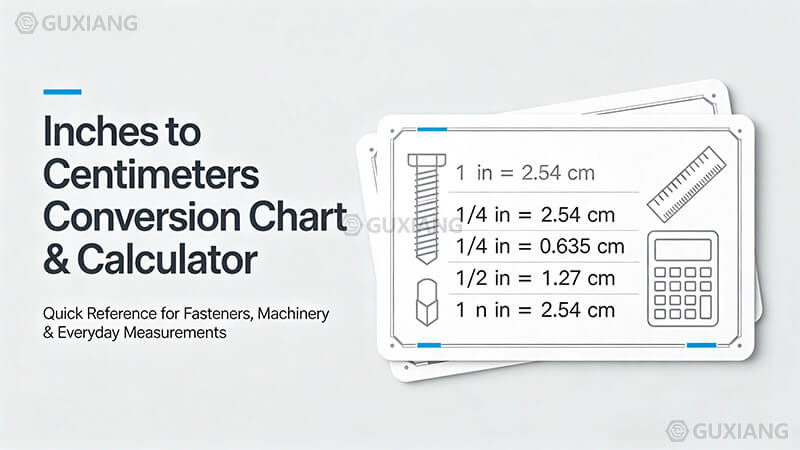
Quick Answer: 1 inch = 2.54 centimeters exactly. To convert inches to centimeters, multiply the inch value by 2.54.
cm = inches × 2.54
Whether you are reading a metric drawing, specifying fastener lengths for an international order, or converting legacy imperial blueprints to metric, accurate inch-to-centimeter conversion is essential in manufacturing and engineering. A small rounding error on a bolt length or thread pitch can cascade into assembly failures, wasted material, and costly re-machining.
This page gives you an interactive calculator, a comprehensive fractional-inch conversion chart (from 1/64" through 10"), and a fastener-specific reference table so you can move between imperial and metric with confidence.
Inches to Centimeters Calculator
Inches → Centimeters
Result
0.0000 cm
Centimeters → Inches
Result
0.0000 in
Fractional Inches to Centimeters Conversion Table
The chart below covers fractional inches from 1/64" to 10", showing the decimal-inch equivalent and the precise centimeter value. Use the filter buttons to jump to the range you need.
| Fractional Inches | Decimal Inches | Centimeters (cm) | Millimeters (mm) |
|---|
How to Convert Inches to Centimeters
The Conversion Formula
The international standard defines 1 inch as exactly 2.54 centimeters. This was agreed upon in 1959 by the United States, the United Kingdom, Canada, Australia, New Zealand, and South Africa (the international yard and pound agreement). The formula is straightforward:
Centimeters = Inches × 2.54
Millimeters = Inches × 25.4
Step-by-Step Example
Let's convert 3/8 inch to centimeters:
1. Convert the fraction to a decimal: 3 ÷ 8 = 0.375"
2. Multiply by 2.54: 0.375 × 2.54 = 0.9525 cm
3. For practical purposes, round to three decimal places: 0.953 cm (or 9.525 mm)
Common Conversion Quick Reference
Here are the conversions most frequently needed in fastener and hardware work:
• 1/4" = 0.635 cm (6.35 mm) — common socket head cap screw sizes
• 5/16" = 0.794 cm (7.94 mm) — standard hex bolt diameter
• 3/8" = 0.953 cm (9.525 mm) — widely used in machinery
• 1/2" = 1.270 cm (12.70 mm) — heavy-duty structural bolts
• 5/8" = 1.588 cm (15.88 mm) — anchor bolts and large flange nuts
• 3/4" = 1.905 cm (19.05 mm) — industrial piping flanges
Common Fastener Sizes: Inch to Metric Cross-Reference
When substituting metric fasteners for imperial ones (or vice versa), the closest metric equivalents are:
Standard Inch-to-Metric Fastener Mapping
- #4 (0.112") → M2.5 (2.5 mm) — electronics, light-duty
- #6 (0.138") → M3 (3.0 mm) — general machine screws
- #8 (0.164") → M4 (4.0 mm) — automotive panels, enclosures
- #10 (0.190") → M5 (5.0 mm) — structural light frames
- 1/4" → M6 (6.0 mm) — hex bolts, socket screws
- 5/16" → M8 (8.0 mm) — machinery, automotive
- 3/8" → M10 (10.0 mm) — heavy equipment, flanges
- 1/2" → M12 (12.0 mm) — structural steel connections
- 5/8" → M16 (16.0 mm) — bridge, construction anchors
- 3/4" → M20 (20.0 mm) — heavy industrial, pressure vessels
Important note: Metric and imperial fastener threads are not interchangeable. An M6 bolt has a 1.0 mm thread pitch, while a 1/4"-20 UNC bolt has 20 threads per inch (1.27 mm pitch). Always verify thread compatibility before substituting.
Why Accurate Conversion Matters in Manufacturing
In CNC machining, stamping, and injection molding, tolerances can be as tight as ±0.01 mm. Converting 0.375" to 0.95 cm instead of the correct 0.9525 cm introduces a 0.0025 cm (0.025 mm) error — small on paper, but potentially outside tolerance on a precision bore or interference fit.
Common scenarios where conversion accuracy is critical include specifying bolt lengths for international supply chains, converting legacy imperial drawings to CAD metric models, ordering replacement fasteners from overseas suppliers, and setting up CNC programs that expect metric input. In each case, always carry at least four significant figures through the calculation, and only round at the final step.
Frequently Asked Questions
Yes. Since the 1959 international yard and pound agreement, 1 inch is defined as exactly 2.54 centimeters with no rounding. This definition is universal across all countries that use the metric system.
First, divide the numerator by the denominator to get the decimal inch value (3 ÷ 8 = 0.375). Then multiply by 2.54 to get centimeters (0.375 × 2.54 = 0.9525 cm). You can also use the calculator above for instant results.
In many cases the diameter is close enough (e.g., 1/4" ≈ M6), but the thread pitch is different. Imperial fasteners use UNC/UNF threads (threads per inch), while metric fasteners use ISO threads (pitch in mm). Never assume interchangeability — always check both diameter and thread pitch.
Differences arise from rounding. Some charts round to 2 decimal places (e.g., 0.04 cm for 1/64"), while others keep 3 or 4 significant figures. For engineering and manufacturing work, we recommend using at least 4 significant figures (as in our table above) to avoid cumulative rounding errors.
Inches belong to the imperial system (used primarily in the United States), while centimeters belong to the metric system (used worldwide). 1 inch = 2.54 cm, and 1 cm ≈ 0.3937 inches. The metric system is based on powers of 10, making it easier to scale between mm, cm, and m.
Divide the centimeter value by 2.54. For example, 15.24 cm ÷ 2.54 = 6 inches. Use the centimeters-to-inches calculator on this page for quick conversions.
International supply chains require dual-unit documentation. A bolt shipped from China to the US must conform to both the origin country's metric specs and the destination's imperial standards. Our NPT drill and tap chart provides another common cross-reference used in pipe fittings and hydraulic connections.
The most frequent mistake is rounding 2.54 to 2.5 for mental math. On a 6-inch bolt, this introduces a 2.4 mm error — enough to prevent a structural fastener from seating properly. Always use the exact factor of 2.54 in engineering calculations.
CNC programs typically operate in 0.001 mm increments. A conversion error of 0.01 mm on a precision dowel pin diameter can cause an interference fit to fail. Always carry at least 4 significant figures through the calculation chain.
For rough estimates, multiply inches by 2.5 and add 1%. For example, 8 inches × 2.5 = 20, plus 1% (0.2) = 20.2 cm. The exact value is 20.32 cm — close enough for layout work but not for machining or thread specification purposes.