





European buyers source billions of euros of fasteners from China every year because the country combines competitive pricing, full standard coverage (ISO, DIN, ANSI, ASME, JIS), and flexible manufacturing for both standard stock and custom parts. This guide walks through the complete sourcing process for a European B2B buyer: how to choose between factories and trading companies, what to put in a request for quotation (RFQ), how to evaluate MOQ, lead time and prototyping, which quality documents you should receive, how to handle EU compliance (CE, EN, REACH, RoHS), how to choose Incoterms and manage customs, and how to protect yourself with contracts and payment terms. Each section gives you concrete checklists you can use in your next supplier conversation. If you are new to fastener categories, read What Is a Fastener? first to anchor the terminology used below.
Why Source Fasteners from China?
China is the world’s largest producer and exporter of fasteners. If you are still defining your material strategy, our fastener materials selection guide is a useful companion to this sourcing overview. The industry is concentrated in industrial clusters such as Hebei (standard bolts and nuts), Zhejiang (stainless fasteners and machine screws), and Guangdong (custom precision parts), where complete supply chains for wire rod, cold heading, thread rolling, heat treatment, plating, and packaging operate within a short distance of each other. This concentration produces three advantages that matter to European buyers.
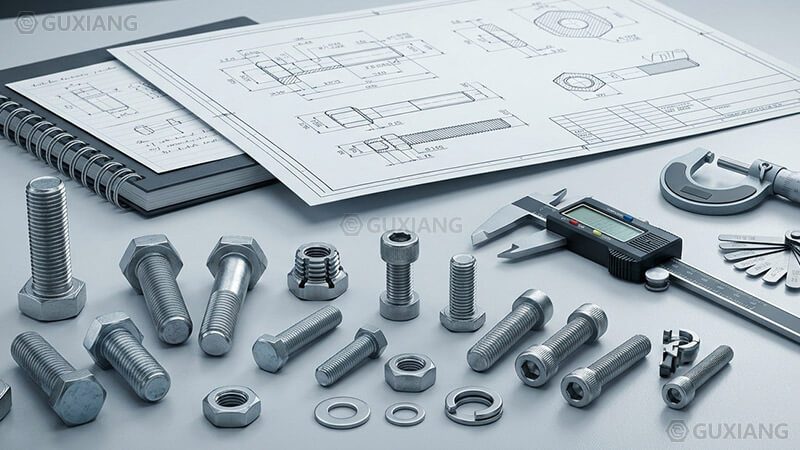
Cost advantage. Fastener manufacturing is material-heavy and labor-assisted. Chinese factories typically quote 30–50% below comparable Western European production for the same standard grade, before logistics. The gap comes from lower overhead, vertical integration of raw material supply, and scale. For carbon steel hex bolts in grades 8.8 and 10.9, or stainless steel A2-70 machine screws, the landed cost in Europe still leaves meaningful savings even after freight, import duties, and inspection. Compare grade definitions side by side in our bolt grades chart.
Standard coverage. A capable Chinese factory runs ISO 898-1 for metric bolt mechanical properties, ISO 3506 for stainless steel grades, DIN 933/931, ANSI/ASME B18.2.1, ASTM A307 or F3125, and JIS B1180, often from the same machines with minimal changeover. If your drawings specify an EN, DIN, or ASTM standard that is obsolete in Europe but still used in your installed base, a Chinese supplier with die inventory can keep producing it. For a breakdown of how the DIN, ISO, ANSI and ASME families compare, see our DIN vs ISO vs ANSI/ASME standards guide. For European buyers who maintain legacy equipment, this compatibility is often the deciding factor.
Flexibility and speed. Chinese factories routinely accept small-lot prototypes, mixed-size orders, and partial shipments. Cold heading tooling for a simple hex bolt can be produced in 10–15 days, and a 2–3 tonne production order can ship within 20–35 days from order confirmation. Custom head forms, drive types, coatings, and packaging are standard capabilities rather than special requests. This is a genuine advantage over large Western mills that require high minimum volumes before a production run becomes economical.
None of this means sourcing is risk-free. Quality control, communication gaps, and compliance documentation are the areas where European buyers most often lose money. The rest of this guide explains how to close those gaps.
Types of Fastener Suppliers: Factory vs Trading Company
Chinese fastener suppliers fall into three broad categories. Understanding which one you are talking to determines how you should verify quality, negotiate price, and structure the order.
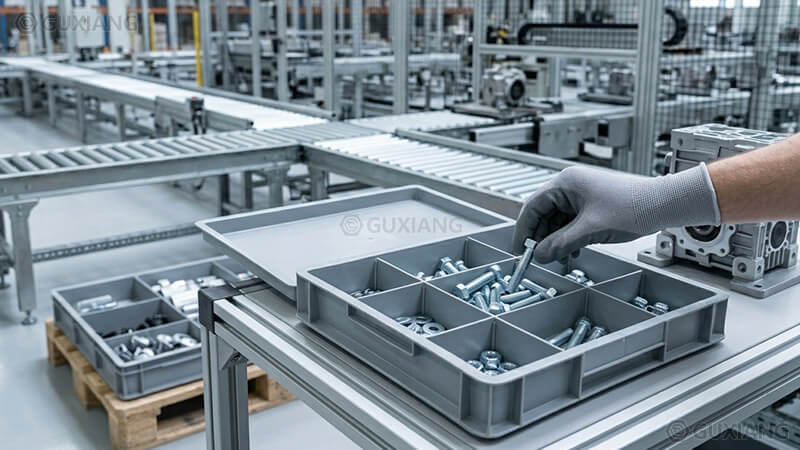
Manufacturing factories (manufacturers). These companies own cold heading machines, thread rolling equipment, heat treatment lines, and often in-house plating or surface treatment. They control the process from wire rod to finished box. Factory-direct pricing is typically 5–15% lower than trading company pricing on the same product because there is no middle layer. The downside is that factories usually have narrower product ranges; a bolt factory may not produce washers or rivets. When you work with a factory, ask which processes are in-house and which are subcontracted. A factory that outsources heat treatment or plating still needs process control, but the risk profile is different from a factory that owns the full line.
Trading companies (exporters). Trading companies buy from multiple factories and consolidate orders. They are useful when you need a mixed basket of fasteners from several production sources in one shipment, or when you need someone to manage inspection, packing, and export documentation. A good trader adds real value: sorting, re-boxing, and quality checking at their warehouse. A poor trader is simply a phone and a spreadsheet. The decisive questions are: which factory actually produces the goods, can you visit or audit that factory, and does the trader issue the quality documents themselves or pass through factory documents?
Third-party sourcing agents. Independent agents represent the buyer rather than the factory. They charge a commission or fixed fee, run factory audits, follow production, and arrange third-party inspection. For a first-time buyer without a trusted network, an agent reduces the risk of choosing a weak supplier, but the fee is a permanent cost on every order. Many experienced buyers graduate from agents to direct factory relationships after two or three successful shipments.
How do you verify which category a supplier belongs to? Ask for production photos and video from the shop floor, request the business license (business license, business registration) and the export license, and ask for references of orders shipped to Europe. Cross-check the factory name against the address on invoices and packing lists; a supplier that hesitates to show its factory address is usually a trading company presenting itself as a factory. For critical programs, the correct answer is an on-site audit, which we cover next.
What to Look for in a Chinese Fastener Factory
A paper check is not enough for high-volume or safety-critical fastener programs. Before you commit a large order, verify the factory on the following six dimensions.
1. Process capability and equipment. Confirm that cold heading, thread rolling (or cutting for special threads), heat treatment, and surface treatment are available, either in-house or with named and audited subcontractors. Ask for the capacity of the cold heading machines, the hardness range of the heat treatment line, and whether the factory runs salt bath or continuous furnaces. For stainless steel, ask whether passivation and magnetic permeability checks are standard.
2. Quality management system. Look for ISO 9001 certification and, where relevant, IATF 16949 for automotive, or ISO 17025 for an in-house test laboratory. Ask which measuring instruments are calibrated and how often, whether incoming wire rod is tested for chemistry, and whether hardness, tensile, and torque tests are performed on every lot or only on samples.
3. Traceability. A fastener factory that cannot trace a finished lot back to a specific heat of wire rod is a factory you cannot use for regulated industries. Ask how heat numbers are recorded and whether mill certificates for raw material are archived. Traceability is the foundation of the material test certificate (MTC) we discuss later.
4. Export experience to Europe. Ask for the list of European destinations served, the documents issued on past shipments (certificates of conformity, declarations of performance if applicable, fumigation-free wooden packing), and any customer audit reports they can share. A factory that already ships to Germany, France, or Poland understands EU import paperwork better than one selling only domestically.
5. On-site audit. If the order value justifies it, conduct a physical audit using a standard checklist: cleanliness and organization of the shop floor, die maintenance, calibration stickers on gauges, segregation of non-conforming material, and the actual condition of the inspection room. If you cannot travel, use a third-party audit service such as SGS, TÜV, or Bureau Veritas to run the same checklist.
6. Communication. Assign a technical contact who can read drawings and discuss tolerances in English (or your language). Delays in sourcing often come from unclear communication about standards, coating thickness, or packaging, not from the factory’s manufacturing ability. Test this on your first small order rather than your first large one.
What to Include in Your RFQ (Quote Request)
The quality of the quote you receive is a direct function of the quality of the request you send. A vague RFQ produces a vague price, and the difference is discovered later in inspection. Send every RFQ with the following eleven elements.
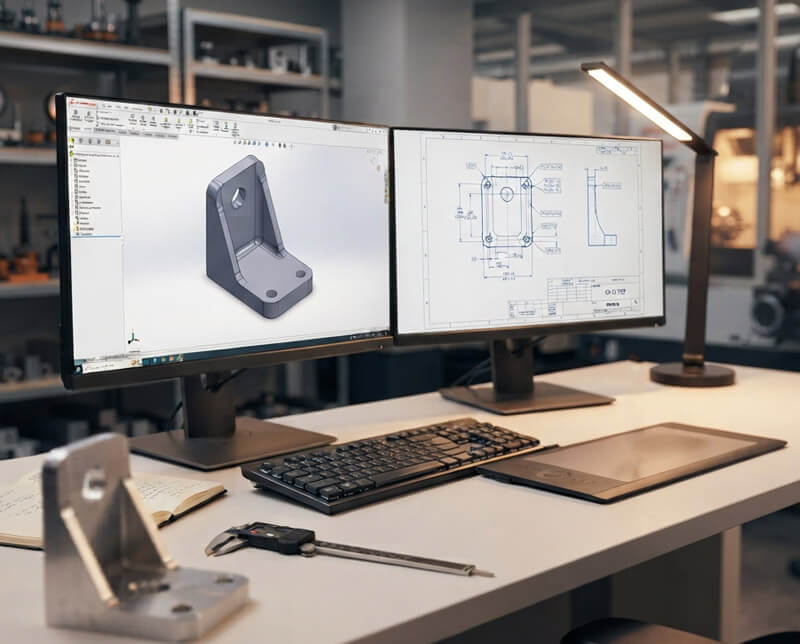
Part identification. Description, part number, and a clear drawing or 3D model. If you use an internal part number, include it so the supplier can reference it in correspondence.
Standard and grade. The exact standard (for example, ISO 4014 for hex bolts, ISO 898-1 property class 8.8, or DIN 933 for fully threaded bolts) and the material grade (carbon steel, alloy steel 10B21 or 40Cr, stainless A2-70, A4-80, or aluminum). Our carbon steel fastener guide and stainless steel grades guide explain the practical differences between common material families. Do not let the supplier choose the standard for you.
Dimensions and thread. Nominal diameter, thread pitch (coarse or fine), length, and any special features such as shoulder length, reduced shank, or drilled holes. For metric threads, reference the tolerance class (for example, 6g) as defined by ISO 965; our metric thread chart lists standard sizes and pitches.
Hardness and mechanical properties. Tensile strength, yield strength, hardness range, and proof load if your application requires them. For carbon steel, specify property class; for stainless, specify the grade and the corresponding strength requirement.
Surface treatment and coating. Zinc plating (clear, blue, yellow, or black), hot-dip galvanizing, Dacromet, phosphate, nickel, black oxide, or none. State the coating standard (for example, ISO 4042 for electroplating) and the required salt spray hours if corrosion performance matters. Our fastener coatings and surface treatments guide compares the common options. Coating thickness drives price and lead time, so be specific.
Tolerances and fit. Dimensional tolerances, thread fit, and any geometric tolerances (concentricity, straightness, flatness). Standard products follow the standard’s default tolerances; custom parts need an explicit tolerance block.
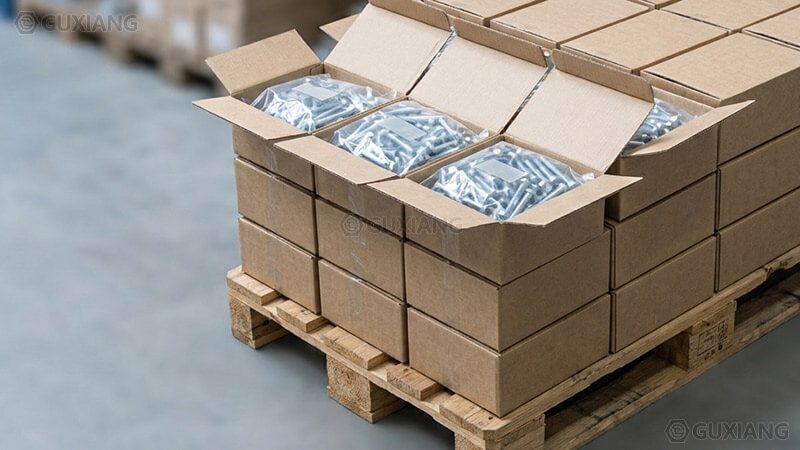
Packaging. Bulk cartons, poly bags, boxes of a fixed count, master carton weight limits for manual handling, wooden pallet or plywood cases, and markings (labels with part number, heat number, quantity, and destination). A 25 kg master carton that suits one warehouse may be unacceptable to another.
Quantity and MOQ. Target order quantity and the minimum acceptable. If you plan frame orders with scheduled releases, say so; factories price better with visibility.
Lead time and delivery date. Required delivery date, whether partial shipments are acceptable, and the port or destination. This determines whether air freight or ocean freight is assumed in the price.
Quality documents. List exactly which documents you need with the shipment: material test certificate, certificate of conformity, inspection report, batch records, declaration of conformity for CE if applicable, and any third-party inspection certificates. Documents cost money and time; ask for them in the RFQ so the price includes them.
Commercial terms. Your preferred Incoterm (EXW, FOB, CIF, or DAP) and payment terms. The same part can differ in price by 10% or more depending on whether the quote includes export packing, inland freight to port, and ocean freight.
Send the same RFQ to three to five qualified suppliers, and compare quotes line by line rather than by total price alone. A lower unit price with a higher tooling charge, weaker packaging, or no documents is often not the better deal.
MOQ, Lead Time and Prototyping
Three numbers define the commercial rhythm of a fastener order: MOQ (minimum order quantity), lead time, and prototyping time. European buyers frequently under-plan all three.
MOQ. For standard fasteners made on existing tooling, MOQs in China are low: often one carton or 2,000–5,000 pieces for small machine screws (see our machine screw size chart for standard dimensions), 500–1,000 kg for common hex bolts, and very small quantities for stock sizes a factory keeps on the shelf. For custom parts requiring new tooling, the practical MOQ is driven by amortizing the tooling cost rather than by an arbitrary number. Ask the supplier to split the tooling cost and the per-piece cost; that tells you the true break-even quantity. Many factories accept sample orders of 50–200 pieces before you commit to a production MOQ.
Lead time. A realistic planning timeline for a custom fastener from a Chinese factory is: tooling 10–15 days, material procurement 5–10 days (more for special alloys), production 10–15 days for a few tonnes, heat treatment and coating 5–10 days, inspection and packing 3–5 days, and ocean freight to Europe 30–40 days (Rotterdam, Hamburg, or Genoa from major Chinese ports). That is roughly 8–12 weeks from order confirmation to warehouse in Europe. Air freight can compress the transit to 3–7 days but multiplies freight cost several times; it is justified for urgent restocks or high-value custom parts, not for routine replenishment.
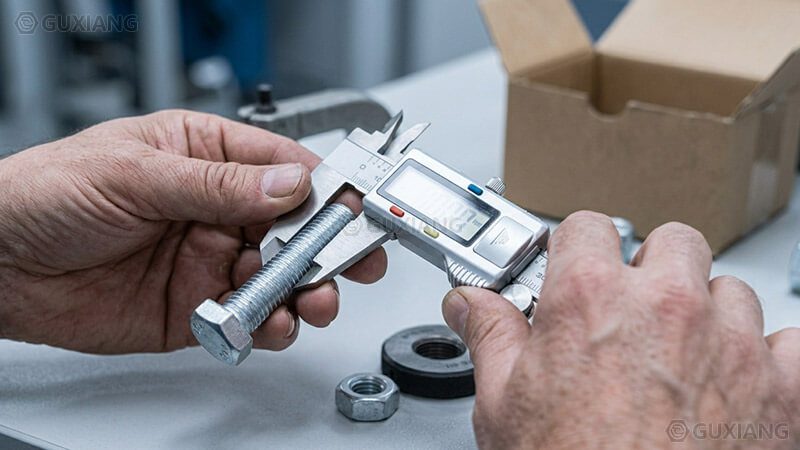
Prototyping. Cold heading is a high-speed process, and the tooling determines the part’s final shape, so prototyping is the cheapest insurance in the entire sourcing process. Send the factory your drawing, receive samples (typically 50–200 pieces), and verify dimensions, threads, hardness, and coating before production starts. Check the samples against your drawing with the same gauges your QC team will use later. The factory should issue a sample inspection report; compare it with your own measurement. This step catches misread tolerances, wrong material substitution, and thread issues before they multiply across thousands of pieces.
Do not accept verbal lead times. Ask for a written production schedule with milestones: tooling complete, material in, production start, coating complete, inspection complete, and estimated port date. Update the schedule weekly.
Quality Assurance: MTC, COC and Third-Party Inspection
Fastener failures cause equipment damage, personal injury, and liability. Quality assurance therefore starts with documents and ends with independent verification.
Material Test Certificate (MTC). The MTC, also called a mill certificate or EN 10204 3.1 certificate, links your finished fasteners to the chemistry and mechanical properties of the raw material. A 3.1 certificate under EN 10204 is issued by the manufacturer with inspection performed by the manufacturer’s own authorized representative, and it is the standard buyers request for structural and safety-critical fasteners. Check that the MTC contains: the heat number of the wire rod, chemical composition (C, Mn, Si, P, S, and alloying elements), mechanical test results (tensile, yield, elongation, hardness), and the standard and property class referenced. Cross-check the heat number on the MTC against the heat numbers marked on the batch records or boxes; discrepancies are a red flag.
Certificate of Conformity (COC). The COC is a supplier declaration that the goods comply with the order’s specifications, standards, and applicable regulations. It is not a substitute for an MTC, but it is the document that names the standard, the drawing revision, the quantity, and the manufacturing date. Keep both documents for your own compliance file and for downstream customers who audit your supply chain.
Third-party inspection. For orders above a value threshold you define (a common rule of thumb is every order above USD 5,000–10,000, or 100% of safety-critical parts), book a pre-shipment inspection by SGS, Bureau Veritas, TÜV, or Intertek. The inspector checks quantity, dimensions, threads with go/no-go gauges, hardness spot checks, coating thickness, packaging, and markings, and issues a report before release. Specify the sampling level (for example, ANSI/ASME/ISO 2859-1 general inspection level II) and the acceptance criteria in your order. This shifts the burden of finding defects from your receiving dock to the factory’s shipping dock.
Dimensional and functional testing. Depending on the application, request additional tests: proof load testing, wedge tensile testing (for bolts), hardness traverse on the thread run-out, salt spray testing for coating performance, hydrogen embrittlement relief confirmation for hardened parts, and torque-tension testing for critical joints. Put the required tests in the RFQ so the price includes them, and ask for the test reports with the shipment.
EU Compliance: CE, EN Standards, REACH and RoHS
European buyers must verify that imported fasteners satisfy EU legislation, not just the technical standard on the drawing. Four regimes matter most.
CE marking under the Construction Products Regulation (EU) 305/2011. Fasteners used as structural components in construction fall under harmonized standards such as EN 15048-1 (non-preload structural bolting assemblies), EN 14399 (high-strength structural bolting assemblies), and EN ISO 898-1 (mechanical properties). When a harmonized standard applies, the manufacturer issues a Declaration of Performance (DoP) and CE marks the product. If you buy structural bolts for construction, you must confirm the factory can issue the DoP and that the product is tested by a notified body where the standard requires it. For non-construction industrial fasteners, CE marking is generally not required; do not let a supplier charge you for a meaningless “CE” sticker.
EN harmonized standards. Even without CE marking, many European applications reference EN standards directly: EN ISO 898-1 for mechanical properties of carbon steel bolts, EN ISO 3506-1 for stainless steel, EN ISO 4014/4017 for hex bolts, EN 20898 series where still referenced, and EN 14399 for structural assemblies. Specify which EN standard your order must meet, and ask the supplier to state conformance on the COC.
REACH (Regulation (EC) 1907/2006). REACH restricts and regulates chemicals in articles. The substances of most concern in fasteners are chromium(VI) in hexavalent chromium passivation (which is restricted), and lead, cadmium, mercury, and their compounds in coatings and materials. Your supplier should confirm that the passivation used is trivalent (Cr-III) where hexavalent is banned, and that no restricted substance exceeds the REACH concentration limits. Ask for a REACH declaration per shipment, and keep it with your compliance file. The ECHA database (eur-lex.europa.eu/eli/reg/2007/1907/oj) lists the restricted substances and their limits.
RoHS (Directive 2011/65/EU). RoHS restricts hazardous substances in electrical and electronic equipment. If your fasteners will be installed in electronics, appliances, or machinery with electronic controls sold in the EU, confirm RoHS compliance for the material and coating. Stainless steel and most standard carbon steel with trivalent zinc plating are RoHS-compliant, but some coatings and lubricants are not. Request a RoHS declaration with a test report where your customer requires it.
Other regimes to check. Depending on your industry, you may also need to verify pressure equipment directives (PED 2014/68/EU) for fasteners in pressurized systems, Machinery Directive conformity for machine components, and food-contact statements for fasteners in food processing lines. Confirm these before ordering, because they affect material choice, certificates, and marking.
Logistics and Incoterms: EXW, FOB and CIF
The Incoterm you choose determines who pays for what, when risk transfers, and who handles export and import formalities. For fastener imports from China to Europe, the three most common terms are EXW, FOB, and CIF, with DAP increasingly used for door delivery.
EXW (Ex Works). The supplier makes the goods available at its factory; you arrange and pay for export packing (if not included), inland trucking, export customs clearance, ocean or air freight, insurance, import clearance, and final delivery. EXW gives you maximum control and the lowest apparent price, but it places every logistics task in your hands. Unless you have a freight forwarder with a China desk, EXW is usually more work than the savings justify.
FOB (Free On Board). The supplier delivers the goods on board the vessel at the named port of shipment (for example, FOB Ningbo or FOB Shanghai), and covers inland transport and export customs. Risk transfers to you once the goods are on board; you pay ocean freight, insurance, and import costs. FOB is the most common term for Chinese fastener exports because the factory’s responsibility ends at the port and you control the international leg with your own forwarder.
CIF (Cost, Insurance and Freight). The supplier pays freight and insurance to the named destination port, and risk transfers to you when the goods are on board the vessel. CIF prices are easy to compare because the supplier quotes a door-to-port total, but you are relying on the supplier’s choice of carrier and insurance, and the coverage may be minimal (typically the insured value at invoice plus 10%). CIF is convenient for small orders; for large shipments, FOB plus your own insurance is usually better value.
DAP (Delivered at Place). The supplier delivers to your named place (often your warehouse or a forwarder’s hub in Europe), covering all costs except import duty and VAT. DAP transfers a large amount of logistics management to the supplier, which many buyers prefer for a single-source experience, but you lose visibility into freight and insurance choices.
Practical guidance: for routine small-to-medium orders, compare FOB quotes and use your own forwarder; for urgent or high-value items, compare air freight quotes separately; for door delivery of consolidated cargo, DAP via a forwarder that consolidates multiple supplier shipments works well. Always write the Incoterm with the named place (for example, FOB Shanghai, not just “FOB”), and state in the order who handles insurance and to what value.
Customs and Tariffs for Fastener Imports to the EU
Fastener imports into the European Union face the Common Customs Tariff, plus VAT at the importing member state’s rate, and in some cases anti-dumping duties or safeguard measures. Plan these costs into your landed cost from the start.
HS codes. Fasteners fall mainly under HS chapter 73 (iron or steel articles), with common codes: 7318 (screws, bolts, nuts, washers, and similar threaded or non-threaded articles of iron or steel), 7318.15 (screws and bolts, with or without nuts), 7318.16 (nuts), 7318.22 (spring washers), and 7318.24 (cotter pins). Stainless steel fasteners are classified in the same 7318 series; the tariff line is determined by the material and the article, not by the brand. Get the correct HS code from your customs broker or the EU TARIC database, because an incorrect code causes delays and potential penalties.
Duties. Conventional duty rates on 7318 products entering the EU are generally low (in the 0–3.7% range for many lines), but check TARIC for the specific code and origin. The EU has also applied anti-dumping and anti-circumvention measures on certain iron or steel fasteners from China in the past; confirm the current status for your product line with your broker. Under the EU’s Generalized System of Preferences, Chinese-origin goods do not currently benefit from preferential rates, so assume the full conventional duty plus any applicable measures.
VAT. Import VAT is charged by the member state of import at its standard rate (for example, 19–27% depending on the country). You can usually recover the import VAT if you are VAT-registered, but you must pay it at import and claim it back through your periodic VAT return. Account for the cash flow impact.
Customs documentation. Your shipment should be accompanied by: commercial invoice, packing list, bill of lading (or air waybill), and, where requested, the MTC/COC and certificates of origin. The EU’s Customs Declaration (SAD, form on the Import Control System 2) is filed electronically by your importer of record or broker. If you ship via a forwarder under DAP, confirm that the supplier’s forwarder files the export declaration correctly; a mismatched value or description is a common cause of customs holds.
Origin marking and packaging. EU rules require certain products to be labeled with origin; check the specific requirements for your member state. Ensure wooden packaging complies with ISPM 15 (fumigation or heat treatment marking) or the shipment will be rejected at the border.
Risk Management: Contracts, Payment Terms and Dispute Resolution
Sourcing across borders means managing commercial risk in four layers: supplier selection, contracts, payment terms, and dispute resolution.
Supplier qualification. Before the first production order, complete a qualification process: business license verification, factory audit or third-party audit report, bank reference check, and reference checks with two or three existing customers (preferably in Europe). Keep a supplier scorecard that tracks on-time delivery, first-pass quality, document accuracy, and communication responsiveness. Re-qualify annually.
Sales contract and order confirmation. Do not rely on WeChat or email confirmations. Use a written order that incorporates: the RFQ and drawing revision, standard and grade, quantity and tolerance, packaging specification, Incoterm and named place, delivery date, required documents, inspection rights, warranty and liability clauses, and dispute resolution mechanism. Require the supplier to return a signed order confirmation or proforma invoice that matches your order line by line. Discrepancies between the order and the confirmation are where hidden costs hide.
Payment terms. Common terms with Chinese factories are 30% deposit (T/T) with 70% balance before shipment, or 30/70 with balance against copy of shipping documents. For first orders, expect the supplier to ask for a higher deposit; negotiate a lower deposit in exchange for a documentary instrument such as a letter of credit (L/C at sight) if the value justifies the bank cost. For repeat orders with a proven supplier, terms can move to net 30/60 after shipment. Never pay 100% in advance to an unproven supplier. The 30% deposit covers material and tooling; the balance is your leverage for quality and documentation before release.
Inspection-linked payment. Structure the payment schedule so that the balance is released after the pre-shipment inspection report is acceptable and the documents are reviewed. Even a simple clause in the order (“payment of balance conditional on inspection report in accordance with order specifications”) changes the supplier’s behavior.
Dispute resolution. State in the order whether disputes are resolved by negotiation, mediation, or arbitration, and which rules apply. Many Chinese suppliers accept arbitration under the China International Economic and Trade Arbitration Commission (CIETAC) or, for international buyers, arbitration at a neutral venue. Avoid clauses that require you to litigate in a Chinese court of an unknown locality. Keep a complete file of RFQ, drawings, confirmations, inspection reports, and correspondence; it is the evidence base if a dispute arises.
Currency and exchange risk. Quote and invoice in a currency you control (EUR or USD). If the supplier insists on RMB, check the exchange rate movement between quote and payment, and confirm whether the price is fixed or adjustable. Most Chinese exporters quote USD or EUR and absorb short-term FX risk.
Working with GUXIANG: A Factory Perspective
GUXIANG is a fastener manufacturing factory, not a trading desk, and the capabilities described above are available under one roof. Our production covers cold heading, CNC machining, heat treatment, and surface treatment, so standard and custom parts move from wire rod to finished goods without hand-offs that dilute traceability. We manufacture to ISO, DIN, ANSI/ASME, and JIS standards, with material grades from carbon steel and alloy steel (including 10B21, 40Cr, SCM435) to stainless steel A2 (304) and A4 (316), aluminum, and selected plastics. Details on alloy steel grades are in our alloy steel fastener guide.
For European buyers, the practical value of a factory relationship is: prototype samples in 15–25 days from drawing confirmation, MOQ tailored to your real consumption rather than a rigid line, honest lead times with weekly milestone updates, and documentation discipline that includes material test certificates, certificates of conformity, and third-party inspection support. Our export team ships by both ocean and air, and we routinely handle the documentation that EU importers need, including declarations related to REACH and RoHS requirements and ISPM 15 packaging.
If you are evaluating a new supplier, send us your drawing and quantity and we will respond with a line-item quote, a tooling and lead time breakdown, and sample options. If you already have a supplier and want a benchmark, compare our quote against your current landed cost; the comparison is free and takes one email.
Request a Fastener Quote – send your drawings, standards, and quantities to our team and receive a detailed quotation with tooling, lead time, and document list. Ask an Engineer – discuss your application, material selection, coating, or compliance questions directly with our technical staff before you commit to tooling.
FAQ
How much cheaper are fasteners from China compared with European suppliers?
Typically 30–50% lower before logistics for standard grades such as 8.8 bolts or A2-70 stainless machine screws. After freight, duty, and inspection, landed savings still remain meaningful for volume orders.
Factory or trading company: which should a European buyer choose?
Choose a factory for direct pricing, traceability, and custom parts. Choose a trading company for consolidated mixed baskets from several factories. Verify the actual manufacturer with an audit or third-party inspection before large orders.
What is the minimum order quantity for fasteners from China?
Standard parts on existing tooling can have MOQs of 2,000–5,000 pieces or 500–1,000 kg. Custom parts depend on tooling amortization; most factories accept 50–200 piece samples before a production MOQ.
How long does a fastener order from China take to arrive in Europe?
Custom parts typically need 8–12 weeks: 2–3 weeks tooling and material, 2–3 weeks production and coating, 3–5 days inspection, and 30–40 days ocean freight. Air freight cuts transit to 3–7 days at much higher cost.
What quality documents should I request from a Chinese fastener supplier?
Request a material test certificate (EN 10204 3.1), a certificate of conformity, batch records with heat numbers, inspection reports, and third-party inspection certificates for critical orders. List them in the RFQ so the price includes them.
Are Chinese fasteners CE marked for the EU?
CE marking is required only where a harmonized standard applies, mainly structural fasteners under the Construction Products Regulation (EU 305/2011). Industrial fasteners outside construction do not need CE, and a paid “CE sticker” adds no value.
Do Chinese fasteners comply with REACH and RoHS?
Standard trivalent zinc-plated carbon steel and stainless steel are generally compliant. Request a REACH declaration and, for electronics applications, a RoHS declaration with test report. Confirm the passivation type is trivalent, not hexavalent.
Which Incoterm should I use: EXW, FOB, or CIF?
FOB is the most common and gives you control of freight and insurance with your own forwarder. EXW shifts all logistics to you; CIF leaves carrier choice to the supplier. Use DAP for consolidated door delivery.
What are the import duties on fasteners from China into the EU?
Most 7318 lines carry conventional duties of 0–3.7%, plus VAT at the member state rate. Check TARIC for your HS code and current anti-dumping status, and confirm with your customs broker.
How do I protect a large fastener order against quality risk?
Qualify the factory with an audit, use a written order with explicit standards and documents, pay a deposit rather than 100% in advance, book third-party pre-shipment inspection, and link the balance payment to the inspection report.