



Surface Finishes: Anodizing – A Practical Guide for Fastener Engineers and Buyers

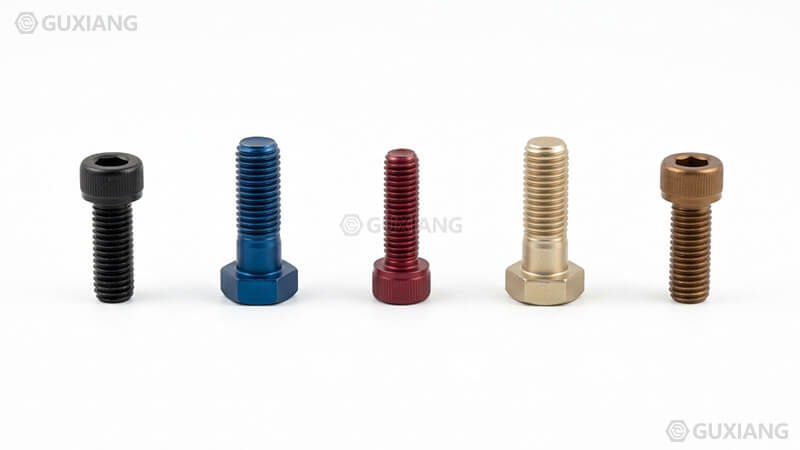
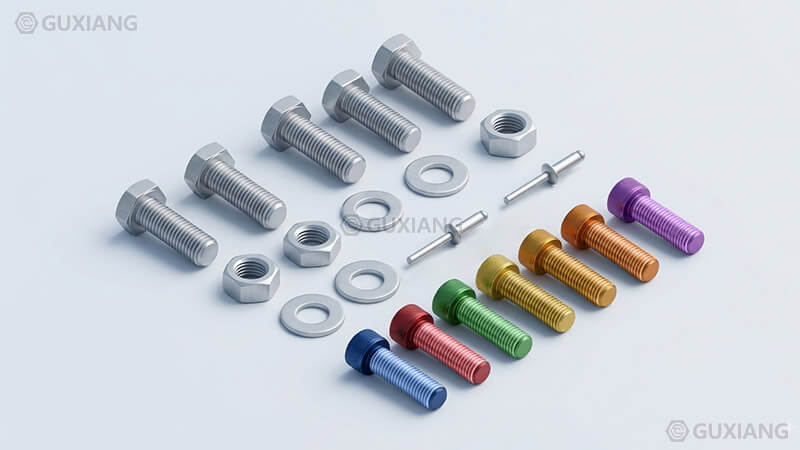
Anodizing is an electrochemical process that grows a controlled aluminum oxide (Al₂O₃) film on the surface of an aluminum fastener. The metal is not coated — it is converted. The outer layer of the aluminum part itself turns into a hard, corrosion-resistant ceramic-like skin that cannot peel, chip, or flake off the way paint and plating do. That distinction is the whole story.

hero_anodizing-fasteners

Nobody anodizes a fastener to make it stronger. Anodizing does not add load capacity. It buys four things in exchange for a measurable thickness penalty: corrosion resistance, surface hardness and wear resistance, a uniform appearance with color options, and electrical insulation where that is wanted. The cost is dimension — the film physically grows into and out of the part, which means threads change size and tight tolerances get messy.

Aluminum fasteners are the only common fastener type that anodizes. Steel, stainless, brass, and titanium cannot be anodized in the conventional sense — their oxides are either not protective or not produced by the same process. So this guide is really about one question: for an aluminum bolt, screw, or nut, when does anodizing pay, when does it bite, and which type should be on the print.

What Anodizing Does to an Aluminum Fastener

Put a bare aluminum screw next to an anodized one and the difference is visible, but the functional difference runs deeper than color. The oxide film that anodizing produces is alumina — the same family of material as the abrasive on sandpaper. On a fastener it changes how the surface behaves in five ways:

EffectWhat ChangesWhy It Matters
Corrosion resistanceSurface sealed against moisture and saltsAluminum oxide is far more inert than bare aluminum
Surface hardnessFilm hardness typically 200–500 HV, hard anodize higherResists scratching and thread wear in repeated assembly
Wear resistanceAbrasion resistance far above bare aluminumSliding surfaces, repeated torque, and thread engagement
AppearanceUniform finish, dyeable to most colorsProduct identity, corrosion inspection, branding
Electrical behaviorFilm is a dielectric insulatorGood where insulation is wanted, a trap for grounding

The film grows from the aluminum itself. That is why it does not delaminate: there is no interface between coating and substrate to fail. A plated part can lose its plating at a scratch; an anodized part has no separate layer to lose.

The Anodizing Process: What Happens in the Tank

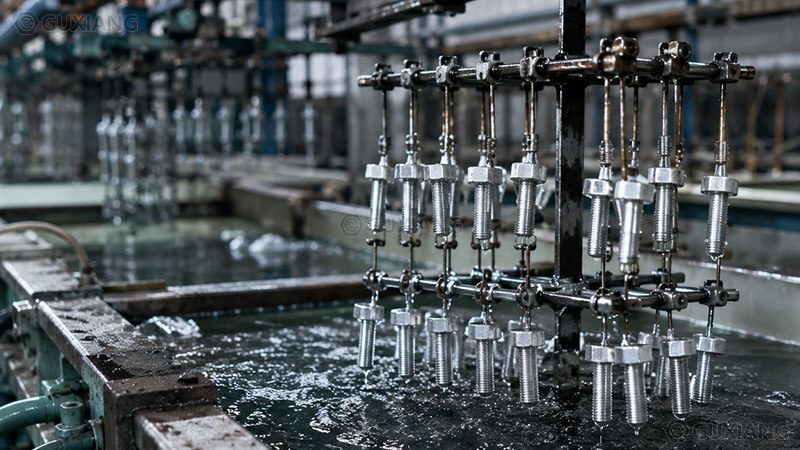
The process is straightforward to describe and surprisingly sensitive in practice. The aluminum part is made the anode in an electrolytic cell; the electrolyte is an acid — sulfuric acid for most fastener work — and current drives oxygen ions into the aluminum surface, where they react to form aluminum oxide.

Two layers form at once. A thin, dense barrier layer sits against the metal, and on top of it grows a thick, porous layer. The porous layer is the useful one: it is thick enough to protect and to hold dye, and it can be sealed afterward by hot water or steam, which hydrates the oxide and closes the pores.

The reaction consumes aluminum. The film grows roughly half inward, into the part, and half outward, above the original surface. That 50/50 split is the single most important practical fact in this guide, and it is the reason fastener people argue about tolerances. A 20 µm anodize film does not add 20 µm to the part — it adds roughly 10 µm outside and removes roughly 10 µm of metal underneath, changing dimensions in both directions.

Process variables that decide the film character: acid concentration, bath temperature (sulfuric baths run cold, typically 15–21°C; hard anodize runs colder), current density, time, and alloy composition. The same recipe that produces a beautiful film on 6061 can produce a blotchy one on 7075, because alloying elements change how the oxide grows. Copper-rich alloys like 2024 anodize darker and less uniformly; magnesium alloys are different again.

Three Anodizing Types That Matter for Fasteners

Nearly all fastener anodizing falls into three families, and the names in North America come from MIL-A-8625.

TypeCommon NameTypical Film ThicknessFastener Use
Type IChromic acid anodize1.5–5 µmFatigue-critical and aerospace parts; thin, low dimensional impact
Type IISulfuric acid anodize5–25 µmThe general-purpose finish; corrosion, color, appearance
Type IIIHard anodize25–150 µmWear, abrasion, and heavy-duty service

Type I: Chromic Acid Anodize

Thin film, good corrosion resistance, minimal dimensional change, and the least damage to fatigue strength. Type I was the aerospace standard for decades, and it still appears where fatigue matters — aircraft control fittings, thin-wall parts. The problem is environmental: chromic acid baths use hexavalent chromium, which is restricted under RoHS and REACH and increasingly hard to justify. Aerospace has largely moved to tartaric-sulphuric acid (TAS) anodizing as the drop-in replacement — same thin-film philosophy, no Cr⁶⁺. Boeing and Airbus specifications (BAC 5632, AIPS 02-04-014) now dominate that space.

Type II: Sulfuric Acid Anodize

The workhorse. Five to twenty-five microns, dyed or natural, sealed or not, used on everything from electronics enclosures to automotive trim to threaded fasteners. It gives the classic anodized look, takes dye well, and has good corrosion resistance when sealed. The film is not particularly hard — do not confuse Type II with hard anodize — but it resists handling scratches far better than bare aluminum.

Type III: Hard Anodize

The heavy one. Hard anodize grows 25 to 150 µm of exceptionally dense oxide, with hardness that can exceed 400 HV and wear resistance approaching that of hard chrome plating on steel. Fasteners specified in Type III are typically in high-wear applications: repeated assembly-disassembly, sliding mechanisms, thread forms that take abuse, and parts that run against other metal surfaces.

Type III has two costs. The dimensional change is large — a 50 µm coating shifts the thread profile by up to 50 µm in the worst direction — and it reduces the fatigue life of the part more than Type I or thin Type II, because the thick brittle film cracks under cyclic strain and those cracks propagate into the substrate. Hard anodize is a wear finish, not a fatigue-friendly one.

The distinction between Type II and Type III is not a line; it is a range. Some shops run “hard” sulfuric baths at 25–40 µm and call them hard anodize; MIL-A-8625 Type III typically means 25+ µm with specified hardness and wear testing. If wear is the requirement, write the thickness and the hardness test into the spec instead of trusting the word “hard.”

hero_aluminum-fasteners

Film Thickness and the Thread Tolerance Problem

This is where anodized fasteners go wrong on real production lines, so it gets its own section.

The 50/50 growth split changes thread dimensions. On an external thread (bolt, screw), the film grows outward and the pitch diameter grows. On an internal thread (nut), the film grows inward and the pitch diameter shrinks. A 20 µm Type II film on a bolt therefore adds roughly 10 µm to the pitch diameter; a 50 µm hard anodize adds roughly 25 µm. On an M6 thread with a standard 6H/6g fit, that is enough to turn a smooth assembly into a forced fit, and forced fits on aluminum threads strip.

Three practices keep this under control:

1. Anodize before threading. Cut the thread after anodizing, so the finished thread is bare aluminum and the tolerance is exactly what the drawing says. This is the cleanest solution and it is standard for precision threaded parts. The bare thread loses the anodize protection, so the corrosion engineer has to accept a compromise — usually acceptable because the exposed thread is a small area and can get a light post-treatment.

2. Machine the thread to the low side of the tolerance. If the thread must be anodized as finished, cut it undersized by the expected film growth. This works when the film thickness is repeatable, which is not always true across suppliers.

3. Post-machine or chase the thread after anodizing. Chase the anodized thread with a tap or die to restore fit. This removes the film on the flanks, again exposing metal, but keeps the rest of the part protected.

The rule of thumb that survives in practice: for any thread finer than about 1.25 mm pitch, or any film over about 15 µm, do not assume standard tolerances will absorb the anodize. Verify with a functional thread gauge on the coated part, not just the drawing. A gauge costs nothing compared with a field assembly that will not go together.

When Anodizing Is the Wrong Finish

Anodizing is a good finish, and it is wrong more often than suppliers like to admit. Four situations where it should be off the print:

1. The fastener must conduct electricity. Anodize film is a dielectric. A sealed Type II film can withstand hundreds of volts per 10 µm, and hard anodize is rated for high voltage outright. For grounding screws, bonding clamps, bus-bar hardware, or any current-carrying joint, an anodized fastener is an insulator and a fire risk in a current path. If the aluminum fastener needs corrosion protection but must stay conductive, the correct finish is a chemical conversion coating — chromate conversion or a modern Cr⁶⁺-free alternative — not anodizing. The conductivity logic parallels what brass fasteners do for copper-alloy systems, covered in the brass fasteners guide.

2. The joint depends on precision fit. Slip-fit pins, press-fit studs, and close-tolerance assemblies do not survive a 20–50 µm film that nobody accounted for. Either machine after anodize or skip the anodize.

3. Fatigue is the life-limiting mode. Thick films — hard anodize especially — reduce fatigue life. For a dynamically loaded aluminum fastener, a thin Type I/TAS film or chemical conversion is the safer choice. This is a known aerospace trade-off, not a rumor.

4. The part sees repeated localized impact or point loading. Anodize film is hard but brittle. A sharp impact that would dent bare aluminum will chip the oxide film, and a chipped film can trap moisture against the substrate. For impact-prone service, a thicker, sealed Type III film is the better bet — or a rethink of the material choice entirely.

There is also a cost case. Anodizing adds a process step, a tolerance problem, and a rejection risk. For a plain aluminum fastener in a benign indoor environment, bare aluminum with a light conversion coating is often the cheaper finish that does the same job. Specify anodize because you need what it delivers, not because it sounds professional.

Corrosion and Galvanic Behavior of Anodized Fasteners

What the Salt Spray Numbers Mean

Salt spray testing shows up on nearly every anodize specification, and the results get read too literally. The common frames are ISO 9227 or ASTM B117 neutral salt spray. Practical expectations for aluminum fasteners:

ConditionTypical ISO 9227 / B117 ResultRead It As
Bare 6061Pitting within 24–72 hBare aluminum is not a corrosion finish
Type II, sealed336+ h before visible pittingSealing quality is the variable that matters
Type II, unsealed96–200 hUnsealed film absorbs salt and moisture
Type III hard anodize500+ h, minimal attackWear and corrosion in one finish
Type I / TAS thin film168–336 hThin but effective when sealed

The honest read: the seal is more important than the film thickness for corrosion. A well-sealed 10 µm Type II film beats a poorly sealed 25 µm film in salt spray every time. The standard acceptance test for seal quality is the dye spot test (ISO 2143) or the phosphoric-chromic acid weight loss test (ISO 3210) — both check whether the pores are actually closed. Buyers who specify “anodized per ISO 7599, sealed” without a seal-quality test are trusting a word that should be a number.

Galvanic Corrosion: The Film Changes the Rules

Bare aluminum is anodic to stainless steel, titanium, brass, and most other fastener metals. Anodizing changes the galvanic picture because the oxide film is an insulator: a properly sealed anodized fastener does not complete an electrical couple with the mating metal, so the classic “aluminum corrodes at the stainless bolt” mechanism is suppressed.

But there is a trap. The film protects only where it is intact. At a scratch, a thread flank, or a bearing surface worn by torque, the exposed aluminum becomes a small anode connected to a large cathodic surface — and the corrosion concentrates exactly where the film is broken. A damaged anodized fastener coupled to stainless can corrode faster than a bare one, because the film directs all the attack to the defect. The field lesson: anodized aluminum fasteners in wet contact with stainless or titanium hardware must be assembled without scratching the film, and the joint should be checked for coating damage after assembly. The broader galvanic framework for aluminum is covered in the aluminum fasteners guide.

anodizing_marine-instrument-housing

Corrosion and Galvanic Behavior of Anodized Fasteners

What the Salt Spray Numbers Mean

Salt spray testing shows up on nearly every anodize specification, and the results get read too literally. The common frames are ISO 9227 or ASTM B117 neutral salt spray. Practical expectations for aluminum fasteners:

ConditionTypical ISO 9227 / B117 ResultRead It As
Bare 6061Pitting within 24–72 hBare aluminum is not a corrosion finish
Type II, sealed336+ h before visible pittingSealing quality is the variable that matters
Type II, unsealed96–200 hUnsealed film absorbs salt and moisture
Type III hard anodize500+ h, minimal attackWear and corrosion in one finish
Type I / TAS thin film168–336 hThin but effective when sealed

The honest read: the seal is more important than the film thickness for corrosion. A well-sealed 10 µm Type II film beats a poorly sealed 25 µm film in salt spray every time. The standard acceptance test for seal quality is the dye spot test (ISO 2143) or the phosphoric-chromic acid weight loss test (ISO 3210) — both check whether the pores are actually closed. Buyers who specify “anodized per ISO 7599, sealed” without a seal-quality test are trusting a word that should be a number.

Galvanic Corrosion: The Film Changes the Rules

Bare aluminum is anodic to stainless steel, titanium, brass, and most other fastener metals. Anodizing changes the galvanic picture because the oxide film is an insulator: a properly sealed anodized fastener does not complete an electrical couple with the mating metal, so the classic “aluminum corrodes at the stainless bolt” mechanism is suppressed.

But there is a trap. The film protects only where it is intact. At a scratch, a thread flank, or a bearing surface worn by torque, the exposed aluminum becomes a small anode connected to a large cathodic surface — and the corrosion concentrates exactly where the film is broken. A damaged anodized fastener coupled to stainless can corrode faster than a bare one, because the film directs all the attack to the defect. The field lesson: anodized aluminum fasteners in wet contact with stainless or titanium hardware must be assembled without scratching the film, and the joint should be checked for coating damage after assembly. The broader galvanic framework for aluminum is covered in the aluminum fasteners guide.

Anodizing vs the Other Aluminum Finishes

Aluminum fasteners have a finish menu, and anodizing is only one item. The practical comparison:

FinishTypical ThicknessCorrosionWearConductivityCostTypical Use
Bare aluminumPoorPoorYesLowestNon-corrosive indoor service
Chemical conversion (chromate/Cr⁶⁺-free)0.2–1 µmGoodPoorYesLowPaint prep, conductive corrosion protection
Type II anodize5–25 µmExcellent (sealed)FairNoModerateAppearance + corrosion
Type III hard anodize25–150 µmExcellentExcellentNoHigherWear + corrosion
Powder coat / paint60–120 µmGoodFairNoModerateThick cosmetic protection
Electroplated nickel5–25 µmGoodGoodYes*HigherDecorative, conductive when specified

The decision usually comes down to two forks. First: does the fastener have to conduct? If yes, conversion coating or bare, and anodizing is out. Second: is the enemy corrosion or wear? Corrosion — Type II sealed. Wear — Type III. Both — Type III with thickness control.

Titanium sits outside this comparison entirely, because titanium does not anodize in the fastener sense — its oxide is a thin self-passivating layer, and the material gets its corrosion resistance from chemistry rather than coating, as covered in the titanium fasteners guide. And on the strength side, no anodized aluminum fastener competes with alloy steel in a load-bearing joint — the strength case is in the alloy steel fasteners guide.

One comparison worth making explicitly: anodized aluminum versus the plated steel fasteners it often replaces. An anodized aluminum screw is lighter, non-magnetic, and corrosion-stable without sacrificial coatings, but it is weaker than any steel bolt and it costs more per part than a zinc-plated steel screw. Where weight and corrosion matter more than strength, the swap is rational; where the joint carries load, it is not. The strength-side comparison is covered in the carbon steel fasteners guide and the plating-side comparison in the stainless steel vs galvanized bolts guide.

anodizing_tank-process

Color, Dyeing, and Batch Consistency

Color is the most visible reason aluminum fasteners get anodized, and it is the source of more field complaints than any technical property. Two coloring routes exist and they behave differently:

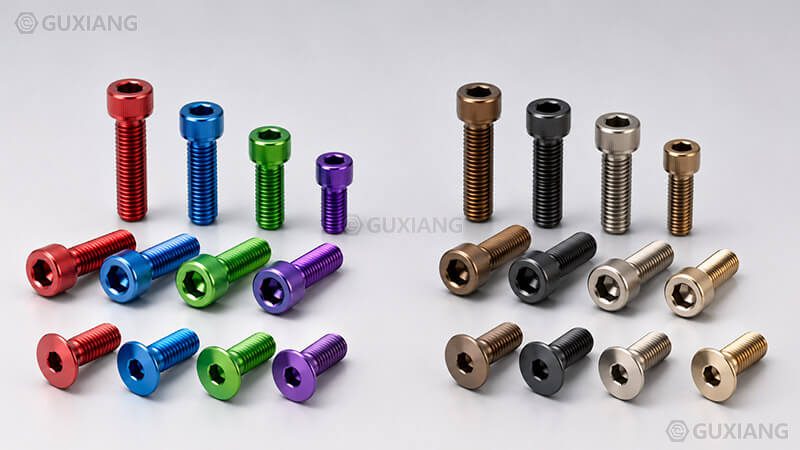
Dyeing (organic dyes). The porous film absorbs dye after anodizing, before sealing. Dyeing gives the widest color range — red, blue, green, purple — and is cheap. The weakness is lightfastness: organic dyes fade outdoors, some in months. Dyed anodize is an indoor or low-UV finish.

Electrolytic coloring. Metal salts are deposited in the pores by a second AC electrolysis step. The color range is limited — bronze, black, champagne, and architectural tones — but the color is lightfast because it is metallic, not organic. European architectural anodizing runs almost entirely on electrolytic coloring, under the QUALANOD quality scheme.

For fasteners, the practical split is: if the part lives outdoors, specify electrolytic coloring; if it is indoor cosmetic hardware, dye is fine and cheaper. Black is the most common fastener color in both routes, and black electrolytic coloring is the workhorse for outdoor black hardware.

Batch consistency deserves a warning. Anodize color depends on alloy, surface preparation, bath condition, film thickness, dye concentration, and sealing time. Two batches from the same supplier can drift visibly, and matching a new batch to a five-year-old part is usually impossible. For assemblies where color match matters, order the complete fastener set from one production run and keep spares from that run. For anything where the color must be reproducible for years, specify electrolytic coloring and a color standard sample signed off before production.

anodizing_dyed-vs-electrolytic-colors

Field Complaints: What Customers Actually Say

Four complaints dominate the anodized fastener call log, and the fixes are rarely what the caller expects.

“The threads will not go in.” The classic tolerance failure from Section 4. The film grew the pitch diameter, the assembler forced it, and the thread stripped or the oxide chipped. Fix: anodize-before-thread, undersize the thread, or chase after coating. Also torque discipline — anodized threads gall less than bare aluminum, but they are still aluminum, not steel.

“It came out of the box scratched with white marks.” White marks on dyed anodize are the oxide film fractured. Causes: handling damage before sealing is complete, soft Type II film on a wear part, or dye that was never sealed properly. Fix: match the type to the wear demand — Type III for parts that get handled — and require sealed film with a seal-quality test.

“The colors do not match between orders.” Covered in Section 8. Fix: one production run per assembly, electrolytic coloring for long-term reproducibility, and a signed color standard.

“It still corroded in the salt fog.” Check the film thickness, the seal, and the damage state before blaming the process. Thin film, unsealed pores, or a scratched surface all produce corrosion on an otherwise correct finish. A salt spray report is only meaningful when the coating thickness and seal quality are part of the same certificate.

North American vs European Practice

Anodizing has two regulatory and standard ecosystems, and exporters ignore the difference at their cost.

TopicNorth AmericaEurope
Primary specsMIL-A-8625 (Type I/II/III), ASTM B580ISO 7599 (general), ISO 10074 (hard anodize)
Thin-film aerospace routeMIL-A-8625 Type I chromicTAS (tartaric-sulphuric), REACH-driven
Architectural quality schemeAAMA 611QUALANOD
ColoringDye and electrolytic both commonElectrolytic dominant for outdoor
Film thickness unitsµm or milµm
Cr⁶⁺ pressureModerate (RoHS applies to products)High (REACH authorization burden)

The practical consequences: a US drawing that says “anodize per MIL-A-8625 Type II, class 2, black” means something precise; a European drawing that says “anodized black” does not. Write the full standard reference on every drawing — the type, the thickness range, the sealing requirement, and the color class. And if the part is headed for Europe, expect chromic acid anodize to be questioned at audit, because hexavalent chromium carries a heavy regulatory load under REACH. The aerospace thin-film alternative is TAS, which is worth specifying preemptively in new designs on both sides of the Atlantic.

Selection Framework

Four questions settle most anodized fastener decisions.

Step 1: Does the Fastener Need to Conduct?

If yes — grounding, bonding, current path — anodizing is off the table. Use chemical conversion coating or bare aluminum with appropriate galvanic management. The conductivity requirement overrides everything else.

Step 2: What Is the Enemy: Corrosion, Wear, or Appearance?

RequirementFinish
Corrosion in wet serviceType II, sealed, 10–25 µm
Wear, repeated assembly, abrasionType III, 25–50 µm, hardness tested
Appearance, color match, brandType II dyed or electrolytic colored
Fatigue-critical dynamic loadType I / TAS thin film, or conversion coating
Conductive corrosion protectionChemical conversion coating

Step 3: Can the Thread Tolerance Absorb the Film?

Check pitch and film thickness against the fit class. If the thread is fine-pitch (≤ 1.25 mm) or the film exceeds ~15 µm, plan for anodize-before-thread or post-coating chase. Verify with a functional thread gauge on coated parts.

Step 4: Specify the Full Package

A correct anodize spec names the standard, the type, the thickness range, the sealing requirement, the seal-quality test, the color, and the batch-control rule. “Anodized” alone is not a specification — it is a conversation starter that leaves the supplier in charge of your tolerance and your corrosion life.

Worked Example: Black Hard-Anodized Screws for a Marine Instrument Housing

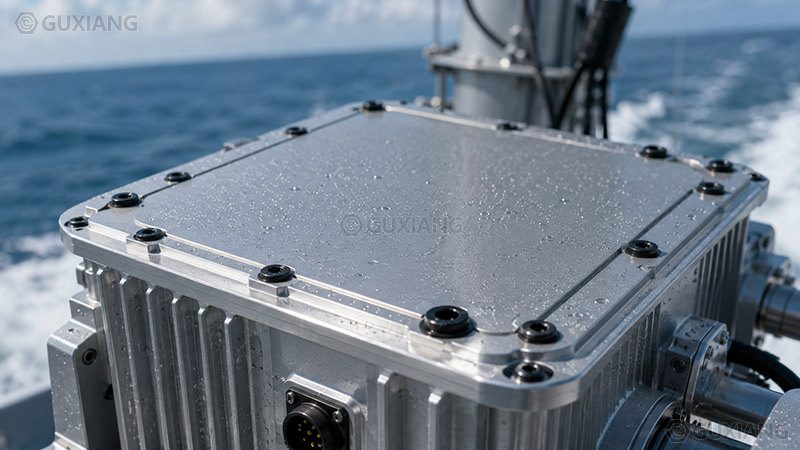
The housing is 6061 aluminum, the screws hold a cover that opens every month, and the environment is salt air. Step 1: no current path, conductivity is not a requirement. Step 2: repeated assembly is the wear driver, so Type III hard anodize, 25–35 µm. Step 3: the screws are M5 × 0.8, fine pitch — the film will eat the fit, so specify anodize-before-thread with a light post-treatment on the thread. Step 4: the spec reads “hard anodize per ISO 10074, 25–35 µm, sealed, electrolytic black, dye spot test per ISO 2143, threads cut after anodize.” Every word of that spec exists because a shorter one failed on a previous project.

Frequently Asked Questions

1. What does anodizing do to aluminum fasteners?

It grows a hard aluminum oxide film on the surface, improving corrosion resistance, wear resistance, and appearance. The film is part of the metal and cannot peel or flake.

2. Is anodized aluminum corrosion resistant?

Yes, when the film is sealed. Sealed Type II film typically passes 336+ hours of neutral salt spray; unsealed film performs far worse.

3. Does anodizing affect fastener dimensions?

Yes. The film grows about half inward and half outward, changing pitch diameters on threads. Fine-pitch threads and thick films need tolerance planning.

4. Can anodized fasteners conduct electricity?

No. The oxide film is a dielectric insulator. Use chemical conversion coating instead for grounding and current-carrying joints.

5. What is hard anodizing?

Type III anodizing, typically 25–150 µm thick, with hardness above 400 HV. It resists wear and abrasion but reduces fatigue life.

6. Does anodizing prevent galvanic corrosion with stainless steel?

A sealed, intact film insulates the couple and suppresses galvanic attack. But scratched film concentrates corrosion at the defect, so assembly must avoid film damage.

7. What color anodizing is best for outdoor use?

Electrolytic coloring — bronze, black, champagne — because metallic color is lightfast. Organic dyes fade outdoors and suit indoor parts only.

8. Does anodizing weaken aluminum fasteners?

Thin films have minimal effect. Thick hard anodize can reduce fatigue life because the brittle film cracks under cyclic strain.

9. How is anodize thickness measured?

Eddy-current instruments per ASTM B244 measure film thickness on aluminum non-destructively; cross-section microscopy and weight-loss methods are the lab alternatives.

10. What is the difference between Type II and Type III anodizing?

Type II sulfuric anodize is 5–25 µm for corrosion and appearance; Type III hard anodize is 25–150 µm for wear and abrasion, with greater dimensional and fatigue impact.

References

  1. International Organization for Standardization. “ISO 7599:2018 — Anodizing of aluminium and its alloys — General specification for anodic oxidation coatings.” https://www.iso.org/standard/70443.html

  2. International Organization for Standardization. “ISO 10074:2019 — Anodizing of aluminium and its alloys — Specification for hard anodic oxidation coatings.” https://www.iso.org/standard/70376.html

  3. ASTM International. “ASTM B580-79(2020) — Standard Specification for Anodic Oxide Coatings on Aluminum.” https://www.astm.org/b0580-79r20.html

  4. ASTM International. “ASTM B244-22 — Standard Test Method for Measurement of Thickness of Anodic Coatings on Aluminum.” https://www.astm.org/b0244-22.html

  5. Wikipedia. “MIL-A-8625.” https://en.wikipedia.org/wiki/MIL-A-8625

  6. QUALANOD. “Quality Label for Anodizing of Aluminium.” https://www.qualanod.net/

  7. MatWeb Material Property Data. “Aluminum and Anodized Coating Property Data.” http://www.matweb.com/

Table of Contents

Send Your Inquiry
Share: