




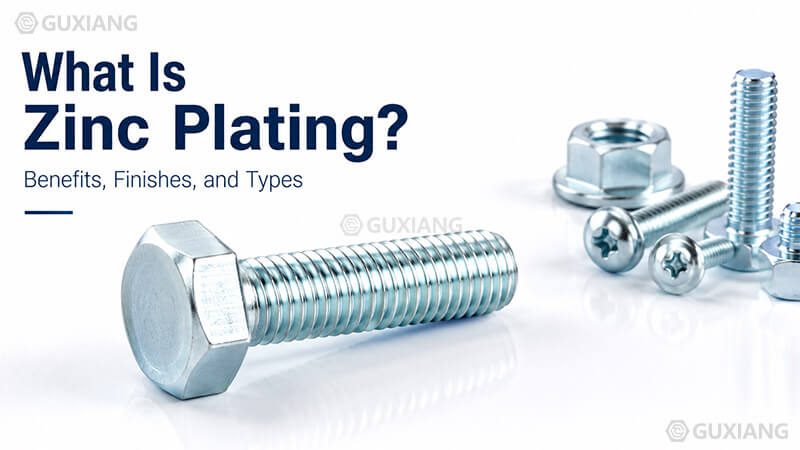
镀锌也叫镀锌电镀或电镀,是利用电流将薄层锌沉入钢或铁零件的过程. 锌会起到牺牲涂层的作用,在底金属之前腐蚀以阻止生锈. 它是在室内和温和环境中使用的紧固件、括号和盖有标记的五金件最常见的低成本腐蚀防护。本指南解释了镀锌是什么,工艺如何运作,其铬酸盐完成,厚度类,以及工艺类型,以便你能够自信地加以说明.
什么是锌平板?
镀锌(大多数工程师和买家称为搜索)是一种被电镀的表面处理,其中薄而连续的锌金属薄膜会沉入铁或钢底物上. 在贸易中,它也被称为锌电镀或电镀. 下一节将解释这一过程本身。在此,只需知道表面处理是在浴缸里应用的,而不是将部分浸入熔融的金属.
表面处理保护钢的原因是电化学. 锌在galvanic系列中坐落在铁下方,这意味着锌是活性更强的(anodic)金属. 两者结合并暴露出水分后,锌会优先腐蚀. 它放弃了金属所以钢不会工程师称这为"牺牲性阳极",而正是地产使得整个表面处理工作. 锌的刮伤不会在下方的钢上打开快生锈道,因为周围的锌会不断牺牲自己来保护被暴露出的地方.
锌还起到物理屏障的作用,使底金属外有水、氧气和路盐。障碍和牺牲效应加在一起,使薄的表面处理在室内和在轻度服务中运作良好.
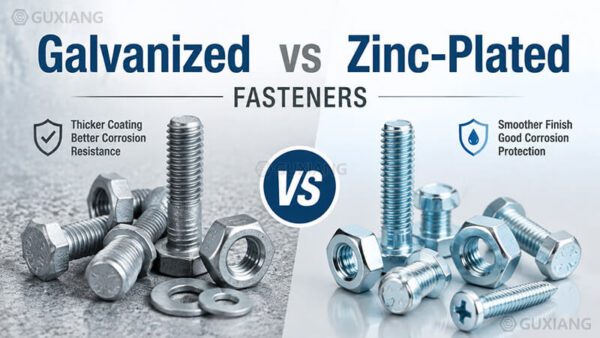
不要把镀锌和热活泼混淆起来。两者都将锌放入钢上,但能激发熔化锌中的部分并产生更厚的表面处理(通常为45至150微米)。镀锌是一种精确,薄薄,室温电镀薄膜(通常为5到25μm),能保持紧凑的螺纹耐受性. 关于电镀化学的无表面处理语言解释,请参见: 电子伽蓝化概况 关于维基百科.
锌板怎么用? (电镀过程步骤)
钢部分为锌电解质浴中的阴极,同浴有锌阳极. 当电流流出时,锌离子会统一排出部分。目前密度,浴缸化学, 和时间设置的储量厚度和均匀.
在锌能粘住之前,钢必须完全干净并有轻微活性. 任何留在地表的石油、氧化物或比例表都会引起裸露的斑点、不良的粘合物或碎裂。下面的顺序是工作店或被扣电镀线上标准的出行.
| 步骤 | 流程 | 发生什么事 |
|---|---|---|
| 1 | 清洁和腐烂 | 碱浸泡和电清除去切口油、商店土壤和水泡化合物 |
| 2 | R和酸活化(泡菜) | 稀释酸盐会剥去氧化物的光线,微细地将表面毛细化,使锌可以拉住 |
| 3 | 电压锌 | 部分为阴极、锌阳极溶解和活性沉积受控制的锌层 |
| 4 | 铬酸盐转化 | 在铬酸盐溶液中作一短暂的浸泡, 形成被动的耐腐蚀顶部胶片 |
| 5 | 冲洗、干燥和(如有必要)烘焙 | 纯净的水冲洗,温暖干燥,高强度钢材的氢解烤 |
| 6 | 检查 | 表面处理厚度(XRF或脱衣试验),粘合物,外观经过验证 |
步骤4值得特别关注,因为它既改变了角色的外观,也改变了角色的寿命. 作为板状锌层的自腐蚀速度相对较快. 铬酸盐转换后表面处理把它封住,添加了颜色,并倍增了盐喷阻. 下文将详细介绍表面处理.
第五步最后的烘焙不是化妆品. 对于硬性,高强度的紧固件,在酸性腌制和电镀过程中可以吸收氢气,而后会突然引起脆性衰竭. 救济烘焙使氢气熄灭。 ASTM B633和ASTM F1941的拇指规则是: 在39至40HRC硬度或以上,或者在1000兆帕(约145克西)及以上抗拉强度的部件,在被电镀后不久,一般在4小时内被烤出,在190至220°C至少3小时. 始终遵循规范标准,客户规格按准确周期进行.
镀锌工艺类型
每个镀锌部分有两个选择形状:浴池化学(碱或酸)和固定方法(架或管). 正确处理这些影响外观、厚度的统一性、氢风险和成本.
碱与酸锌
碱锌浴通常为氰化物自由氯化钾系统. 氯化酸锌浴是高体积的明亮工作。 他们的行为非常不同.
| 属性 | 碱锌(KCl,无氰化物) | 氯化酸锌 |
|---|---|---|
| 抛出力量 | 精致而统一的内线和下垂 | 平缓地 从深沉起伏 |
| 撤离率 | 中等 | 高 |
| 外观质量 | 切入到半亮度, 容易亮度 | 光亮处理轻松实现 |
| Hydrogen embrittlement risk | Lower | 更高 |
| Best geometry | Complex, threaded, deep recesses | Simple shapes, high volume small parts |
对于 螺纹紧固件 and parts with blind holes, alkaline zinc is usually the safer pick because it reaches into the geometry. Acid zinc wins on speed and brightness for simple stampings.
Rack vs. Barrel Plating
Fixturing decides how parts move through the line.
| 属性 | Rack plating | Barrel plating |
|---|---|---|
| Part handling | Hung individually on frames | Tumbled inside a rotating perforated barrel |
| Best part size | Medium to large, delicate, precision | Small, high volume, robust |
| Thread and cosmetic risk | Low damage | Higher, from tumbling wear and possible burrs |
| Throughput | Lower | 高 |
| Unit cost | 更高 | Lower |
| Coating uniformity | Very uniform | Good, with minor contact shadowing |
Rack plating protects threads and critical surfaces but costs more. Barrel plating is the economy choice for thousands of small screws and washers, at the price of some surface marking. For very high strength fasteners where hydrogen embrittlement is a concern, mechanical galvanizing (a room temperature peening process with no acid pickling) is sometimes specified instead, because it introduces essentially no hydrogen.
Zinc Plating Finishes: Chromate Conversion Coatings
The chromate film on top of the zinc is what gives the part its color and most of its corrosion resistance. Without it, bright zinc tarnishes and forms white corrosion within days in humid air. With it, the same part can survive weeks of salt spray.
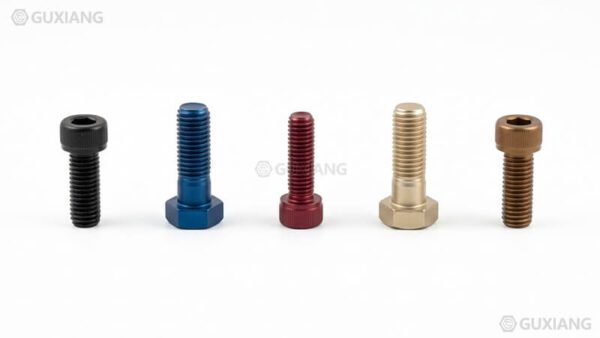
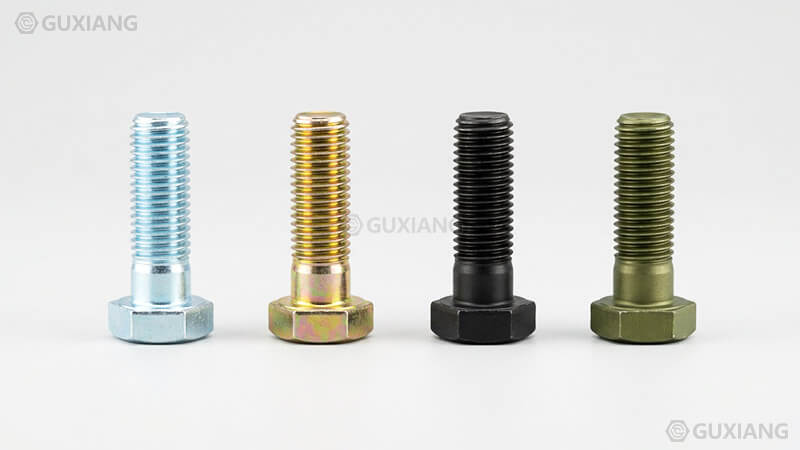
Four colors are common in supply:
Clear or blue chromate is nearly colorless with a faint blue tint. It is the thinnest film and the least protective, but it is clean, decorative, and an excellent paint base.
Yellow or iridescent chromate shows a golden to yellow sheen. It is the traditional general purpose finish for hardware and mild outdoor use.
Black chromate is dark and often used for architectural, automotive, and low reflection applications. It usually needs a sealer or topcoat to reach good salt spray times.
Olive drab (olive green) chromate is the darkest and thickest, favored for severe outdoor, military, and defense work.
The color trend tracks protection: darker chromate films are physically thicker, so they resist longer. The table below gives typical neutral salt spray (ASTM B117) performance to first white corrosion over roughly 8 µm of zinc. Treat these as industry reference ranges, not guarantees, because bath chemistry and zinc thickness move the numbers.
| Chromate finish | 颜色 | Chromium chemistry | Typical NSS to white corrosion* | When to use |
|---|---|---|---|---|
| Clear / blue | Transparent blue | Trivalent (Cr3+) | 12 to 48 h | Indoor, decorative, paint base |
| Yellow / iridescent | Golden yellow | Cr3+ or Cr6+ | 72 to 120 h | Mild outdoor, general hardware |
| 黑色 | 黑色 | Cr3+ or Cr6+ | 24 to 96 h | Architectural, decorative, low reflection |
| Olive drab | Olive green | Cr3+ or Cr6+ | 96 to 200 h | Severe outdoor, military, defense |
*Over approximately 8 µm zinc per ASTM B117 neutral salt spray. Actual results vary with zinc thickness, sealer, and bath condition.
Trivalent (Cr3+) vs. Hexavalent (Cr6+) Chromium
This distinction matters for compliance and for corrosion resistance. Hexavalent chromium (Cr6+) chromate gives the best protection and the classic yellow gold look. It is also a known carcinogen and is restricted under the EU RoHS Directive and REACH. RoHS caps hexavalent chromium at 0.1 percent by weight in most applications. Trivalent chromium (Cr3+) chromate is the modern, RoHS compliant standard. It protects nearly as well (slightly below Cr6+ for the same color) and is the default for EU and most North American supply. For the underlying chemistry of the film, see the chromate conversion coating reference. The coating families and color codes are also standardized in ISO 4520, the international standard for chromate conversion coatings on electroplated zinc and cadmium.
Zinc Plating Thickness and Salt Spray Corrosion Resistance
Thickness is the master variable for lifespan. More zinc means more metal to sacrifice before the steel is exposed. ASTM B633 organizes thickness into four service conditions, and the same numbers appear in ISO and fastener standards.
| ASTM B633 service condition | Designation (ISO 2081 / ASTM F1941) | Minimum thickness | Typical environment |
|---|---|---|---|
| SC1 | Fe/Zn 5 | 5 µm | Heated, dry indoor |
| SC2 | Fe/Zn 8 | 8 µm | Unheated buildings, mild indoor |
| SC3 | Fe/Zn 12 | 12 µm | Outdoor, moderate exposure |
| SC4 | Fe/Zn 25 | 25 µm | Severe outdoor, road salt, with chromate |
SC1 is the bare minimum for dry, heated space. SC2 covers most indoor hardware and fasteners. SC3 and SC4 are for genuine outdoor exposure, and SC4 should always be paired with a good chromate (yellow or olive) because 25 µm of bare zinc still fails fast in weather.
In salt spray testing, learn to read the two failure points. White corrosion is zinc oxide or hydroxide forming on the zinc itself. It means the coating is being consumed but the steel is still safe. Red rust is base steel rusting, which means the coating has failed and the part is now corroding. A thicker coating plus a better chromate pushes the red rust point further out. The standard test method is ASTM B117 neutral salt spray, and the thickness classes themselves are defined in ASTM B633-23, the current revision of the electroplated zinc specification.
Key Benefits of Zinc Plating
Engineers specify zinc plating with standards so that a callout means the same thing in a Chinese plating shop and a German assembly plant. The core references are:
ASTM B633-23. The U.S. standard for electrodeposited zinc on iron and steel. It defines the SC1 to SC4 thickness service conditions above and the supplementary treatments. Those treatments are labeled Type I (as plated, no chromate), Type II (colored chromate, typically yellow or olive), Type III (colorless or clear chromate), Type IV (phosphate), Type V (phosphate and oil), and Type VI (black chromate). Read the current revision at ASTM B633-23.
ASTM F1941. The fastener specific standard for electrodeposited coatings on mechanical fasteners, in both inch and metric. It uses the Fe/Zn designation with a chromate letter (for example Fe/Zn 8C) and sets the thread tolerance rules that keep plated bolts fit for service. Portland Bolt publishes a practical walkthrough of the Fe/Zn codes, thickness, chromate types, and baking at the ASTM F1941 reference page.
ISO 2081:2025. The international equivalent, now in its 5th edition (published November 2025), covering electroplated zinc with supplementary treatments. It uses the same Fe/Zn 5, 8, 12, 25 scale and the chromate marker. The official listing is at ISO 2081:2025.
ISO 4520. The international standard for chromate conversion coatings on electroplated zinc and cadmium, which fixes the color and performance classes. See ISO 4520.
RoHS and REACH. EU law restricts hexavalent chromium and other substances. Specifying trivalent chromate keeps parts inside the limits for the European market.
A specifier quick reference: choose the thickness by environment (SC1 to SC4), choose the chromate by appearance and salt spray need (Type III clear, Type II yellow, Type VI black, or olive), and add a baking note for any part at 39 to 40 HRC or above.
Zinc Plating vs. Other Coatings (Brief Comparison)
Zinc plating is one of several ways to protect steel, and it is not always the right one. The table below shows where it fits. It is intentionally short. For the full decision logic across every coating, use our fastener coating selection guide, which compares all finishes by environment.
| 涂层 | 典型厚度 | Max service temp | 最适合 | See selection guide |
|---|---|---|---|---|
| 镀锌 | 5 to 25 µm | About 200°C | Indoor, mild, precise threads | This article |
| 热浸镀锌 | 45 to 150 µm | 高 | Structural outdoor, thick sections | fastener coating selection guide |
| Zinc flake (Geomet, Dacromet) | 8 to 12 µm | About 300°C | Automotive, high temp, no H2 risk | full fastener coating overview |
| 316 stainless steel | Bulk material | Very high | Marine, strong corrosion | 304 vs 316 stainless steel fasteners guide |
The practical rule is simple. Zinc plating wins on cost and precision for mild service. Hot dip galvanizing is the heavier option for rugged outdoor steel. Zinc flake beats electroplating for high temperature or hydrogen sensitive automotive parts. For genuine marine or chemical exposure, solid 316 stainless steel is often the only durable answer, covered in our 304 vs 316 stainless steel fasteners guide. When the environment is uncertain, let the full range of fastener coatings settle the choice.
Industries and Common Applications
Zinc plating shows up wherever steel parts live in mild to moderate air and need to look acceptable while they resist rust.
Automotive. Interior clip nuts, brackets, and hose clamps are overwhelmingly zinc plated, while underbody and engine bay parts that see heat or salt usually move to zinc flake.
Construction and building hardware. Screws, anchors, hinges, and strike plates in dry or mild indoor buildings rely on SC1 to SC2 zinc.
Electronics. Connector shells, shielding cans, and small stamped contacts use thin clear chromate zinc because it is clean and a good finish base.
General industrial hardware. Conveyor clips, appliance screws, and enclosure fasteners are plated in high volume by barrel, keeping cost low.
The environment rule of thumb: mild and indoor maps to Fe/Zn 5 or 8, moderate outdoor maps to Fe/Zn 12 with yellow chromate, and severe outdoor maps to Fe/Zn 25 with olive drab. Anything harsher than that leaves the zinc plating comfort zone, which is the subject of the next section.
How to Specify Zinc Plating on a Drawing or PO
This is the section job shop competitors skip and specifiers need most. A good callout removes ambiguity at the plating line and prevents rejected lots.
1. Pick the thickness class. Use SC1 to SC4 (ASTM B633) or Fe/Zn 5, 8, 12, 25 (ISO 2081 / ASTM F1941). For a typical indoor fastener, Fe/Zn 8 is the common default.
2. Pick the chromate (supplementary treatment). On a drawing this is the Type or the chromate letter. Examples:
ASTM B633: “SC2, Type III” means 8 µm with clear chromate.
ISO 2081: “Fe/Zn 8 c” means 8 µm zinc with chromate.
ASTM F1941 (fasteners): “Fe/Zn 8C” means 8 µm zinc with chromate, with the thread tolerance built in.
3. Handle the threads. Plating adds to the major diameter. For a precise fit, specify pre plate thread cutting (the blank is cut undersized, then plated to finished size) or post plate thread rolling. State the acceptance on thread go/no go gauges so the shop knows the plated part must still assemble.
4. Add the hydrogen relief bake for hard parts. If hardness is 39 to 40 HRC or above, or tensile strength is 1000 MPa and above, apply the same relief bake from Step 5 (190 to 220°C, minimum 3 h, within 4 h of plating). This single line protects you from embrittlement claims.
5. Note appearance and any topcoat. Black chromate parts that must hit long salt spray times should call out a sealer. Painted parts should call out clear chromate as the base.
A complete purchase order line might read: “Zinc plated per ASTM F1941, Fe/Zn 8C, clear chromate, bake per F1941, RoHS compliant.” That one line tells the plater the thickness, the finish, the hardness treatment, and the compliance target. The detailed Fe/Zn code tables behind this are laid out by Portland Bolt in their ASTM F1941 technical reference.
Limitations and When Zinc Plating Is the Wrong Choice
We are upfront about where zinc plating stops working, because guessing wrong costs a failed lot. It is a thin coating, and thin coatings have limits.
Severe outdoor and marine. At a 25 µm maximum, zinc plating is simply too thin for constant salt air or standing coastal exposure. It will white and then red rust faster than buyers expect. For that world, see the full fastener coating overview and consider hot dip galvanizing, zinc flake, or 316 stainless steel.
Long term standing water or acid and alkali immersion. Zinc is amphoteric, so it dissolves in strong acid or alkali. Plating is wrong for chemical tanks and constant wet contact.
High temperature above 200°C. Zinc oxidizes past about 200°C, so continuous hot service needs zinc flake (to about 300°C) or another system.
Very high strength steel. Parts above roughly 40 HRC or 1200 MPa are at real risk of hydrogen embrittlement. Baking helps, but some specs forbid electroplating and require mechanical galvanizing or a coating with no acid step.
Heavy abrasion. A 5 to 25 µm film wears through under rub and fretting, exposing the steel underneath.
None of this makes zinc plating weak. It makes it a precision tool with a defined range. Used inside that range, it is the best value in corrosion protection.
How to Choose the Right Zinc Finish for Your Part
Use the environment as the first filter, then refine by appearance and thread need.
Heated, dry indoor (warehouse racking, appliance interiors). Fe/Zn 5, clear chromate. Cheapest, clean, adequate.
Unheated indoor or mild (building hardware, electronics). Fe/Zn 8, clear or yellow chromate.
Outdoor, moderate (fences, enclosures, garden equipment). Fe/Zn 12, yellow chromate.
Outdoor, severe or road salt (trailer hardware, brackish air). Fe/Zn 25, olive drab chromate, and accept shorter life than heavier coatings.
High temperature above 200°C. Do not use zinc plating. Move to zinc flake or another high temp system.
Marine or strong chemical exposure. Do not use zinc plating alone. Specify 316 stainless or a heavier coating after checking our coating selection guide.
For appearance, clear chromate is the neutral default, yellow is the traditional hardware look, black suits architectural and low glare parts, and olive drab signals severe service. Remember that thicker coatings need pre plate cutting, so state the fit requirement up front. When the choice is between zinc plating and a different coating, the compare all fastener coatings resource gives the full environment based decision table.
常见问题解答
镀锌和活化有什么区别?
A: 镀锌(电镀)在室温下会沉积出5至25微米的薄而精确的锌薄膜,使线的耐受性保持了收紧并低廉的室内和温和服务成本. 高压(热浸泡)将部分浸入熔锌中,并产生更厚45至150微米的表面处理,这适合结构钢和严酷的室外使用,但可膨胀线程。两者共用同一种砂锌保护,但它们在厚度,温度,成本,以及它们合用的部分上有所不同.
镀锌在微量层中有多厚?
A: 标准被电镀的锌厚度运行从5到25μm,按使用条件设置. ASTM B633和ISO 2081定义了Fe/Zn 5 (5μm,干室内),Fe/Zn 8 (8μm,轻室内),Fe/Zn 12 (12μm,中室外)和Fe/Zn 25 (25μm,重室外). 25微米最大是机架和枪管电镀的实用天花板,所以任何需要更多金属动作来进行热浸激发或锌片.
镀锌的生锈证明吗?
A: 没有表面处理是永久生锈的证明,但是镀锌在它的范围内非常能抵抗生锈. 锌是一种活泼的阳极,所以即使是一刮也保护了钢. 在中性盐喷剂中,好色相8微米表面处理根据铬的颜色抵抗白色腐蚀约24至120小时,而红锈在锌被消耗后出现. 在干燥的室内空气中,部分可以持续多年. 在船舶或常湿服务中,它最终会生锈.
镀锌的不同颜色是什么?
A: 四种常见的颜色出自锌上方的铬酸盐转化膜. 清或蓝色是薄薄的,保护性最弱,但清洁并具有良好的颜料基础. 黄色或快活是具有更好的盐喷活性的五金件-表面处理的一般用途. 黑色用于建筑和低光泽部分,通常需要密封器. 橄榄干是最黑暗和最有保护的,用于严重的户外和防御工作. 更深色的色相片体质更厚并抵抗更久.
镀锌钢在室外持续多久?
A: 生活松依赖于厚度和铬酸盐,以及环境. 室内,镀锌钢材经常会持续多年或几十年. 在中度空气的室外,有黄色铬酸盐的Fe/Zn 12可能存活了几年,而有橄榄干油的Fe/Zn 25则持续时间更长,但仍是一种薄薄的涂层. 在沿海,咸或常湿条件下镀锌是错误的选择,会相对快地生锈,因此更重的涂层或不锈钢是更好的规格.
镀锌RoHS和REACH是否符合规定?
A: 它可以,对欧盟和大多数北美供应来说,它应该是。合规依赖于铬酸盐化学. 三价(Cr3+)铬合金完成后不含受限的六价铬并符合RoHS和REACH的极限. 传统的六价(Cr6+)铬酸盐能产生最好的盐喷洒活性,但被限制在RoHS下以重量为0.1%,因此大部分被淘汰出口. 在图纸上指定三价铬以保持该部分的一致性.
参考文献
ASTM B633-23, Standard Specification for Electrodeposited Coatings of Zinc on Iron and Steel. The current ASTM revision defining the SC1 to SC4 thickness service conditions and Type I to VI supplementary chromate treatments used throughout this article.
ISO 2081:2025, Electroplated Coatings of Zinc on Iron and Steel. The 5th edition international standard (published November 2025) that sets the Fe/Zn 5, 8, 12, 25 thickness scale and chromate marker.
ISO 4520:1981, Chromate Conversion Coatings on Electroplated Zinc and Cadmium Coatings. The international reference that fixes chromate color and performance classes for electroplated zinc.
ASTM F1941, Electrodeposited Coatings on Mechanical Fasteners (Portland Bolt technical reference). A practical breakdown of the Fe/Zn designation, thickness, chromate types, and hydrogen relief bake rules for fasteners.
Wikipedia, Electrogalvanization. Background on the zinc electroplating principle, electrolytes, and conversion films referenced in the definition section.
Wikipedia, Chromate Conversion Coating. Reference for the chromate film mechanism, the color to protection trend, and the restriction on hexavalent chromium.