EN
EN  ZH
ZH 

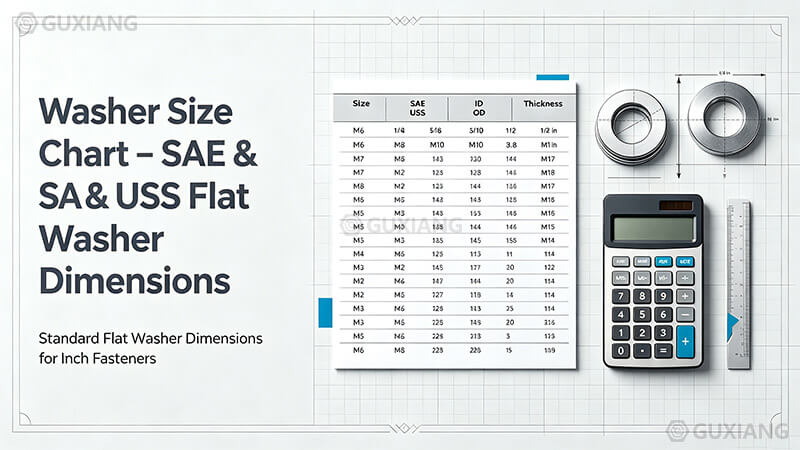
Quick Reference: Flat washers distribute bolt load over a wider area, protect surfaces from damage, and compensate for oversized holes. This chart covers standard dimensions for both SAE (Society of Automotive Engineers) and USS (United States Standard) flat washers from 3/16" to 3", with inside diameter, outside diameter, and thickness in both inches and millimeters.
Selecting the correct washer size is essential for ensuring proper load distribution and secure fastening. Using the wrong washer — one with an incorrect inner diameter or insufficient outer diameter — can lead to joint failure, surface damage, or uneven clamp force distribution. This page provides an interactive size lookup tool, complete dimension tables for both SAE and USS standards, and a practical selection guide to help you choose the right washer every time.
Inside Dia. (ID)
—
Outside Dia. (OD)
—
Thickness
—
USS (United States Standard) flat washers have a larger outside diameter relative to the screw size compared to SAE washers. They are commonly used in construction, general fabrication, and applications where a wider load distribution area is needed. The larger OD helps distribute clamp force over a broader surface, reducing the risk of damage to soft materials.
| Screw Size | ID (inches) | OD (inches) | Thickness (in) | ID (mm) | OD (mm) | Thickness (mm) |
|---|
SAE (Society of Automotive Engineers) flat washers have a tighter inner diameter tolerance and a proportionally smaller outside diameter compared to USS washers of the same screw size. They are the preferred choice in precision applications, automotive assemblies, and machinery where space constraints or close-tolerance fits are required. SAE washers are also commonly referenced as AN960 washers in aerospace applications.
| Screw Size | ID (inches) | OD (inches) | Thickness (in) | ID (mm) | OD (mm) | Thickness (mm) |
|---|
Although both SAE and USS washers serve the same fundamental purpose — distributing bolt load and protecting surfaces — they differ in key dimensional aspects that make each better suited for specific applications.
Key tip: For a given screw size, USS and SAE washers are not interchangeable. A USS washer for a 1/2" bolt has an OD of 1-3/32", while the SAE equivalent is only 7/8". Always verify which standard your application requires before ordering.
Step 1: Identify the bolt or screw size (e.g., 3/8", M10). The washer's inner diameter must be slightly larger than the bolt's nominal diameter to slide freely over the shank.
Step 2: Determine the washer standard required by your application. Construction and structural drawings typically specify USS washers, while automotive and machinery specifications often call for SAE washers.
Step 3: Check the outside diameter. The washer OD must be large enough to distribute the clamp force without the bolt head or nut pulling through. For soft materials (wood, plastic, aluminum), prefer a larger OD (USS style).
Step 4: Select the appropriate thickness. Thicker washers handle higher loads and resist deformation, while thinner washers are suitable for light-duty and precision applications.
Step 5: Consider the material. Standard carbon steel washers work for most indoor applications. For outdoor or corrosive environments, specify stainless steel washers or hot-dip galvanized washers.
The main difference is in the outside diameter and thickness. USS washers have a larger OD and are generally thicker, providing wider load distribution for construction and structural applications. SAE washers have a smaller OD, tighter ID tolerance, and are thinner, making them ideal for automotive, machinery, and precision assemblies where space is limited.
Match the washer to the bolt's nominal diameter. A 3/8" bolt requires a 3/8" washer. The washer's inner diameter (ID) should be slightly larger than the bolt shank to allow free sliding. Check the appropriate chart above — USS or SAE — depending on your application standard. For precision fastener joints, SAE washers provide a closer fit.
In some cases yes, but it depends on the application. USS washers have a larger OD, so they may not fit in tight spaces designed for SAE washers. The thicker profile can also affect the grip length calculation for the bolt. For critical joints, always follow the engineering specification. Substituting washer types without approval can affect joint integrity.
Flat washers serve four primary functions: (1) Distribute the bolt's clamp force over a wider area, preventing surface damage. (2) Compensate for oversized or slotted holes. (3) Provide a smooth bearing surface for the bolt head or nut to rotate against during tightening. (4) Act as a shim to fill gaps between the fastener and the workpiece.
Most standard flat washers are made from low-carbon steel (SAE Grade 1 or equivalent) with a plain, zinc-plated, or hot-dip galvanized finish. For corrosive environments, stainless steel (18-8 / 304 or 316) washers are specified. Brass and silicon bronze washers are used in marine and electrical applications. Material selection should match the bolt material to prevent galvanic corrosion.
AN960 is the military/aerospace designation for SAE-style flat washers per NAS (National Aerospace Standard) specifications. AN960 washers have the same dimensions as standard SAE flat washers but are manufactured to tighter tolerances and with material traceability requirements. They are widely used in aviation and aerospace applications where reliability is critical.
In most applications, the washer goes under the component that rotates during tightening — typically the nut. This prevents the rotating nut from damaging the workpiece surface. If both the bolt head and nut rotate, or if the joint uses soft material, place washers under both. For structural connections, follow the specification — some require washers under both the head and nut.
Multiply the inch value by 25.4 to get millimeters. For example, a 1/2" ID washer: 0.5 × 25.4 = 12.7 mm. The charts above include both imperial and metric values for every size. For a comprehensive inch-to-metric conversion tool, see our conversion chart.
A flat washer is a flat ring that distributes load and protects surfaces. A lock washer (split lock washer, toothed lock washer, etc.) is designed to prevent the fastener from loosening under vibration. Lock washers create spring tension or bite into the mating surface to resist rotation. Both types are often used together — flat washer first, then lock washer, then the nut.
Yes. A washer changes the friction surface under the bolt head or nut. With a washer present, the friction coefficient under the head is typically lower (especially with hardened or plated washers), meaning more of the applied torque converts to clamp force. When tightening to a specific torque value, the presence or absence of a washer can change the achieved preload by 10–20%. Always torque with the washer in place if it will be present in the final assembly.
Social Chat is free, download and try it now here!