





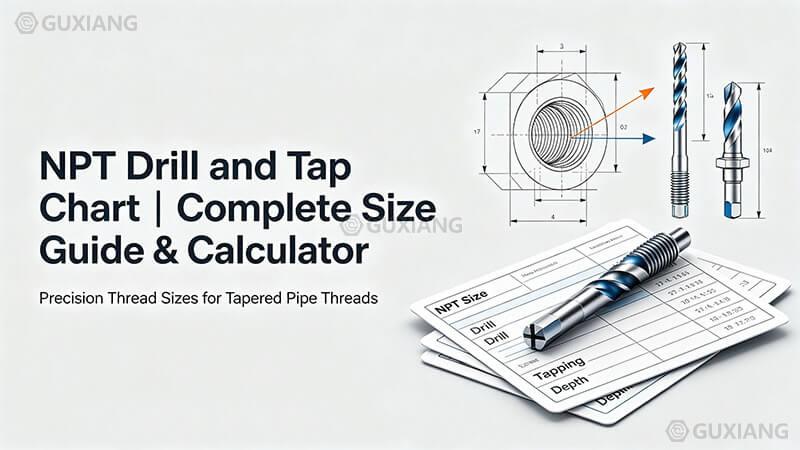
Быстрая ссылка: Нити NPT (National Pipe Taper) следуют за ANSI B1.20.1 с углом 60 ° резьба и сужением 1:16 (3/4) на фут. Выберите любой размер NPT ниже, чтобы мгновенно найти правильный размер крана, витков на дюйм и эквивалент метрическая система.
Выбор правильной буровой установки размер для потоков NPT имеет решающее значение для достижения надлежащего уплотнения под давлением и предотвращения дорогостоящих переработок в трубопроводной арматуре, гидравлических системах и приложениях для питания жидкости. Если вам нужен 1/4 ДНТ сверлил ЗЗ0ЗЗ, the 1/2 NPT бурение размер, или размеры для более крупных фитингов, как 2) ДНЯО или 4) ДНЯО, этот график дает вам точное соответствие каждый раз.
NPT Drill размер Lookup
Скачать NPT Drill размер
Щелчок дрель
—
Нити / дюйм
—
Двигатель метрическая система
—
NPT Tap Drill Table (все размеры)
Этот всеобъемлющий график охватывает все размеры ДНЯО стандарт от 1/16" - 12", включая крановую дрель размер, десятичный эквивалент, миллиметровый эквивалент, витков на дюйм и трубу за пределами диаметр. Используйте кнопки фильтра, чтобы перейти на нужный вам диапазон.
| ДНЯО размер | TPI | Обсуждение Drill размер | Децимальный (в) | Метрическая система (мм) | Труба OD (in) |
|---|
резьба NPT Размеры Ссылка
Для механической обработки и проверка таблица ниже предоставляет критические диаметры резьба в герметичной плоскости. Все значения ANSI B1.20.1.
| ДНЯО размер | TPI | Майор Диа | Pitch Dia | Маленькая Диа | Тапочка |
|---|
Как выбрать правильный дрель размер для нажатия NPT
Понимание отношений
Крановое сверло создает пробное отверстие до того, как кран ДНЯО разрежет внутренний кран резьба. Правильный размер бура должен производить внутренний диаметр резьбы близко к стандарт NPT внутренний диаметр резьбы для этого размера. Если дрель слишком мала, кран будет перегружен и может сломаться. Если слишком большие, нити будут неглубокими, и сустав может протекать под давлением.
Step-by-Step Selection
Step 1: Identify the NPT size of your fitting (e.g., 1/4" NPT).
Step 2: Look up the tap drill size in the chart above (for 1/4" NPT: 7/16" drill, 0.438" decimal).
Step 3: Select the matching drill bit. If fractional sizes are not available, use the decimal equivalent to find the nearest letter or metric drill.
Step 4: Drill the pilot hole, then tap with the corresponding NPT tap. Verify thread engagement with the fitting hand-tight.
75% Thread Engagement Rule
For most NPT applications, 75% thread engagement provides an optimal balance between joint strength and ease of assembly. The tap drill sizes in this chart are calculated for approximately 75% engagement. For high-pressure hydraulic systems, some engineers prefer 80–85% engagement, which requires a slightly smaller drill.
Important: NPT threads are tapered (1:16 ratio, or 3/4" per foot). The minor diameter varies along the length of the thread. The drill sizes listed produce the correct minor diameter at the hand-tight plane. Always use a taper pipe tap (not a straight NPT tap) for through-hole applications, and verify fit with a thread gauge.
NPT vs. BSPT: основные различия
When working with international fittings, you may encounter BSPT (British Standard Pipe Taper) threads alongside NPT. While both are tapered pipe threads, they are not interchangeable.
The key differences are: NPT uses a 60° thread angle (ANSI B1.20.1, American standard), while BSPT uses a 55° thread angle (ISO 7-1, British/international standard). The thread forms have different flank angles and pitches per inch. Forcing an NPT fitting into a BSPT port (or vice versa) will cross-thread and damage both components. Always verify the thread standard before assembly — look for markings on the fitting or consult the equipment manual.
Часто задаваемые вопросы
For 1/4" NPT (18 TPI), use a 7/16" drill bit (0.438" decimal / 11.1 mm). This produces the correct minor diameter for 75% thread engagement at the hand-tight plane.
For 1/2" NPT (14 TPI), use a 23/32" drill bit (0.719" decimal / 18.3 mm). The 1/2" NPT has a pipe OD of 1.050" and 14 threads per inch.
NPT (National Pipe Taper) has tapered threads that create a pressure seal through thread interference. NPS (National Pipe Straight) has parallel threads and requires an O-ring or gasket for sealing. They share the same thread angle (60°) and pitch, but the taper is the critical difference — never mix NPT and NPS fittings in pressure applications.
Нет. NPT (60° thread angle, ANSI standard) and BSPT (55° thread angle, ISO standard) have incompatible thread forms. Forcing them together will cross-thread and damage the connection. Always match the thread standard exactly.
TPI stands for Threads Per Inch — the number of thread peaks in one linear inch. For example, 1/4" NPT has 18 TPI (pitch = 1/18 = 0.0556"), while 1/2" NPT has 14 TPI (pitch = 1/14 = 0.0714"). Larger NPT sizes generally have fewer threads per inch.
All NPT threads have a 1:16 taper (3/4" per foot), meaning the diameter decreases by 3/4" over a 12-inch length. This taper is what creates the pressure seal when male and female threads are tightened together. The taper applies to both the thread diameter and the pitch diameter.
Yes, in most cases. While the taper creates mechanical interference, NPT threads typically require PTFE tape, pipe dope, or anaerobic sealant to achieve a leak-free seal in pressure applications. The only exception is when using NPT fittings with integrated O-ring seals (SAE O-ring boss), which seal on the O-ring, not the threads.
The pilot hole should be drilled at least 1–2 threads deeper than the required thread engagement depth. For standard pipe fittings, a minimum of 6 full threads of engagement is typical. Use the drill depth formula: drill depth = thread engagement length + 2× thread pitch. This ensures the tap can start cleanly without bottoming out.
NPT fittings are generally rated for pressures up to 10,000 PSI depending on size, material, and temperature. Smaller sizes (1/4"–1/2") typically handle higher pressures. For high-pressure hydraulic systems, always verify the fitting manufacturer's pressure rating table and ensure proper thread engagement and sealant application. Material selection also affects the pressure capability.
Reusing NPT fittings is generally not recommended for pressure applications. The tapered threads deform during initial assembly to create the seal, and re-tightening can compromise this seal. For non-critical, low-pressure applications, reuse may be acceptable if the threads show no visible damage. Always inspect threads before reinstallation and apply fresh sealant.