





Hex болт это шестисторонний внешне управляемый крепежное изделие, который зажимает детали гайкой или пробитым отверстием, и он определяется стандарт, а не формой. Это руководство охватывает основные типы гексболтов, стандарты ISO, DIN, ASME и EN, и где каждый тип используется в реальных соединениях. Вы также получаете готовые к вставке таблицы выбора, чит-лист класса и сухую таблицу крутящий момент.
Что такое Hex болт?
перейти к механике и исполнитель: болт представляет собой головку крепежное изделие с шестиугольной движущей поверхностью и резьбовым шанком, обычно с непоточной рукояткой под головой. Гекс-профиль принимает высокий крутящий момент от гаечного ключа или розетки, поэтому гекс-болты доминируют в стали конструкционный и тяжелой оборудование. Для более широкой геометрии головы см. наше руководство по типы головок винтов.
Анатомия
Пять Характеристики материи: голова (Акросс-флэтс устанавливает гаечный ключ размер) несущая поверхность (без покрытия, или машинное лицо шайба на винт с головкой) нитчатый шанк; the сцепление длинаZ (гладкий участок в плоскости сдвига); и чаевые (плоский на болты, скошенный на шапке винты). Внешняя гекса является одной из нескольких Типы приводаZ и сопротивляется камуфляжу под тяжелым крутящий момент.
Как это работает
болты зарабатывают на своем, слегка растягиваясь под напряжением, чтобы создать силу зажима. До тех пор, пока зажим остается над разделяющим нагрузка, сустав действует как один сплошной кусок. Когда зажим падает, сустав проскальзывает. Все это скатывается в одно число: предзагрузка.
Hex болт против кареты или лага
Начните с болт с квадратным подголовником: закругленная голова с квадратной шеей, которая кусает дерево. Далее лаг болт является грубым резьбовым и тупым наконечником, приводимым в движение собственными нитями в дерево или кладку без ореха. Напротив, гекс болт зажимается гайкой или прокалывает подготовленное отверстие и строится до опубликованного стандарт; замена в карете или лаге обычно лишает дизайн.
Hex болт Типы
Шестизарядные болты разделяются по покрытию резьба (полный или частичный) и форме головы (стандарт, тяжелый, фланец, конструкционный).
Шестикратные болты делятся на шесть основных типов: полностью и частично резьбовые болты, тяжелые шестигранные болты, фланцевые шестигранные болты, шестигранные болты конструкционный (F3125 / A325 / A490) и преобладающие варианты крутящего момента. Hex cap винты - это более плотный кузен допуск, покрытый отдельно.
Полностью или частично склеен
Go полностью резьбовой и болт запускает нити к голове для максимального вовлечения в пробитые отверстия и тонкие стеки. Частично резьбовый болт сохраняет непоточное сцепление, рабочую лошадку сдвига суставов, потому что корни резьба являются выемками и самым слабым сечением. Правило спецификации: где сустав видит сдвиг, укажите неполная резьба и размер захвата, чтобы покрыть плоскость сдвига.
Тяжелый Хекс болты
Тяжелая гекса является укороченным двоюродным братом: его голова бежит шире и выше, чем гекс стандарт на том же диаметр (на 3/4 дюйма, 1-1/4 дюйма против 1-1/8 дюйма). Дополнительный металл распределяет нагрузку и сопротивляется скольжению гаечного ключа; тяжелые шестнадцатеричные болты являются основой стальных работ конструкционный для ASTM F3125 (Главная A325 и A490).
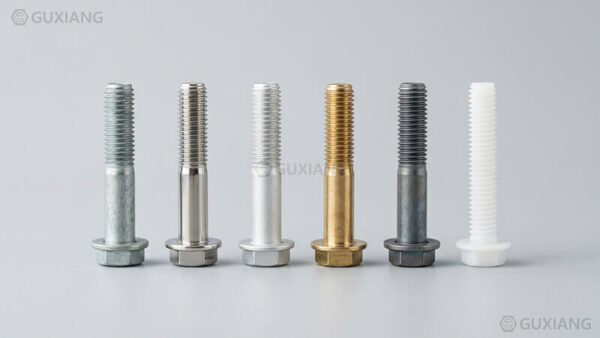
фланец x болты
Hex фланцевый болт создает шайба: интегрированная поверхность подшипника борется с ослаблением вибрации, идеально подходит для насосов и компрессоров, где помогает меньше деталей. Затворы фланец соответствуют собственным стандартам (например, DIN 6921).
конструкционный x болты
Шестизарядные болты конструкционный являются тяжелыми шестизарядными крепежные изделия для F3125, с A325 для стали конструкционный и A490 для самой высокой. Они устанавливаются с затвердевшими шайба под головой и орехом; шайба и орех являются частью системы.
Преобладают варианты крутящий момент
Prevailing-torque types fight back on their own: they resist rotation without a separate lock nut, usually through a distorted thread or a bonded patch. They hold in high vibration service where a standard nut would walk off. Use them where vibration is real and document the method, as the feature adds torque and can mask proper preload.
Hex cap screws (overview only)
The hex cap screw wears the same six sides but is machined to tighter tolerances under ASME B18.2.1, usually carries a washer face, and is meant for a tapped hole. The two are not interchangeable in precision or code driven joints. We cover the DIN 933/931 versus ASME B18.2.1 detail and socket head options in the винты с шестигранной головкой guide. For the contrast with recessed drives, see Phillips vs Torx vs flat head.
Hex Bolt Sizes and Threads
Hex bolt sizes span two systems that look close but are not close, and size is the first thing a storeroom gets wrong. An M12 bolt is 12 mm; a 1/2 inch bolt is 12.7 mm, and the threads will not mate. Pick your system from the equipment and stay in it.
Metric sizes (M series, ISO)
Metric hex bolt dimensions are called out as diameter, pitch, and length, for example M16 x 2 x 80. The table below is a paste ready reference for the common range, built from ISO 4014 (partial) and ISO 4017 (full).
Hex bolt dimensions follow two systems. Metric sizes use diameter, pitch, and length (for example M16 x 2 x 80); imperial sizes use fractional diameter, TPI, and length in inches. The tables below are paste-ready references built from ISO 4014/4017 and ASME B18.2.1.
| Nominal dia (M) | Coarse pitch (mm) | Across flats (mm) | Head height (mm) | Thread length b, partial (mm) |
|---|---|---|---|---|
| M6 | 1.0 | 10 | 4.0 | 18 |
| M8 | 1.25 | 13 | 5.3 | 22 |
| M10 | 1.5 | 16 | 6.4 | 26 |
| M12 | 1.75 | 18 | 7.5 | 30 |
| M16 | 2.0 | 24 | 10.0 | 38 |
| M20 | 2.5 | 30 | 12.5 | 46 |
| M24 | 3.0 | 36 | 15.0 | 54 |
| M30 | 3.5 | 46 | 18.7 | 66 |
| M36 | 4.0 | 55 | 22.5 | 78 |
Values are approximate per ISO 4014/4017 and rounded for shop use. Confirm against the standard for certified work.
Imperial sizes (ANSI/ASME B18.2.1)
Imperial bolts use fractional diameter, threads per inch (TPI), and length in inches. Coarse is UNC; fine is UNF.
| Nominal dia | UNC (TPI) | Across flats | Head height |
|---|---|---|---|
| 1/4″ | 20 | 7/16″ | 11/64″ |
| 5/16″ | 18 | 1/2″ | 7/32″ |
| 3/8″ | 16 | 9/16″ | 1/4″ |
| 1/2″ | 13 | 3/4″ | 5/16″ |
| 5/8″ | 11 | 15/16″ | 25/64″ |
| 3/4″ | 10 | 1-1/8″ | 15/32″ |
| 7/8″ | 9 | 1-5/16″ | 35/64″ |
| 1″ | 8 | 1-1/2″ | 39/64″ |
| 1-1/4″ | 7 | 1-7/8″ | 25/32″ |
| 1-1/2″ | 6 | 2-1/4″ | 15/16″ |
Dimensions per ASME B18.2.1. The inch series spans roughly 1/4″–1-1/2″ in the common structural and machinery range, with larger sizes available.
Coarse versus fine
Coarse (UNC, or coarse metric pitch) is the field default: it assembles faster, shrugs off dirt, and resists cross threading. Fine (UNF, or fine metric pitch) gives roughly 5 to 10 percent more preload at the same torque, holds better under vibration, and suits thin sections and automotive work. Do not mix the two in one joint.
How to measure
Measure the nominal diameter across the thread crest and the length from directly under the head to the tip; the head height never counts. For the thread, count TPI on the imperial side or measure pitch in millimetres on the metric side with a gauge, and read the head markings to confirm grade before you trust a bin bolt.
Hex Bolt Strength Grades
Hex bolt grades tell you what the fastener carries before it yields or breaks; the grade is stamped on the head, and reading it takes five minutes and saves a failure.
Metric property classes (ISO 898-1)
Strength lives in the numbers. For Class 8.8, the first digit times 100 gives nominal tensile strength in MPa (about 800). The second digit times 10 gives the yield to tensile ratio (8.8 yields at roughly 640 MPa).
Hex bolt grades encode strength. Metric property classes (ISO 898-1) read as two numbers: the first x100 gives tensile strength in MPa, the second x10 gives the yield ratio. The table below maps Class 4.6 through 12.9 to typical use.
| Класс собственности | Tensile strength (MPa) | Yield strength (MPa) | Типичное использование |
|---|---|---|---|
| 4.6 | 400 | 240 | Mild steel, non structural, light duty |
| 8.8 | 800 | 640 | General machinery, structural, flanges |
| 10.9 | 1000 | 900 | High load, automotive, slip critical |
| 12.9 | 1200 | 1080 | Maximum strength, hydraulic, tooling |
SAE grades (SAE J429)
Imperial grades mark strength with radial lines: Grade 2 (no markings, about 74,000 psi, hardware); Grade 5 (three radial lines, about 120,000 psi, the workhorse); Grade 8 (six radial lines, about 150,000 psi, suspension and structural).
ASTM structural grades
ASTM A307 is the low carbon commercial bolt, about 60,000 psi, for general purpose and non critical members. A325 and A490 are the high strength structural grades, now folded into ASTM F3125, which means the whole system: heavy hex head, nut, washer, and a documented tension method.
Head marking cheat sheet
Paste this into your inspection sheet: Метрическая система digits “8.8”, “10.9”, or “12.9”; САЙ no lines for Grade 2, three radial lines for Grade 5, six for Grade 8; ASTM “A325” or “A490” plus a manufacturer mark, while A307 is often marked “A307” or with a single dot.
Class 8.8 versus 10.9
Reach for 8.8 for general machinery, flanges, and motor mounts where loads are moderate. Step up to 10.9 for slip critical, high load, or weight limited joints such as automotive powertrain. Do not default to the highest number; a 12.9 bolt is brittle under shock.
Hex Bolt Standards
Because of standards, a bolt made in one plant fits a nut made in another; the cross reference table is the part most guides leave out.
ISO 4014 and ISO 4017
ISO 4014 covers the partially threaded hex bolt; ISO 4017 covers the fully threaded version. ISO 4014 and 4017 are the global default for metric hex bolts and your dimensional inspection documents.
DIN 933 and DIN 931
DIN 933 is the German full thread standard and DIN 931 the partial thread standard. They precede the ISO pair: DIN 933 aligns with ISO 4017, and DIN 931 aligns with ISO 4014. Many drawings still call out the DIN numbers, so knowing the mapping prevents a mismatched order.
ASME B18.2.1 and ASME B18.2.6
ASME B18.2.1 governs the inch series hex cap screw and hex bolt. ASME B18.2.6 governs the heavy hex structural bolt, the dimensional home of A325 and A490. If you build to US or Canadian codes, B18.2.6 is the one your inspector will cite.
EN 24014 and EN 24017
EN 24014 and EN 24017 are the European harmonized equivalents: EN 24014 matches ISO 4014 (partial) and EN 24017 matches ISO 4017 (full). For exporters shipping into the EU, citing the EN number on the certificate satisfies the harmonized requirement that the bare ISO number alone may not. This EN coverage is where GUXIANG gives you an edge most competitor guides never mention.
Standard cross reference table
| Thread coverage | ISO | DIN | ASME | EN |
|---|---|---|---|---|
| Full thread | ISO 4017 | DIN 933 | ASME B18.2.1 (inch) | EN 24017 |
| Partial thread | ISO 4014 | DIN 931 | ASME B18.2.1 (inch) | EN 24014 |
| Heavy hex structural | ISO 4775 | DIN 6914 | ASME B18.2.6 (F3125) | EN 14399 (sets) |
Spec rule: when a drawing lists one standard, you may substitute the equivalent in the same row only if the purchase order and certificate state both the original and the supplied standard. Never assume equivalency across rows.
Hex Bolt Materials
Material sets the ceiling on strength and corrosion resistance; the grade tells you strength, the material tells you what environment the bolt survives.
Углеродистая сталь
Carbon steel is the default: cheap, strong, easy to heat treat, but it rusts in wet or outdoor service and needs a coating. Our без покрытия нейлон guide covers options; carbon steel plus the right finish covers most bolted joints.
Нержавеющая сталь
Stainless hex bolts are called out as A2-70 (304) or A4-80 (316), about 700 MPa and 800 MPa tensile. It is not as strong as alloy steel but removes the coating question in corrosive service. The trap is galling: stainless threads seize under dry high torque, so lubrication matters more here than anywhere. For the 304 versus 316 call, our 304 vs 316 stainless steel guide lays out the chloride threshold where 316 earns its premium.
Легированная сталь
Alloy steel sits behind Class 10.9 and 12.9. It is quenched and tempered for high strength, the choice for engine, suspension, and hydraulic joints. The trade is brittleness under shock and a hard no on some coatings. Our aluminum fasteners note helps when weight, not strength, drives the design, though aluminum hex bolts are rare and light duty only.
Specialty and selection
Brass and silicon bronze show up in electrical and marine work needing corrosion resistance without magnetic or galvanic conflict. Match the metal to the mating parts to avoid galvanic corrosion, and when in doubt read our материалы для крепления guide before you commit.
Surface Treatments and Coatings
Coatings decide whether the bolt still works in year ten. Pick the finish from the environment, not the catalogue.
Цинкование
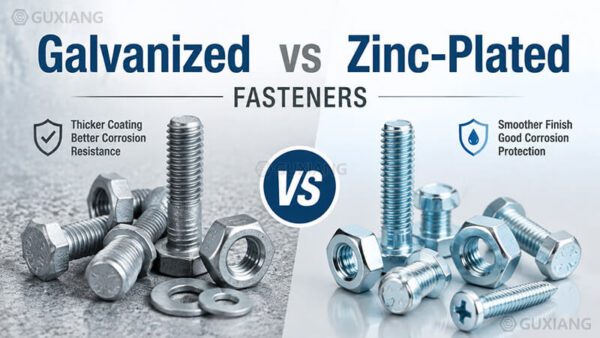
Zinc plating lays down 5 to 12 microns of zinc for indoor and mild atmospheric service (roughly 72 to 200 hours salt spray), the default for indoor machinery and the cheapest clean defense.
Hot dip galvanizing (HDG)
HDG drops the bolt in molten zinc for a 45–85 micron coating that survives outdoor and structural exposure for decades. The thick coating changes the thread form, so a galvanized bolt needs a galvanized nut tapped to the oversized tolerance. Do not hot dip galvanize Class 12.9: the acid pickling step can introduce hydrogen, and a 1200 MPa bolt is the one that fails by hydrogen embrittlement. Keep HDG to carbon steel and alloy up to about Class 10.9, with a controlled bake out.
Dacromet and Geomet (zinc flake)
Zinc flake coatings such as Dacromet and Geomet give 1000 plus hours salt spray with no hydrogen embrittlement risk, because there is no acid pickling. That is why they are the preferred finish for Class 10.9 and 12.9 bolts in automotive, wind, and marine service, though they cost more than zinc plate.
Black oxide and phosphate
Black oxide and phosphate are thin, mostly cosmetic finishes with low corrosion resistance. They suit an engine bay or display unit but need oil, offering little standalone protection; do not specify them for anything that sees weather.
Coating by environment
| Environment | Best finish | Why |
|---|---|---|
| В помещении, в сухом месте | Plain or black oxide | No corrosion driver; cost first |
| Mild outdoor | Zinc plate | Cheap, adequate salt spray life |
| Harsh outdoor, structural | HDG (to Class 10.9 max) | Thick, long life, field proven |
| Automotive, wind, marine | Zinc flake (Dacromet/Geomet) | No H2 risk, 1000+ hours |
| Chloride, seawater | A4-80 stainless or zinc flake | Resists pitting and crevice attack |
Where a seated joint meets a countersunk feature, our угол зенкерования guide keeps the bearing surface seating correctly under the coated head.
How to Choose the Right Hex Bolt
Copy this matrix into your specification; it turns the tables above into one decision path.
The selection matrix
| Заявка | Load | Environment | Тип | Оценка | Материал | Завершить |
|---|---|---|---|---|---|---|
| General machinery | Умеренный | В помещении | Partial hex | 8.8 / Grade 5 | Углеродистая сталь | Zinc plate |
| Structural steel frame | High, slip critical | На открытом воздухе | Heavy hex, F3125 | A325 / A490 | Углеродистая сталь | HDG |
| Pump or compressor skid | Moderate, vibration | Indoor or washdown | Flange bolt | 10.9 / Grade 8 | Carbon or alloy | Zinc flake |
| Marine or chemical | Умеренный | Chloride | Partial hex | A4-80 | 316 stainless | Plain (stainless) |
| Automotive powertrain | Высокий | Underbody | Partial hex | 10.9 | Легированная сталь | Zinc flake |
| Precision tapped hole | Умеренный | В помещении | Hex cap screw | 8.8 / Grade 5 | Carbon or alloy | Zinc plate |
Worked examples
Outdoor steel frame. Heavy hex A325, HDG, carbon steel, with heavy hex nut and hardened washer. The heavy head spreads load, HDG fights weather, and F3125 gives the inspector a tension path.
Pump housing. Flange bolt, Class 10.9, zinc flake. The flange replaces a loose washer, 10.9 holds preload, and zinc flake avoids hydrogen risk.
Marine handrail. Partial hex, A4-80 stainless, plain. No coating to fail, and 316 resists the chloride that would eat carbon steel in a season.
Procurement checklist
Engineers spec the bolt; buyers make sure the box matches. Before you release payment:
Mill Test Report (MTR). Demand a report showing actual chemistry and mechanical results, not just the grade claim.
Dimensional inspection. Verify across flats, head height, thread pitch, and length against the standard on a sampled basis.
Certifications. Confirm ISO 9001 for the plant, and CE or the relevant harmonized standard (such as EN 24014/24017) for EU shipment. Check RoHS where restricted substances apply.
Traceability. The lot number on the package should tie back to the MTR and the heat.
One buyer I work with skipped the mill test report to save two days on a container of Class 10.9 bolts. Third-party inspection found them 12 percent under the declared proof load. The lot was rejected, and the line sat idle for a week. The two days saved turned into eleven days lost. Paperwork is the part of the product you cannot see until it fails.
Torque and Installation Best Practices
Hex bolt torque is the lever you pull to reach preload; get the relationship wrong and a perfectly graded bolt still fails.
The torque equation and nut factor
In short: T = K × d × F, where T is torque, K the nut factor, d the nominal diameter, and F target preload. K swallows every real world variable: friction under the head, in the threads, and surface condition. Use K = 0.20 dry, K = 0.15 lubricated, and K near 0.13 for anti seize or wax; the same bolt can need 35 percent less torque once lubricated.
Torque reference table
Hex bolt torque depends on grade and lubrication. The same bolt can need up to 35% less torque once lubricated. The table below lists dry and lubricated Nm for Grade 8.8 and 10.9 from M6 to M24.
| Размер | Grade 8.8 dry (Nm) | Grade 8.8 lube (Nm) | Grade 10.9 dry (Nm) | Grade 10.9 lube (Nm) |
|---|---|---|---|---|
| M6 | 10 | 7 | 14 | 10 |
| M8 | 25 | 18 | 35 | 25 |
| M10 | 50 | 35 | 70 | 50 |
| M12 | 85 | 60 | 120 | 85 |
| M16 | 210 | 150 | 300 | 210 |
| M20 | 410 | 290 | 580 | 410 |
| M24 | 700 | 500 | 1000 | 700 |
Treat the table as a starting point, not the final word; a lubricated stainless joint can need half the dry torque before galling begins.
Why lubrication matters
Dry stainless threads gall: the metal welds to itself under turning load and the head spins while the shank stays put, freezing the joint. A dab of anti seize on stainless is the difference between a clean install and a drilled out bolt. Lubrication also makes your torque reading mean something; without a known K, torque is just a guess at preload.
Target preload
Aim for 70–90% of proof load in a properly prepared joint. Below 70 percent clamp may not beat the separating load; above 90 percent you crowd yield and small errors snap the bolt. For structural F3125 work, follow the turn of nut or direct tension method in the project spec rather than a torque wrench alone.
Common Hex Bolt Specification Mistakes
Most joint failures trace back to a short list of spec errors. Most surface in the field, not on the drawing.
Mixing coarse and fine, or metric and imperial. The diameters look close and the threads strip. Confirm the system before you order.
Threads in the shear plane. A fully threaded bolt in a shear joint loads through thread roots. Specify partial thread and size the grip to cover the shear plane.
Hot dip galvanizing Class 12.9. The pickling step risks hydrogen embrittlement in the one grade that cannot tolerate it. Cap HDG at about Class 10.9 with bake out.
Over torquing dry stainless. Dry stainless galls and freezes. Lubricate it and torque to the lubricated value.
Substituting without checking yield and standard. A bolt that looks right can be a different grade or standard. Verify the head mark and the certificate.
Skipping the paperwork. No MTR, no dimensional check, no traceability. When the joint fails, you will wish you had the paper.
Hex Bolts FAQ
Engineers and buyers type the same questions every time. Here they are: if your joint involves thinner sheet or wood based assemblies, our notes on винты для листового металла и drywall vs deck screws cover the fasteners that are not hex bolts at all.
В чем разница между шестнадцатеричным болтом и шестнадцатеричным винтом?
A: На практике: дотянуться до винта с шестнадцатеричной крышкой, когда у вас есть прослушанное отверстие и нет доступа к задней части; дотянуться до шестнадцатеричного болта, когда гайка зажимается.
Что такое стандартный шестнадцатеричный болт?
A: Единого стандартного уровня не существует. Класс 8.8 является обычной высокопрочной метрической точкой входа; Класс 4.6 - мягкая сталь для неструктурного использования. В Imperial, SAE Grade 5 - это ход, а Grade 2 - аппаратное обеспечение низкой прочности.
Как измерить шестигранный болт?
A: Измерьте номинальный диаметр по гребню резьбы и длину от непосредственно под головой до кончика; высота головы никогда не считается. Для нити подсчитайте TPI (имперский) или измерьте шаг в миллиметрах (метрический).
Для чего используется тяжелый шестигранный болт?
A: Тяжёлая гекса болты используется для стали, мостов, сосудов под давлением и трансмиссионных башен. Они имеют более широкую и высокую голову, чем стандарт гекс болты и указаны в ASTM F3125 (A325 или A490).
Можете ли вы использовать гекс в пробитой дыре?
A: Да. [5] будет резьба в пробитое отверстие, но он предназначен для [6]-и-шайба сборки через отверстия зазора. Для точность или контролируемого кодом сустава гекс винт с головкой с более плотным допуск и шайба лицом является более безопасным выбором.
Что означают 8,8 или 10,9 на голове?
A: Это метрическая система классы свойств ISO 898-1. Первое число раз 100 дает предел прочности при растяжении в MPa (8,8 составляет около 800); второе время 10 дает соотношение доходности к напряжению (8,8 дает примерно 640 MPa). Класс 10.9 более сильный.
Нержавеющая гекса болты слабее?
A: Нержавеющая ниже по прямой прочности, чем закаленная легированная сталь, но не слабая. A2-70 (304) достигает около 700 МПа и A4-80 (316) около 800 МПа, что соответствует большинству атмосферных и судостроение услуг. Укажите покрытый высокопрочной болт как для прочности, так и для коррозии.
горячеоцинкованный гайки соответствует горячеоцинкованный болты?
A: Да, но только если оба являются горячими горячеоцинкованный для соответствия негабаритным допускам резьба. Гальванизация утолщает нити, поэтому ей нужен орех горячеоцинкованный, прикрепленный к специальному классу. Соединение его с орехом без покрытия, вероятно, свяжет или разрежет нити.
Что такое крутящий момент для M12 класс прочности 8.8 болт?
A: В качестве сухого эталона M12 класса 8.8 болт занимает примерно 75-85 Нм, чтобы достичь около 75 процентов пробная нагрузка при ореховом факторе около 0,20. Смазка опускает эту цифру существенно, поэтому крутящий момент выходит на фактическую поверхность и проверяется калиброванным гаечным ключом.
Должен ли Hex болты быть полностью или частично резьбовым?
A: Используйте частично резьбовый болты, где сустав видит сдвига, потому что непоточный захват сидит в плоскости сдвига и сопротивляется резке лучше, чем нити. Используйте полностью резьбовой (tap) болты для полного вовлечения в прослушиваемое отверстие или max резьба в тонком стеке.
Conclusion
Hex bolts are simple parts with unforgiving rules. Pick the type from the load path, the grade from the strength need, the standard from the market, and the finish from the environment; a partially threaded heavy hex A325 in HDG is a different animal from a fully threaded Class 8.8 in zinc plate, though both wear a six sided head.
When your next project needs hex bolts specified and sourced, get a quote from GUXIANG. We stock carbon steel, stainless, and alloy hex bolts to ISO 4014/4017, DIN 933/931, EN 24014/24017, and ASTM A325/A490, with full material test reports and dimensional inspection on every lot. Send us the drawing and we will match the standard, not just the shape.
References
The following authoritative standards and reference works were used to source specifications, grades, and application guidance cited throughout this guide.
ISO 4014: Hexagon head bolts (Product grade A/B) governs hexagon head bolt dimensions, tolerances, and product grades A and B.
ISO 4017:2022: Hexagon head screws (Product grades A and B) specifies hexagon head screw dimensions and mechanical grades for full and partial thread forms.
ASTM F3125 / F3125M: Structural bolts, including A325 and A490 types covers high-strength structural bolting for steel-to-steel connections.
ASTM A325: Structural bolts (historical, now consolidated under F3125) is retained for legacy reference as the predecessor specification for structural bolts.
ASME B18.2.1: Square, hex, heavy hex bolts and screws (Inch series) defines inch-series dimensions and thread requirements for hex and heavy hex fasteners.
DIN 933 and DIN 931: Hexagon head bolts (full and partial thread) provide German national specifications for fully and partially threaded hexagon head bolts.
EN ISO 24014 and 24017: European adoptions of ISO 4014 and 4017 are the CEN-published European versions of the ISO hexagon head bolt and screw standards.
Wikipedia: Bolt (fastener) offers a general reference overview of fastener terminology and bolt types.