






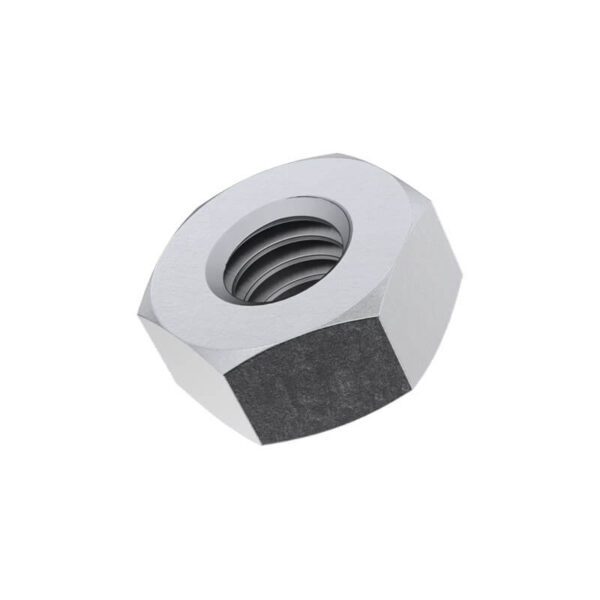

A nut is an internally threaded fastener that mates with a bolt or stud to form a clamped joint. When the nut is turned against the workpiece, thread friction converts rotational torque into axial tension in the bolt, creating clamp force. The nut carries the full reaction load: every unit of clamp the bolt pulls, the nut pushes back through its bearing face into the joint surface.
Unlike the bolt—which can fail in tension, shear, or at the head-to-shank transition—the nut’s failure mode is almost always thread stripping. This is because the engaged thread length in a standard nut is shorter than the bolt’s grip length, making thread shear the governing limit state. Matching nut proof load to bolt proof load is the central principle of nut specification, codified in ISO 898-2 and ASTM A563.
The nut works on two interfaces simultaneously. Thread interface: as the nut advances, the inclined plane of the threads converts a small rotational effort into a large axial force. The coarse pitch of metric threads amplifies this effect—each full turn of an M12 nut draws the bolt approximately 1.75 mm into tension. Bearing face interface: the nut’s underside presses against the washer or workpiece surface. Friction here resists self-loosening and accounts for roughly 50% of total installation torque.
Lock nuts add a third mechanism. A nylon insert nut embeds the bolt thread into the elastic collar, creating prevailing torque that opposes loosening even after joint settlement. A castle nut pairs with a cotter pin that passes through a cross-drilled bolt, forming a positive mechanical lock incapable of rotation until the pin is removed. All-metal lock nuts use deformed threads or a pinched collar to achieve the same prevailing torque effect without temperature-limited polymer components.
Tightening strategy is nut-dependent. Nuts are typically the turned element when the bolt head is inaccessible—think of structural steel connections where the erector tightens nuts from one side while the bolt head sits against the far face. In through-bolted assemblies, turning the nut generates consistent torque-tension curves because the nut’s bearing face is a known, repeatable friction surface.
Nuts are classified by locking mechanism and geometry—not just by hex size. A heavy hex nut and a nylock nut may share the same thread and across-flats dimension but serve opposite roles in the joint.
Standard nuts form the baseline. The hex nut (DIN 934 / ISO 4032) is the universal default—six flats, chamfered on both faces, used everywhere a bolt is used. The heavy hex nut has a wider across-flats dimension and thicker body, giving more bearing area and higher proof load for structural bolting. The jam nut is half-thickness and tightens against the main nut to create a lock—the pair wedges onto opposite thread flanks. The flange nut integrates a serrated or plain circular flange that replaces the separate washer, saving one component and one assembly step.
Lock nuts prevent self-loosening. Nylock nuts embed a nylon collar at the top of the internal threads; as the bolt enters the collar, the nylon deforms and wraps the thread, generating prevailing torque. Temperature range is -50 °C to +120 °C—above this, the nylon softens and loses grip. Castle / slotted nuts have radial slots machined into the upper body. After torqueing, a cotter pin passes through the slots and a cross-drilled bolt hole, creating a mechanical stop that cannot back off unless the pin shears. This is the standard lock method for automotive steering linkages, suspension joints, and aircraft control rods.
Assembly nuts join components rather than just clamp them. T-nuts have prongs that embed into wood or composite panels from the reverse side, providing machine threads in materials that cannot be tapped. Weld nuts have small projections that concentrate current during resistance welding, fusing the nut to the sheet metal surface in under a second. Coupling nuts are elongated hex bodies with threads running the full length, used to join two threaded rods end-to-end or to serve as a threaded spacer.
Special-geometry nuts solve access and ergonomics problems. Cap / acorn nuts have a domed closed end that covers exposed bolt threads for safety—no sharp thread ends protruding from machinery guards or handrails. Wing nuts have two projecting wings for finger-tightening without tools, suited to frequent assembly and disassembly. Square nuts have a larger footprint than hex types and resist spinning in slotted channels and unistrut framing—they predate hex nuts historically and remain common in furniture, electrical enclosures, and rail applications.
The twelve nut types below span four functional groups. Hex and heavy hex nuts handle the majority of structural bolting; lock nuts of various designs prevent loosening under dynamic loads; assembly nuts provide threads in materials that cannot be tapped; and special nuts address ergonomic and safety needs.
| Type | Group | Key Feature | Key Standard | Typical Application |
|---|---|---|---|---|
| Hex Nut | Standard | Double-chamfered, universal fit | DIN 934 / ISO 4032 | General-purpose bolting, machinery, automotive |
| Heavy Hex Nut | Standard | Wider AF, thicker body, higher proof load | ASTM A563 / ISO 4033 | Structural steel, high-strength joints, pipeline flanges |
| Jam Nut | Standard | Half-thickness, used as lock against main nut | DIN 439 | Backup lock for non-critical assemblies, adjustment nuts |
| Flange Nut | Standard | Integrated serrated flange replaces washer | DIN 6923 | Automotive exhaust, engine bay, appliances |
| Nylock Nut | Lock | Nylon insert collar, prevailing torque | DIN 985 / ISO 7040 | Automotive, general vibration resistance, -50°C to +120°C |
| Castle / Slotted Nut | Lock | Radial slots + cotter pin, positive mechanical lock | DIN 935 | Steering linkages, suspension joints, aircraft control rods |
| Cap / Acorn Nut | Special | Domed closed end, covers exposed threads | DIN 1587 | Handrails, guards, exposed bolting, decorative covers |
| Wing Nut | Special | Two projecting wings, tool-free tightening | DIN 315 | Jigs, fixtures, camera tripods, quick-release assemblies |
| T-Nut | Assembly | Prongs embed into reverse side of panel | — | Wood furniture, MDF panels, composite workholding |
| Coupling Nut | Assembly | Elongated hex, full-length internal thread | — | Threaded rod joints, standoffs, tie-rod extensions |
| Square Nut | Special | Larger footprint, anti-rotation in channels | DIN 557 | Unistrut framing, electrical enclosures, furniture |
| Weld Nut | Assembly | Projections for resistance spot welding | DIN 928 | Sheet metal assemblies, automotive body panels |
Carbon Steel
Low-carbon steel — hex, wing, and square nuts for indoor general use; zinc-plated or black oxide finish
Medium-carbon steel, quenched and tempered — heavy hex nuts (ASTM A563 Grade DH) and flange nuts for high-strength bolting; minimum proof load 150 ksi
Case-hardened steel — nylock and all-metal lock nuts where the deformed section must maintain hardness against repeated installation
Stainless Steel
A2 / 304 — general outdoor, food processing, architectural; comparable proof load to Class 8 nuts when properly cold-worked
A4 / 316 — coastal, offshore, chemical processing; higher nickel and molybdenum content resists chloride pitting
Gall resistance — stainless-on-stainless thread pairs have a high risk of cold welding (galling). Anti-seize compound or dissimilar materials (e.g., stainless nut on carbon steel bolt) reduces this risk
Brass
Decorative, electrical, and low-strength applications. Brass nuts are non-magnetic and resist freshwater corrosion. Lower proof load than steel—not suitable for structural joints. Common in electrical terminals, musical instruments, and plumbing trim where appearance or conductivity matters.
Non-Metallic
Nylon — all-plastic nuts for electrical isolation and lightweight applications; glass-filled nylon for moderate strength at elevated temperature
PTFE — chemical-resistant nuts for laboratory equipment and semiconductor processing
Step 1: Thread match and strength class
The nut’s proof load must equal or exceed the bolt’s tensile strength. ISO 898-2 Grade 8 nut for ISO 898-1 Class 8.8 bolt. ASTM A563 Grade DH heavy hex for ASTM A325 structural bolt. A softer nut will strip before the bolt reaches design preload—check the nut proof stress against the bolt ultimate tensile stress for the thread size.
Step 2: Locking requirement
Static joint, no vibration → standard hex or flange nut; flange nut saves the washer.
Light to moderate vibration → nylock nut; verify temperature stays within nylon limits.
High-temperature or high-vibration where nylon cannot be used → all-metal lock nut or castle nut with cotter pin.
Safety-critical where a backed-off nut creates a hazard → castle nut + cotter pin for a verifiable, inspectable lock.
Step 3: Assembly and access constraints
Blind mounting, no rear access → weld nut or T-nut; the nut is pre-installed on the reverse side.
Frequent re-assembly, no tools → wing nut; lower clamp load is the trade-off.
Rod-to-rod connection → coupling nut; threads full depth, no bottom.
Exposed threads are a safety hazard → cap nut covers the bolt end.
What is the difference between a hex nut and a heavy hex nut? Heavy hex nuts have a wider across-flats dimension (1/8″ larger than standard for inch sizes) and a thicker body. They carry a higher proof load and provide more bearing area under the nut face. Structural bolting codes require heavy hex nuts for A325 and A490 bolt assemblies.
How does a jam nut lock a joint? A thin jam nut is tightened against the main nut after the main nut is torqued. The two nuts wedge onto opposite flanks of the bolt thread—the jam nut pushes the main nut down while pulling itself up, creating a thread jamming effect that resists loosening.
Can I reuse a nylock nut? Nylock nuts lose prevailing torque with each installation as the nylon collar permanently deforms. DIN 985 permits up to 5 reuses if the prevailing torque still meets specification. After that, the nylon insert no longer delivers reliable locking torque and the nut should be replaced.
What applications require a castle nut with a cotter pin? Any joint where nut loosening creates a catastrophic hazard: steering linkages, suspension ball joints, aircraft flight control linkages, and rotating shaft retention. The cotter pin forms a visible, inspectable lock—a quick glance confirms the nut has not rotated.
Square nut vs. hex nut: when would I choose square? Square nuts resist spinning in channels and slots without the need for a second wrench. They are standard in unistrut framing, electrical panel mounting rails, and traditional furniture joinery. Their larger footprint also distributes the bearing load over a wider area in soft materials.
Does a flange nut need a washer? No. The integrated serrated or smooth flange replaces the separate flat washer, providing both bearing area distribution and anti-loosening via serration bite. This saves one part number and one assembly step per joint.
Social Chat is free, download and try it now here!