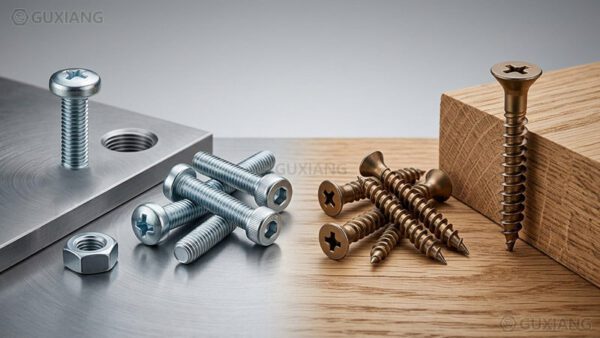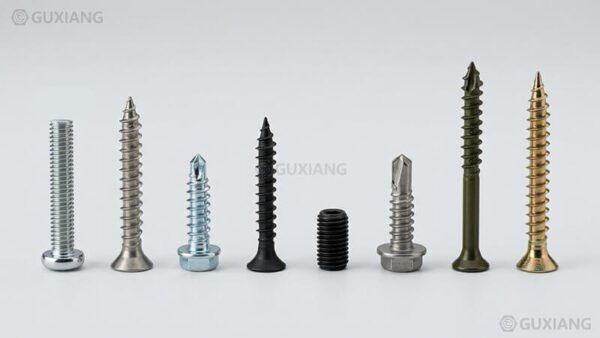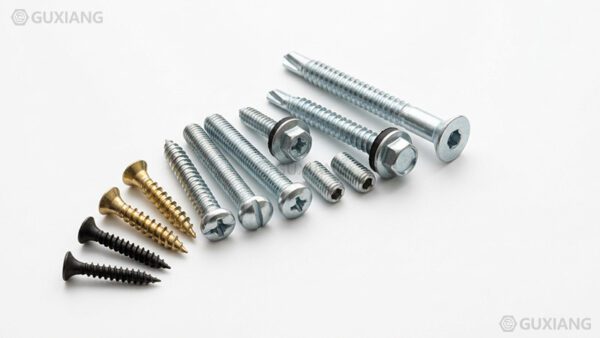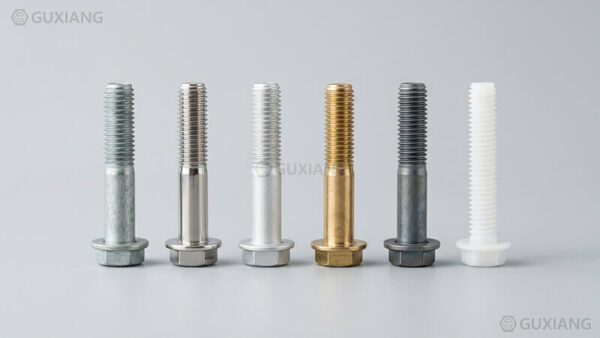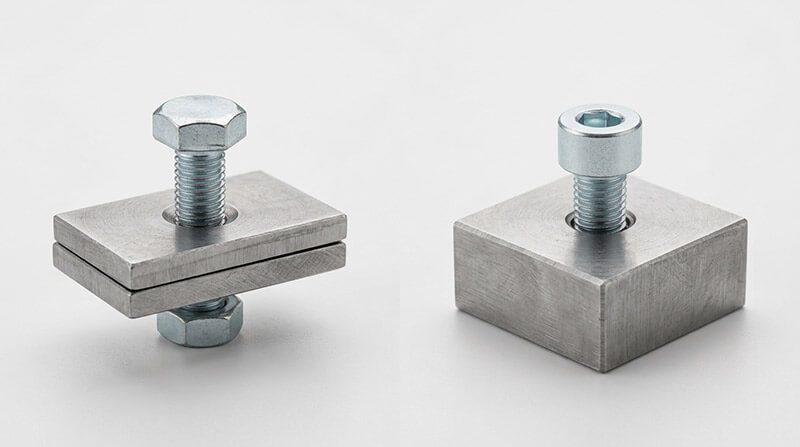
Ein Bolzen und eine Schraube befinden sich beide außen Gewindebefestigungen, and the practical difference between them is how each one is used, not how it looks. A bolt is inserted through clearance holes in the parts being joined and is tightened with a nut, while a screw mates with an internal thread already cut into one of the parts, or cuts its own thread as it is driven. That single distinction drives the rest of the conversation: whether the joint is clamped from the nut side or the head side, whether a tapped hole is required, how torque gets into the fastener, and which standard families apply. Buyers and engineers who mix up the two end up with the wrong hole preparation, the wrong torque tooling, or the wrong grade callout, and the error usually shows up on the assembly line rather than on the drawing. This guide walks through the definition, the engineering standards, the type families, size notation, strength grades, and selection logic, and closes with the manufacturing services that turn a specification into a production fastener.
The Short Answer: What Separates a Bolt from a Screw
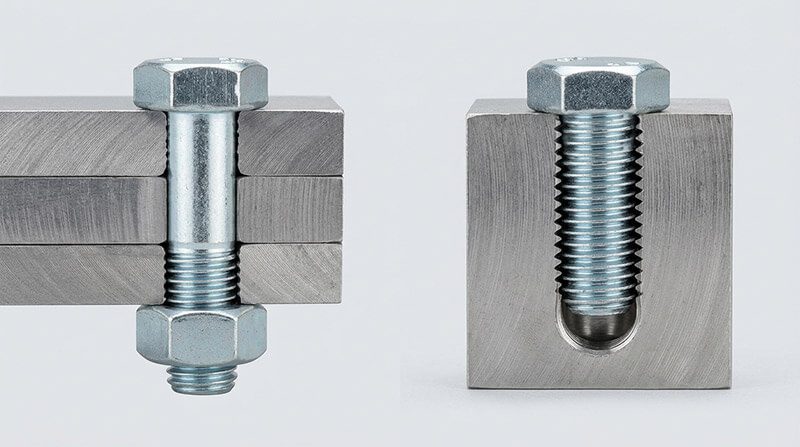
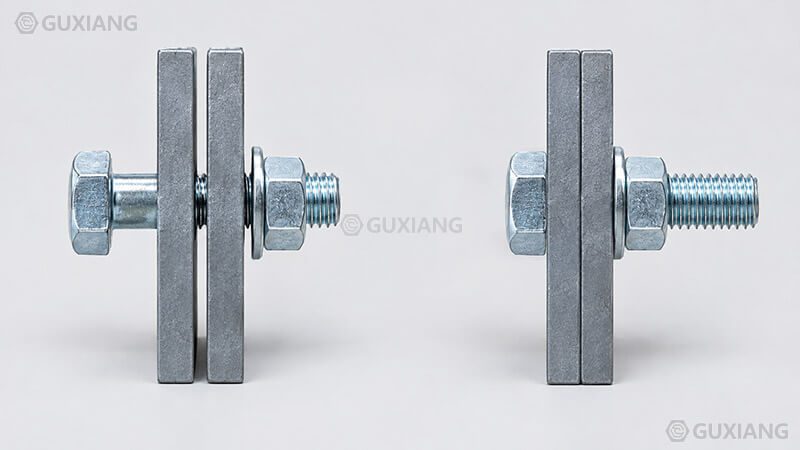
State the rule once and the rest of the subject falls into place: a bolt works with a nut, and a screw works without one. In a bolted joint, the bolt passes through clearance holes in two or more stacked parts and a nut is threaded onto the far end. Tightening the nut stretches the bolt shank in tension, and that tension clamps the stack so that friction between the parts carries the service load. In a screwed joint, the screw is turned directly into a tapped hole in one of the parts, or into a material that the screw thread cuts or forms for itself, and the head drives the screw. There is no nut on the far side because the mating thread lives in the workpiece.
This rule is a service classification, not a shape classification. The same external thread form, the same head style, and the same nominal diameter can appear on a part that one catalog calls a bolt and another catalog calls a screw. What changes is the joint the part is intended for. The ASME inch-series standards draw exactly this line: ASME B18.2.1 defines a bolt as a fastener intended to be tightened by torquing a nut, and ASME B18.6.3 defines a machine screw as a fastener intended to be tightened by torquing its head into a tapped hole [3]. Engineers use the same logic every day on the shop floor, which is why a 1/2-13 hex part becomes a “Sechskantschraube” when it clamps a flange with a nut, and the identical thread becomes a “cap screw” when it threads into a blind tapped hole in a housing.

The distinction matters commercially for three reasons. First, hole preparation differs: a bolted joint uses oversized clearance holes and does not need a tapped hole, while a screwed joint needs a tapped hole or a self-tapping point. Second, torque tooling differs: the nut side and the head side have different access requirements, and some bolted joints are tightened with the head held and the nut turned, which flips the tooling arrangement. Third, removal behavior differs: a bolt can be removed by pulling the nut, but a screw that has cut its own thread in soft material can damage the thread on the way out. None of that shows up in a photograph of the two parts side by side, which is exactly why the “how it is used” rule beats the “how it looks” rule in every engineering discussion.
Core Differences at a Glance
The table below compresses the comparison that the rest of the guide expands. Each row is a practical decision point that appears on drawings, in purchasing requests, and on the assembly line.
| Comparison point | Bolzen | Schrauben |
|---|---|---|
| Paarungsteil | Nut on the far side of the joint | Tapped hole in a component, or a thread cut into the material |
| Hole preparation | Clearance holes in all stacked parts | Tapped hole, pilot hole, or direct self-tapping drive |
| Torque application | Usually on the nut; sometimes the head is held while the nut turns | On the head, through the drive recess or wrenching flats |
| Thread duty | Thread engages the nut or a tapped hole; full and uniform for most of the length | Thread engages a tapped hole, or is hardened and sharp enough to cut its own thread |
| Removal | Nut comes off and the bolt is reused; joint is cleanly serviceable | Unscrewed from the hole; self-cut threads can strip or gall in soft materials |
| Pfad laden | Clamp load from bolt stretch; shear carried by friction between clamped parts | Clamp load from thread engagement; lighter-duty assemblies dominate |
| Typical standards | ISO 898-1, ASME B18.2.1, ASTM A307, ASTM F3125 | ASME B18.6.3, ISO 965-1, ISO 3506 |
| Common head styles | Hex, carriage, flange, eye, T-head, socket cap | Machine, wood, self-tapping, self-drilling, set, drywall, socket cap |
Read the third row carefully because it catches the most people. A bolt can be tightened either by turning the nut or by turning the head while the nut is held, and the joint is dimensioned from the nut side. A screw is always driven from the head side, and the joint is dimensioned from the head to the thread tip. When a designer calls out a “Bolzen” but specifies a blind tapped hole, or calls out a “schrauben” but adds a nut to the drawing, the assembly either will not fit or will be assembled with the wrong torque path.
Two more mechanical facts belong in the quick view. First, the thread engagement length rule of thumb applies differently. A screw into a tapped hole needs roughly one times the diameter of engagement in steel and more in softer materials, while a bolt with a nut depends on the nut height plus the thread protrusion beyond the nut. Second, the torque source changes the way preload is controlled: a bolted joint often relies on torque-to-yield or angle-controlled tightening on the nut, while a screwed joint usually relies on head torque alone, which makes friction on the threads and under the head a bigger factor in the final clamp load.
Engineering Definitions: What ISO and ASME Actually Say
The everyday rule maps cleanly onto the standards used in global fastener procurement, and knowing the exact wording prevents the classic misquote that “a bolt has a partially threaded shank and a screw is fully threaded.” That visual shortcut is wrong on both sides of the ledger. The governing documents sort fasteners by service intent.
ISO 898-1, the international standard for mechanical properties of fasteners made of carbon steel and alloy steel, covers “bolts, screws and studs” as one family and grades them by property class, from 4.6 up to 12.9. The standard does not draw the bolt-screw line by geometry; it sets the strength, hardness, and ductility requirements that a fastener must meet regardless of the word used on the drawing [1]. The line between bolt and screw in the ISO world is drawn by the design intent in the joint: the same property class applies whether the part engages a nut or a tapped hole, and the callout must name the thread form and length correctly for the mating part.
ASME B18.2.1 covers inch-series square and hex Bolzen und Schrauben. Its bolt definition centers on the nut: a bolt is an externally threaded fastener inserted through holes in assembled parts and normally tightened or released by torquing a nut. ASME B18.6.3 covers inch-series machine screws and tapping screws, and its machine screw definition centers on the tapped hole: a machine screw is an externally threaded fastener that is assembled into a tapped hole and is tightened by torquing the head [3]. That is the formal pair that the everyday rule paraphrases, and it is also why the same physical part can carry either name.
ASME B18.2.8, the inch-series “slow-bolt” guide, and the related B18 family documents add another layer: they list bolts, cap screws, machine screws, and studs as separate categories with separate dimensional and application notes. The terminology differences show up in practice in four ways worth memorizing.
| Naming question | Standard answer | Warum es wichtig ist |
|---|---|---|
| Hex bolt vs hex cap screw | B18.2.1: bolt for nut joints; cap screw for tapped-hole joints | Identical threads, different joint intent and tolerance conventions |
| Machine screw vs bolt | B18.6.3: screw engages a tapped hole and is head-driven | Drives the tapped-hole callout and the tapping operation |
| Lag bolt vs lag screw | Lag screw by function: it cuts its own thread in wood | Der “Bolzen” name is a trades term; the engineering behavior is a screw |
| Carriage bolt vs coach bolt | Same part, regional naming; always nut-driven | No tapping, no pilot hole beyond the clearance hole |
ASTM A307 covers low-carbon steel bolts, studs, and threaded rod in inch series, and ASTM F3125 covers high-strength structural bolts (including the former A325 and A490 grades) for structural steel joints 4. These standards sit above the dimensional standards: they set the material, tensile, and yield requirements for a specific duty, and they frequently override the generic property class in structural work. A structural bolted joint under F3125 is a nut joint by definition, because the connection is a clearance-hole, high-preload design tightened to the fastener’s proof load.
The full landscape of dimensional and material standards, including where DIN, ISO, ANSI, and ASME documents overlap, is laid out in our Leitfaden für Verbindungselementnormen. For this article the operational summary is short: when a part works with a nut, call it a bolt and specify it under the bolt standards; when it threads into a workpiece, call it a screw and specify it under the screw standards.
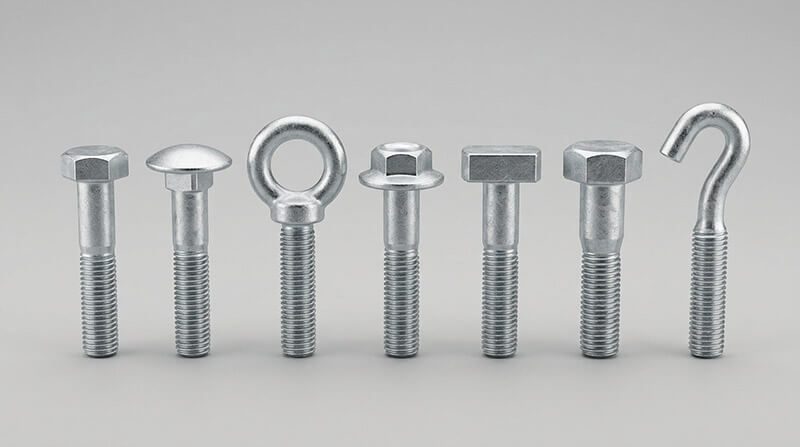
Bolt Types and Their Jobs
Bolts are the workhorses of structural and machinery connections because a nut joint can be disassembled, re-tensioned, and inspected without destroying anything. Each bolt type changes the head geometry, the bearing arrangement, or the intended loading mode, and the differences decide tooling, hole size, and torque limits.
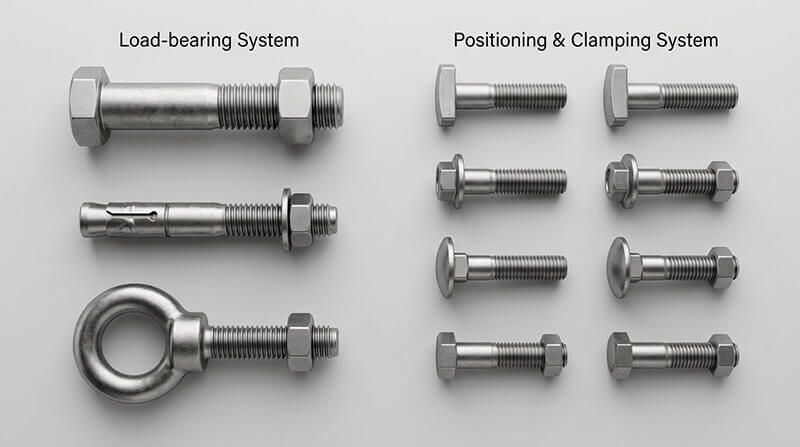
Hex bolts and hex cap screws. The six-sided head is the default because a wrench or socket grips it from the side with almost no slip, and the head height and bearing area are generous enough for heavy clamp loads. In inch-series practice the name splits by duty: a hex bolt for nut joints and a hex cap screw for tapped-hole joints, with the cap screw carrying tighter tolerances on the head and fillet. Metric practice tends to call the same geometry a hex bolt (ISO 4014/4017) regardless of joint type, which is why the drawing callout, not the catalog name, carries the authority. The full family is covered in our Sechskantschraubenführung with grade and size tables.
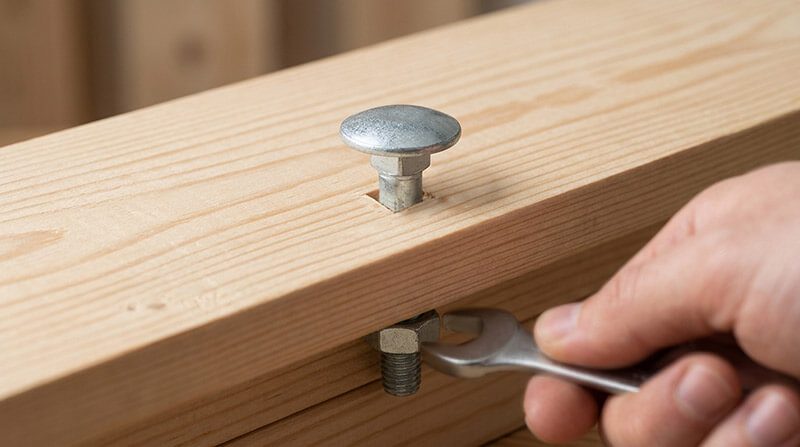
Carriage bolts. A carriage bolt has a round head and a square neck under the head. The square neck bites into the material as the nut is tightened, so the head side never needs a wrench: the bolt cannot rotate while the nut is driven. That makes carriage bolts the standard choice for wood-to-wood and wood-to-steel connections in fencing, decking, and timber framing, where only one side of the joint is accessible.
Eye bolts. The head is a closed loop instead of a hex, and the threaded shank anchors into a plate, a beam, or a tapped block. Eye bolts carry lifting and rigging loads, and the grade matters enormously: a forged eye bolt rated for overhead lifting has a marked working load limit, while a generic bent-wire eye bolt is not a lifting component at all. The thread and the eye plane must be matched to the load direction, because side loading derates the capacity.
Flange bolts. A flange bolt replaces the separate washer with an integral circular bearing face under the head. The flange spreads the clamp load over a larger area and can eliminate a loose washer from the BOM, which is why flange bolts dominate automotive engine and chassis joints where package space is tight and the joint must not relax. Serrated flange bolts add small teeth under the flange that bite into the surface and resist loosening under vibration.
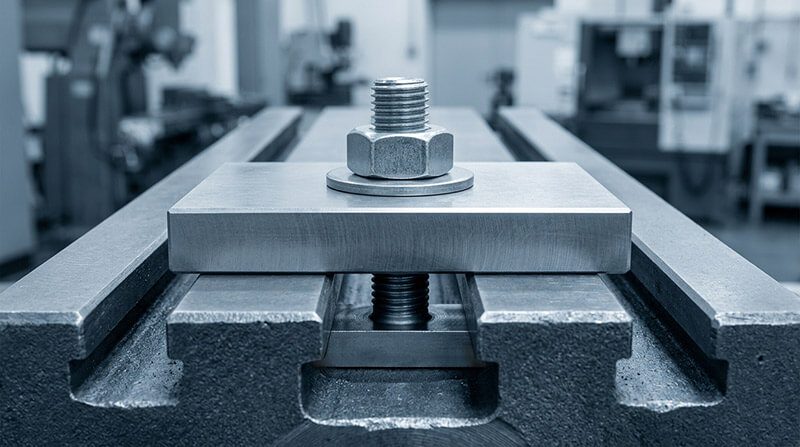
T-head bolts. The head is a rectangular or square block that slides into a T-slot in a machine table or a casting. Tightening the nut pulls the head against the slot shoulder, which locks the bolt in position along the slot. T-head bolts are the standard way to clamp workpieces and fixtures to milling machine tables and transfer lines, and the head width must match the slot width exactly or the clamp will not hold.
Structural bolts. These are the highest-duty members of the bolt family: ASTM F3125 Grade A325 and A490 in inch series, and property class 8.8 or 10.9 equivalents in metric work. Structural bolts carry the shear and tension loads of steel building frames and bridges through friction-type or bearing-type connections, and their installation is controlled by a torque or turn-of-nut procedure rather than a hand torque. Mixing a Grade 2 bolt into a structural connection is a safety defect, not a sourcing choice.
Anchor bolts. Anchor bolts embed into concrete foundations and stick out to receive a base plate, a column, or a piece of machinery. The embedded end uses a hook, a plate, or a forged head to develop pull-out resistance, while the exposed threaded end takes the nut that clamps the structure down. Anchor bolt placement is fixed at pouring time, so the projecting thread length and the template accuracy are the two details that get checked first on every foundation job.
| Bolt type | Head / feature | Typical joint | Primary load | Werkzeuge |
|---|---|---|---|---|
| Sechskantschraube | Six-sided head | Flanges, frames, machinery | Tension preload | Socket or wrench on nut |
| Carriage bolt | Round head + square neck | Wood and timber connections | Clamp load, shear | Wrench on nut only |
| Eye bolt | Closed loop head | Lifting and rigging | Direct tension | Shackle or hook |
| Flange bolt | Integral bearing face | Automotive, compact machinery | Tension preload | Socket on head or nut |
| T-head bolt | Rectangular T-slot head | Machine tables, fixtures | Clamp load | Wrench on nut |
| Structural bolt | Heavy hex head | Steel frames and bridges | Tension and shear | Turn-of-nut or torque wrench |
| Anchor bolt | Hook, plate, or forged head | Foundations, base plates | Tension, pull-out | Wrench on exposed nut |
Choosing among these starts with the load path, not the head style. A lifting application wants a certified eye bolt; a timber fence wants a carriage bolt; a structural frame wants a specified structural bolt. When the head style is still open after the load is fixed, the head shape and drive become packaging and tooling questions, and the answer usually follows the assembly access.
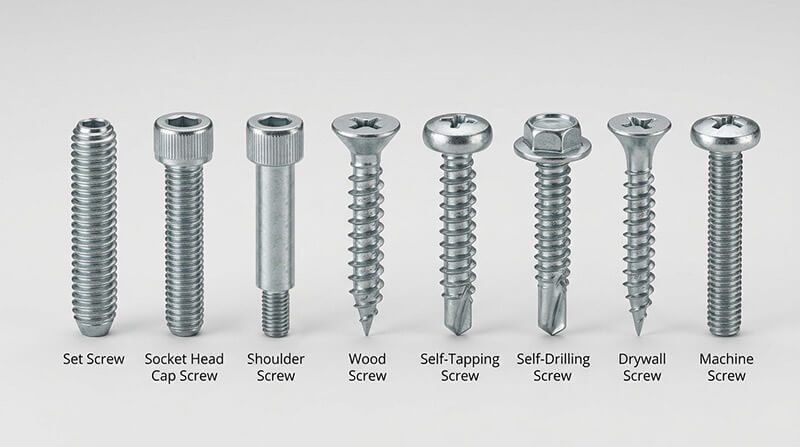
Screw Types and Their Jobs
Screws carry the same threading, clamping logic into joints where there is no nut and no access to the far side. The screw family is wide because the point, the thread form, and the hardness have to match the material being fastened, and the type names encode that match.
Machine screws. A machine screw is the direct counterpart of a bolt in a tapped hole: it engages an internal thread cut into a component and is driven from the head. Machine screws come in diameters from tiny instrument sizes up to about 1/2 inch, with either coarse or fine threads, and they are specified in the same callout language as bolts: diameter, thread, length, head style, drive, material, and finish. The size conventions, including the distinction between number sizes and fractional sizes, sit in our Größentabelle für Maschinenschrauben.
Socket head cap screws. These are machine screws with a cylindrical head and a hex socket drive. The socket drive transfers torque with almost no cam-out, the low-profile head fits into counterbored holes for flush assembly, and the strength is typically high because the head design allows heat-treated alloy steel at 12.9 or Grade 8 levels. Socket head cap screws are the default for tooling, die sets, machine guards, and any joint that is tightened and released repeatedly.
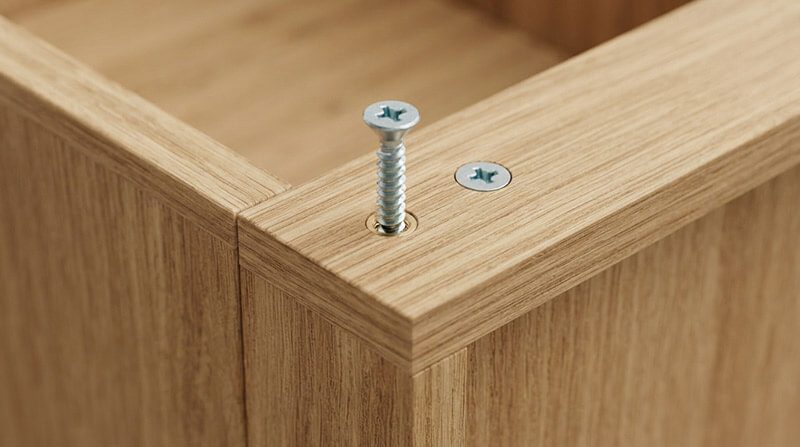
Wood screws. A wood screw has a sharp gimlet point and a thread that cuts into wood grain, pulling the screw into the material without a nut. The thread usually stops below the head on the unthreaded shank, so the clamping action comes from the shank being pulled into the top board while the head presses it down. Pilot hole practice decides most of the performance: hardwoods need a drilled pilot and a countersink, while softwoods can take a direct drive, and the drilling rules follow the species hardness and the screw diameter.
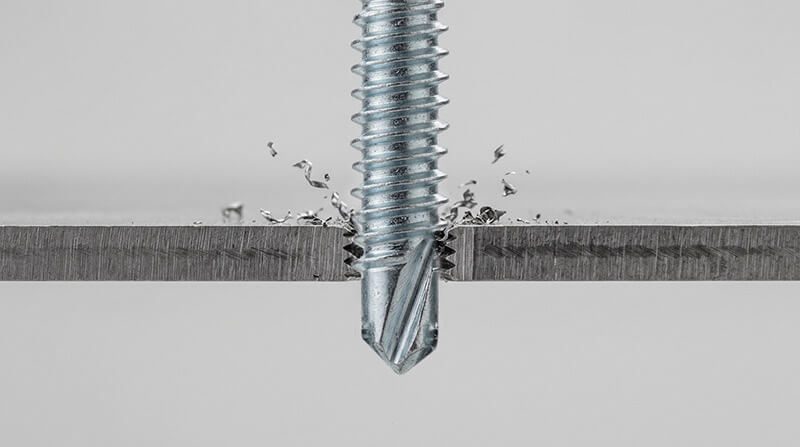
Self-tapping screws. Die Gewindeform einer selbstschneidenden Schraube schneidet oder formt beim Eindrehen der Schraube ein passendes Gewinde in das Material. Blechschrauben sind die häufigste Familie: Sie bohren in dünne Stahl-, Aluminium- und Kunststoffplatten ohne vorgefertigtes Loch. Der Spitzentyp bestimmt den Mechanismus: Eine scharfe Spitze schneidet ein Gewinde in duktiles Metall, während gewindeformende Spitzen das Material beiseite schieben und am besten in Kunststoffen funktionieren. Selbstschneidende Schrauben ersparen einen Arbeitsgang pro Verbindung, weshalb sie in Gehäusen, Leitungen und Heizungs-, Lüftungs- und Klimatechnik weit verbreitet sind.
Selbstbohrende Schrauben. A self-drilling screw carries a drill-point tip ahead of the thread, so one screw drills its own hole and then taps its own thread in a single drive. The tip looks like a tiny twist drill and must be long enough to pass through the material stack before the thread starts cutting. Self-drilling screws are the production answer for steel-to-steel and steel-to-wood fastening in metal buildings and roofing, because the crew eliminates the separate drilling step entirely.
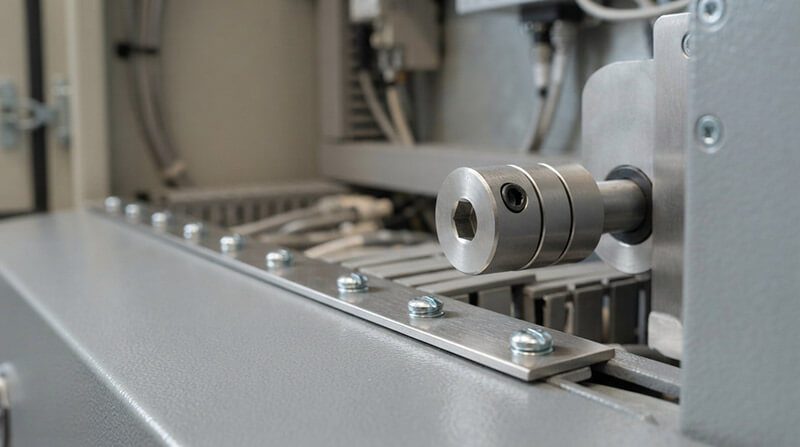
Set screws. A set screw is headless, usually with a socket drive, and it is threaded into a tapped hole in a hub or collar to press against a shaft. Set screws lock pulleys, gears, and handles to shafts by friction or by embedding a cone or cup point into the shaft. The holding power depends on the point style, the hardness, and whether a flat is ground into the shaft, and the shaft penetration limit is a standard engineering check.
Drywall screws. Drywall screws are hardened, self-tapping production screws with a bugle head, a needle point, and a double-lead thread tuned for gypsum board on wood or steel studs. They drive fast, countersink themselves below the paper face, and are available in coarse thread for wood studs and fine thread for steel studs. Their coating is typically phosphate or a corrosion-resistant finish selected for the exposure class of the framing system.
Cap screws and shoulder screws. Der “cap screw” family in inch-series practice (B18.3 for socket cap screws, B18.6.3 for slotted and recessed cap screws) covers headed screws that are tightened by the head into tapped holes. Shoulder screws add a precision ground shoulder between the head and the thread, so the shoulder acts as a bearing surface or a pivot pin while the threaded end clamps. Shoulder screws are common in linkages, hinges, and locating pins.
| Screw type | Point / thread | Typical material | Pre-drill needed | Drive access |
|---|---|---|---|---|
| Maschinenschraube | Uniform thread, blunt or pointed end | Tapped holes in metal and plastic | Gewindebohrung | Head, any drive |
| Socket head cap screw | High-strength, cylindrical head | Tooling, machine assemblies | Tapped hole or counterbore | Innensechskant |
| Holzschraube | Sharp gimlet point, tapered thread | Wood and soft materials | Pilot in hardwood | Kopf, Schlitz oder Kreuzschlitz |
| Selbstschneidende Schraube | Gewinde schneiden oder formen | Blech, Kunststoff, dünner Stahl | Normalerweise keine | Kopf |
| Selbstbohrende Schraube | Bohrspitze vor dem Gewinde | Stahl-auf-Stahl-Metallgebäude | Keiner | Kopf, Sechskant oder Kreuzschlitz |
| Stellschraube | Kopflose Spitzenstile | Naben auf Wellen | Gewindebohrung | Innensechskant |
| Trockenbauschraube | Nadelspitze, doppelte Führung | Gipskartonplatte auf Ständern | Keiner | Kopf, Phillips |
| Schulterschraube | Bodenschulter + Gewinde | Gestänge, Drehpunkte, Fixierstifte | Gewindebohrung + Abstand | Kopf, Sockel |
Die Übersicht über die Schraubenfamilien mit der vollständigen Taxonomie und Auswahllogik für alle diese Typen befindet sich in unserem Arten von Schrauben Industrieführer. Die Kopf- und Antriebsgeometrie ist eine separate Achse, und die praktischen Unterschiede zwischen Kreuzschlitz-, Torx-, Schlitz-, Sechskant- und Vierkantantrieben werden im behandelt Leitfaden für Schraubenkopftypen.
Sizes and Naming: Reading a Bolt or Screw Callout
The size system is where bolt and screw practice diverges most visibly, and where the naming difference between metric and inch series causes the most rework. Every callout carries four pieces of information: nominal diameter, thread pitch or threads per inch, length, and strength grade. Getting all four right is the difference between a joint that assembles and a bin of rejected parts.
Metric callouts. A metric callout starts with M and a nominal diameter in millimetres, followed by the pitch in millimetres and the length: M8 x 1.25 x 40 means an 8 mm nominal diameter, a 1.25 mm thread pitch, and a 40 mm length. When the pitch is not written, the coarse pitch for the diameter is implied, so M8 alone means M8 x 1.25. Fine pitch is written explicitly, for example M8 x 1.0, and it is used where adjustment resolution, vibration resistance, or a thin-walled nut is more important than fast assembly. The full pitch table by diameter sits in our metrische Fadentabelle.
Inch callouts. An inch callout uses a fractional or number diameter, the thread series, and threads per inch: 1/4-20 UNC x 1 bedeutet einen Durchmesser von 1/4 Zoll, 20 Gewindegänge pro Zoll, die Unified National Coarse-Serie und eine Länge von 1 Zoll. Die Zahlengrößen decken die kleinen Durchmesser ab: Eine Schraube Nr. 6-32 hat einen Durchmesser von 0,138 Zoll mit 32 Gewindegängen pro Zoll, und die Umrechnung von Zahl in Durchmesser ist eine Standardsuche, die Käufer und Maschinenbauer ständig verwenden. UNC-Gewinde der Feinserie werden als UNF (Unified National Fine) geschrieben, und die 60-Grad-Gewindeform entspricht auf Geometrieebene der metrischen ISO-Form.
Längenkonventionen. The length is measured differently by head type. For most bolts and machine screws the length is measured from the underside of the head to the end of the thread. For countersunk head screws the length includes the head, because the head seats into the countersink and contributes to the engaged stack. For set screws the length is the overall body length because there is no head. Drawing a countersunk screw with a bolt-style length callout produces parts that are systematically too long.
Thread engagement and grip. For a bolted joint, the grip is the total thickness of the clamped stack, and the bolt length must be the grip plus the nut height plus two to three threads of protrusion. For a screwed joint, the minimum thread engagement is roughly one diameter in steel, 1.5 diameters in aluminium, and more in plastics; below that minimum the internal thread strips before the fastener reaches its rated load. Those two rules explain most of the length errors found on engineering drawings.
| Callout | Durchmesser | Faden | Länge | Grad |
|---|---|---|---|---|
| M8 x 1.25 x 40 | 8 mm | 1.25 mm pitch | 40 mm | property class, e.g. 8.8 |
| M10 x 1.5 x 60 | 10 mm | 1.5 mm pitch | 60 mm | property class, e.g. 10.9 |
| 1/4-20 UNC x 1 | 1/4 inch | 20 TPI, coarse | 1 inch | SAE grade, e.g. 2, 5, 8 |
| #6-32 x 3/4 | 0.138 inch | 32 TPI, machine | 3/4 inch | material finish, e.g. stainless |
| 1/2-13 UNC x 2-1/2 | 1/2 inch | 13 TPI, coarse | 2.5 inches | A307 or F3125 grade |
The practical rule for this article: if the drawing carries a nut, dimension the bolt length from the grip plus nut and protrusion; if the drawing carries a tapped hole, dimension the screw length from the engaged depth plus the clearance allowance. Writing the pitch explicitly in metric and the TPI explicitly in inch closes the last ambiguity, because a coarse-thread nut will start on a fine thread and then seize halfway down.
Strength Grades and Property Classes
Strength grading is the fastest place to lose money in fastener sourcing, because the markings are small and the load consequences are large. The metric and inch systems use different marking codes, and the two are not directly convertible without looking at the yield and tensile values.
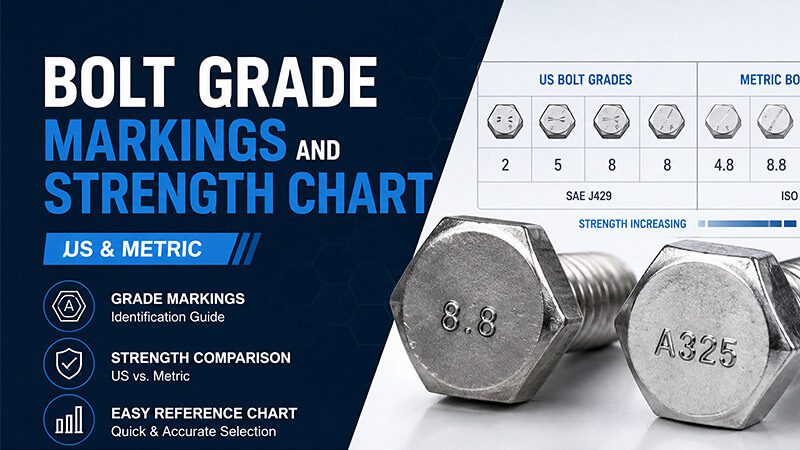
Metric property classes (ISO 898-1). Metrische Verbindungselemente aus Kohlenstoffstahl und legiertem Stahl tragen eine Festigkeitsklasse, die aus zwei durch einen Punkt getrennten Zahlen besteht, z. B. 4,6, 8,8, 10,9 oder 12,9. Die erste Zahl mal 100 gibt die Mindestzugfestigkeit in MPa an und die zweite Zahl mal 10 gibt das Verhältnis von Streckgrenze zu Zugfestigkeit an. Ein 8.8-Befestigungselement hat eine Mindestzugfestigkeit von 800 MPa und gibt bei 80 Prozent davon nach, also 640 MPa. Ein 10.9-Befestigungselement hat eine Mindestzugfestigkeit von 1.000 MPa und gibt bei 90 Prozent nach, also 900 MPa [1]. Die Markierung erscheint auf dem Kopf als Klassennummer, und das Vorhandensein der Markierung selbst ist eine Prüfung: Ein unmarkierter 8,8, der seine Wärmebehandlung nicht nachweisen kann, ist ein gefälschter Kandidat.
SAE-Klassen (Zoll-Serie). Zollschrauben aus Kohlenstoffstahl und legiertem Stahl tragen die SAE-Klassen 1, 2, 5 und 8 gemäß SAE J429. Güteklasse 2 ist kohlenstoffarm, Güteklasse 5 ist mittelgekohlt, vergütet und Güteklasse 8 ist legierter Stahl mit mittlerem Kohlenstoffgehalt, vergütet. Die Markierung besteht aus radialen Linien auf dem Kopf: drei Linien für Grad 5, sechs Linien für Grad 8, wobei Grad 2 oft nicht markiert ist. Schrauben der Güteklasse 5 eignen sich für allgemeine Maschinen, Schrauben der Güteklasse 8 eignen sich für hochfeste Verbindungen wie Fahrzeugaufhängungen und schwere Geräte, und die Spannungsspanne zwischen ihnen beträgt etwa 57.000 psi gegenüber 130.000 psi im mittleren Größenbereich. Die vollständige Tabelle mit Markierungsabbildungen finden Sie in unserem Schraubenklassentabelle.
ASTM-Strukturqualitäten. Structural bolts in inch series are specified by ASTM rather than SAE. ASTM A307 covers low-carbon bolts for general applications and is the weakest common structural choice. ASTM F3125 consolidates Grades A325 and A490: A325 is medium carbon or alloy steel with a minimum tensile around 120 ksi, and A490 is alloy steel with a minimum tensile around 150 ksi [5]. The structural connection design, not the vendor catalog, decides which grade applies, and the grade marking on a structural bolt head is a legal identification of the material.
Stainless and other materials. Befestigungselemente aus Edelstahl carry designations from ISO 3506, such as A2-70 or A4-80, where the letter and first number identify the steel grade (A2 is 304-type austenitic, A4 is 316-type) and the last number is the minimum tensile in units of 100 MPa: A4-80 means 316-type material at 800 MPa. The corrosion and strength trade-offs across stainless, carbon steel, alloy steel, and non-ferrous families are covered in our Leitfaden zu Edelstahlsorten Und Leitfaden für Verbindungselemente aus Kohlenstoffstahl.
| Grad | Min tensile | Min yield | Typischer Dienst | Marking |
|---|---|---|---|---|
| 4.6 (metric) | 400 MPa | 240 MPa | Light general duty | 4.6 on head |
| 8.8 (metric) | 800 MPa | 640 MPa | Machinery, automotive | 8.8 on head |
| 10.9 (metric) | 1,000 MPa | 900 MPa | High-strength joints | 10.9 on head |
| SAE-Klasse 2 | 60-74 ksi | 57 ksi range | General hardware | Normalerweise keine |
| SAE-Klasse 5 | 105-120 ksi | 81-92 ksi | Machinery, automotive | Three radial lines |
| SAE-Klasse 8 | 150 ksi | 130 ksi | Suspension, heavy duty | Six radial lines |
| A325 / F3125 | ~120 ksi | ~92 ksi | Baustahl | A325 or F3125 marking |
| A490 / F3125 | ~150 ksi | ~130 ksi | High-strength structural | A490 or F3125 marking |
| A2-70 stainless | 700 MPa | ~450 MPa | Korrosive Umgebungen | A2-70 on head |
The torque required to reach a given preload scales with diameter, grade, thread friction, and head friction, and the practical tables are gathered in our Tabelle mit metrischen Schraubendrehmomenten. The takeaway for the bolt-vs-screw decision is that grades apply to both families equally: a socket head cap screw at 12.9 is every bit as strong as a 10.9 bolt of the same diameter, and the strength is set by the property class, not by the name on the part.
How to Choose: Bolt or Screw for Your Joint
Die Entscheidung reduziert sich auf eine Checkliste mit fünf Fragen, die ein Ingenieur in einer Minute durchgehen kann. Die Antworten weisen normalerweise auf die eine oder andere Familie hin, bevor ein Katalog geöffnet wird.
Gibt es Zugang zur anderen Seite des Gelenks? Wenn beide Seiten offen sind, ist ein Riegel möglich; Wenn die andere Seite geschlossen ist, ist eine Schraube ausgeschlossen und eine Schraube in ein Gewindeloch oder eine selbstschneidende Schraube ist die einzige Möglichkeit mit Gewinde.
Wie viel Ladung und wie oft wird sie gewartet? Hohe, wiederholte oder inspizierbare Belastungen bevorzugen eine Schraubverbindung mit kontrollierter Vorspannung und sauberer Mutternentfernung; Leichte, dauerhafte oder einseitige Belastungen begünstigen eine Schraube.
Aus welchem Material bestehen die Teile? Steel and aluminium accept tapped holes; wood and thin sheet need thread-cutting or self-drilling points; plastics need thread-forming points with generous engagement.
What torque control is available? Bolted joints accept torque, angle, or turn-of-nut control from the nut side; screwed joints rely on head torque, so the thread and head friction become the controlling variables.
What does the drawing standard say? Structural steel, flanges, and lifting hardware default to bolted practice with bolt standards; enclosures, panels, and production sheet metal default to screwed practice.
The flow logic is straightforward. Start with access: no far-side access means a screw family. Then check load and serviceability: structural or high-preload duty means a bolt family with a specified grade. Then check the material: tapped-hole capability decides between machine screw and self-tapping or self-drilling. Then check the assembly volume: a production line that wants to eliminate a tapping operation pushes toward self-drilling or thread-forming screws. Every step also names the failure mode it avoids, which keeps the choice anchored to engineering rather than preference.
The same logic extends to material and coating. A carbon steel bolt with Verzinkung handles indoor machinery; a stainless steel screw with a 316-grade composition handles outdoor and marine exposure; an alloy steel fastener at 10.9 or Grade 8 handles high cyclic loads. The material families behind those choices, and the galvanic and corrosion questions that follow from them, are covered in the zinc plating and stainless corrosion guides. When the joint is outdoors, the coating choice matters as much as the type choice, because a plain carbon screw in a coastal environment fails long before its threads wear out.
Industry Applications: Where Each Family Wins
Die Typenfamilien sind so konsistent auf Branchen abgebildet, dass die Anwendung oft einen stärkeren Hinweis gibt als die Geometrie. In der folgenden Tabelle sind die vorherrschenden Muster pro Branche und der Grund dafür aufgeführt.
| Industrie | Typische Wahl | Grund |
|---|---|---|
| Bau- und Baustahl | Strukturbolzen (A325/F3125, 10.9), Ankerbolzen | Hohe Vorspannung, Inspektion, lösbare Verbindungen |
| Holzrahmen und Terrassendielen | Schlossschrauben, Zugschrauben, Holzschrauben | Einseitiger Zugriff, Auszugsfestigkeit in Holz |
| Automobil | Flanschschrauben, Innensechskantschrauben, selbstschneidende Schrauben | Kompakte Gelenke, Vibrationsfestigkeit, Massenproduktion |
| Maschinen und Werkzeuge | Innensechskantschrauben, Hammerkopfschrauben, Stellschrauben | Wiederholter Service, präzise Klemmung, niedriges Profil |
| Möbel und Tischlerei | Holzschrauben, Maschinenschrauben mit Einsätzen | Cost, appearance, easy field assembly |
| Enclosures and HVAC | Self-tapping and self-drilling screws | Eliminates tapping and drilling operations |
| Electrical and instrumentation | Machine screws, set screws, thread-forming screws | Small diameters, repeated adjustment |
| Energy and infrastructure | High-strength bolts, stainless screws | Corrosion, high loads, long service life |
Zwei Anwendungsfallen verdienen Hervorhebung. Erstens wird Baustahl nach Konstruktionsvorschriften und nicht nach Vorliebe verschraubt: Die Verbindung wird als Schraubengruppe mit einer bestimmten Vorspannung konstruiert, und das Einsetzen einer Schraube in ein Gewindeloch in einem Stahlbauteil ist keine gleichwertige Verbindung. Zweitens werden bei Holzrahmen Zugschrauben und Schlossschrauben verwendet, die sich wie Bolzen auf der Zeichnung verhalten, aber ihr eigenes Gewinde in das Holz schneiden, sodass das Führungsloch und die Gewindelänge die beiden Details sind, die über die Ausziehfestigkeit entscheiden. Der gleiche Teil kann zwischen Branchen mit unterschiedlichen Namen wechseln, und der Käufer muss zuerst die Branchenkonvention lesen.
Häufige Verwirrungen und Fehler
The bolt-screw vocabulary is full of traps, and most of them cost money in rework or returns. The list below covers the ones that appear in real purchase orders and engineering reviews.
“A bolt has a partial thread and a screw is fully threaded.” This visual shortcut fails on both counts. Many hex bolts are fully threaded, many machine screws have unthreaded shanks, and the standards define the parts by service intent, not by the threaded length. Check the drawing, not the photograph.
“Lag bolt vs lag screw is a size thing.” Lag bolts (or lag screws, depending on the catalog) are large wood fasteners with a hex head and a coarse thread. They cut their own thread in wood and are driven with a wrench, which makes the “Bolzen” name a trades convention. Functionally they are screws, and they need a pilot hole, not a clearance hole with a nut.
“Machine screw vs bolt is interchangeable.” A machine screw engages a tapped hole and is head-driven; a bolt engages a nut and is nut-driven. Swapping one for the other changes the hole preparation, the tooling, and often the length callout. The threads may be identical, but the joint intent is not.
“Cap screw means any screw with a cap.” Cap screw is a defined category in the standards: a headed screw for tapped-hole joints, typically socket head. Calling every screw a “cap screw” on a drawing invites the supplier to deliver the wrong drive or the wrong head height.
“Grade markings are decorative.” Head markings identify the property class and are required for traceability on structural and high-strength parts. An unmarked bolt that claims 10.9 or Grade 8 performance has no verifiable heat treatment and belongs in a scrap bin, not a critical joint.
“Self-tapping screws replace bolts in steel.” A self-tapping screw in thin sheet is a production shortcut; it is not a substitute for a bolted joint in load-bearing steel. The thread engagement, the point behavior, and the shear strength are all different, and the joint must be built for the screw, not assumed to be a bolt.
“Coarse threads are always stronger.” Bei einem gegebenen Durchmesser hat ein Feingewinde einen größeren Kerndurchmesser und oft eine höhere Zugfestigkeit, während ein Grobgewinde in weichen Materialien besser dem Abisolieren widersteht und sich schneller zusammenfügt. Der “stärker” Die Antwort hängt vom Lastmodus ab und das Drehmomentdiagramm für die jeweilige Steigung ist die sichere Referenz.
“Das Drehmoment ist bei Bolzen- und Schraubverbindungen gleich.” An der Mutter kann eine Schraubverbindung winkelgesteuert angezogen werden; Eine Schraubverbindung wird durch die Gewindereibung in der Schlaufe mit dem Kopf angezogen. Das gleiche Nenndrehmoment führt in beiden Fällen zu unterschiedlichen Vorspannkräften, weshalb Drehmomentangaben immer gelenkspezifisch sind.
Der Weg, alle acht Fallen zu vermeiden, ist derselbe: Lesen Sie die Zeichnung, benennen Sie die gemeinsame Absicht und lassen Sie dann den Standard das Vokabular bestimmen. Wenn das Teil in eine Mutter eingreift, handelt es sich um eine Schraube; wenn es in das Werkstück eingreift oder ein Gewinde schneidet, handelt es sich um eine Schraube; Größe, Qualität und Beschichtung richten sich nach der Belastung und der Umgebung.
Herstellung und kundenspezifische Verbindungselemente von GUXIANG
Die Unterscheidung zwischen Bolzen und Schraube ist für einen Hersteller von Verbindungselementen nicht nur eine Vokabelübung. Es legt die Prozesslinie, die Werkzeuge und den Prüfplan für jeden Auftrag fest, der in einem Werk ankommt, und es ist das erste Gespräch, das GUXIANG mit einem OEM-Käufer führt, der eine Zeichnung oder ein Muster sendet.
GUXIANG führt Kaltstauchen, CNC-Bearbeitung, Gewindewalzen, Wärmebehandlung und Oberflächenveredelung in einer Produktionskette durch, was bedeutet, dass eine kundenspezifische Schraube oder Schraube von der technischen Prüfung zu Produktionsmustern gelangen kann, ohne den Lieferanten zu wechseln. Beim Kaltstauchen werden Sechskantköpfe, Innensechskantköpfe, Flanschköpfe und die meisten Standardgeometrien mit hoher Geschwindigkeit und geringem Materialabfall geformt. Die CNC-Bearbeitung deckt nicht standardmäßige Kopfprofile, Schultermerkmale und Durchmesser mit engen Toleranzen ab. Beim Gewindewalzen entstehen Gewinde mit höherer Ermüdungsfestigkeit im Vergleich zu geschnittenen Gewinden, da der Faserverlauf der Gewindekontur folgt. Durch die Wärmebehandlung wird die Festigkeitsklasse auf 8,8 bis 12,9 oder das SAE-Äquivalent festgelegt. Die Oberflächenveredelung schließt den Kreislauf: Verzinkung, Feuerverzinkung, Phosphatierung, Brünierung, Dacromet und Passivierung für Edelstahl werden alle im eigenen Haus mit Chargenprüfungen durchgeführt.
Das Technikteam unterstützt die gleichen Entscheidungen, die in diesem Artikel beschrieben werden. Ein Käufer, der sich nicht sicher ist, ob für eine Verbindung ein Bolzen oder eine Schraube, ein Gewindeloch oder ein Durchgangsloch, ein 8,8 oder ein 10,9 benötigt wird, erhält eine Verbindungsbewertung, in der der Lastpfad und die Fehlerart aufgeführt sind, bevor ein Angebot abgegeben wird. OEM-Programme erhalten Musterfreigabeteile, Maßberichte, Materialzertifikate und Drehmomentdaten, um das Design zu validieren, bevor Produktionswerkzeuge eingesetzt werden. Mindestmengen, Lieferzeiten und Beschichtungsoptionen werden pro Zeichnung angegeben, und die gleiche Überprüfung gilt für einen ersten Artikel, eine Pilotserie oder einen vollständigen Produktionsauftrag.
If you are evaluating a joint right now, send the drawing or the sample to GUXIANG and ask for a joint review. The team will confirm the fastener type, size, grade, and finish, and return a quotation with the process and the lead time attached. Fordern Sie ein Angebot für Verbindungselemente an at the GUXIANG contact page, and reference this article in the message so the engineer knows the context of your application.
FAQ
What is the main difference between a bolt and a screw?
A: A bolt is tightened with a nut on the far side of the joint, while a screw mates with a tapped hole in the workpiece or cuts its own thread. The distinction is how each is used, not how it looks.
Is the difference based on appearance or on how the fastener is used?
A: Es basiert auf der Nutzung. ASME-Standards definieren eine Schraube als ein Befestigungselement, das von einer Mutter angezogen wird, und eine Maschinenschraube als ein Befestigungselement, das von seinem Kopf in ein Gewindeloch angezogen wird, sodass identische Gewinde beide Namen tragen können.
Wann sollte man einen Bolzen anstelle einer Schraube verwenden?
A: Verwenden Sie eine Schraube, wenn beide Seiten der Verbindung zugänglich sind, die Belastung hoch oder strukturell ist und die Verbindung eine kontrollierte Vorspannung, Inspektion oder saubere Demontage erfordert. Schraubverbindungen halten wiederholtem Einsatz am besten stand.
Wann sollte man eine Schraube anstelle einer Schraube verwenden?
A: Verwenden Sie eine Schraube, wenn die andere Seite geschlossen ist, wenn bereits ein Gewindeloch vorhanden ist oder wenn das Material ein selbstschneidendes Gewinde aufnehmen kann. Schrauben machen die Mutter überflüssig und eignen sich für leichte, einseitige Montagen.
Kann dasselbe Teil sowohl als Bolzen als auch als Schraube bezeichnet werden?
A: Ja. Das gleiche Sechskant-Außengewinde ist eine Schraube, wenn es Teile mit einer Mutter festklemmt, und eine Kopfschraube, wenn es in ein Gewindeloch eingeschraubt wird. Der Katalogname folgt der gemeinsamen Absicht.
Was ist der Unterschied zwischen einer Maschinenschraube und einer Schraube?
A: Eine Maschinenschraube greift in ein Gewindeloch ein und wird vom Kopf aus festgezogen. Eine Schraube geht durch Durchgangslöcher und wird mit einer Mutter festgezogen. Die Threads können identisch sein; die gemeinsame Absicht ist unterschiedlich.
Was sind die häufigsten Arten von Schrauben?
A: Sechskantschrauben, Schlossschrauben, Ringschrauben, Flanschschrauben, Hammerkopfschrauben, Strukturschrauben und Ankerschrauben. Jedes ändert die Kopfgeometrie, die Lageranordnung oder den Belastungsmodus für ein bestimmtes Gelenk.
Was sind die häufigsten Arten von Schrauben?
A: Machine screws, socket head cap screws, wood screws, self-tapping screws, self-drilling screws, set screws, and drywall screws. The type matches the point, thread, and hardness to the material.
What do 8.8 and 10.9 mean on a bolt head?
A: They are ISO 898-1 property classes. The first number times 100 is minimum tensile strength in MPa, and the second times 10 is the yield-to-tensile ratio. So 8.8 means 800 MPa tensile with 640 MPa yield.
What is the difference between SAE Grade 5 and Grade 8 bolts?
A: Grade 5 is medium carbon, quenched and tempered, with about 120 ksi tensile, marked with three radial lines. Grade 8 is alloy steel with about 150 ksi tensile, marked with six radial lines, for high-strength joints.
Referenzen
ISO 898-1:2013, Mechanische Eigenschaften von Verbindungselementen aus Kohlenstoffstahl und legiertem Stahl – Teil 1: Bolzen, Schrauben und Bolzen mit festgelegten Festigkeitsklassen. https://www.iso.org/standard/73658.html
ISO 965-1:1998, Metrische ISO-Allzweck-Schraubengewinde – Toleranzen. https://www.iso.org/standard/44271.html
ASME, Codes & Normen – Normen für Verbindungselemente und Schraubengewinde (Serie B18). https://www.asme.org/codes-standards
ASTM A307, Standardspezifikation für Schrauben, Bolzen und Gewindestangen aus Kohlenstoffstahl mit einer Zugfestigkeit von 59.000 psi. https://www.astm.org/a0307-21.html
ASTM F3125, Standardspezifikation für hochfeste Strukturschrauben aus Stahl und legiertem Stahl, wärmebehandelt, 120 ksi und 150 ksi Mindestzugfestigkeit. https://www.astm.org/f3125_f3125m-19e01.html
Wikipedia, Bolzen (Befestigungselement). https://en.wikipedia.org/wiki/Bolt_(fastener)
Wikipedia, Schrauben. https://en.wikipedia.org/wiki/Screw