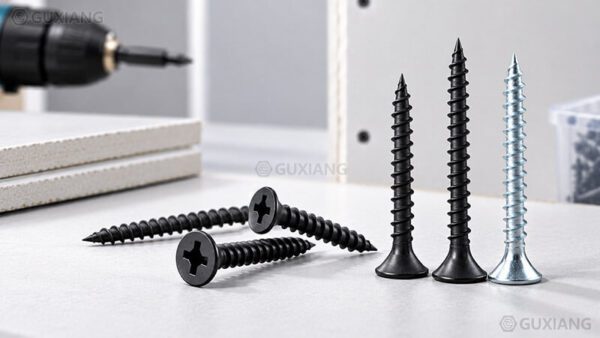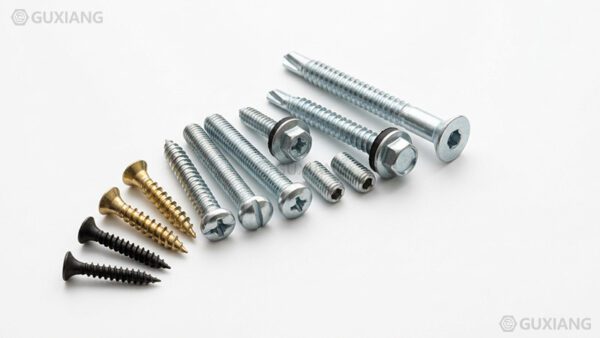






A screw is a threaded fastener that converts rotary torque into axial clamping force, and every industrial assembly starts with the same question: which screw goes here? This guide classifies screws by head geometry, drive recess, thread form, material, and application, then walks through an eight-step selection process aligned with ASTM, ISO, and ASME standards so engineers and procurement teams can specify the right fastener the first time. Read on for the complete industrial screw selection reference.
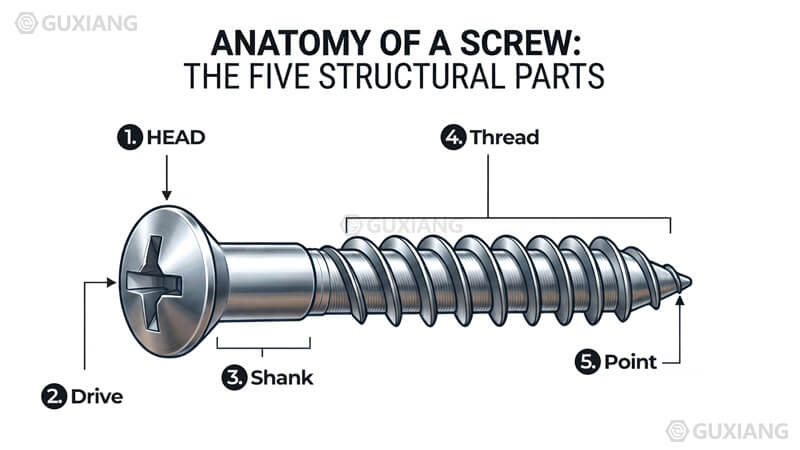
Anatomy of a Screw: The Five Structural Parts
Every screw, from an M1.6 micro machine screw to a 12 mm structural wood screw, shares five functional zones. Understanding these zones matters because each one drives a separate specification decision.
| Part | Function | Specification impact |
|---|---|---|
| Head | Bearing surface that transfers clamp load into the joint and seats against the material | Head type controls flushness, bearing area, and tool access |
| 驱动 | Recess or external shape that accepts the driving tool | Drive type controls torque transfer, cam-out resistance, and tamper resistance |
| 柄 | Smooth or threaded body between head and thread | Shank diameter and length govern shear strength and grip length |
| 主题 | Helical ridge that converts rotation into axial pull | Thread form, pitch, and depth determine engagement and pull-out strength |
| Point | Tip geometry that starts penetration | Point style decides whether a pilot hole is needed and how the screw self-starts |
A screw head transfers the driver torque into the joint, which is why head and drive selection often dominate catalog decisions. The shank carries the shear load in structural joints, and a partially threaded screw keeps a smooth shank across the shear plane for maximum strength. The thread does the mechanical work of converting rotation into clamp force, and the point determines installation behavior. Each part appears again in the selection framework later in this guide.
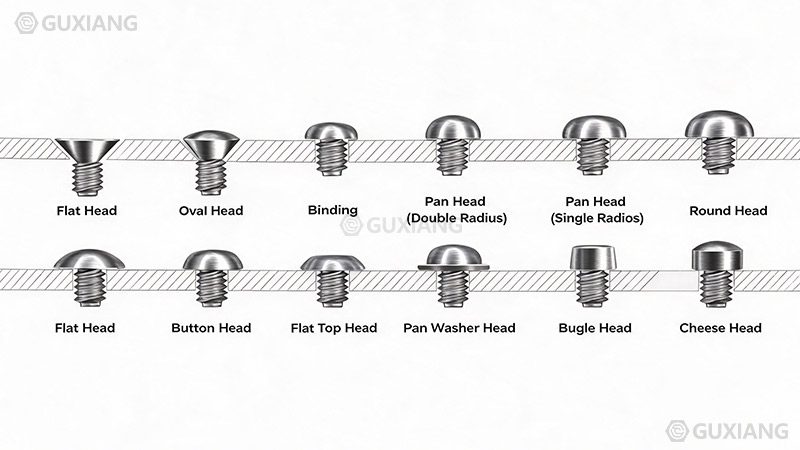
Screw Head Types: Countersunk, Protruding, and Load-Distributing
Head geometry decides how the screw sits on the surface and how much load the head transfers into the substrate. The two broad families are countersunk heads, which sit flush with or below the surface, and non-countersunk heads, which sit above it. For a visual reference across all common forms, see our 螺钉头型 指南。.
平头
The flat head uses a conical underside that matches a countersunk pilot hole, so the top of the head sits flush with or slightly below the material surface. Flat heads appear in woodworking, cabinetry, and any application where a smooth surface is required for safety or appearance. The countersink requirement removes material around the hole, so flat heads are a poor choice in thin sections where bearing area is already limited.
平头
The pan head has a flat top with slightly rounded sides and a wide bearing surface. It sits above the material, which gives it a larger contact area than a countersunk head of the same diameter. Pan heads are the default for 机螺钉, sheet metal screws, and general-purpose fastening where appearance is secondary. The wide flange resists pull-through in thin sheet metal.
纽扣头
The button head is a low-profile rounded dome that sits above the surface but protrudes less than a pan head. Button heads are common on socket cap screws and Torx-drive fasteners used in electronics, machinery guards, and furniture where a clean look and low clearance matter. The reduced head height limits the torque the drive can accept before the head deforms.
圆头
The round head is the traditional fully domed profile that sits above the surface. It appears on older wood screws and in restoration work, and it still shows up in decorative hardware. Modern manufacturing has largely replaced round heads with pan or button heads because the latter transfer torque more predictably and occupy less space.
椭圆形头部
The oval head, also called raised countersunk, combines a countersunk base with a domed top. The head seats flush at the perimeter while the dome rises above the surface. Oval heads appear in decorative trim, exposed hinges, and furniture where a polished profile is part of the design.
桁架头
The truss head has an extra-wide, low-profile dome that maximizes bearing area without adding height. It distributes clamp load over a large footprint, which prevents pull-through in thin sheet metal, plastic panels, and electrical enclosures. Truss heads are common in HVAC ducting and appliance assembly.
Flange Head
The flange head integrates a washer-like flange under the head, eliminating a separate washer and increasing the bearing surface. Serrated flange versions bite into the mating surface to resist loosening under vibration. Flange heads appear in automotive and machinery joints where space and parts count both matter.
六角头
The hex head is a six-sided external drive head driven by a wrench or socket. It accepts the highest torque of any head style because the driving tool grips the outside of the head rather than a recess. Hex heads are standard on 螺栓, lag screws, and heavy construction screws, and they dominate structural connections. For heavy hex configurations and grade selection, our hex bolts guide covers the bolt-side details.
内六角螺栓
The socket head is a cylindrical head with an internal hex recess, driven by an Allen key or hex bit. The cylindrical profile fits into counterbored holes for a flush installation while retaining high torque capacity. Socket head cap screws are the workhorse of precision machinery, tooling, and automation where space is tight and strength matters.
布格尔角
The bugle head has a curved countersunk profile that compresses drywall paper and gypsum automatically as it seats, forming its own countersunk hole without a separate countersink step. Bugle heads are standard on drywall screws and some deck screws, where installation speed across thousands of fasteners is the priority.
Head Comparison Quick Table
| 头型 | Sits | Bearing area | 典型用途 |
|---|---|---|---|
| 平的 | Flush | Small after countersink | Woodworking, finish work |
| Pan | Above | Wide | Machine screws, sheet metal |
| 按钮 | Above (low) | 中 | Electronics, guards |
| 圆形 | Above (tall) | 中 | Decorative, legacy |
| Oval | Flush + dome | 中 | Trim, furniture |
| 桁架 | Above (wide) | Largest | Thin sheet, panels |
| Flange | Above | Wide + washer | Automotive, vibration |
| Hex | Above | 中 | Structural, high torque |
| Socket | Flush (counterbore) | 中 | Precision machinery |
| 号角 | Flush (self-countersink) | Small | Drywall |

Screw Drive Types: Torque Transfer and Cam-Out Control
The drive is the interface between the tool and the screw, and it controls how much torque reaches the thread before the tool slips. Drive selection directly affects assembly speed, bit wear, and stripping rates on a production line. The four-way comparison in our 菲利普斯螺丝刀 vs 托克斯螺丝刀 vs 平头螺丝刀 article helps narrow the choice before you commit tooling.
开槽的
The slotted drive is a single straight line across the head, driven by a flat-blade screwdriver. It is the oldest drive type and still appears in electrical fittings, terminal blocks, and vintage equipment. The slot offers poor centering and slips sideways under torque, so it suits low-torque manual installation rather than powered assembly.
菲利普斯
The Phillips drive uses a cross-shaped recess with tapered walls that self-center the driver and cam out under excessive torque. Cam-out acts as a built-in torque limiter that prevents over-tightening but also strips the head when operators keep driving. Phillips is the most common drive worldwide and works well with powered drivers in wood and drywall, though bit wear and stripping are the trade-off.
Pozidriv
The Pozidriv drive looks similar to Phillips but adds secondary ribs between the main cross arms. The geometry prevents cam-out and transfers higher torque, so Pozidriv is common in European furniture and high-volume assembly. Pozidriv bits do not fit Phillips recesses correctly, and the reverse also fails, so mixing the two on one line creates rework.
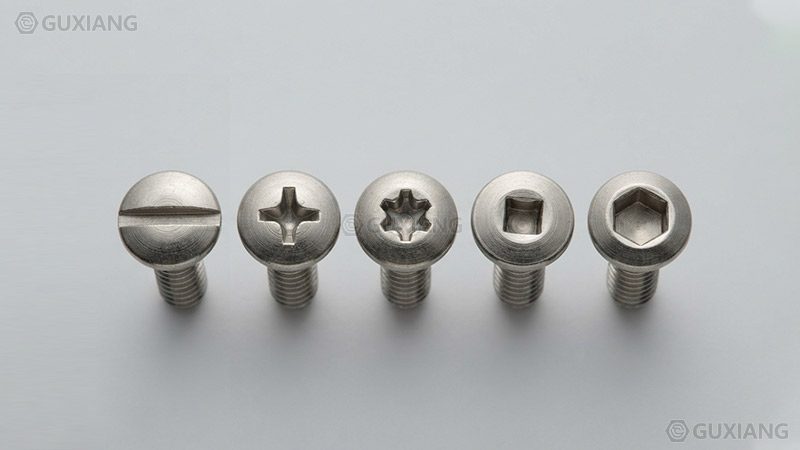
Torx
The Torx drive uses a six-pointed star recess with vertical walls that transfer torque efficiently and resist cam-out almost completely. Torx allows higher seating torque, longer bit life, and fewer stripped heads, which makes it the default for automotive, electronics, and high-volume production. Tamper-resistant Torx adds a center pin for security applications.
Robertson
The Robertson drive, also called square drive, uses a tapered square recess that holds the screw on the bit without a magnet. The taper centers the driver, and the square walls transfer torque without cam-out. Robertson is dominant in Canadian wood construction and appears in decking and framing where one-handed driving matters.
六角套筒
The hex socket drive is an internal hexagon recess driven by a hex key or hex bit. It transfers high torque with a compact head profile, which is why socket head cap screws and set screws use it. Hex socket drive is standard in machinery, tooling, and automotive where access is limited and torque is high.
Security and Tamper-Resistant Drives
Security drives add center pins, asymmetric slots, or one-way geometry that requires a special tool to remove. Common types include pin-in-Torx, pin-in-hex, spanner (two-hole), tri-wing, and one-way slotted. They protect public fixtures, electronics enclosures, and restricted-access equipment from unauthorized removal.
Drive Comparison Quick Table
| 驱动 | Cam-out | Torque capacity | 最适合 |
|---|---|---|---|
| 开槽的 | 高 | 低 | Electrical, legacy, manual |
| 菲利普斯 | 中 | 中 | Wood, drywall, general |
| Pozidriv | 低 | Medium-high | Furniture, European assembly |
| Torx | Very low | 高 | Automotive, electronics, production |
| Robertson | Very low | Medium-high | Wood construction, one-hand driving |
| 六角套筒 | 低 | 高 | Machinery, socket cap screws |
| Security | Depends | Varies | Anti-tamper applications |
Screw Thread Types: Coarse, Fine, and Self-Forming
Thread geometry determines how the screw engages the substrate and how much holding force the joint achieves. Thread pitch, flank angle, and point style each change installation behavior and pull-out strength.
Coarse Thread
Coarse threads have fewer threads per inch (or a larger metric pitch), with aggressive spacing that grips fast in soft materials. Coarse threads install quickly, resist stripping in wood and plastic, and tolerate dirt or coatings better than fine threads. Standard machine threads follow the ISO metric coarse series under ISO 965, with tolerance classes that define fit.
Fine Thread
Fine threads have more threads per inch (or a smaller metric pitch), which increases the thread contact area and pull-out strength in metal. Fine threads resist vibration better because the helix angle is shallower, and they allow finer adjustment. They cost more to produce, strip more easily if cross-threaded, and require cleaner holes.
Self-Tapping Thread
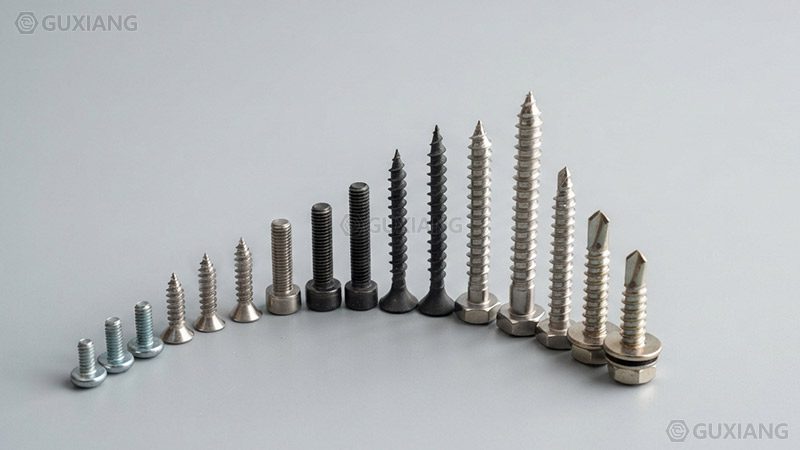
Self-tapping screws cut or form a mating thread as they install, eliminating a separate tapping operation. Thread-cutting types remove material with a cutting edge, while thread-forming types displace material into the thread flanks. Self-tapping screws suit sheet metal, plastic, and light structural assemblies where pre-tapped holes would add cost.
Self-Drilling Thread
Self-drilling screws combine a drill-point tip with self-tapping threads, so they drill their own pilot hole and form the thread in a single operation. The tip is hardened and shaped like a twist drill. Self-drilling screws dominate metal roofing, steel framing, and HVAC where the operator cannot pre-drill every hole.
Thread-Forming for Plastics
Thread-forming screws for plastics use a tri-lobular or special cross-section that displaces material rather than cutting it. Displaced material flows into the root of the thread, which creates a strong, stress-relieved joint that resists loosening under vibration. These screws reduce boss cracking in nylon, ABS, and other engineering thermoplastics.
Drywall Thread
Drywall screws use an aggressive coarse thread with a sharp point and a bugle head. Coarse-thread drywall screws suit wood studs, while fine-thread versions engage steel studs. The thread design drives fast and seats the bugle head flush without tearing the paper face.
Thread Comparison Quick Table
| Thread type | Installation | 典型基材 | Key advantage |
|---|---|---|---|
| 粗糙 | Fast | Wood, plastic, soft metal | Quick grip, tolerant of dirt |
| Fine | Slower | Metal, hardwoods | Higher pull-out, vibration resistance |
| Self-tapping | One step | 钣金、塑料 | No pre-tapping |
| Self-drilling | One step | Steel framing, roofing | No pre-drilling |
| Plastic-forming | One step | 工程塑料 | Low boss stress |
| Drywall | Very fast | Gypsum board + studs | Flush bugle seating |
Common Screw Types: Application-Driven Classification
The six most common screw families are defined by the material they fasten and the load they carry. Each family optimizes thread, point, and head for a specific substrate.
木螺钉
Wood screws have a coarse thread and a sharp gimlet point that bites into wood without a pilot hole in softwood, though hardwood and edge work benefit from a pilot hole. The thread pulls the screw into the timber and creates a strong grip. For correct pilot diameters by screw size and wood type, our pilot hole sizes for wood screws table removes the guesswork. Wood screws appear in framing, furniture, cabinetry, and joinery.
机牙螺钉
Machine screws have uniform threads along the full length and mate with a pre-tapped hole or a nut. They come in metric and inch series with coarse or fine pitch, and they are the standard for metal assemblies, electronic enclosures, and machinery. Because they rely on existing threads, dimensional accuracy matters more than cutting ability. Our 机螺钉规格表 lists the standard diameters and pitches for specification work.
Sheet Metal Screws
Sheet metal screws use sharp, closely spaced threads that cut into thin metal, and they can be thread-cutting or self-tapping. They fasten HVAC ducting, electrical enclosures, and light fabrication without a nut. Thread-cutting types work in harder sheet metal, while thread-forming types suit softer materials and plastics.
自攻螺钉
Self-tapping screws form or cut their own mating thread in a pre-drilled pilot hole. They reduce assembly time in sheet metal, plastic, and light structural work by removing the separate tapping step. The pilot hole diameter is critical: too small and the screw jams, too large and the thread strips.
自钻螺钉
Self-drilling screws integrate a drill point that creates the hole and the thread in one pass. They eliminate the pilot-hole operation entirely, which makes them the fastest option for metal-to-metal fastening in roofing, steel framing, and HVAC. Point length must match the total material thickness being drilled.
石膏板螺钉
Drywall screws are fully threaded, hardened, and fitted with a bugle head and sharp point. They secure gypsum board to wood or steel studs quickly and seat flush without tearing the paper. Coarse-thread versions suit wood studs; fine-thread versions engage steel studs.
露台螺丝
Deck screws are corrosion-resistant wood screws with coarse threads and a countersunk head, built for outdoor decking and fencing. Stainless or coated versions resist moisture and weathering, and many have a self-drilling tip and serrated threads that reduce splitting in composite boards.
Lag Screws
Lag screws, also called lag bolts, are large-diameter fasteners with a hex head and coarse wood thread. They transfer heavy loads into wood and masonry anchors, and they are driven with a wrench rather than a screwdriver. Lag screws carry structural loads in timber framing, deck posts, and equipment mounting.
紧定螺钉
Set screws are headless fasteners with a drive recess in one end, threaded fully along the body. They lock a component in place against a shaft, collar, or hub by pressing a flat, cup, cone, or pointed tip into the mating part. Set screws hold pulleys, gears, and handles on rotating shafts.
Concrete Screws
Concrete screws, also called masonry screws, use hardened threads that cut into concrete, brick, or block through a pre-drilled hole. They install with a driver and remove cleanly, which makes them a convenient alternative to expansion anchors. Blue-zinc or stainless versions resist corrosion in exterior and damp applications.
Screw Materials and Coatings: Corrosion and Strength Selection
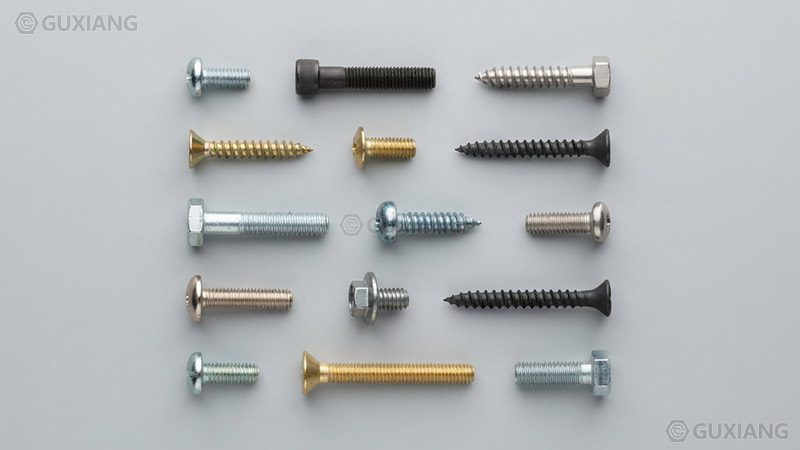
Material grade and surface finish determine mechanical strength, corrosion resistance, and cost. The material must match the environment and the load, and the coating must protect the joint for its service life.
碳钢
Carbon steel is the most economical screw material and delivers adequate strength for general-purpose and indoor use. Low-carbon grades suit light fastening, while medium-carbon and alloy grades are heat-treated for higher tensile strength. Bare carbon steel corrodes quickly outdoors, so coated versions are mandatory for exterior service. For the strength families and grade marking systems, our 碳钢紧固件指南 is the reference.
不锈钢
Stainless steel resists corrosion through a chromium oxide surface film. Type 304 covers most indoor and mild outdoor service, while Type 316 adds molybdenum for chloride and marine environments. Stainless screws are non-magnetic in the austenitic grades, which matters in electronics and medical equipment. For grade selection across environments, our 不锈钢紧固件等级 article ranks the options.
合金钢
Alloy steel is heat-treated to high strength grades such as Class 10.9 and 12.9 metric, and it carries heavy loads in automotive and machinery. High strength brings a trade-off: elevated hardness increases sensitivity to hydrogen embrittlement, so coating and plating processes must be controlled. The alloy steel specification details follow the same mechanical-property logic as the other heat-treated grades.
Brass and Bronze
Brass and bronze screws offer corrosion resistance, electrical conductivity, and a decorative appearance. They are softer than steel, so they suit light loads, plumbing, and marine hardware where galling with stainless is a concern. Brass is non-magnetic and commonly used in electrical terminals and fine furniture.
铝
Aluminum screws are lightweight and naturally corrosion-resistant, and they suit weight-sensitive assemblies in aerospace, electronics, and automotive. They are softer and weaker than steel, so thread engagement must be longer. Anodized aluminum adds a wear-resistant oxide layer.
镀锌
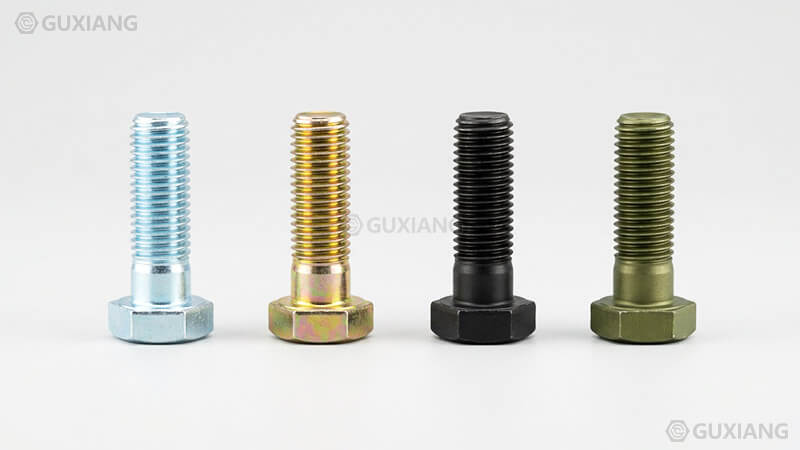
Zinc electroplating is the standard low-cost corrosion protection for carbon steel screws. It sacrifices itself to protect the steel, and thickness grades are defined in ASTM B633. Clear, yellow, and blue passivates change the appearance and extend protection. For the difference between plated and hot-dip protection, our 热镀锌与电镀锌紧固件的对比 article draws the line between the two corrosion strategies.
热浸镀锌
Hot-dip galvanizing coats the screw in a thick zinc layer by immersion in molten zinc, following ASTM A153 for hardware. The coating is several times thicker than electroplating, so it survives decades of outdoor exposure. Hot-dip coating can fill fine threads, so galvanized fasteners are often over-tapped to restore fit.
黑氧化物
Black oxide is a thin conversion coating that adds mild corrosion protection and a matte black finish. It does not protect bare steel outdoors, but it reduces reflectivity, improves lubricity, and serves as a base for oil or wax. Black oxide is common on tooling, machinery, and automotive interior fasteners.
Material Selection Quick Table
| 材料 | 强度 | 耐腐蚀性 | Typical environment |
|---|---|---|---|
| Carbon steel, coated | Medium-high | Good (with coating) | Indoor, general |
| 304不锈钢 | 中 | 好 | Indoor, mild outdoor |
| 316不锈钢 | 中 | 非常棒 | 海事、化工 |
| 合金钢 | 高 | Fair (needs coating) | Automotive, machinery |
| 黄铜 | Low-medium | 好 | Electrical, decorative |
| 铝 | Low-medium | 好 | Weight-sensitive |
| Zinc plated steel | 中 | 中等 | General, indoor |
| Hot-dip galvanized | 中 | 非常棒 | Outdoor, structural |
Screw vs Bolt: What Is the Difference?
Engineers use “screw” and “bolt” loosely, but the formal distinction comes from how the fastener is used and driven. A screw mates with its own thread formed in the material, while a bolt mates with a pre-formed nut thread. The practical classification depends on assembly method and head style.
| 属性 | 螺丝 | 博尔特 |
|---|---|---|
| Mating thread | Forms its own thread in the material | Pairs with a nut or tapped hole |
| Installation tool | Screwdriver or driver bit | Wrench or socket |
| Head | Slotted, Phillips, Torx, socket, etc. | Hex head typical |
| Load path | Pull-out and bearing | Tension with nut |
| 典型用途 | Wood, sheet metal, plastic | Structural, machinery |
A hex-head lag screw still counts as a screw because it cuts its own thread in wood, while a hex bolt with a nut is a bolt. Machine screws sit on the boundary: they mate with tapped holes, so some standards classify them with bolts. In practice, specify by application: if the joint uses a nut, think bolt; if the fastener cuts or forms its own thread, think screw.
Screw Applications by Industry
Different industries optimize the same five screw variables in different directions. The table below summarizes the dominant screw types, critical specifications, and common failure modes for six industrial sectors.
| 行业 | Primary screw types | Critical spec | Common failure mode |
|---|---|---|---|
| 汽车 | Machine screws, thread-forming, Torx | Torque spec, drive type | Stripped drives, cross-threading |
| 电子产品 | Micro machine screws (M1.6–M3) | Non-magnetic, torque limit | Over-torque, stripped drives |
| 建筑 | Structural wood, concrete screws | Load rating, code approval | Wrong embedment, corrosion |
| 航空航天 | Titanium, alloy steel | Weight, fatigue life | Corrosion, torque sequence |
| HVAC / Enclosures | Sheet metal, self-tapping | 腐蚀评级 | Rust in outdoor units |
| Furniture | Confirmat, wood screws | Pull-out resistance | Stripping in engineered wood |
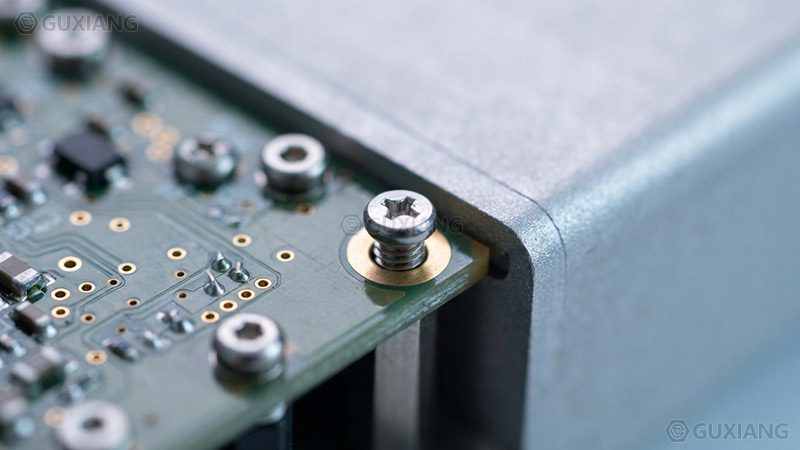
8-Step Industrial Screw Selection Framework
Use this sequence to specify the correct screw without over-engineering the joint.
Step 1: Define the Load
Identify the primary loading mode. Tension and clamping call for fully threaded machine screws with adequate engagement. Shear calls for partially threaded screws with a smooth shank across the shear plane, because the shank is stronger than the thread root. Combined tension and shear pushes the decision toward a larger diameter rather than a longer thread.
Step 2: Map the Environment
Classify the installation site by corrosion severity. Indoor and dry permits zinc-plated carbon steel. Humid or wash-down service calls for stainless 304 or zinc-nickel. Outdoor non-marine suits hot-dip galvanized or stainless. Marine and coastal require stainless 316. High-temperature service above roughly 150 °C disqualifies 镀锌 and demands alloy steel.
Step 3: Select the Thread Type
Match the thread to the substrate. Steel tapped holes use metric or UNC/UNF machine threads. Tapped aluminum prefers fine threads or coated threads to prevent galling. Plastic bosses use thread-forming screws or brass inserts. Sheet metal up to about 3 mm uses self-tapping screws. Wood uses wood screws or structural screws. Concrete uses concrete anchor screws.
Step 4: Choose the Head Type
Decide whether the head must sit flush. Flat and bugle heads suit flush surfaces. Pan, truss, and flange heads add bearing area for thin materials. Hex and socket heads accept higher torque. Clearance, appearance, and bearing area narrow the list.
Step 5: Specify the Drive Type
For high-volume production, Torx or hex socket minimizes cam-out and bit wear. For one-handed service work, Robertson or Torx holds the screw on the bit. For matching existing hardware, match exactly, because mixing Phillips and Pozidriv on one assembly creates rework.
Step 6: Verify the Grade and Material
Confirm the strength grade against the load and the material against the environment. Grade 8 and Class 10.9/12.9 alloy steel carry the heaviest loads. Stainless 304 and 316 trade strength for corrosion resistance. Document the chosen grade on the drawing so the supplier cannot substitute.
Step 7: Set the Torque Specification
Every critical screw needs a torque value from a recognized source: Machinery’s Handbook tables, the manufacturer’s published torque data, or ISO 898-1 mechanical property tables. Lubricated fasteners need 15–30% less torque than dry ones for the same clamp load, so account for coatings and thread treatments. Our 公制螺栓扭矩表 gives a working starting point by grade and size.
Step 8: Validate with Prototype Assembly
Run a pilot assembly before full production. Verify drive fit, thread engagement, seating torque, and removal torque. Check that the screw survives the installation process without stripping and that the joint holds the specified clamp load. Batch-test new lots from a new supplier, because heat treatment and coating quality vary.
Common Screw Failure Modes and Torque Problems
Most screw failures trace to a small set of root causes, and each has a prevention path.
| Failure mode | Cause | 预防 |
|---|---|---|
| Stripped drive | Wrong bit, high cam-out, over-torque | Torx drive, correct bit, torque control |
| Stripped threads | Cross-threading, too-large pilot | Straight start, correct pilot hole |
| Pull-out | Short engagement, wrong thread | Longer engagement, coarse thread in soft material |
| Head shear | Over-torque, weak grade | Higher grade, larger diameter |
| 腐蚀 | Wrong material for environment | Stainless or proper coating |
| Loosening | Vibration, insufficient preload | Correct torque, thread locker, flange head |
| Hydrogen embrittlement | High-strength steel, bad plating | Controlled plating, lower hardness, baking |
Torque problems deserve special attention. Over-tightening stretches the screw past yield, which can crack the head or strip the thread. Under-tightening leaves the joint loose, so vibration works the fastener out. Use a calibrated torque wrench, follow the published spec, and re-verify torque after any change to lubrication or coating.
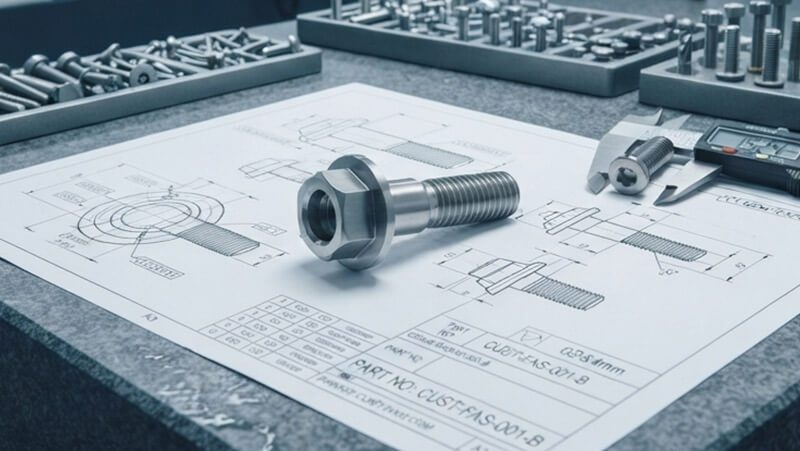
Screw Manufacturing and Customization
For high-volume or application-specific screws, custom manufacturing closes the gap between catalog parts and the exact joint requirement. A capable screw manufacturer controls the whole chain: material, heading, thread rolling, heat treatment, and surface finish.
CNC Machining and Precision Turning
CNC machining produces screws with tight tolerances for micro sizes, unusual geometries, and low to medium volumes. Precision turning and milling cover non-standard heads, threads, and points that cold heading cannot produce. CNC also supports quick iterations during product development.
Cold Heading and Thread Rolling
Cold heading forms the screw head and body by upsetting wire at room temperature, which preserves grain flow and improves strength. Thread rolling then forms threads by displacing material rather than cutting it, which adds compressive residual stress and fatigue resistance. Cold-headed screws dominate high-volume production because they run fast and waste little material.
Prototyping and Sampling
A reliable manufacturer offers prototyping and sampling before volume production. Samples let the engineering team verify fit, torque, and finish in the actual assembly, and they catch problems before tooling is committed. Short-run sampling also supports design changes without full tooling cost.
OEM and Custom Specification
OEM partners supply screws made to the customer’s drawing, including custom heads, drives, materials, and coatings. The manufacturer manages tolerances, mechanical property testing, and lot traceability, so the buyer receives documented compliance with ISO 898-1, ASTM, or ASME specifications. For the standard landscape that governs such custom parts, our 紧固件标准指南 explains which standard to cite.
Surface Treatment and Plating Services
Custom screw manufacturers offer in-house surface treatment: 镀锌 to ASTM B633, hot-dip galvanizing to ASTM A153, black oxide, phosphate, anodizing, and Dacromet-type coatings. Controlling the finish in-house keeps quality consistent and shortens lead times, especially for corrosion-critical outdoor and marine parts.
Why Custom Manufacturing Matters
Off-the-shelf screws fit standard joints, but production lines often need a specific drive, a tighter tolerance, a special coating, or a non-standard length. Custom screws eliminate field modifications, reduce assembly defects, and improve the total cost of ownership. A manufacturer with CNC, cold heading, heat treatment, and plating in one facility shortens the supply chain and keeps quality documentation in one place.
Screw Selection FAQ
1. What are the most common types of screws?
最常见的家庭是[[5]、[[3]、[[2]s、[1]、[0]、[4]s、[[6]s、[8]、[7]和混凝土[8]。 每个家族都优化螺纹并点几何,用于特定的地基.
2. What is the difference between a screw and a bolt?
A[[2]在[0]中形成自己的交配[1]],而一[4]对有螺母或预接孔. 螺丝一般由螺钉个司机或被位驱动;螺栓用扳手驱动. 滞后螺钉在木材中切出自己的螺纹,所以保持[2].
3. What are the main screw head types?
常见的头型有平型,平型,平型,扣子,圆型,椭圆型,特鲁斯型,法兰型,Hex型,Socket型,和活管型. 平地和相机等反冲头坐倒. 潘,出出出出出出出出出出出出出出出出出出出出出出出出出出出出出出出出出出出出出出出入出出出出出出出出出出出出出出出出出出出出出出出出出出出出出出出出出出出出出出出出出出出出出入出出出出出出出出出出出出出出出出出出出出出出入出出出出出出出出出出出出出出出出出出出出出入出出出出出出出出出出出出出出出入出出出出出出出出出出出出出出出出出出出出出出出出出出出出出出出出入出出出出出出出出出出出出出出出出出出出出出出出出出出出出出出出出出出出出出出出出出出出出出出出出出出出出出出出出出出出出出出出出出出出出出出出出出.
4. What is the difference between Phillips and Pozidriv?
Phillips has a simple cross recess that cams out under torque. Pozidriv adds secondary ribs between the cross arms, which prevents cam-out and transfers higher torque. The two drives are not interchangeable, and using the wrong bit strips the head.
5. What are self-tapping screws?
Self-tapping screws cut or form their own mating thread as they install into a pre-drilled pilot hole. They eliminate a separate tapping operation in sheet metal, plastic, and light structural work, and they speed up assembly in high-volume production.
6. What is the difference between self-tapping and self-drilling screws?
Self-tapping screws need a pre-drilled pilot hole and then form the thread. Self-drilling screws have a drill-point tip that creates the hole and the thread in one pass. Self-drilling screws are faster and suit metal-to-metal work where pre-drilling is impractical.
7. Which screw should I use for wood?
Use wood screws with coarse threads and a sharp point for softwood, and fine-thread versions for hardwood. Deck screws add corrosion resistance for outdoor wood. Drill a pilot hole in hardwood or near edges to prevent splitting, and match the pilot diameter to the screw size.
8. What are drywall screws used for?
Drywall screws secure gypsum board to wood or steel studs. The bugle head seats flush without tearing the paper, and the sharp point drives fast. Coarse-thread versions suit wood studs, while fine-thread versions engage steel studs.
9. What is the best drive type for high torque?
Torx and hex socket drives transfer the highest torque with minimal cam-out. Torx is the production standard in automotive and electronics, while hex socket suits socket cap screws. External hex heads accept even more torque but require wrench access.
10. How do I prevent screws from stripping?
Match the bit to the drive, keep the driver aligned with the screw axis, drill the correct pilot hole, and apply the specified torque. Switch to Torx for high-torque joints, and never mix Phillips and Pozidriv bits in one assembly.
结论
A screw is specified by five variables: head, drive, thread, material, and coating. Start with the load and the environment, choose the thread for the substrate, pick the head for the surface, and select the drive for the torque and assembly speed. Document the grade, set the torque, and validate with prototype assembly. For custom requirements, a manufacturer with CNC machining, cold heading, heat treatment, and surface finishing in one facility delivers the exact fastener, documented to the applicable standard.
参考文献
ISO 898-1, Mechanical properties of fasteners made of carbon steel and alloy steel — Part 1: Bolts, screws and studs with specified property classes — Coarse and fine pitch thread.
ISO 965-1, ISO general purpose metric screw threads — Tolerances — Part 1: Principles and basic data.
1个TP5T B633, Standard Specification for Electrodeposited Coatings of Zinc on Iron and Steel.
1个TP5T A153, Standard Specification for Zinc Coating (Hot-Dip) on Iron and Steel Hardware.
ASME B18.6.3, Machine Screws, Tapping Screws, and Metallic Drive Screws (Inch Series).
Oberg, E., Jones, F. D., Horton, H. L., Ryffel, H. H., Machinery’s Handbook, Industrial Press.
工业紧固件 Institute, Fastener Standards Manual.