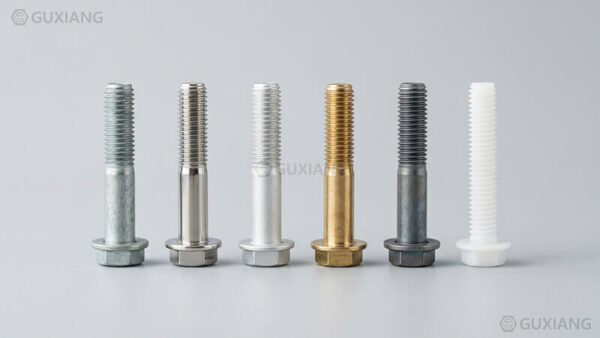






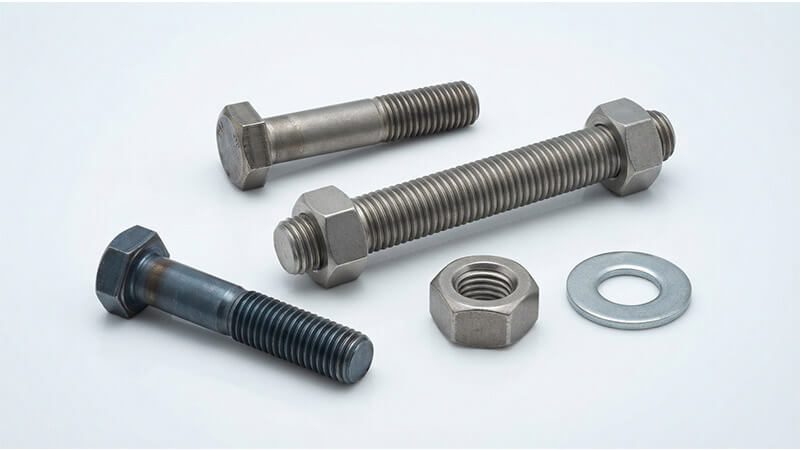
Скрепитель из легированной стали начинается как болт из углеродистой стали, который не может одновременно доставлять высокое сопротивление ползучести предел прочности при растяжении, высокотемпературное сопротивление ползучести и низкотемпературную ударную вязкость - так что хром, молибден, никель и ванадий легируются в расплав, а готовый болт - упрочненный и отпущенный, чтобы разблокировать свойства, которые ни углеродистая сталь, ни нержавеющая сталь не могут доставить по цене легированной стали. Результатом является класс крепежных элементов, которые работают непрерывно при 538 ° C, где болты из углеродистой стали теряют половину своей прочности и выживают при -101 ° C. Тестирование удара Шарпи, при котором стандартные высокопрочные болты разбиваются при первом ударе.
Это руководство охватывает металлургические механизмы, которые делают возможными легированная сталь крепежные изделия, полную матрицу ASTM A193/A320 класс прочности от B7 до B16 и L7, количественные данные о производительности при экстремальных температурах, экологические ограничения, включая кислые ограничения обслуживания NACE MR0175, и четырехэтапную структуру выбора, которая отображает условия работы на правильный класс прочности.
Что такое легированная сталь крепежные изделия
легированная сталь крепежные изделия - это болты, шпильки, орехи и шайбы, изготовленные из низколегированных сталей - углеродистых сталей, к которым хром, молибден, никель, ванадий и марганец были добавлены в контролируемых количествах для повышения конкретных свойств. Общее содержание сплавов обычно остается ниже 5-8%, что отличает их от нержавеющих сталей (10,5% + хром) и систем с высоким содержанием сплавов или суперсплавов.
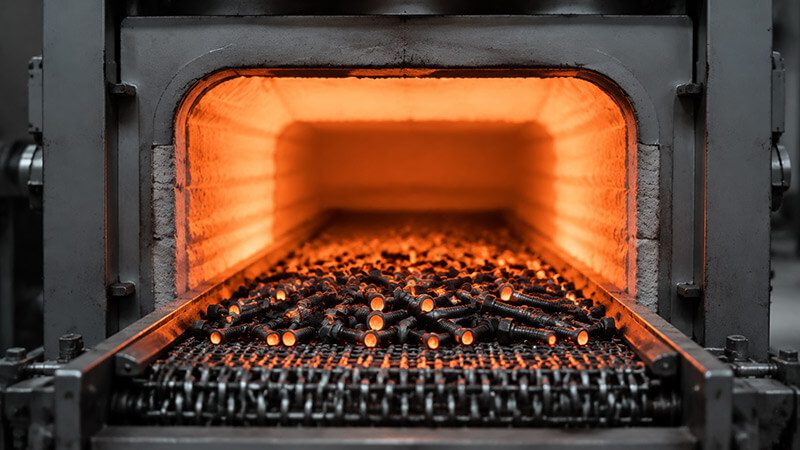
Определяющая последовательность производство закалка и закалка. Сталь нагревается до аустенитной температуры (845-870 ° C), быстро охлаждается в масле или полимере, чтобы сформировать мартенсит, а затем нагревается до 540-680 ° C, чтобы закалить хрупкий мартенсит в жесткую обрабатываемую микроструктуру. Без этой термообработки легированная сталь не имеет преимущества перед углеродистая сталь — именно сочетание химии сплавов и термической обработки дает конечные механические свойства.
Три границы определяют принадлежность легированная сталь крепежные изделия к иерархии материал:
| Класс материал | предел прочности при растяженииZ | Коррозионная стойкость | Диапазон температур | Относительная стоимость |
|---|---|---|---|---|
| углеродистая сталь (класс прочности 2, 5, 8) | Низко-высокий (60-150 кси) | Не требуется покрытие | -30°C до 200°C | 1× |
| легированная сталь (B7, B16, L7) | Высоко (100-125 кси) | Низкоумеренный | 101°C до 593°C | 1.2–1.5× |
| нержавеющая сталь (304, 316) | Низко-средний (75-125 кси) | Высокий | От -200°C до 800°C | 3–8× |
Застежки легированная сталь занимают центральную колонку: значительно прочнее нержавеющая сталь, пригодны для использования через температурное окно на 3 × шире, чем углеродистая сталь, но зависят от покрытий для защиты от коррозии. Компромисс - это цена - при стоимости 1,2-1,5 × углеродистая сталь, крепежи легированная сталь обеспечивают самое широкое соотношение производительности к стоимости в промышленных болтах.
Двумя основными стандартами ASTM, регулирующими эти крепежные изделия, являются:
ASTM A193: Сплав-сталь и болт нержавеющая сталь для высокотемпературного обслуживания. Охватывает B7, B7M, B16, B8, B8M и другие марки.
ASTM A320: Сплав-сталь и болт нержавеющая сталь для низкотемпературного обслуживания. Охватывает L7, L7M, L43 и другие классы с обязательным испытанием на удар Charpy.
Критическая оговорка: A193 включает марки нержавеющая сталь B8 (304) и B8M (316). Это не легированные стали — это аустенитные нержавеющие стали, которые используют A193 стандарт для административных удобств. В разделе 9 подробно рассматривается это различие.
Металлургия: почему легирующие элементы превращают сталь
без покрытия углеродистая сталь при комнатной температуре имеет потолок предел прочности при растяжении около 100-120 кси в тонких секциях, быстро теряет свою прочность выше 200°C и становится хрупким ниже -20°C. Добавление хрома, молибдена, ванадия и никеля изменяет сталь с помощью трех отдельных механизмов укрепления, которые работают одновременно.
Укрепление твердых решений
Атомы хрома, молибдена и никеля заменяют атомы железа в кубической решетке феррита и мартенсита. Поскольку эти легирующие атомы отличаются в размер от железа — хром близок (+0,25%), молибден значительно больше (+27%), — они создают локальные поля деформации в кристаллической решетке. Вывихи, пытающиеся пройти через решетку, встречают сопротивление на каждом замещающем участке. Результатом является повышенный предел текучести при комнатной температуре и улучшенное удержание прочности при повышенных температурах, где тепловая энергия в противном случае помогла бы вывихам в обход барьеров.
Укрепление карбида
Молибден и ванадий образуют карбиды тонкого сплава — Mo2C и V4C3 — во время закалки. Эти карбиды осаждаются в виде частиц 5-50 нанометров в диаметр, рассеянных по закаленной мартенситной матрице. Поскольку карбиды термодинамически стабильны при высоких температурах и устойчивы к огрублению, они закрепляют дислокации и границы зерна против ползучей деформации при температурах, где микроструктуры из углеродистой стали уже смягчились бы.
Карбид ванадия (V4C3) особенно эффективен, потому что он оседает при температурах около 600°C — типичный диапазон закалки для высокопрочных марок крепежное изделие. Это создает вторичное закаливание: по мере того, как мартенсит смягчается с увеличением температуры закаливания, осадки карбида ванадия добавляют прочность обратно в матрицу, компенсируя потерю. Этот вторичный эффект затвердевания является основной причиной того, что B16 крепежные изделия (Cr-Mo-V) поддерживает прочность на 55 ° C выше, чем B7 крепежные изделия (только Cr-Mo).
Уточнение зерна
Карбонитриды ванадия, которые остаются нерастворимыми во время аустенитного штифта границ аустенитного зерна, предотвращая рост зерна во время нагревания. Мелкое предварительно аустенитное зерно размер производит тонкий мартенситный пакет размер после закалки, что приводит как к более высокой прочности (отношение Холла-Петча), так и к улучшенной прочности - особенно к низкотемпературной ударной прочности, где рафинирование зерна сдвигает температуру перехода проточного к хрупкому (DBTT) вниз. Этот механизм является основой для криогенного L7-класс прочности крепежные изделия, достигающего значений удара Шарпи при -101°C, с которыми не может справиться идентичная химия B7 крепежные изделия.
Функция элемента Резюме
| Элемент | Типичный диапазон в легированная сталь крепежные изделия | Основные функции | класс прочностиZ Где наиболее критически |
|---|---|---|---|
| Cr | 0.75–1.20% | Укрепление твердого раствора, повышение твердости, стойкость к окислению | Все оценки |
| Момо | 0.15–0.65% | Образование карбида, высокотемпературное удержание прочности, устойчивость к размягчению темперамента | B16 (0.50-0.65%) |
| V | 0.25–0.35% | Утончение зерна, вторичное затвердевание через осадки V4C3, сопротивление ползучести | B16 |
| Нить | 0.50–1.00% | Низкотемпературная прочность, снижение DBTT | L7 |
| Мн | 0.45–1.10% | Деоксидация при изготовлении стали, укрепление твердого раствора, упрочнение | Все оценки |
Надежность: почему кросс-сектор размер управляет силой
Распространенной ошибкой спецификация является предположение, что 3-дюймовый болт диаметр B7 имеет тот же предел прочности при растяжении, что и 0,5-дюймовый болт B7. Стандарт ASTM A193 явно снижает требования к механическим свойствам по мере увеличения диаметр.
Тест Jominy End-Quench
Закаливаемость измеряет мощность стали, чтобы сформировать мартенсит во время закалки, как функцию скорости охлаждения и расстояния от закаленной поверхности. Тест Jominy end-quench (ASTM A255) количественно определяет это: бар стандарт нагревается до температуры аустенизации, один конец закаляется водяной струей, а твердость измеряется с интервалами вдоль бара.
Бар 4140 легированная сталь (базовая композиция для B7 и L7) сохраняет твердость выше 45 HRC на 50 мм от закаленного конца. Бар 1045 углеродистая сталь на том же расстоянии падает ниже 25 HRC — он охлаждается слишком медленно, чтобы образовывать мартенсит, и вместо этого образует смесь бейнита, феррита и перлита с значительно более низким твердость. Хром и молибден в 4140 году задерживают превращение аустенита в перламут, давая центру бара время для образования мартенсита, прежде чем температура упадет слишком далеко.
Критический диаметр
Практическое последствие: 1045 углеродистая сталь может быть закален до 12 мм диаметр при закалке масла. 4140 легированная сталь может быть закален до приблизительно 50 мм в масляном закалке и 75 мм в более агрессивных закалках. Помимо критического диаметр, ядро болта содержит смесь микроструктур — закаленного мартенсита на поверхности, бейнита и феррита в центре — с пропорционально меньшей прочностью.
Прочность ASTM A193 B7 подтверждена диаметр
| Номинальный болт диаметр | Минимальный предел прочности при растяженииZ | Минимальный предел текучестиZ | Металлургические основы |
|---|---|---|---|
| ≤ 2-1/2 в (63,5 мм) | 125 кси (862 МПа) | 105 кси (724 МПа) | Полностью мартенситное сечение |
| > 2-1/2 - 4 дюйма (63,5-101,6 мм) | 115 кси (793 МПа) | 95 кси (655 МПа) | Ядро содержит немного бейнита |
| > 4-7 в (101,6–177,8 мм) | 105 кси (724 МПа) | 75 ksi (517 MPa) | Significant non-martensitic core |
These reductions are not conservative assumptions — they are the measured minimum properties that can be reliably achieved given the hardenability limit of 4140-type steel. For bolting applications in the 4–7 inch range requiring full 125 ksi properties, a higher-hardenability grade such as 4340 (higher Ni+Mo) or a larger-diameter B16 stud (higher Mo+Cr promotes deeper hardenability) may be necessary.
Heat Treatment: Quenching and Tempering
Every alloy steel fastener’s final properties are determined by the heat treatment cycle. The three-stage process — austenitize, quench, temper — must be executed within controlled temperature windows and time limits to meet ASTM A193/A320 requirements.
Stage 1: Austenitizing
The steel is heated to 845–870°C and held at temperature until the microstructure fully transforms to austenite and alloy carbides dissolve into solution. The holding time is thickness-dependent — approximately 1 hour per 25 mm of cross-section. Undersoaking leaves undissolved carbides and chemical heterogeneity; oversoaking promotes grain growth that degrades toughness, especially critical for L7 cryogenic grades.
Stage 2: Quenching
The bolts are rapidly cooled in oil or polymer quenchant to transform austenite to martensite. The as-quenched hardness reaches 55–60 HRC, but the microstructure is brittle and contains high residual stresses. The cooling rate must exceed the critical cooling rate for the specific alloy — 4140’s critical cooling rate is approximately 8°C/s at 700°C, achievable in oil for sections up to roughly 50 mm diameter. Thicker sections require more aggressive quenchants or alloy modifications (higher Mo+Cr) to maintain cooling rate through the core.
Stage 3: Tempering
The quenched bolts are reheated to 540–680°C, held for a minimum of 1–2 hours, and air-cooled. This decomposes brittle martensite into tempered martensite — a microstructure of fine iron carbides dispersed in a ferrite matrix — with dramatically improved toughness at a controlled sacrifice of hardness.
The tempering temperature directly determines the final strength-toughness balance:
| Tempering Temperature | Approximate Final Hardness (4140) | Tensile Strength (ksi) | Заявка |
|---|---|---|---|
| 540°C (1000°F) | 30–35 HRC | ~125 | B7, L7 (maximum strength) |
| 595°C (1100°F) | 26–30 HRC | ~115 | B7 oversized (moderate derating) |
| 650°C (1200°F) | 20–24 HRC | ~100 | B7M (NACE sour service) |
Molybdenum and vanadium are critical during tempering because they resist the coarsening of iron carbides at high temperature. In a plain carbon steel, carbides coarsen rapidly above 500°C and strength falls quickly. In 4140 (with 0.15–0.25% Mo), carbide coarsening is delayed until approximately 550–580°C. In B16 (with 0.50–0.65% Mo plus 0.25–0.35% V), vanadium carbide precipitation offsets softening up to 600–620°C — the mechanism behind B16’s 55°C temperature advantage.
The Larson-Miller Parameter
For high-temperature service, the Larson-Miller parameter (LMP) relates temperature, time, and creep rupture life through a single equation:
LMP = T × (C + log t)Where T is temperature in degrees Rankine (°F + 460), t is time in hours to rupture, and C is a material constant (approximately 20 for low-alloy steels). For B16 at 540°C, an LMP of approximately 22.5 × 10³ indicates roughly 100,000 hours of creep life at design stress — a factor of 8–12× longer than B7 at the same temperature and stress. This is the quantitative justification for specifying B16 over B7 in supercritical steam service where unplanned outages carry six- to seven-figure costs per day.
Primary Grades Overview
The following table consolidates the five alloy steel fastener grades most commonly specified in industrial bolting. All five are governed by ASTM A193 (high-temperature) or ASTM A320 (low-temperature).
| Grade (ASTM) | Base Material | Tensile min (ksi) | Yield min (ksi) | Hardness max | Диапазон температур | Primary Use |
|---|---|---|---|---|---|---|
| A193 B7 | AISI 4140/4142 | 125 (≤2.5 in) | 105 | 321 HB / 35 HRC | -46°C до 538°C | Нефть и газ, сосуды под давлением, болт конструкционный |
| A193 B7M | AISI 4140 | 100 | 80 | 235 HB / 22 HRC | -46°C до 538°C | NACE MR0175 кислый сервис (H2S) |
| A193 B16 | Сплав Cr-Mo-V | 125 | 105 | 321 HB / 35 HRC | до 593°C | Производство электроэнергии, паровые турбины, обогреватели нефтеперерабатывающего завода |
| A320 L7 | AISI 4140 | 125 | 105 | 321 HB / 35 HRC | 101°C до 343°C | СПГ, криогенный газ, арктический оборудование |
| A193 B8/B8M | 304/316 SS | 75 (Cl.1) | 30 | 223 HB / 96 HRB | до 816°C | Коррозионные среды (примечание: нержавеющая, а не легированная сталь) |
ASTM A193 B7 — рабочая лошадка
ASTM A193 Grade B7 является наиболее широко заданной маркой легированная сталь крепежное изделие во всем мире. Его сочетание высокой прочности, умеренной стоимости, доступности в полном диапазоне размеров от M6 до M100 и признания ASME Boiler and Pressure Vessel Code, API и других нормативных рамок делает его выбором по умолчанию для промышленного болтования, где температура превышает пределы углеродистая сталь.
Химический состав
| Элемент | C | Мн | Р (макс) | S (max) | Сиси | Cr | Момо |
|---|---|---|---|---|---|---|---|
| B7 (%) | 0.37–0.49 | 0.65–1.10 | 0.035 | 0.040 | 0.15–0.35 | 0.75–1.20 | 0.15–0.25 |
Механические свойства диаметр
| Номинальный диаметр | предел прочности при растяжении (ksi/MPa) | предел текучести (ksi/MPa) | Мин удлинения (%) | Сокращение площади мин (%) | твердость (HB/HRC) |
|---|---|---|---|---|---|
| ≤ 2-1/2 в | 125 / 862 | 105 / 724 | 16 | 50 | 321 HB / 35 HRC max |
| 2-1/2 - 4 в | 115 / 793 | 95 / 655 | 16 | 50 | 321 HB / 35 HRC max |
| от 4 до 7 в | 105 / 724 | 75 / 517 | 18 | 50 | 321 HB / 35 HRC max |
Температурные возможности
Верхний предел (538°C/1000°F). B7 fasteners are typically tempered at 590–650°C. Sustained operation above approximately 538°C risks further tempering — progressive softening as carbides continue to coarsen beyond the intended microstructure. The bolt loses preload as its yield strength decreases, which can lead to flange leakage. ASME B31.3 and ASME Section VIII Div.1 explicitly restrict B7 to temperatures where this relaxation is within design margins.
Lower limit (-46°C / -50°F). B7 does not mandate low-temperature impact testing. Below approximately -50°F, 4140 steel without grain refinement enters its ductile-to-brittle transition and Charpy impact values drop below 20 ft-lbs. For temperatures below -50°F, A320 L7 (same chemistry, mandatory Charpy-tested) replaces B7.
Типичные области применения
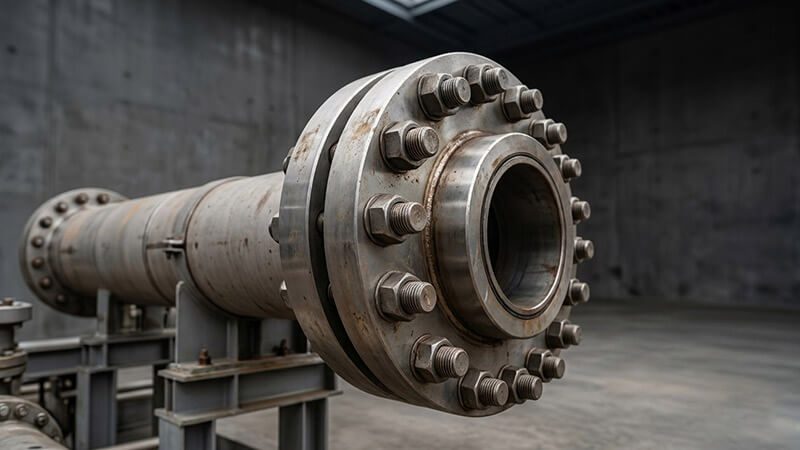
ASME B16.5 and B16.47 pipe flange bolting in refinery and petrochemical plants
API 6A wellhead and Christmas tree flange connections
Pressure vessel manway and handhole cover bolting
Industrial compressor and pump casing studs
Heat exchanger channel-to-shell and body flange bolting
Structural steel connections in high-temperature environments (furnace structures, exhaust stacks)
B7M: The NACE-Compliant Variant
When the service environment contains hydrogen sulfide (H₂S) in aqueous solution — common in oil and gas production, refining, and gas processing — standard B7 at HRC 25–35 is susceptible to sulfide stress cracking (SSC), a form of hydrogen embrittlement. NACE MR0175 / ISO 15156 restricts carbon and low-alloy steels in sour service to a maximum hardness of 22 HRC.
B7M is produced to the same chemical composition as B7 but tempered at a higher temperature (typically 650–675°C) to achieve 22 HRC maximum. The trade-off:
| Собственность | B7 | B7M |
|---|---|---|
| Tensile Strength (ksi) | 125 | 100 |
| Yield Strength (ksi) | 105 | 80 |
| Hardness (HRC max) | 35 | 22 |
| NACE MR0175 Compliant | Нет | Да |
B7M is specified wherever the NACE fluid categorization identifies the environment as sour. Using standard B7 in these conditions has caused catastrophic fastener failures — including well-documented incidents in Canadian and Middle Eastern gas fields where B7 studs fractured within hours of H₂S exposure.
ASTM A193 B16 — The High-Temperature Champion
B16 exists because B7’s upper temperature limit of 538°C is insufficient for supercritical and ultra-supercritical steam power cycles, where steam temperatures of 566–620°C are routine. B16 pushes the operational ceiling to 593°C through higher molybdenum content (0.50–0.65% vs B7’s 0.15–0.25%) and the addition of vanadium.
Химический состав
| Элемент | C | Мн | Р (макс) | S (max) | Сиси | Cr | Момо | V |
|---|---|---|---|---|---|---|---|---|
| B16 (%) | 0.36–0.47 | 0.45–0.70 | 0.035 | 0.040 | 0.15–0.35 | 0.80–1.15 | 0.50–0.65 | 0.25–0.35 |
The Mo+V Synergy
B16’s elevated temperature performance comes from two interacting mechanisms:
Doubled molybdenum (0.50–0.65% vs B7’s 0.15–0.25%) produces a higher density of Mo₂C carbide precipitates. These carbides are thermodynamically stable, resist coarsening at elevated temperature, and pin dislocations against creep deformation. At 550°C, B16 retains approximately 78% of its room-temperature yield strength compared to approximately 60% for B7.
Vanadium addition (0.25–0.35%) forms V₄C₃ precipitates that provide secondary hardening during tempering and remain stable up to approximately 620°C. Vanadium carbides also pin austenite grain boundaries during heat treatment, producing the fine grain structure that supports creep resistance.
B7 vs B16 — Yield Strength Retention vs Temperature
| Температура | B7 Yield Strength (est. % of room temp) | B16 Yield Strength (est. % of room temp) | Operational Implication |
|---|---|---|---|
| 450°C (842°F) | ~75% | ~85% | Moderate advantage for B16 |
| 500°C (932°F) | ~60% | ~78% | B16 begins to diverge clearly |
| 538°C (1000°F) | ~50% (B7 upper limit) | ~70% | B7 marginal; B16 within design range |
| 593°C (1100°F) | Not recommended | ~55% (B16 upper limit) | B16 sole option in this class |
Creep Life Comparison
At 540°C and a stress of 100 MPa, creep rupture data for Cr-Mo and Cr-Mo-V steels from the ASM Metals Handbook and NIMS creep data sheets indicate that B16 (Cr-Mo-V) achieves 8–12× the rupture life of B7 (Cr-Mo). This translates directly into maintenance interval economics: a B7 stud set requiring replacement at every 18-month turnaround in a refinery hydrocracker might be replaced with B16 studs that last through four or five turnarounds.
Типичные области применения
Main steam and hot reheat piping flange bolting in supercritical (566°C) and ultra-supercritical (620°C) coal-fired power plants
Heat recovery steam generator (HRSG) flange connections in combined-cycle gas turbine plants
Refinery fluid catalytic cracking unit (FCCU) reactor and regenerator head bolting
Steam turbine casing and valve bolting
High-temperature hydrogen service in refinery hydroprocessing units (with appropriate material verification per API 941 Nelson curves)
ASTM A320 L7 — The Cryogenic Specialist
A320 L7 fasteners are manufactured from the same AISI 4140 base material as A193 B7. The chemical composition is identical. The difference is in the quality control: L7 mandates fine grain practice and Charpy V-notch impact testing at -101°C (-150°F) — testing that B7 does not require and would likely fail.
Charpy Impact Requirements (ASTM A320 L7)
| Test Temperature | Minimum Average (3 specimens) | Minimum Individual | Units |
|---|---|---|---|
| -101°C (-150°F) | 20 ft-lbs | 16 ft-lbs | ft-lbs |
| -101°C (-150°F) | 27 J | 22 J | Joules |
Why Identical Chemistry Can Perform Differently at Low Temperature
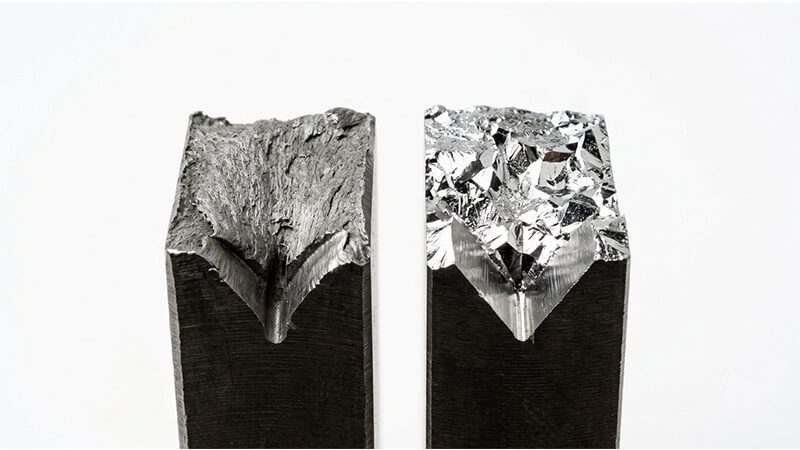
The Charpy impact test measures the energy absorbed during fracture of a notched specimen under dynamic loading. Above the ductile-to-brittle transition temperature (DBTT), the fracture surface is fibrous and the absorbed energy is high (40–80 ft-lbs for 4140). Below the DBTT, the fracture surface is crystalline cleavage and the absorbed energy collapses to 5–15 ft-lbs — a brittle failure with no plastic deformation.
Grain size is the dominant variable controlling DBTT in quenched and tempered steels. Fine-grain 4140 (ASTM grain size ≥ 7) has a DBTT shifted approximately 40–60°C lower than coarse-grain 4140 (grain size ≤ 5). B7 production does not mandate grain size control, so a commercially supplied B7 bolt may have a DBTT anywhere from -20°C to -60°C. L7 production mandates fine grain practice with a typical DBTT of -60°C to -80°C, placing -101°C within or near the upper-shelf energy plateau.
| Test Temperature | Coarse-Grain B7 (Uncontrolled) | Fine-Grain L7 (Controlled) |
|---|---|---|
| +20°C (68°F) | ~45 ft-lbs (61 J) | ~60 ft-lbs (81 J) |
| -50°C (-58°F) | ~10 ft-lbs (14 J) — brittle | ~45 ft-lbs (61 J) — ductile |
| -101°C (-150°F) | <5 ft-lbs (7 J) — fully brittle | ~25 ft-lbs (34 J) — ductile, passes |
Mechanical Properties
L7 mechanical properties are identical to B7 (125 ksi tensile, 105 ksi yield for diameters ≤ 2-1/2 in). The service temperature range extends from -101°C to approximately 343°C. Above 343°C, L7 is functionally equivalent to B7 and can be used interchangeably for high-temperature service, though B7 is typically specified for simplicity when only high-temperature performance is required.
Типичные области применения
LNG liquefaction train piping and valve bolting (-162°C)
LNG storage tank manway and nozzle flange bolting
Industrial gas (liquid oxygen, nitrogen, argon) plant cold-box bolting
Arctic and subarctic oil and gas production facilities (North Slope, Siberia, offshore Newfoundland)
Ethylene and propylene refrigeration system bolting
B8 and B8M: Why They Appear in A193 but Are Not Alloy Steel
ASTM A193 includes stainless steel grades B8 and B8M, which creates a persistent confusion. The standard is titled “Alloy-Steel and Stainless Steel Bolting” precisely because it covers both categories. B8 and B8M fall on the stainless side of the boundary.
B8 is manufactured from AISI 304 austenitic stainless steel (18Cr-8Ni). B8M is manufactured from AISI 316 (16Cr-10Ni-2Mo). They are carbide solution-treated, not quenched and tempered. Their microstructure is austenitic (face-centered cubic) rather than tempered martensitic (body-centered tetragonal/body-centered cubic).
Key Distinctions from Alloy Steel Grades
| Собственность | легированная сталь (B7, B16, L7) | Stainless (B8, B8M) |
|---|---|---|
| Strengthening mechanism | Martensitic transformation + tempering | Solid solution + optional strain hardening |
| Устойчивость к коррозии | Low–moderate (Cr ≤ 1.20%) | High (Cr ≥ 16%) |
| High-temperature strength | High (125 ksi up to 538°C) | Class 1: moderate (75 ksi); Class 2: high (125 ksi, strain-hardened) |
| Low-temperature toughness | L7 only, tested to -101°C | Inherently tough to cryogenic temperatures (FCC structure) |
| Magnetic | Yes (ferromagnetic) | Slightly magnetic (Class 2 cold-worked); non-magnetic (Class 1) |
When to Choose B8/B8M Over B7
The decision reduces to a single question: is corrosion resistance or mechanical strength the dominant requirement?
Corrosion-dominated (chemical processing, marine atmosphere, food-grade equipment) → B8 or B8M. The chromium oxide passive film on stainless steel supplies corrosion resistance that alloy steel, even with coatings, cannot match.
Strength-dominated (high-pressure flanges, heavy structural bolting, fatigue-critical joints) → B7 or B16. At the same diameter, B7 carries 67% more tensile load than B8 Class 1.
For applications requiring both high strength and corrosion resistance, A193 B8 Class 2 (strain-hardened 304, 125 ksi tensile) bridges the gap but at a significant cost premium. The 304 vs 316 stainless steel fastener guide covers stainless grade selection in depth.
Corrosion Resistance and Environmental Limits
Alloy steel fasteners have low to moderate inherent corrosion resistance — better than unprotected carbon steel, substantially worse than stainless steel. Their corrosion performance depends on chromium content (0.75–1.20%), surface condition, and whether a coating or plating has been applied.
Atmospheric Corrosion
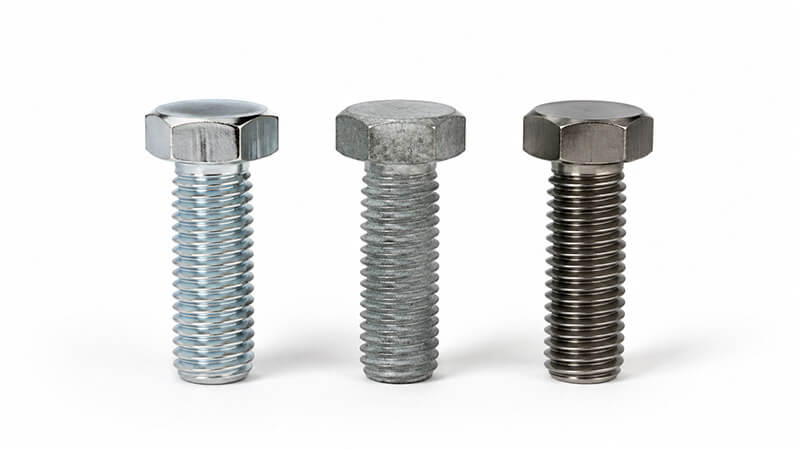
In ISO 9223 categories C1 (indoor, dry) and C2 (rural outdoor), alloy steel fasteners develop superficial surface oxidation but maintain structural integrity. In C3 (urban/industrial), unprotected alloy steel fasteners will rust visibly within months to years, though the corrosion rate is lower than plain carbon steel due to the small chromium addition. For C3 and above, alloy steel fasteners should be coated — zinc plating, hot-dip galvanizing, PTFE, or Xylan coatings, depending on temperature and chemical exposure.
Hydrogen Sulfide (H₂S) and NACE MR0175/ISO 15156
The most severe environmental restriction on alloy steel fasteners is sour service — environments containing H₂S in aqueous solution. The failure mechanism is sulfide stress cracking (SSC), a form of hydrogen embrittlement where atomic hydrogen, generated by the corrosion reaction between H₂S and steel, diffuses into the steel lattice and causes brittle fracture at applied stresses below the yield strength.
NACE MR0175 / ISO 15156 restricts carbon and low-alloy steels in sour environments to 22 HRC maximum hardness. Standard B7 at 25–35 HRC is non-compliant and has been documented to fail within hours to days of H₂S exposure at high stress. The compliant grade is B7M, identical in chemistry to B7 but tempered to 22 HRC maximum.
This restriction applies regardless of whether the fastener is coated or isolated — the hardness limit is on the base metal, not the surface. Coating does not protect against SSC because atomic hydrogen diffuses through most coating systems.
Hydrogen Embrittlement from Plating
Electroplating processes (zinc, cadmium) generate hydrogen at the steel surface, which can diffuse into high-strength steels (hardness ≥ 32 HRC / tensile strength ≥ 145 ksi) and cause delayed brittle fracture — sometimes hours or days after installation, at loads well below the bolt’s rated capacity.
ASTM A193/A320 require hydrogen embrittlement relief (baking) for electroplated high-strength fasteners: hold at 190–230°C for a minimum of 4 hours, initiated within 1 hour of plating. This drives diffusible hydrogen out of the steel before it can accumulate at grain boundaries and inclusion sites. Mechanical plating and hot-dip galvanizing produce negligible hydrogen and avoid the embrittlement risk entirely.
High-Temperature Oxidation
Above 450°C, alloy steel fasteners form visible oxide scale in air. The scale is non-protective (unlike the Cr₂O₃ scale on stainless steel) and thickens progressively with time and temperature. At 593°C (B16’s upper limit), the oxidation rate in air is approximately 0.25–0.5 mm/year — acceptable for the bolt’s mechanical function but unsuitable for applications requiring clean surfaces or minimal particulate generation.
Coating Compatibility at Temperature
| Coating Type | Maximum Continuous Temperature | Примечания |
|---|---|---|
| Electroplated Zinc | 200°C | Zinc melts at 419°C but diffusion into steel accelerates above 200°C |
| Hot-Dip Galvanized | 200–250°C | Similar zinc limitation; bath temperature (450°C) approaches B7 tempering range |
| PTFE / Xylan | 260°C | Organic binder degrades above 260°C |
| Cadmium Plate | 230°C | Effective but restricted (toxicity); common in aerospace |
| Zinc-Nickel Alloy Plate | 250–300°C | Improved high-temperature performance over pure zinc |
| Bare (uncoated) | Grade-dependent | B7 to 538°C, B16 to 593°C; accept oxidation |
For operating temperatures above approximately 300°C, most practical coating systems are thermally limited, and alloy steel fasteners are used bare with oxidation accepted as a maintenance consideration. This is standard practice in power generation and refinery high-temperature bolting.
How to Select Alloy Steel Fasteners: A Four-Step Decision Framework
The sequence below converts the technical data covered in Sections 1–10 into an actionable selection process.
Step 1: Define the Operating Temperature Range
| Temperature Condition | Оценка | Action |
|---|---|---|
| -101°C to -46°C | L7 | Verify Charpy certification at -101°C |
| -46°C до 538°C | B7 | Proceed to Step 2 |
| 538°C to 593°C | B16 | Verify Mo and V content on MTC |
| Above 593°C | Beyond alloy steel range | Consider nickel-based alloys (Inconel 718, A286) |
Step 2: Determine Sour Service Status (H₂S Present?)
| Condition | Оценка | Validate |
|---|---|---|
| H₂S present per NACE MR0175 definition | B7M | HRC ≤ 22 verified; NACE compliance statement on MTC |
| No H₂S | Continue to Step 3 |
Step 3: Check Diameter and Strength Derating
| Bolt Diameter | B7 Tensile | B16 Tensile | If 125 ksi Is Required |
|---|---|---|---|
| ≤ 2-1/2 в | 125 ksi | 125 ksi | B7 or B16 — either meets requirement |
| 2-1/2 - 4 в | 115 ksi | 125 ksi | Specify B16 if full 125 ksi needed |
| > 4 in | 105 ksi | Contact manufacturer | Evaluate larger diameter or higher-hardenability grade |
Step 4: Evaluate Corrosion Exposure
| Exposure | Recommendation |
|---|---|
| Dry, indoor, or C1-C2 atmosphere | Bare or light oil coating (standard B7/L7) |
| C3-C4 atmosphere | Zinc-plated + hydrogen bake, or HDG |
| Marine atmosphere (chloride-bearing) | Coated alloy steel with inspection schedule, or upgrade to B8M (316 stainless) |
| Chemical exposure (acids, alkalis, solvents) | Consult chemical compatibility data; likely B8/B8M stainless required |
Quick Reference Table
| Service Condition | Recommended Grade | Confirm on MTC |
|---|---|---|
| General high-temperature bolting | B7 | Tensile 125 ksi, chemistry |
| Sour oil & gas (H₂S) | B7M | Hardness ≤ 22 HRC, NACE statement |
| Steam power plant, >538°C | B16 | Mo 0.50%+, V present |
| LNG / cryogenic | L7 | Charpy at -101°C ≥ 20 ft-lbs avg |
| High corrosion, moderate strength | B8 (304) or B8M (316) | Chemistry per A193 |
| Oversized bolting, max strength | B16 (superior hardenability) | Full mechanicals at diameter |
Часто задаваемые вопросы
1. What is the difference between B7 and Grade 8 bolts?
B7 is an ASTM A193 alloy steel grade (4140 Cr-Mo) with material certification and rated service to 538°C. Grade 8 is an SAE J429 medium-carbon alloy steel grade with 150 ksi tensile but no high-temperature/low-temperature rating and no MTC traceability. For pressure vessels and piping, B7 is the specification-grade choice.
2. Can B7 bolts be used at temperatures above 1000°F (538°C)?
No. B7 is tempered at 590–650°C, and sustained service above this range causes further temper softening — yield strength drops below design margins and bolt preload relaxes. For service above 538°C, upgrade to B16 (rated to 593°C).
3. Are alloy steel fasteners stainless?
No. Alloy steel fasteners contain 0.75–1.20% chromium — far below the 10.5% minimum required for stainless steel. They rust in moist environments and require coatings or platings for corrosion protection. Grades B8 and B8M are stainless steels listed in A193; they are not alloy steels.
4. What is B7M and when is it required?
B7M is the NACE MR0175-compliant version of B7, tempered to a maximum hardness of 22 HRC (standard B7 allows up to 35 HRC). It is required whenever the service fluid contains H₂S in aqueous solution, as higher hardness steels are susceptible to sulfide stress cracking.
5. Can alloy steel fasteners be galvanized?
Yes, with precautions. Electroplated fasteners must receive hydrogen embrittlement relief baking (190–230°C, minimum 4 hours) within 1 hour of plating. Hot-dip galvanizing approaches the B7 tempering range and may slightly reduce tensile strength. For high-temperature service, bare alloy steel fasteners are standard.
6. What certifications should I require when purchasing alloy steel fasteners?
At minimum, an EN 10204 Type 3.1 certificate listing chemical composition, mechanical properties, and heat number. NACE sour service requires an MR0175 compliance statement. L7 fasteners require Charpy impact reports. Critical applications (pressure vessels, LNG) upgrade to EN 10204 Type 3.2 with third-party witnessed testing.
7. What is the difference between B7 and L7 if they use the same steel?
The chemistry is identical (AISI 4140), but L7 requires fine grain practice and mandatory Charpy V-notch impact testing at -101°C (20 ft-lbs minimum average). B7 has no grain size or low-temperature impact requirements. Use B7 for high-temperature bolting; switch to L7 when service temperatures drop below -46°C.
8. Can alloy steel fasteners be welded or repaired?
Welding alloy steel fasteners is not recommended. The heat-affected zone destroys the quenched-and-tempered microstructure, creating a softened region with uncontrolled hardness, residual stress, and risk of hydrogen-induced cracking. Damaged or corroded alloy steel fasteners should be replaced, not repaired.
9. How do I verify genuine B7 bolts versus counterfeit?
Confirm the head-stamped heat number matches the MTC. Perform portable PMI (XRF/OES) verifying Cr 0.75–1.20%, Mo 0.15–0.25%. Hardness test should return 25–35 HRC (below 25 = overtempered; above 35 = brittle failure risk). Source from ISO 9001 manufacturer with audited ASTM A193 certification.
10. What is the typical lead time for custom alloy steel fasteners?
Standard B7 stock ships same day to 2 weeks. Non-standard sizes require 4–8 weeks for forging, machining, and heat treatment. L7 and B16 add 2–4 weeks for specialized testing. EN 10204 Type 3.2 third-party inspection adds 1–2 weeks.
References
ASTM International. “ASTM A193/A193M — Standard Specification for Alloy-Steel and Stainless Steel Bolting for High Temperature or High Pressure Service and Other Special Purpose Applications.” https://www.astm.org/Standards/A193.htm
ASTM International. “ASTM A320/A320M — Standard Specification for Alloy-Steel and Stainless Steel Bolting for Low-Temperature Service.” https://www.astm.org/Standards/A320.htm
International Organization for Standardization. “ISO 15156 / NACE MR0175 — Petroleum and Natural Gas Industries — Materials for Use in H₂S-Containing Environments in Oil and Gas Production.” https://www.iso.org/standard/76461.html
International Organization for Standardization. “EN 10204:2004 — Metallic Products — Types of Inspection Documents.” (adopted as ISO 10474)
ASM International. ASM Handbook Volume 1: Properties and Selection: Irons, Steels, and High-Performance Alloys. 10th Edition. (Print reference — mechanical property and creep rupture data for Cr-Mo and Cr-Mo-V steels.)
Davis, J.R. (ed.). ASM Specialty Handbook: Carbon and Alloy Steels. ASM International, 1996. (Hardenability data, Jominy curves, and tempering response for 4140 and related grades.)
Wikipedia contributors. “41xx steel.” Wikipedia, The Free Encyclopedia. https://en.wikipedia.org/wiki/41xx_steel
Wikipedia contributors. “Charpy impact test.” Wikipedia, The Free Encyclopedia. https://en.wikipedia.org/wiki/Charpy_impact_test
National Institute for Materials Science (NIMS). Creep Data Sheet No. 10B: Data Sheets on the Elevated-Temperature Properties of 1Cr-0.5Mo Steel. NIMS, Japan. (Larson-Miller parameter and creep rupture data.)