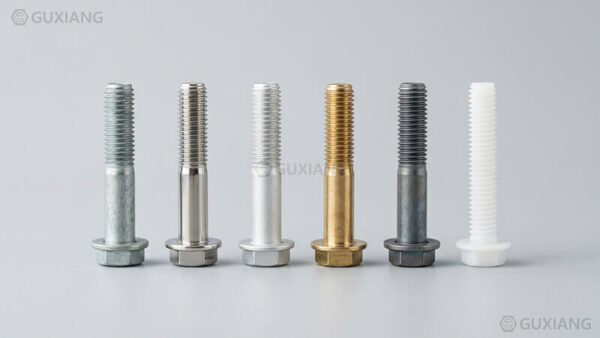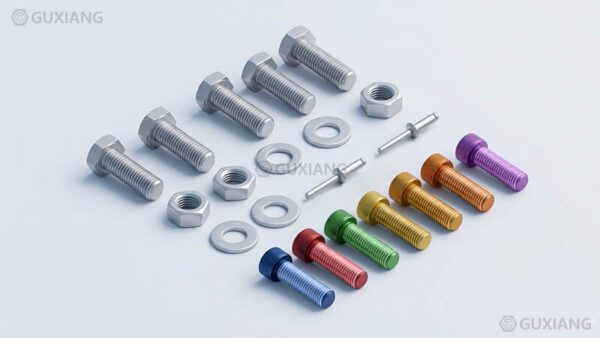






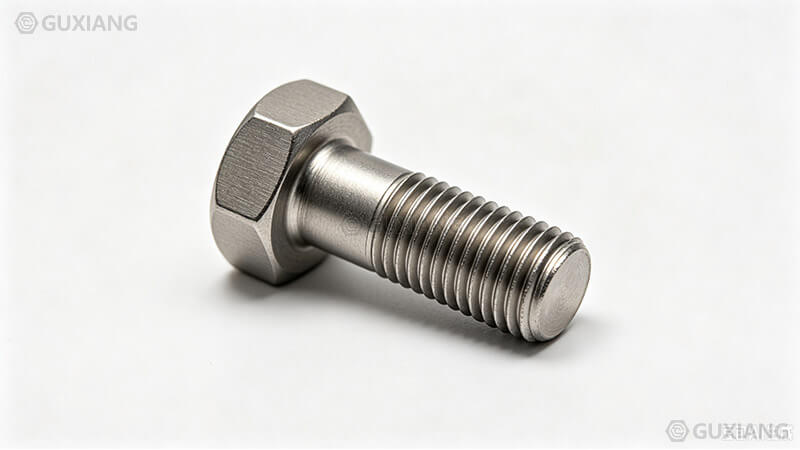
A titanium fastener is a bolt, screw, nut, or rivet made from commercially pure titanium or a titanium alloy — most commonly Ti-6Al-4V (ASTM Grade 5) — selected for a single dominant reason: it delivers the highest strength-to-weight ratio of any metal fastener available, plus corrosion resistance that exceeds stainless steel, at a price that runs three to five times higher than stainless and five to eight times higher than carbon steel. The engineering question behind every titanium fastener specification is therefore not “is titanium better” — in most mechanical and corrosion metrics it is — but “does this application justify the cost.”
This guide answers that question for two audiences. For engineers, it covers the ASTM grade system, quantitative mechanical property tables, corrosion fundamentals including the reversal of galvanic behavior versus aluminum, and the galling problem unique to titanium assembly. For purchasing and procurement teams, it presents the same material in plain terms with side-by-side cost comparisons and a decision framework that converts an application requirement into a yes-or-no titanium call.
What Are Titanium Fasteners
Titanium fasteners are mechanical joining components manufactured from titanium or titanium alloy bar and billet, typically by machining or cold forming. The material is classified into two families that determine nearly every downstream property:
| Family | Examples | Характеристики |
|---|---|---|
| Commercially Pure (CP) titanium | Grade 1, 2, 3, 4 | Lower strength, maximum corrosion resistance, maximum ductility, easiest to form |
| Titanium alloys | Grade 5 (Ti-6Al-4V), Grade 9 (Ti-3Al-2.5V) | Higher strength, heat-treatable, engineering-grade properties |
The defining material properties that drive titanium fastener selection are concentrated in four numbers:
| Собственность | Titanium (Gr5) | Углеродистая сталь | Stainless (304/316) | Aluminum (7075) | Почему это важно |
|---|---|---|---|---|---|
| Density | 4.43 g/cm³ | 7.85 g/cm³ | 7.9–8.0 g/cm³ | 2.70 g/cm³ | ~43% lighter than steel |
| Tensile strength (max grade) | 895 MPa (130 ksi) | 1030 MPa (150 ksi, Grade 8) | 860 MPa (125 ksi) | 572 MPa (83 ksi) | Strong, but below top steel grades |
| Corrosion in seawater | Immune (passive TiO₂) | Rusts | Pits and crevice-corrodes | Pits | Titanium outclasses all rivals |
| Magnetism | Non-magnetic | Ferromagnetic | Mostly non-magnetic | Non-magnetic | Critical in electronics and medical |
| Thermal conductivity | Низкий | Высокий | Умеренный | Высокий | Affects machining and heat flow |
Titanium fasteners are never a one-for-one drop-in for steel. They carry a different torque-to-preload relationship, demand lubrication to avoid galling, and interact differently with the metals they join in a galvanic couple. The sections that follow establish these boundaries precisely.
Grade System and Composition
Titanium fastener grades are defined by ASTM in a numeric system where the composition — not the temper — determines the properties. The grades used in fasteners are governed mechanically by ASTM F467/F468 (nonferrous fasteners), with material specifications in ASTM B348 (titanium bar and billet).
The Grade Table
| ASTM Grade | Общее имя | Principal Composition | Family | Character |
|---|---|---|---|---|
| Grade 1 | CP-1 | 99.5% Ti | CP (α) | Softest, most formable, best corrosion |
| класс прочности 2 | CP-2 | 99.2% Ti | CP (α) | Workhorse CP grade, balanced |
| Grade 3 | CP-3 | 99.1% Ti | CP (α) | Intermediate strength |
| Grade 4 | CP-4 | 98.9% Ti | CP (α) | Strongest pure titanium |
| класс прочности 5 | Ti-6Al-4V | Ti-6Al-4V | α+β | Most common engineering alloy |
| Grade 7 | Ti-0.2Pd | Ti-0.2Pd | CP (α) + Pd | Enhanced resistance to reducing acids |
| Grade 9 | Ti-3Al-2.5V | Ti-3Al-2.5V | Near-α | Cold-formable, moderate strength |
| Ti-6Al-4V ELI | Grade 5 ELI | Ti-6Al-4V, extra-low interstitial | α+β | Higher fracture toughness, medical grade |
The microstructural distinction matters for selection. CP grades (Grade 1–4) are single-phase alpha titanium: they cannot be strengthened by heat treatment, only by cold working, and their strength rises from Grade 1 to Grade 4 as interstitial elements (oxygen, iron) increase. Grade 5 is the alpha-beta workhorse, heat-treatable to its 895 MPa minimum, and Grade 9 is a near-alpha alloy that balances moderate strength with superior cold-formability for tubing and fasteners that must be formed rather than machined.
Grade 7 (Ti-0.2Pd) adds roughly 0.15–0.25% palladium to commercially pure titanium. This small addition is not about strength — Grade 7 carries the same 345 MPa minimum as Grade 2 — but about corrosion: palladium shifts the material’s corrosion resistance into reducing acid environments where standard titanium and even stainless steel would be attacked. Ti-6Al-4V ELI (extra-low interstitial) is Grade 5 with tightened oxygen, iron, and carbon limits, producing higher fracture toughness and improved fatigue performance for fracture-critical and implant applications.
Mechanical Properties
The mechanical properties of titanium fasteners are specified in ASTM F467/F468. Minimum values for the common grades are listed below; typical production values run modestly higher.
| ASTM Grade | Tensile Strength (min) | Yield Strength (min) | Typical Shear Strength |
|---|---|---|---|
| Grade 1 | 240 MPa (35 ksi) | 170 MPa (25 ksi) | ~165 MPa (24 ksi) |
| класс прочности 2 | 345 MPa (50 ksi) | 275 MPa (40 ksi) | ~240 MPa (35 ksi) |
| Grade 4 | 550 MPa (80 ksi) | 483 MPa (70 ksi) | ~385 MPa (56 ksi) |
| класс прочности 5 | 895 MPa (130 ksi) | 828 MPa (120 ksi) | ~625 MPa (91 ksi) |
| Grade 7 | 345 MPa (50 ksi) | 275 MPa (40 ksi) | ~240 MPa (35 ksi) |
| Grade 9 | 620 MPa (90 ksi) | 483 MPa (70 ksi) | ~435 MPa (63 ksi) |
Strength-to-Weight Ratio
Titanium’s headline advantage is not absolute strength — a Grade 8 carbon steel bolt at 1030 MPa exceeds Grade 5 titanium — but specific strength. Dividing tensile strength by density yields a clearer picture:
| Материал | Tensile Strength (MPa) | Density (g/cm³) | Specific Strength (MPa·cm³/g) |
|---|---|---|---|
| Ti-6Al-4V (Gr5) | 895–950 | 4.43 | 202–214 |
| Aluminum 7075-T6 | 572 | 2.70 | 212 |
| Alloy steel (A193 B7) | 860 | 7.85 | 110 |
| 304 stainless | 515 | 8.0 | 64 |
Grade 5 titanium carries roughly twice the strength per unit weight of alloy steel and three times that of 304 stainless — on a strength-to-weight basis it equals 7075 aluminum while retaining far superior temperature and corrosion capability. This is the property that makes titanium structurally irreplaceable in weight-critical applications. For load-driven applications where weight does not matter, the alloy steel fasteners guide covers the higher-absolute-strength, lower-cost alternative.
Temperature Behavior
Grade 5 titanium retains useful strength to approximately 315°C (600°F) in continuous service and tolerates short excursions to 540°C (1000°F). Commercially pure grades are typically limited to roughly 300°C. At the other extreme, titanium retains toughness at cryogenic temperatures down to -250°C, where many steels become brittle — a dual capability few other fastener materials match.
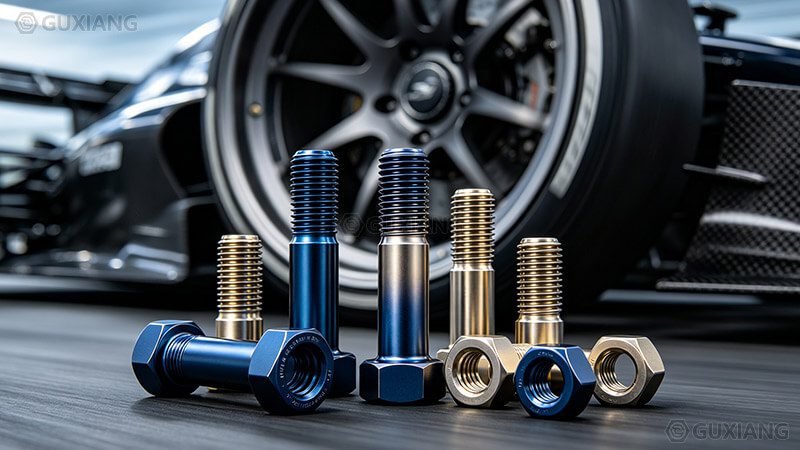
Corrosion Resistance and Galvanic Behavior
Titanium’s corrosion resistance is the single strongest argument in its favor and rests on one fact: titanium forms a passive oxide film (TiO₂) that is stable, adherent, and self-healing across an extraordinarily wide range of environments.
Where Titanium Excels
Titanium fasteners are effectively immune to corrosion in:
Seawater and brine — no pitting, no crevice corrosion, no stress-corrosion cracking, at any temperature encountered in marine service.
Chloride environments — the environment that pitting-attacks 300-series stainless steel leaves titanium untouched.
Oxidizing acids — nitric acid, chromic acid, and most organic acids.
Chlorine and chlorine compounds in wet service.
This is the direct contrast to stainless steel: where 316 stainless pitting-corrodes and crevice-corrodes in warm seawater and chloride-bearing joints, titanium does not. The mechanism and the environments where stainless fails are detailed in the why stainless steel rusts guide.
Where Titanium Is Vulnerable
Titanium’s oxide film dissolves in reducing acids — hydrochloric acid, sulfuric acid, and hydrofluoric acid in particular. In these environments, unalloyed titanium corrodes, and the remedy is either Grade 7 (palladium addition) or a change of material. Titanium is also attacked by anhydrous chlorine and by molten metals, both irrelevant to typical fastener service.
Galvanic Behavior: The Reversal
The most counterintuitive — and most consequential — corrosion fact about titanium fasteners is their position in the galvanic series. Unlike aluminum, which sits at the active (anodic) end and sacrifices itself, titanium sits at the noble (cathodic) end, near platinum:
| Metal | Corrosion Potential in Seawater (V vs SCE) |
|---|---|
| Aluminum alloys | -0.76 to -0.90 |
| Углеродистая сталь | -0.60 to -0.70 |
| Stainless steel (passive) | -0.05 to -0.45 |
| Titanium (passive) | -0.05 to -0.15 |
The practical consequences run in two opposite directions:
Titanium is protected. When a titanium fastener is coupled to almost any other structural metal, the titanium is the cathode and remains intact — the coupled metal corrodes instead. Titanium fasteners endure in aggressive environments precisely because they cannot be galvanically sacrificed.
The substrate pays the price. A titanium fastener passing through an aluminum panel, bracket, or structure forms a strong galvanic cell in which the aluminum — the anode — corrodes aggressively around the fastener hole. The potential difference between titanium and aluminum is roughly 0.6 to 0.7 V, among the largest in practical engineering. The result is rapid aluminum degradation around titanium fasteners in wet or salt environments.
This is the exact inverse of the aluminum-fastener situation, where the aluminum fastener itself is the sacrificial component. The interaction and its mitigation — insulation, wet-installation sealants, and compatible coatings — are covered in the aluminum fasteners guide, and the two articles should be read together by anyone mixing titanium and aluminum in an assembly.
Mitigation for titanium fasteners in aluminum:
| Measure | Mechanism |
|---|---|
| Insulating washer or bushing | Breaks the electrical circuit between the two metals |
| Sealant (wet installation) | Excludes the electrolyte from the joint |
| Cadmium or aluminum coating on titanium | Coats the titanium so a compatible sacrificial layer is the contact surface |
| Redesign to avoid the couple | Select aluminum fasteners for aluminum structure |
Galling: The Titanium-Specific Assembly Problem
Galling is the single most common field failure in titanium fastening, and it is unique in severity among fastener materials. Galling is not corrosion and not overload — it is cold welding between the mating thread surfaces during tightening.
Why Titanium Galls
Titanium’s oxide film, which is the source of its corrosion resistance, is also the source of its galling problem. Under the sliding contact of a tightening thread, the thin oxide film ruptures, exposing clean, chemically active titanium. Two clean titanium surfaces in contact cold-weld together; as tightening continues, these micro-welds tear, roughening the surface, creating more welding, and the joint seizes — often before design preload is reached. Once galled, a titanium nut and bolt frequently cannot be disassembled and must be cut off.
The problem is worst in titanium-to-titanium pairs, and it scales with tightening speed, thread roughness, and the absence of lubrication.
Prevention
| Practice | Эффект |
|---|---|
| Apply anti-seize or thread lubricant | Separates titanium surfaces, prevents metal-to-metal contact |
| Use a dissimilar-metal or coated nut | Breaks the titanium-titanium couple |
| Anodize or coat the threads | The oxide/coating layer resists cold welding |
| Reduce tightening speed | Reduces frictional heating that accelerates galling |
| Control torque, avoid overtightening | Limits contact pressure at the thread flank |
Molybdenum disulfide, silver-based, and copper-based anti-seize compounds are standard for titanium threads. In critical aerospace assemblies, titanium fasteners are routinely supplied with a dry-film lubricant or a coating (silver or aluminum) specifically to control galling and to deliver a predictable torque-tension relationship.
Surface Finishes
Titanium fasteners receive surface treatment for one of four reasons: galling prevention, corrosion protection in specific couples, wear resistance, or appearance.
| Завершить | Primary Purpose | Примечания |
|---|---|---|
| Bare / passivated | Corrosion | Titanium needs no coating for corrosion in most environments |
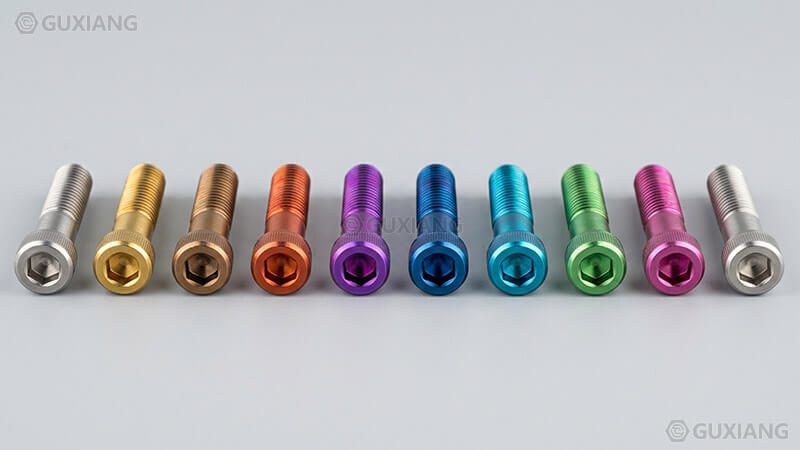
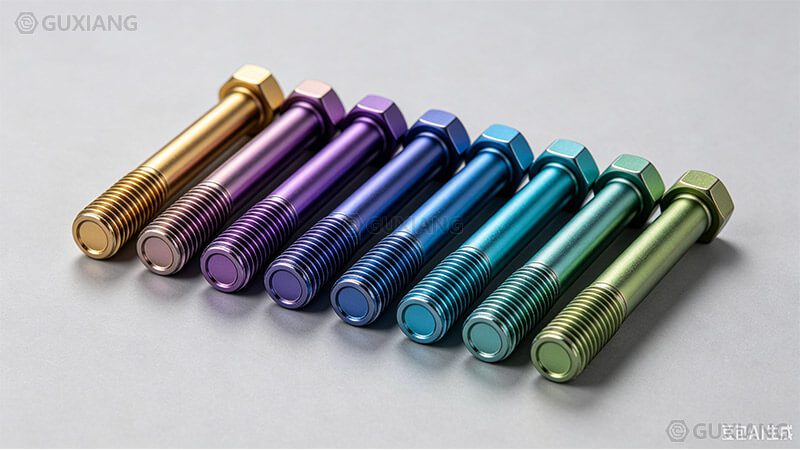
| Anodized (color) | Anti-galling, wear, identification | Titanium anodizing produces colored oxide layers; thickness set by voltage |
| Dry-film lubricant (MoS₂, silver) | Anti-galling, torque control | Standard for aerospace titanium threads |
| DLC (diamond-like carbon) | Носить сопротивление | High-hardness coating for sliding or repeated assembly |
| Aluminum or cadmium coating | Galvanic compatibility | Prevents titanium from cathodically attacking aluminum structure |
Anodizing titanium differs from aluminum anodizing in a useful way: the color of the titanium oxide layer is a direct function of the applied voltage, so a controlled anodizing process both hardens the surface and produces a color code. The general logic of matching a coating to an application — and when a coating is unnecessary — is covered in the galvanized vs zinc-plated fasteners guide.
A key procurement point: titanium fasteners specified for aerospace are almost always supplied with an anti-galling lubricant or coating as a standard requirement. Specifying bare titanium threads for a structural titanium-to-titanium joint is a known cause of assembly failure.
Titanium vs Steel, Stainless Steel, and Aluminum
The comparison that drives most purchasing decisions is titanium against its three principal rivals. The table below normalizes the key decision dimensions.
| Dimension | Titanium (Gr5) | Alloy Steel (B7) | Stainless (316) | Aluminum (7075) |
|---|---|---|---|---|
| Density (g/cm³) | 4.43 | 7.85 | 8.0 | 2.70 |
| предел прочности при растяжении (MPa) | 895 | 860 | 515 | 572 |
| Specific strength (MPa·cm³/g) | ~202 | ~110 | ~64 | ~212 |
| Max service temp (°C) | ~315 (short 540) | ~400 | ~400 | ~150 |
| Seawater corrosion | Immune | Rusts | Pits/crevices | Pits |
| Galvanic position | Noble (cathode) | Active (anode) | Mid-noble | Active (anode) |
| Magnetism | Non-magnetic | Magnetic | Mostly non-magnetic | Non-magnetic |
| Relative cost per part | 5–8× steel | 1× | 3–5× | 1–2× |
| Galling risk | Высокий | Низкий | Умеренный | Умеренный |
The Three Comparisons in Plain Terms
Titanium vs steel: steel wins on absolute strength and cost; titanium wins on weight, corrosion, and temperature-plus-corrosion combined. Choose titanium where weight or corrosion dominates and the load is within titanium’s 895 MPa capability; choose steel where maximum load at minimum cost is the requirement — the carbon steel fasteners guide covers that domain.
Titanium vs stainless steel: stainless is the budget corrosion option; titanium is the upgrade when stainless pitting or crevice corrosion is unacceptable, when weight matters, or when magnetic neutrality is required. The cost premium buys a material that does not pit in chloride service at all.
Titanium vs aluminum: aluminum is lighter and cheaper; titanium is stronger, far more corrosion-resistant, and usable at temperatures where aluminum fails. Where aluminum’s 83 ksi ceiling is too low or its temperature and corrosion limits are exceeded, titanium is the step up — and the galvanic interaction between the two (covered in §4) must be managed whenever they are joined.
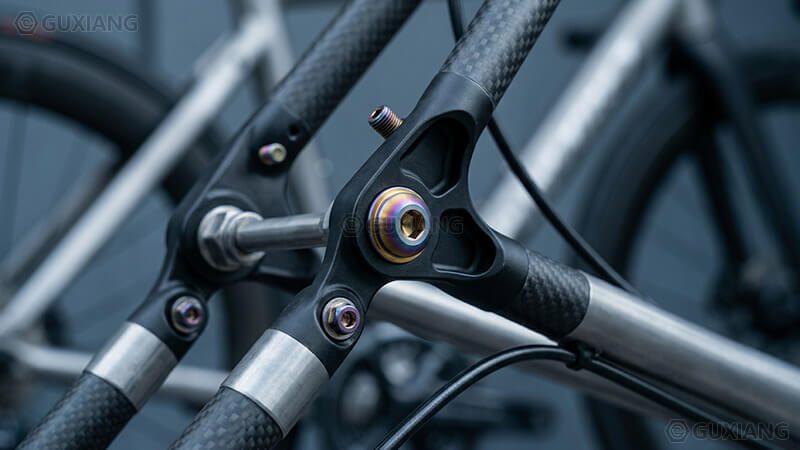
Cost and the Decision Framework
Titanium fasteners are expensive, and the cost is structural rather than a supplier margin. Three factors drive the price:
Raw material — titanium sponge and mill products cost several times steel on a per-kilogram basis, and the supply chain is constrained relative to steel and aluminum.
Machining difficulty — titanium’s low thermal conductivity and high work-hardening rate make it slow and tooling-intensive to machine, raising the cost of every turned thread.
Quality requirements — aerospace and medical titanium carries certification, traceability, and testing overhead that commercial steel fasteners do not.
The result: titanium fasteners run roughly 3–5× the cost of stainless steel и 5–8× the cost of carbon steel for an equivalent part.
The Lifecycle Counterargument
The purchase-price comparison is not the whole story. In the environments where titanium is specified, the alternative is not “a cheaper fastener that works just as well” but “a cheaper fastener that must be replaced repeatedly, or that fails catastrophically.”
| Cost View | Steel/Stainless | Титан |
|---|---|---|
| Initial purchase | Низкий | Высокий |
| Replacement frequency in corrosive service | High (recurrent) | Near-zero |
| Downtime and labor for replacement | Recurrent | Нет |
| Failure risk in critical service | Present | Minimal |
| Total cost over service life | Often higher | Lower in aggressive environments |
The decision rule is straightforward:
Choose titanium when any of these is true:
The fastener must not corrode in chloride or marine service over a long life.
Weight reduction carries measurable value (aerospace, motorsport, portable equipment).
Magnetic neutrality or biocompatibility is required.
The cost of failure or replacement exceeds the material premium.
Do not choose titanium when:
The joint requires strength beyond 895 MPa (use alloy steel).
The environment is dry and benign (carbon steel is adequate).
The budget is fixed and corrosion is manageable with stainless (use 316).
Key Grades Explained
This section details the grades that account for titanium fastener production, grouped by their defining role.
Grade 2 (CP-2) — The Industrial Workhorse
Grade 2 is commercially pure titanium at its most balanced point: 345 MPa strength, maximum corrosion resistance, good formability, and the lowest cost of any titanium grade. It is the default for chemical processing, marine hardware, and general corrosion-service fastening where strength requirements are modest.
Strengths: maximum corrosion resistance, weldable, economical for titanium.
Limitations: only 345 MPa — unsuitable for high-load structural joints.
Типичное использование: chemical plants, seawater piping, food processing, general corrosion-service fasteners.
Grade 4 (CP-4) — The Strongest Pure Titanium
Grade 4 raises commercially pure titanium to 550 MPa while retaining the full corrosion resistance of the CP family. It fills the gap between Grade 2 and the alloy grades.
Strengths: best strength among CP grades with full corrosion resistance.
Limitations: lower strength than Grade 5, slightly more costly than Grade 2.
Типичное использование: surgical implants, marine hardware needing higher strength, corrosion-service structural fasteners.
Grade 5 (Ti-6Al-4V) — The Engineering Standard
Grade 5 is the most widely used titanium alloy in the world and the default choice whenever “titanium fastener” means a structural component. At 895 MPa minimum it matches alloy steel’s strength class while at 4.43 g/cm³ it weighs 43% less, and it retains that strength to 315°C.
Strengths: highest strength-to-weight ratio of any practical fastener, heat-treatable, aerospace-proven.
Limitations: cost, galling susceptibility, machining difficulty.
Типичное использование: aerospace structural fasteners, motorsport, high-performance automotive, marine structural bolting.
Grade 9 (Ti-3Al-2.5V) — The Cold-Formable Alloy
Grade 9 offers 620 MPa strength with markedly better cold-formability than Grade 5, making it the preferred titanium alloy for fasteners produced by cold heading rather than machining.
Strengths: good strength, cold-formable for high-volume production.
Limitations: lower strength than Grade 5.
Типичное использование: aerospace fluid systems, bicycle and sporting equipment fasteners, formed titanium components.
Grade 7 (Ti-0.2Pd) — The Reducing-Acid Grade
Grade 7 adds palladium to commercially pure titanium, extending corrosion resistance into reducing acids (hydrochloric, sulfuric) where standard titanium is attacked, while keeping 345 MPa strength.
Strengths: corrosion resistance in environments that defeat standard titanium and stainless steel.
Limitations: higher cost from the palladium addition, modest strength.
Типичное использование: chemical processing in reducing-acid service, where the alternative is exotic alloys.
Ti-6Al-4V ELI — The Medical and Fracture-Critical Grade
Ti-6Al-4V ELI tightens the oxygen, iron, and carbon limits of Grade 5 to produce higher fracture toughness and improved fatigue behavior. Its primary domains are orthopedic implants and fracture-critical aerospace components where a crack-initiation failure is unacceptable.
| Оценка | Tensile (MPa) | Corrosion | Heat-Treatable | Идеально подходит для |
|---|---|---|---|---|
| Grade 1 | 240 | Отлично | Нет | Formability-critical, maximum corrosion |
| класс прочности 2 | 345 | Отлично | Нет | General corrosion service |
| Grade 4 | 550 | Отлично | Нет | Strongest pure titanium |
| класс прочности 5 | 895 | Good | Да | Structural, strength-to-weight |
| Grade 7 | 345 | Excellent (reducing acids) | Нет | Chemical processing |
| Grade 9 | 620 | Good | Partial | Cold-formed fasteners |
| Grade 5 ELI | 860 | Good | Да | Medical implants, fracture-critical |
Application Scenarios
| Industry | Dominant Requirement | Recommended Grade | Finish / Note |
|---|---|---|---|
| Аэрокосмическая отрасль | Weight + strength + fatigue | Grade 5, Ti-6Al-4V | Dry-film lubricant, aluminum-coated for galvanic control |
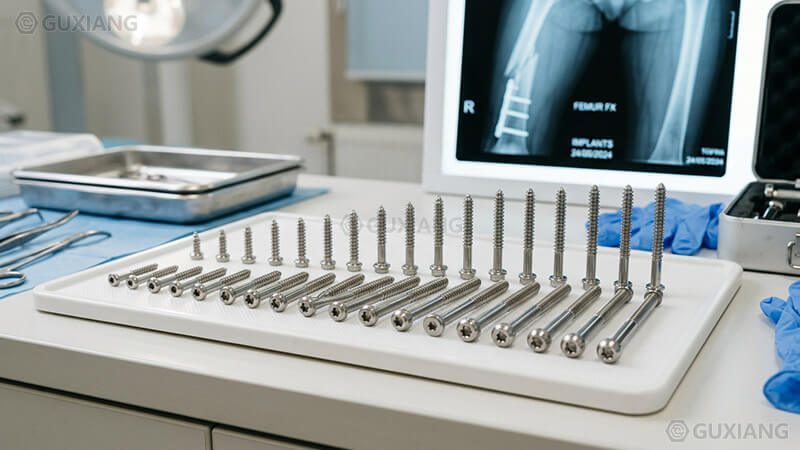
| Medical (implants) | Biocompatibility, fatigue | Grade 5 ELI, Grade 4 | No coating; implant-grade surface |
| Medical (instruments) | Corrosion, non-magnetic | класс прочности 2 | Пассивный |
| Marine / offshore | Seawater corrosion | Grade 2, Grade 5 | No coating required; monitor aluminum contact |
| Motorsport / performance auto | Weight reduction | Grade 5, Grade 9 | Anti-galling lubricant mandatory |
| Chemical processing | Acid/chloride corrosion | Grade 2, Grade 7 | Grade 7 for reducing acids |
| Electronics / MRI | Non-magnetic | Grade 2, Grade 5 | No magnetic interference |
| General high-corrosion | Long service life | класс прочности 2 | Cost-effective vs frequent replacement |
In the highest-corrosion marine and chemical applications, titanium frequently outlives the structure it fastens. In electrical isolation applications where a non-metallic, non-conductive fastener is required, the plastic fasteners guide covers the alternative that titanium — still a conductor — cannot offer.
Four-Step Selection Framework
Step 1: Establish the Strength Requirement
If the required tensile strength exceeds 895 MPa, titanium is eliminated — use alloy steel. Below that, Grade 5 (895 MPa), Grade 4 (550 MPa), Grade 9 (620 MPa), and Grade 2 (345 MPa) bracket the available options.
Step 2: Assess the Corrosion Environment
| Environment | Recommended Grade |
|---|---|
| Dry indoor, benign | Titanium is overkill — use steel |
| Marine, chloride, seawater | Grade 2 or Grade 5 |
| Reducing acids (HCl, H₂SO₄) | Grade 7 |
| Oxidizing acids, general chemical | класс прочности 2 |
Step 3: Verify Galvanic and Assembly Compatibility
Identify every metal the titanium fastener contacts. Aluminum and carbon steel are anodic to titanium and will corrode preferentially — apply insulation, sealant, or a compatible coating. Titanium-to-titanium joints demand anti-galling lubricant or a dissimilar-metal nut.
Step 4: Apply the Cost Gate
Run the decision rule from §8. If none of the four titanium triggers (long-life corrosion resistance, weight value, magnetic/biocompatibility requirement, high failure cost) applies, the application does not justify titanium’s premium — specify steel or stainless.
Часто задаваемые вопросы
1. What is the strongest grade of titanium bolt?
5 класс (Ti-6Al-4V) при минимальной прочности на растяжение 895 МПа. ELI 5 степени немного ниже (860 МПа), но обеспечивает более высокую прочность при переломах. 4 класс является самым сильным коммерчески чистым классом в 550 МПа.
2. How much more do titanium bolts cost than steel?
Титановые крепежи стоят примерно в 5-8 раз дороже углеродистой стали и в 3-5 раз дороже нержавеющей стали для эквивалентной части. Премия исходит из стоимости сырья, сложности обработки и накладных расходов на сертификацию.
3. Do titanium bolts gall or seize?
Да — титановые желчи легко в титано-титановых нитях, потому что оксидная пленка разрывается, а чистые поверхности холодно свариваются. Анти-захват смазки, покрытый или непохожий металлический орех и контролируемый крутящий момент являются стандартной профилактикой.
4. Can I use titanium bolts with aluminum?
Механически да, но гальванически рискованно. Титан катодный и ускоряет коррозию алюминия вокруг сустава. Изолируйте металлы, нанесите герметик или покройте титан, чтобы сломать пару.
5. Do titanium bolts rust?
Нет. Титан образует самовосстанавливающуюся пассивную оксидную пленку и не ржавеет, не ржавеет и не расщелинится в морской воде или хлоридной службе. Он разъедает только в уменьшении кислот, таких как соляная кислота.
6. What is Ti-6Al-4V titanium?
Наиболее широко используется сплав титан, также называемый ASTM класс прочности 5. Это примерно 90% титан, 6% алюминий и 4% ванадия, обеспечивая прочность 895 МПа при 43% меньшем весе, чем сталь.
7. Are titanium bolts magnetic?
Нет. Титан фактически немагнитный, поэтому титан крепежные изделия указан рядом с оборудованием МРТ, в электроника и в инструментах точность, где будет мешать стальной крепеж.
8. What temperature can titanium bolts withstand?
Grade 5 titanium retains strength to about 315°C continuously and tolerates short excursions to 540°C. Commercially pure grades are limited to roughly 300°C. Titanium also stays tough down to -250°C.
9. What is the difference between Grade 2 and Grade 5 titanium?
Grade 2 is commercially pure titanium at 345 MPa with maximum corrosion resistance. Grade 5 is the Ti-6Al-4V alloy at 895 MPa with higher strength but slightly lower corrosion resistance and higher cost.
10. Are titanium bolts worth the cost?
In corrosive, weight-critical, or high-failure-cost applications, yes — titanium’s near-zero maintenance and long life often make lifetime cost lower than repeatedly replaced steel. In dry, benign, low-load service, titanium is unnecessary.
References
ASTM International. “ASTM F467/F467M — Standard Specification for Nonferrous Nuts for General Use.” https://www.astm.org/f0467-13.html
ASTM International. “ASTM F468/F468M — Standard Specification for Nonferrous Bolts, Hex Cap Screws, Socket Head Cap Screws, and Studs for General Use.” https://www.astm.org/f0468-06.html
ASTM International. “ASTM B348/B348M — Standard Specification for Titanium and Titanium Alloy Bars and Billets.” https://www.astm.org/b0348-21.html
SAE International. “AMS 4928 — Titanium Alloy Bars, Wire, Forgings, and Rings, 6Al-4V.”
SAE International. “AMS 7476 — Bolts and Screws, Titanium Alloy.”
MatWeb Material Property Data. “Titanium Alloy Property Data.” http ://www.matweb.com/
ASM International. ASM Handbook Volume 2: Properties and Selection: Nonferrous Alloys and Special-Purpose Materials. 10th Edition. (Print reference — mechanical and corrosion data for titanium alloys.)
AZoM (Materials Online). “Titanium Alloys — Ti6Al4V Grade 5.” https://www.azom.com/