EN
EN  ZH
ZH 

An aluminum fastener is a bolt, screw, nut, rivet, or washer made from an aluminum alloy — most commonly 2024, 5052, 6061, or 7075 — selected not because aluminum matches steel in strength, but because it delivers a combination no steel can offer: roughly one-third the density, a self-healing corrosion-resistant oxide film, high electrical and thermal conductivity, and complete non-magnetism. The trade-off is structural — the strongest aluminum fasteners cap out at roughly 83 ksi tensile strength, below the 125 ksi of a standard alloy steel bolt — which is why the decision to use aluminum is always a decision about what matters more in a given application: weight, corrosion, and conductivity, or raw load capacity.
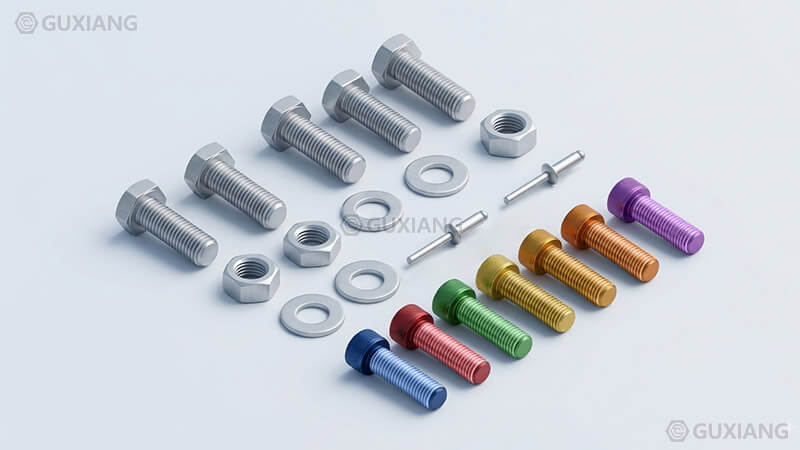
This guide maps the complete aluminum fastener landscape for two audiences. For engineers, it presents the alloy designation system, quantitative mechanical property tables, galvanic corrosion fundamentals with anodic/cathodic potential data, and surface treatment specifications. For purchasing and procurement teams, it explains the same material in plain terms with side-by-side comparison tables, cost context, and a four-step selection framework that turns an application requirement into a specific grade and finish.
Aluminum fasteners are mechanical joining components — bolts, screws, studs, nuts, washers, and rivets — manufactured from wrought aluminum alloys. They differ from steel fasteners in both material and manufacturing route: most aluminum fasteners are cold-formed or machined from bar stock, and the finished component’s strength comes from the alloy composition plus its temper designation rather than from a quench-and-temper heat treatment cycle applied to the fastener itself.
The defining characteristics that drive aluminum fastener selection are fourfold:
| Property | Aluminum Value | Steel (Carbon/Alloy) | Stainless Steel | Why It Matters |
|---|---|---|---|---|
| Density | 2.70 g/cm³ | 7.85 g/cm³ | 7.9–8.0 g/cm³ | ~66% weight reduction per fastener |
| Tensile strength (max grade) | 83 ksi (7075-T6) | 150 ksi (Grade 8) | 125 ksi (B8 Class 2) | Aluminum is structurally weaker |
| Corrosion mechanism | Self-healing oxide film | Rusts without coating | Chromium oxide passivation | Aluminum resists many environments steel cannot |
| Electrical conductivity | 30–40% IACS | ~10% IACS | ~2.4% IACS | Aluminum is a conductor, not an insulator |
| Magnetism | Non-magnetic | Ferromagnetic | Mostly non-magnetic (annealed) | Critical in electronics and medical equipment |
Two naming conventions appear throughout the industry: the American spelling aluminum and the British/European spelling aluminium. Both refer to the same material and are used interchangeably in specifications, catalogs, and search queries — a purchasing search for “aluminium fasteners” returns the same product class as “aluminum fasteners.”
Aluminum fasteners are rarely interchangeable with steel fasteners on a one-for-one basis. An aluminum bolt has lower tensile and shear strength, different thread engagement requirements, different torque behavior, and different corrosion interactions with the materials it joins. Understanding these boundaries — rather than treating aluminum as a drop-in replacement for steel — is the foundation of correct specification.
Aluminum fasteners are not made from “pure aluminum.” They are made from wrought aluminum alloys whose four-digit designation system (established by the Aluminum Association and adopted into ASTM and ISO standards) encodes the principal alloying elements.
| Series | Principal Alloying Element | Characteristics | Common Fastener Alloys |
|---|---|---|---|
| 1xxx | None (99%+ pure aluminum) | Excellent corrosion resistance, low strength, high conductivity | 1100 |
| 2xxx | Copper (Cu) | High strength, heat-treatable, poor corrosion resistance | 2024 |
| 3xxx | Manganese (Mn) | Moderate strength, good workability, good corrosion resistance | 3003 |
| 5xxx | Magnesium (Mg) | Best marine corrosion resistance, moderate strength, non-heat-treatable | 5052, 5083, 5086 |
| 6xxx | Magnesium + Silicon | Balanced strength/corrosion, heat-treatable, excellent extrudability | 6061, 6063 |
| 7xxx | Zinc (Zn) | Highest strength, heat-treatable, poor corrosion resistance, SCC-sensitive | 7075 |
The first digit identifies the series; the second digit indicates modifications to the original alloy; the last two digits are arbitrary identifiers within the series. For example, 2024 means a 2xxx-series (copper) alloy that is a fourth-generation development within that series.
The mechanical properties of an aluminum alloy depend as much on its temper as on its composition. The temper is appended after a hyphen — for example, 6061-T6 or 5052-H32.
| Temper | Meaning | Resulting Character |
|---|---|---|
| O | Annealed | Softest, maximum ductility, lowest strength |
| T4 | Solution heat-treated + naturally aged | Moderate strength, good formability |
| T6 | Solution heat-treated + artificially aged | Peak strength, most common fastener temper |
| T73 | Solution heat-treated + overaged | Sacrifices some strength for stress-corrosion resistance |
| H32 | Strain-hardened + stabilized (¼ hard) | Work-hardened strength, stable properties |
The distinction between heat-treatable and non-heat-treatable alloys matters for fasteners. The 2xxx, 6xxx, and 7xxx series gain strength through solution heat treatment and aging (T tempers). The 5xxx series gains strength only through cold working (strain hardening), so its strength designations use H tempers — 5052-H32, 5083-H32, and 5086-H32 are all strain-hardened-and-stabilized conditions. This distinction affects availability: 5xxx-series fasteners cannot be re-tempered by heat treatment, so their strength is fixed at the mill.
Aluminum fastener mechanical properties are governed in North America by ASTM F468 (nonferrous bolts, screws, and studs) and internationally by ISO 8839 and the equivalent GB/T 3098.10. The table below lists representative minimum tensile and yield strength values for the alloys most commonly specified in fasteners.
| Alloy-Temper | Tensile Strength | Yield Strength | Shear Strength | Typical Hardness |
|---|---|---|---|---|
| 2024-T4 | 68 ksi (470 MPa) | 47 ksi (325 MPa) | 41 ksi (283 MPa) | 120 HB |
| 5052-H32 | 33 ksi (228 MPa) | 28 ksi (193 MPa) | 20 ksi (138 MPa) | 60 HB |
| 5083-H32 | 46 ksi (317 MPa) | 33 ksi (228 MPa) | 26 ksi (179 MPa) | 85 HB |
| 5086-H32 | 42 ksi (290 MPa) | 30 ksi (207 MPa) | 24 ksi (165 MPa) | — |
| 6061-T6 | 45 ksi (310 MPa) | 40 ksi (276 MPa) | 30 ksi (207 MPa) | 95 HB |
| 7075-T6 | 83 ksi (572 MPa) | 73 ksi (503 MPa) | 48 ksi (331 MPa) | 150 HB |
| 2117-T4 (rivet) | 43 ksi (297 MPa) | 24 ksi (165 MPa) | 26 ksi (179 MPa) | — |
The strongest aluminum fastener grade (7075-T6) delivers approximately 83 ksi tensile strength. The comparison against steel is instructive and central to material selection:
| Material Grade | Tensile Strength | Relative to 7075-T6 |
|---|---|---|
| 6061-T6 aluminum | 45 ksi | 0.54× |
| 7075-T6 aluminum | 83 ksi | 1.0× (aluminum ceiling) |
| A193 B7 alloy steel | 125 ksi | 1.5× |
| SAE Grade 8 steel | 150 ksi | 1.8× |
| A286 stainless (strain-hardened) | 130 ksi | 1.6× |
The structural implication is direct: where a steel bolt of a given diameter is required, an aluminum bolt of the same diameter carries less than two-thirds the load. Replacing a steel fastener with aluminum on a strength-equivalent basis requires either a larger diameter, more fasteners, or a redesign of the joint. This is the single most important engineering consideration covered in the alloy steel fasteners guide for high-load applications — and the reason aluminum fasteners are specified primarily for weight-sensitive, corrosion-sensitive, or electrical applications rather than maximum-load structural joints.
The strength ceiling narrative reverses when weight enters the calculation. Aluminum’s density is 34% of steel’s, so for a fixed fastener weight, aluminum carries approximately 1.8× the load of an equal-weight steel fastener at the 7075-T6 grade, and roughly equal load at the 6061-T6 grade. In weight-critical applications — aerospace structures, automotive lightweighting, and portable equipment — this specific-strength advantage is the primary justification for aluminum.
Aluminum loses strength more rapidly than steel at elevated temperature. At 200°C (392°F), 6061-T6 retains approximately 70% of its room-temperature strength, and above 300°C (572°F) the heat-treatable alloys begin to overage, permanently reducing their properties. Aluminum fasteners are therefore unsuitable for service above approximately 200–250°C for heat-treatable grades, and the working range for most aluminum fasteners is -40°C to 150°C. For high-temperature bolting, the carbon steel fasteners guide covers the appropriate material classes.
Aluminum’s corrosion story has two opposite faces. Against atmospheric and many chemical environments, aluminum fasteners outperform steel dramatically because of the self-healing oxide film. Against dissimilar metals in a wet environment, aluminum fasteners are frequently the sacrificial victim of galvanic corrosion.
When aluminum is exposed to air, it immediately forms a thin, adherent layer of aluminum oxide (Al₂O₃), approximately 4–10 nanometers thick. Unlike the iron oxide (rust) that forms on steel — which is porous, non-adherent, and accelerates corrosion — aluminum oxide is dense, tightly bonded to the substrate, and self-repairing: if the film is scratched, it re-forms within milliseconds in the presence of oxygen.
This oxide film is stable in the pH range of approximately 4 to 9. Outside this range — in strongly acidic or strongly alkaline environments — the film dissolves and aluminum corrodes rapidly. This pH sensitivity is why aluminum fasteners perform well in neutral atmospheric and freshwater environments but poorly in concrete (alkaline) or in contact with strong acids.
The single most important corrosion consideration for aluminum fasteners is galvanic (bimetallic) corrosion, which occurs when two dissimilar metals are in electrical contact in the presence of an electrolyte (water, humidity, salt spray). In this couple, the more active (anodic) metal corrodes preferentially, while the more noble (cathodic) metal is protected.
In the galvanic series for seawater, aluminum and its alloys occupy the active (anodic) end, with corrosion potentials of approximately -0.76 to -0.90 V versus the saturated calomel electrode (SCE). Steel and stainless steel sit substantially more noble:
| Metal | Typical Corrosion Potential in Seawater (V vs SCE) |
|---|---|
| Aluminum alloys | -0.76 to -0.90 |
| Carbon steel | -0.60 to -0.70 |
| Stainless steel (304/316, passive) | -0.05 to -0.45 |
| Copper alloys | -0.25 to -0.35 |
| Titanium | -0.05 to -0.15 |
A potential difference greater than approximately 0.25 V between coupled metals indicates significant galvanic corrosion risk. Aluminum coupled to stainless steel shows a difference of 0.4 to 0.6 V — a high-risk combination.
The direct answer to the most-searched aluminum fastener question — “can I use stainless steel fasteners in aluminum?” — is: yes, mechanically, but the stainless steel fastener will accelerate corrosion of the aluminum base material around the joint. The stainless fastener itself remains intact because it is the cathode; the aluminum panel, bracket, or housing it passes through corrodes around the hole. The practical question is not whether the fastener survives, but whether the aluminum substrate survives.
This interaction is explored quantitatively in the stainless steel vs galvanized fasteners guide, which compares the corrosion behavior of different fastener materials against aluminum substrates.
Four standard practices reduce or eliminate galvanic corrosion between aluminum fasteners (or aluminum substrates) and dissimilar metals:
Insulation — Insert a non-conductive barrier (nylon washer, PTFE bushing, or coated gasket) between the two metals to break the electrical circuit.
Cathodic area control — Avoid small-anode/large-cathode geometry. A small aluminum fastener in a large stainless steel structure is the worst case; a large aluminum component with small stainless fasteners is more tolerable.
Coatings — Apply a corrosion-resistant coating to the more noble fastener (zinc, zinc-nickel, or organic coatings) so that the coating, not the aluminum, becomes the sacrificial anode.
Compatible material selection — Use aluminum fasteners with aluminum substrates (no galvanic couple), or select fasteners with corrosion potentials close to aluminum, such as galvanized steel rather than stainless steel.
For non-galvanic exposure, the general corrosion resistance of aluminum fasteners follows the alloy series. The 5xxx-series (5052, 5083, 5086) and 6xxx-series (6061) alloys offer the best general atmospheric resistance and are the standard choices for marine and outdoor applications. The 2xxx-series (2024) and 7xxx-series (7075) are copper- and zinc-bearing respectively, have notably poorer corrosion resistance, and are almost always anodized or coated in service. The underlying failure modes — pitting, intergranular corrosion, and stress-corrosion cracking — are detailed in the why stainless steel rusts guide, which explains the parallel corrosion mechanisms in steel-based fastener materials.
Surface treatment on aluminum fasteners serves three purposes: corrosion protection, wear resistance, and (for certain processes) electrical conductivity. The three dominant processes are anodizing, chromate conversion coating, and organic coatings.
Anodizing is an electrolytic process that thickens the natural oxide film on aluminum into a controlled, porous ceramic layer of aluminum oxide. The process runs the fastener as the anode in an acid electrolyte, converting the surface to Al₂O₃ to a controlled thickness.
| Anodizing Type | Electrolyte | Coating Thickness | Characteristics | Typical Use |
|---|---|---|---|---|
| Type I (Chromic) | Chromic acid | 0.5–7.6 μm | Thin, fatigue-friendly, good corrosion, limited dyeing | Aerospace, tight-tolerance threads |
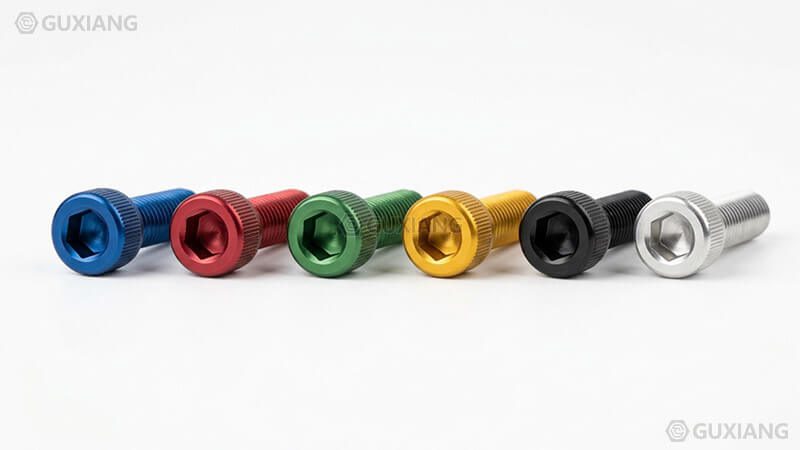
| Type II (Sulfuric) | Sulfuric acid | 1.8–25 μm | General purpose, dyeable, most common | General industrial, colored fasteners |
| Type III (Hardcoat) | Sulfuric acid, low temp | 25–150 μm | Very hard, wear-resistant, thick | High-wear sliding or clamping surfaces |
The anodized layer is extremely hard (comparable to sapphire on the Mohs scale at the surface) but also electrically insulating — anodized aluminum fasteners are non-conductive, which matters when electrical continuity across a joint is required. Aerospace specifications for anodizing are governed by AMS 2470; the sulfuric acid process for fasteners is specified in MIL-A-8625.
Chromate conversion coatings (commonly sold under trade names such as Alodine and Iridite) form a very thin (0.05–0.5 μm) chemical film that maintains electrical conductivity while improving corrosion resistance and paint adhesion. Because the film is thin and conductive, chromate conversion is the standard finish for aluminum fasteners that must remain electrically conductive — a key advantage over anodizing in electronics applications.
For fasteners requiring lubrication, specific friction characteristics, or additional corrosion protection, organic coatings such as PTFE or Xylan are applied over the aluminum substrate. These are functional coatings chosen for their frictional properties rather than corrosion resistance alone. The broader logic of matching a coating to an application — and when a coating is or is not necessary — is covered in the galvanized vs zinc-plated fasteners guide.
| Finish | Corrosion Protection | Electrical Conductivity | Thread Fit Impact | Relative Cost |
|---|---|---|---|---|
| Bare (natural oxide) | Low | Conductive | None | 1× |
| Chromate conversion | Moderate | Conductive | Minimal (thin film) | 1.1× |
| Anodized (Type II) | High | Non-conductive | Significant (account in tolerance) | 1.2–1.5× |
| Anodized (Type III) | High + wear | Non-conductive | Significant (account in tolerance) | 1.5–2× |
| Organic (PTFE/Xylan) | Moderate | Non-conductive | Minimal | 1.3–1.8× |
A critical specification detail: anodizing adds measurable thickness to the thread surface, which reduces the effective thread clearance. Anodized aluminum fasteners are typically manufactured with an allowance for this coating growth, or mated with an oversized tap — failing to account for coating thickness is a common cause of seized or galled threads in anodized aluminum assemblies.
Aluminum fastener economics are best understood on two levels: raw material cost per unit weight, and total lifecycle cost including weight-driven savings.
On a per-kilogram basis, aluminum costs more than carbon steel but less than stainless steel. Representative relative material costs (indexed to carbon steel):
| Material | Relative Cost per kg | Relative Cost per Part (Equal Volume) |
|---|---|---|
| Carbon steel | 1.0 | 1.0 |
| Alloy steel (4140) | 1.2–1.5 | 1.2–1.5 |
| Aluminum (6061) | 2.5–3.5 | 0.9–1.2 (density-adjusted) |
| Stainless steel (304/316) | 4–6 | 4–6 |
The density adjustment is decisive. Because aluminum weighs one-third as much as steel, an aluminum fastener of identical dimensions contains one-third the mass — so its material cost per part is comparable to or even below that of carbon steel despite a higher per-kilogram price. The cost premium for aluminum fasteners comes from processing (cold-forming and machining aluminum is faster than machining steel) being partly offset, with the net result that aluminum fasteners typically cost 1.2–1.5× the equivalent carbon steel fastener — close to alloy steel, and well below stainless steel.
In weight-sensitive systems, aluminum fasteners generate savings that dwarf the modest per-part price difference:
Aerospace: each kilogram removed from an airframe saves an estimated $200–$500 in fuel over the aircraft’s service life. A switch from steel to aluminum fasteners in non-structural assemblies contributes directly to this reduction.
Automotive: mass reduction is a regulatory and range driver in electric vehicles; aluminum fasteners in body, battery enclosure, and interior assemblies reduce vehicle mass and improve efficiency.
Transport and handling: lighter assemblies reduce shipping cost and operator fatigue in field-assembled equipment.
For procurement teams, the selection logic is simple: if the application is weight- or corrosion-driven, aluminum is the cost-effective choice; if it is load-driven and there is no weight penalty to bear, carbon or alloy steel is cheaper. For high-volume sourcing decisions, the aluminum fastener manufacturers and supplier evaluation anchor covers qualification, lead time, and certification requirements.
This section details the alloy grades that account for the vast majority of aluminum fastener production, grouped by their defining capability.
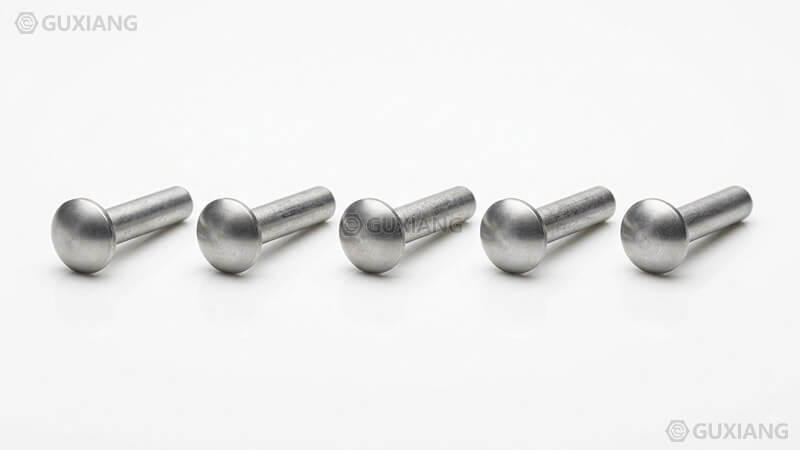
2024 is a copper-bearing (2xxx-series) heat-treatable alloy with the best strength-to-weight ratio among the common fastener grades below 7xxx. At 68 ksi tensile strength, it carries structural loads in aircraft skins, ribs, and stringers, most commonly in the form of solid rivets.
Strengths: high strength, good fatigue resistance, established aerospace pedigree.
Limitations: poor corrosion resistance — 2024 fasteners must be anodized or coated, and uncoated 2024 in a marine environment pits and intergranular-corrodes rapidly.
Typical use: aircraft structural rivets, high-strength non-corrosive applications.
5052 is a magnesium-bearing (5xxx-series) non-heat-treatable alloy. It offers the best combination of moderate strength, excellent corrosion resistance, and good cold-forming characteristics. Because it cannot be heat-treated, its strength is developed through strain hardening (H32 temper).
Strengths: excellent resistance to marine and industrial atmospheres, good formability, weldable.
Limitations: lower strength (33 ksi) — unsuitable for load-bearing structural joints.
Typical use: marine hardware, outdoor enclosures, sheet-metal assemblies, general-purpose aluminum fasteners.
5083 and 5086 are higher-magnesium 5xxx-series alloys specified where maximum seawater corrosion resistance is required alongside greater strength than 5052. 5083-H32 reaches 46 ksi tensile — the strongest of the marine-focused aluminum fastener grades — while 5086-H32 reaches 42 ksi. Both retain the outstanding seawater corrosion resistance of the 5xxx series.
Strengths: the best seawater corrosion resistance of any commonly available aluminum fastener grade, combined with useful strength.
Limitations: non-heat-treatable (strength fixed at mill), higher cost than 5052, limited availability in small fastener sizes.
Typical use: shipbuilding, offshore platforms, dock and harbor equipment, marine-grade bolting.
6061 is a magnesium-silicon (6xxx-series) heat-treatable alloy and the most widely available aluminum fastener grade in the world. It offers a balanced profile: 45 ksi tensile strength, good corrosion resistance, excellent machinability, and low cost relative to 2xxx and 7xxx alloys.
Strengths: best overall balance of strength, corrosion resistance, availability, and price; heat-treatable for property control.
Limitations: not the strongest, not the most corrosion-resistant — a compromise in both directions.
Typical use: general industrial fastening, electrical enclosures, consumer products, structural assemblies not requiring 7xxx strength.
7075 is a zinc-bearing (7xxx-series) heat-treatable alloy and the strongest aluminum fastener grade in common production at 83 ksi tensile strength — approaching the strength of mild steel.
Strengths: maximum strength of any aluminum fastener grade.
Limitations: poor corrosion resistance and a well-documented susceptibility to stress-corrosion cracking (SCC), particularly in the short-transverse grain direction and in the T6 temper. For SCC-sensitive applications, the overaged 7075-T73 temper is specified, trading roughly 12% tensile strength for dramatically improved SCC resistance.
Typical use: high-strength weight-critical applications — aerospace fittings, competition vehicles, precision equipment — where corrosion is managed through anodizing or where the service environment is benign.
2117 is a specialized aluminum-copper alloy developed specifically for solid rivets. Its defining property is that it can be driven in the solution-treated (T4) condition and then age-harden in place at room temperature — eliminating the need to solution-treat and re-heat-treat the rivet before installation. At 43 ksi tensile and 26 ksi shear, 2117-T4 rivets are the backbone of aluminum aircraft assembly.
| Grade | Tensile (ksi) | Corrosion Resistance | Heat-Treatable | Best For |
|---|---|---|---|---|
| 2024-T4 | 68 | Poor | Yes | Aerospace structural rivets |
| 5052-H32 | 33 | Excellent | No | Marine, general purpose |
| 5083-H32 | 46 | Excellent | No | Heavy marine, offshore |
| 5086-H32 | 42 | Excellent | No | Shipbuilding, harbor |
| 6061-T6 | 45 | Good | Yes | Universal industrial |
| 7075-T6 | 83 | Poor | Yes | Maximum strength |
| 2117-T4 | 43 | Moderate | Yes (self-aging) | Aircraft rivets |
Each application scenario below pairs the dominant requirement with the recommended grade and finish.
The dominant requirement is weight reduction with structural integrity. Aircraft use 2117-T4 and 2024-T4 solid rivets for skin and structure, and 7075-T6 or 2024-T4 bolts in higher-load fittings. All aerospace aluminum fasteners are anodized or conversion-coated per AMS specifications, and galvanic isolation from titanium and stainless fasteners is managed through wet-installation sealants and coatings.
| Requirement | Grade | Finish |
|---|---|---|
| Skin and stringer rivets | 2117-T4, 2024-T4 | Alodine / anodized |
| High-load fittings | 7075-T6, 2024-T4 | Anodized Type I/II |
| Corrosion-critical areas | 5052, 6061 | Chromate conversion |
The dominant requirement is mass reduction without sacrificing joint reliability. 6xxx-series fasteners (6061-T6) dominate interior, body, and battery-enclosure assemblies; 7xxx-series (7075-T6) appears in high-strength chassis and suspension applications where weight savings justify the cost. Aluminum fasteners are increasingly paired with aluminum body panels to eliminate galvanic couples entirely.
The dominant requirement is electrical conductivity, thermal conductivity, and non-magnetism. 6061-T6 fasteners — often with chromate conversion coating to preserve conductivity — secure bus bars, heat sinks, and RF shields. Non-magnetic behavior is mandatory near magnetic sensors, MRI equipment, and precision instruments, where steel fasteners would interfere with operation. For electrical enclosures that must resist moisture without conductive paths, the plastic fasteners guide covers the non-metallic alternative.
The dominant requirement is seawater corrosion resistance. 5083-H32 and 5086-H32 are the top grades for immersed or splash-zone service; 5052-H32 serves above-deck and general marine hardware. Aluminum-to-aluminum fastening is standard practice, and galvanic isolation is mandatory wherever stainless steel fasteners or hardware contact aluminum structure.
The dominant requirement is a balance of cost, corrosion resistance, and strength. 6061-T6 is the default grade; 5052-H32 is substituted for improved corrosion resistance at the cost of strength. Applications include machinery guards, food-processing equipment (where non-toxic, corrosion-resistant fasteners are required), and consumer products.
The decision process below converts the preceding data into an actionable sequence.
Determine the required tensile or shear strength for the joint. If the required strength exceeds roughly 55 ksi, only 7075-T6 (83 ksi) or 2024-T4 (68 ksi) are viable among aluminum grades — and both demand corrosion management. If the requirement is below 45 ksi, the lower-cost, higher-corrosion-resistance 6061-T6 and 5xxx-series grades open up.
| Environment | Recommended Grade | Required Finish |
|---|---|---|
| Dry indoor, benign | 6061-T6 | Bare or light anodize |
| Outdoor, industrial | 6061-T6, 5052-H32 | Anodized Type II |
| Marine, splash zone | 5083-H32, 5086-H32 | Bare (self-protective) |
| Marine, immersed | 5083-H32 | Bare or anodized |
| Dissimilar metal contact present | Any | Galvanic isolation required |
Identify every metal the aluminum fastener will contact. If the mating material is aluminum, no galvanic couple exists. If it is stainless steel, titanium, or copper, the aluminum fastener (or the aluminum substrate it passes through) is at risk — apply insulation, coating, or a compatible alternative. For aluminum substrates receiving non-aluminum fasteners, the aluminum substrate is the anode and must be protected.
Finalize the finish based on conductivity and corrosion needs, then balance against cost. Anodized finishes add thread-fit considerations; chromate conversion preserves conductivity. The complete selection is summarized below.
| Application | Recommended Grade | Finish | Key Reason |
|---|---|---|---|
| Aircraft structural rivet | 2117-T4, 2024-T4 | Alodine/anodized | Strength-to-weight + self-aging |
| Marine hardware | 5052-H32 | Bare | Best corrosion/cost balance |
| Offshore / immersed | 5083-H32 | Bare or anodized | Maximum seawater resistance |
| Shipbuilding | 5086-H32 | Bare | Seawater + weldability |
| General industrial | 6061-T6 | Bare / anodized | Best overall balance |
| Maximum strength, weight-critical | 7075-T6 (or T73 for SCC) | Anodized | Highest strength |
| Electrical continuity required | 6061-T6 | Chromate conversion | Conductive finish |
| Non-metallic, insulating joint | (see plastic guide) | — | Electrical isolation |
1. Are aluminum fasteners strong enough for structural use?
Only in specific cases. The strongest grade (7075-T6) reaches 83 ksi, below typical alloy steel (125 ksi). Aluminum fasteners work structurally in weight-critical or corrosion-critical applications, but a load-bearing steel joint cannot be swapped to aluminum without a redesign for the lower strength.
2. Can I use stainless steel fasteners in aluminum?
Mechanically yes, but galvanically risky. The stainless fastener is cathodic and accelerates corrosion of the aluminum around the joint. Use insulation, coatings, or a compatible fastener to prevent this bimetallic corrosion.
3. What is the difference between 7075 and 6061 aluminum fasteners?
7075-T6 is much stronger (83 ksi vs 45 ksi) but has poor corrosion resistance and is stress-corrosion-cracking sensitive. 6061-T6 is weaker but offers good corrosion resistance, lower cost, and wider availability — the general-purpose choice.
4. Do aluminum fasteners rust?
No, not in the iron-oxide sense. Aluminum forms a self-healing oxide film that resists corrosion in neutral environments (pH 4–9). It does corrode in strongly acidic or alkaline conditions, and can suffer galvanic corrosion when coupled to dissimilar metals.
5. Do aluminum fasteners need anodizing?
Not always. Anodizing improves corrosion and wear resistance but adds thickness and makes the surface non-conductive. Marine 5xxx grades often need no anodizing; 2024 and 7075 almost always do. Conductive applications should use chromate conversion instead.
6. Why are aircraft rivets made of aluminum?
Weight and strength-to-weight ratio. 2117-T4 rivets self-age after driving, eliminating heat treatment during assembly, while aluminum’s low density minimizes airframe weight — a dominant cost and efficiency driver in aviation.
7. What temperature can aluminum fasteners withstand?
Heat-treatable grades lose strength above 200–250°C and begin to overage. Most aluminum fasteners are rated for -40°C to 150°C service. For elevated temperatures, steel or stainless fasteners are required.
8. How do I prevent galvanic corrosion between aluminum fasteners and steel?
Break the electrical circuit with insulating washers or bushings, coat the more noble metal so it becomes sacrificial, avoid small-anode/large-cathode geometry, or select galvanized steel rather than stainless steel to reduce the potential difference.
9. What certifications are required for aluminum fasteners?
Require ASTM F468 or ISO 8839 mechanical property certification and a material certificate listing the alloy and temper (e.g., 6061-T6). Aerospace applications additionally require AMS material specifications (AMS 4027, AMS 4045) and traceability to the heat or lot.
10. Are aluminum fasteners cheaper than stainless steel?
Yes. Aluminum costs roughly half to one-third of stainless steel per part, and its low density means comparable or lower cost than carbon steel by volume. For corrosion-driven applications below 200°C, aluminum is typically the lower-cost option.
ASTM International. “ASTM F468/F468M — Standard Specification for Nonferrous Bolts, Hex Cap Screws, Socket Head Cap Screws, and Studs for General Use.” https://www.astm.org/f0468-06.html
ASTM International. “ASTM B211/B211M — Standard Specification for Aluminum and Aluminum-Alloy Rolled or Cold Finished Bar, Rod, and Wire.” https://www.astm.org/b0211-22.html
ASTM International. “ASTM G85 — Standard Practice for Modified Salt Spray (Fog) Testing.” https://www.astm.org/g0085-19.html
SAE International. “AMS 4027 — Aluminum Alloy, Bar, Rod, and Wire, 6061.”
SAE International. “AMS 4045 — Aluminum Alloy, Sheet and Plate, 7075.”
SAE International. “AMS 2470 — Anodic Treatment of Aluminum Alloys, Chromic Acid Process.”
International Organization for Standardization. “ISO 8839 — Mechanical Properties of Fasteners — Bolts, Screws, Studs and Nuts Made of Non-Ferrous Metals.” https://www.iso.org/standard/16551.html
International Organization for Standardization. “ISO 9227 — Corrosion Tests in Artificial Atmospheres — Salt Spray Tests.” https://www.iso.org/standard/56534.html
ASM International. ASM Handbook Volume 2: Properties and Selection: Nonferrous Alloys and Special-Purpose Materials. 10th Edition. (Print reference — mechanical and corrosion data for aluminum alloys.)
MatWeb Material Property Data. “Aluminum Alloy Property Data.” http://www.matweb.com/
Social Chat is free, download and try it now here!