EN
EN  ZH
ZH 

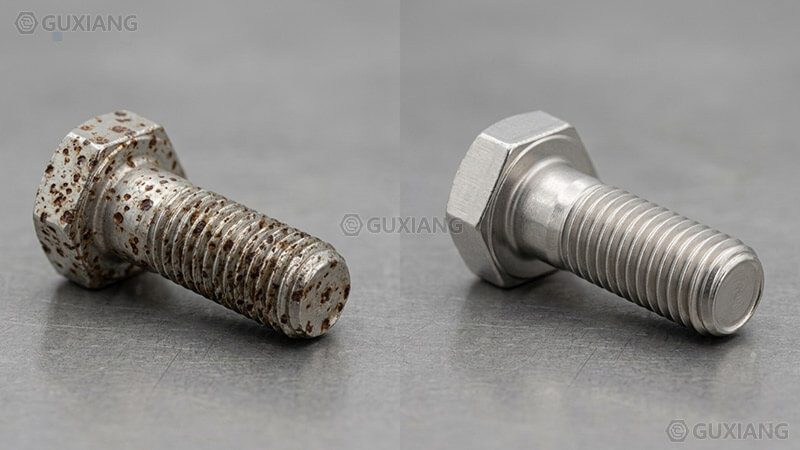
304 (A2) handles roughly 70% of fastener applications, yet in any chloride environment it pits within 18–24 months while 316 (A4) lasts a decade. This is an environment and risk decision, not a cost one. When you specify 304 vs 316 stainless steel fasteners, you answer one question: how much chloride and mechanical stress will this joint face over its life? Both 304 stainless steel fasteners and 316 stainless steel fasteners are austenitic, non magnetic when annealed, and share the same strength at equal property class. The real difference is corrosion behaviour, which decides whether your structure stands two years or twenty. Here is a side-by-side comparison you can paste straight into a material specification, covering chemistry, PREN, strength data, the true cost premium, and a selection matrix by environment. For the wider picture on stainless steel grades, start with our material grades overview.
This table packs the facts an engineer needs on a spec sheet. If your environment contains chlorides, skip to 316. If it is dry and controlled, 304 is the efficient default.
| Attribute | 304 (A2) | 316 (A4) |
|---|---|---|
| EN / UNS | 1.4301 / S30400 | 1.4401 / S31600 |
| Chromium | 17.5–19.5% | 16.5–18.5% |
| Nickel | 8.0–10.5% | 10.0–13.0% |
| Molybdenum | ≤0.5% (effectively 0) | 2.0–3.0% |
| PREN | ~18–20 | ~23–28 |
| Tensile, class 70 | 700 MPa | 700 MPa |
| Typical cost | baseline | +25–35% |
| Best for | indoor, dry, mild | coastal, marine, chemical |
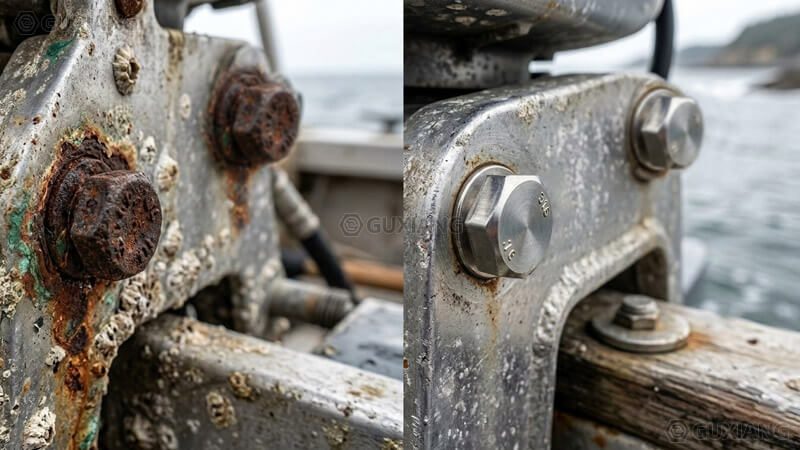
Back in 2019, a coastal county specified A2-70 hex bolts for a timber boardwalk railing at a salt marsh edge, roughly 4,000 fasteners, and saved about 30% on material against a 316 quote. Within 22 months, 38% of the bolts showed through wall pitting and two railing posts had loosened enough to fail inspection. The corrective work, a full reinstall with A4-70 plus six weeks of partial boardwalk closure, cost 3.4 times the original 304 saving. The grade was never the problem. The specification was.
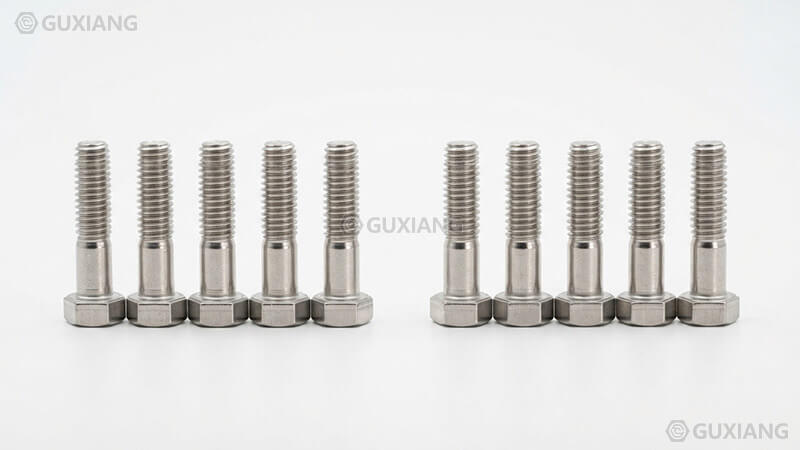
Both grades are austenitic 18-8 steels that share crystal structure and strength. The split is a single alloying element, and that element decides where you can safely use the fastener.
304 stainless steel fasteners use the classic 18-8 mix of about 18% chromium and 8% nickel, carbon capped at 0.08%. Under ISO 3506 they carry the A2 grade in classes A2-50, A2-70, and A2-80. The AISI number 304 and the fastener grade A2 are the same alloy; the dash number is the strength class. 304 is the default for indoor equipment, architectural trim, and food contact where the atmosphere stays dry or mildly humid, and its low cost and easy forming explain why it covers most fastener demand.
316 stainless steel fasteners take the 18-8 base and add 2–3% molybdenum, EN 1.4401. Under ISO 3506 the grade is A4 in classes A4-50, A4-70, and A4-80. That molybdenum is the whole story: it stabilises the passive chromium oxide layer and sharply improves pitting and crevice resistance in chloride bearing environments. This is why 316 earns the “marine grade” label and is the standard choice for coastal structures, shipbuilding, offshore platforms, and process plants using chlorinated cleaning or brines. The trade off is a modest material premium and lower machinability, both acceptable given the service life it delivers.
Plenty of buyers trip over the naming system, so here is the crosswalk in one place.
| AISI (USA) | EN (Europe) | ISO fastener grade | Typical property classes |
|---|---|---|---|
| 304 | 1.4301 | A2 | A2-50, A2-70, A2-80 |
| 316 | 1.4401 | A4 | A4-50, A4-70, A4-80 |
Composition ranges from ISO 3506 and ASTM for the two fastener grades appear in the table below. The only structural difference is molybdenum, present at roughly zero in 304 and at 2–3% in 316.
| Element (max unless range) | 304 (A2, 1.4301) | 316 (A4, 1.4401) |
|---|---|---|
| Carbon, C | 0.08% | 0.08% |
| Chromium, Cr | 17.5–19.5% | 16.5–18.5% |
| Nickel, Ni | 8.0–10.5% | 10.0–13.0% |
| Molybdenum, Mo | ≤0.5% | 2.0–3.0% |
| Manganese, Mn | 2.0% | 2.0% |
| Silicon, Si | 1.0% | 1.0% |
| Nitrogen, N | 0.10% | 0.10% |
Molybdenum matters because stainless resists corrosion through a thin passive chromium oxide film. Chloride ions attack that film at weak points and trigger localised pitting. Molybdenum slows the chloride attack and raises the threshold where pitting begins, which is the whole reason 316 outlasts 304 near the sea. The slightly lower chromium in 316 is more than compensated by molybdenum, as the PREN calculation below shows.
This is the section that breaks the most expensive myth in fastener buying. Strength in stainless fasteners comes from the property class, not the alloy. At the same class, A2 and A4 are mechanically identical.
| Property class | Min tensile Rm (MPa) | Min yield Rp0.2 (MPa) | Applies to A2 and A4 |
|---|---|---|---|
| -50 | 500 | 210 | A2-50, A4-50 |
| -70 | 700 | 450 | A2-70, A4-70 |
| -80 | 800 | 600 | A2-80, A4-80 |
When you compare A2 vs A4 stainless at the same dash number, the tensile and yield values match exactly. A2-70 and A4-70 both deliver 700 MPa tensile and 450 MPa yield. A2-80 and A4-80 both deliver 800 MPa tensile and 600 MPa yield. The -80 classes reach higher strength through cold working, which also raises magnetism, a point we address in the myths section. Specifying 316 does not make a joint stronger. It makes it more corrosion resistant. If your joint needs more strength, you move up the property class (from -70 to -80) or you change the fastener size, not the alloy.
When buyers ask about 304 vs 316 corrosion resistance, they are really asking one thing: at what chloride level does 304 fail? The honest answer is sooner than most expect, and the PREN number lets you quantify it.
PREN rolls the corrosion relevant elements into a single score using the formula:
PREN = %Cr + 3.3×%Mo + 16×%N
Chromium counts once, molybdenum counts 3.3 times because of its outsized effect on pitting, and nitrogen counts 16 times. Plug in typical values and 304 lands at about 18–20, while 316 lands at about 23–28. The higher the PREN, the better the resistance to initiation of pitting. A jump from 20 to 26 is the difference between a fastener that pits in two seasons and one that runs for a decade in the same seawater splash zone.
304 begins to pit in chloride at roughly 200 ppm under warm conditions, and the threshold drops with temperature. Real coastal air is never a clean lab value, because salt aerosol and crevices under bolt heads concentrate chlorides well above ambient. ISO 9223 rates corrosivity from C1 (dry indoor) to CX (offshore). For the grade system behind these ratings, see our material grades overview. 304 is comfortable through C3, but from C4 (coastal) upward it pits within 18–24 months, matching the boardwalk failure in our opening example. 316, PREN near 26, holds through C5 and CX for the design life.
There is a limit even on 316. In hot chloride service above roughly 60°C, austenitic stainless can fail by stress corrosion cracking (SCC) even at 316. A Wisconsin dairy plant paid for that assumption, running a clean in place system with 316 (A4) studs at 75°C in chlorinated caustic and assuming marine grade meant immune. After 14 months, nine studs failed by transgranular SCC and the line stopped for 52 hours. Above about 60°C in hot chlorinated service, the right move is duplex 2205 (ISO A5), not more 316. Match the alloy to the temperature as well as the chemistry.
Most specifications get decided at the cost question, so let us put real numbers on the table for 304 vs 316 cost rather than vague warnings.
For 316 over 304, the material and conversion premium runs about 15–40% across fastener forms, with most standard bolts, nuts, and screws in the 25–35% band. Larger or cold worked items sit higher; high volume parts sit lower. Molybdenum is pricier and more volatile than chromium or nickel, so the gap widens when molybdenum spikes. A typical M10 A2-70 versus A4-70 hex bolt costs roughly a third more, which is cheap against the cost of a failure.
That premium is a rounding error next to replacement labour, access equipment, and production downtime. On the boardwalk example, the 30% first cost saving became a 340% net loss after one replacement cycle. In marine and coastal service, the 316 premium pays back at the first scheduled maintenance that 304 would have missed. In dry indoor or controlled environments, where 304 will never see chlorides, paying for 316 is pure waste, and that is where carbon steel fasteners or 304 both beat an over specified 316 on value.
Most specification errors happen at the standards boundary, where a buyer names a grade the supplier interprets differently. Use the crosswalk below so everyone means the same metal.
| ISO 3506-1:2020 | ASTM F593 | ASTM A193 | Property description |
|---|---|---|---|
| A2 (304) | Group 1 (304) | B8 (304) | general purpose austenitic |
| A4 (316) | Group 2 (316) | B8M (316) | molybdenum marine grade |
| A2-70 / A4-70 | F593 304 / 316 Condition A | B8 / B8M Class 1 | 700 MPa, annealed |
| A2-80 / A4-80 | F593 304 / 316 Condition CW | B8 / B8M Class 2 | 800 MPa, cold worked |
ISO 3506-1:2020 is the global reference for stainless fastener properties and grades, covering A2 and A4 across the -50, -70, and -80 classes. ASTM F593 governs stainless bolts, hex cap screws, and studs in the United States and groups 304 and 316 as Groups 1 and 2. ASTM A193 B8 and B8M cover stainless bolting for high temperature and high pressure service such as pressure vessels, valves, and flanges, where the class (1 annealed, 2 strain hardened) sets strength. Reference the sources directly: the ISO 3506 standard page, the ASTM F593 specification, and the ASTM A193 specification. For the alloy family background, the stainless steel overview on Wikipedia is a useful primer.
Use this matrix as a first pass spec. Find your environment on the left, read the recommended grade and the reason on the right, then confirm against the standards crosswalk above.
| Environment | Recommended grade | Reason |
|---|---|---|
| Indoor dry or clean (C1) | 304 (A2-70) | no chloride, best value |
| Mild outdoor, low pollution (C2–C3) | 304 (A2-70) | low corrosion risk |
| Coastal, urban polluted (C4) | 316 (A4-70) | chloride pitting threat |
| Marine, offshore (C5 / CX) | 316 (A4-70 or -80) | high chloride, long life |
| Chemical process, chlorides | 316 (A4) or higher | depends on exact media |
| Food, pharma, washdown | 316 (A4) | chlorinated cleaning, hygiene |
| High load structural | A2-80 / A4-80 | property class drives strength |
But the grade is only half the specification. Pair it with the correct screw head types for your assembly and driving method, and review Phillips vs Torx vs flat head drives if installation torque or cam out is a concern. Where weight or a different corrosion profile matters, aluminum fasteners suit non structural, low load joints. For aggressive acids outside the 316 envelope, step up to a higher alloy rather than push 316 past its limit.
A few beliefs cause repeated, expensive failures. Clear them up before you write the next bill of materials.
316 is stronger than 304. False at equal property class. A2-70 and A4-70 share the same 700 MPa tensile. Strength comes from the class, not the alloy.
Stainless steel never rusts. False. Stainless resists rust through its passive film. Break that film in a tight crevice with trapped chlorides and even 316 will pit. Design for drainage and avoid crevices.
316 is a universal corrosion cure. False. A refinery paid for that assumption: an engineer specified A4 for all external bolting, assuming marine grade meant universal protection. In a unit with sulfuric acid mist at 40°C, the 316 bolts suffered uniform corrosion where a higher alloy such as 904L or alloy 20 was required. The result was a three day unplanned shutdown. 316 is the chloride answer, not the chemical answer.
Magnetism means fake stainless. False. Cold worked A2-80 and A4-80 develop measurable magnetism from deformation, not from being counterfeit. Use a PMI gun or MTC, not a fridge magnet, to verify grade.
You can never mix 304 and 316. False. Both are austenitic with similar electrochemical potential, so mixing them creates no harmful galvanic couple. The only downside is cosmetic: if one grade stains, the contrast shows. For critical chloride service, standardise on 316 for a uniform look.
A: For any chloride exposure, yes. The 25–35% material premium for 316 (A4) is small against the cost of premature failure, replacement labour, and downtime. In dry or controlled indoor environments, 304 (A2) is the better value and 316 is unnecessary.
A: In mild, non coastal outdoor air rated ISO 9223 C2 to C3, 304 performs well for years. Near the coast or in any chloride rich environment, 304 pits within 18–24 months. Specify 316 (A4) for coastal, marine, and de icing salt exposure.
A: A2 is the ISO designation for 304 stainless, A4 for 316. The -70 denotes a property class with 700 MPa minimum tensile strength and 450 MPa yield. At the same class, A2-70 and A4-70 have identical strength; only the alloy and corrosion resistance differ.
A: No. At equal property class, for example A2-70 versus A4-70, the tensile and yield strengths are the same. 316 is not stronger than 304; it is more corrosion resistant because of its 2–3% molybdenum. Strength comes from the property class, not the grade.
A: Yes. Both are austenitic stainless steels with similar electrochemical potentials, so mixing them does not create a harmful galvanic couple. The practical risk is cosmetic: if one grade corrodes, the difference becomes visible. For critical chloride service, use 316 throughout.
Stating the rule is simple, misapplying it is easy. Chlorides point to 316; dry or controlled conditions point to 304. Strength never decides the grade, because A2 and A4 match at every property class, and only the molybdenum in 316 buys the chloride resistance that turns a two year failure into a twenty year service life. Write the standard on the drawing, map your environment to the decision matrix, and verify every batch with a material certificate. For the full context on fastener material grades, and how these two sit among carbon, alloy, and aluminum fasteners, use our material guides, and compare value against carbon steel fasteners where chlorides are absent.
Social Chat is free, download and try it now here!