ZH
ZH  EN
EN 

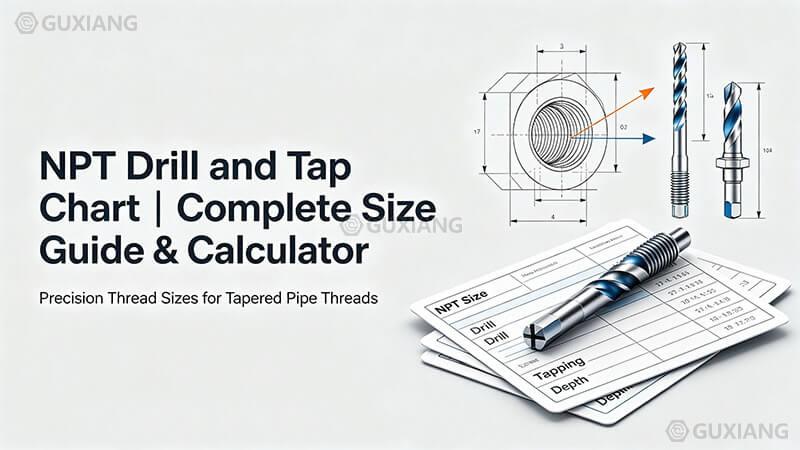
Quick Reference: NPT (National Pipe Taper) threads follow ANSI B1.20.1 with a 60° thread angle and 1:16 taper (3/4" per foot). Select any NPT size below to instantly find the correct tap drill size, threads per inch, and metric equivalent.
Selecting the correct drill size for NPT threads is critical for achieving a proper pressure seal and avoiding costly rework in pipe fitting, hydraulic systems, and fluid power applications. Whether you need the 1/4 NPT drill size, the 1/2 NPT drill size, or dimensions for larger fittings like 2" NPT or 4" NPT, this chart gives you the exact match every time.
Tap Drill
—
Threads / Inch
—
Metric Drill
—
This comprehensive chart covers all standard NPT sizes from 1/16" to 12", including the tap drill size, decimal equivalent, millimeter equivalent, threads per inch, and pipe outside diameter. Use the filter buttons to jump to the range you need.
| NPT Size | TPI | Tap Drill Size | Decimal (in) | Metric (mm) | Pipe OD (in) |
|---|
For machining and inspection purposes, the table below provides the critical thread diameters at the hand-tight plane. All values per ANSI B1.20.1.
| NPT Size | TPI | Major Dia. (in) | Pitch Dia. (in) | Minor Dia. (in) | Taper |
|---|
The tap drill creates the pilot hole before the NPT tap cuts the internal taper thread. The correct drill size should produce a minor diameter close to the standard NPT minor diameter for that size. If the drill is too small, the tap will be overworked and may break. If too large, the threads will be shallow and the joint may leak under pressure.
Step 1: Identify the NPT size of your fitting (e.g., 1/4" NPT).
Step 2: Look up the tap drill size in the chart above (for 1/4" NPT: 7/16" drill, 0.438" decimal).
Step 3: Select the matching drill bit. If fractional sizes are not available, use the decimal equivalent to find the nearest letter or metric drill.
Step 4: Drill the pilot hole, then tap with the corresponding NPT tap. Verify thread engagement with the fitting hand-tight.
For most NPT applications, 75% thread engagement provides an optimal balance between joint strength and ease of assembly. The tap drill sizes in this chart are calculated for approximately 75% engagement. For high-pressure hydraulic systems, some engineers prefer 80–85% engagement, which requires a slightly smaller drill.
Important: NPT threads are tapered (1:16 ratio, or 3/4" per foot). The minor diameter varies along the length of the thread. The drill sizes listed produce the correct minor diameter at the hand-tight plane. Always use a taper pipe tap (not a straight NPT tap) for through-hole applications, and verify fit with a thread gauge.
When working with international fittings, you may encounter BSPT (British Standard Pipe Taper) threads alongside NPT. While both are tapered pipe threads, they are not interchangeable.
The key differences are: NPT uses a 60° thread angle (ANSI B1.20.1, American standard), while BSPT uses a 55° thread angle (ISO 7-1, British/international standard). The thread forms have different flank angles and pitches per inch. Forcing an NPT fitting into a BSPT port (or vice versa) will cross-thread and damage both components. Always verify the thread standard before assembly — look for markings on the fitting or consult the equipment manual.
For 1/4" NPT (18 TPI), use a 7/16" drill bit (0.438" decimal / 11.1 mm). This produces the correct minor diameter for 75% thread engagement at the hand-tight plane.
For 1/2" NPT (14 TPI), use a 23/32" drill bit (0.719" decimal / 18.3 mm). The 1/2" NPT has a pipe OD of 1.050" and 14 threads per inch.
NPT (National Pipe Taper) has tapered threads that create a pressure seal through thread interference. NPS (National Pipe Straight) has parallel threads and requires an O-ring or gasket for sealing. They share the same thread angle (60°) and pitch, but the taper is the critical difference — never mix NPT and NPS fittings in pressure applications.
No. NPT (60° thread angle, ANSI standard) and BSPT (55° thread angle, ISO standard) have incompatible thread forms. Forcing them together will cross-thread and damage the connection. Always match the thread standard exactly.
TPI stands for Threads Per Inch — the number of thread peaks in one linear inch. For example, 1/4" NPT has 18 TPI (pitch = 1/18 = 0.0556"), while 1/2" NPT has 14 TPI (pitch = 1/14 = 0.0714"). Larger NPT sizes generally have fewer threads per inch.
All NPT threads have a 1:16 taper (3/4" per foot), meaning the diameter decreases by 3/4" over a 12-inch length. This taper is what creates the pressure seal when male and female threads are tightened together. The taper applies to both the thread diameter and the pitch diameter.
Yes, in most cases. While the taper creates mechanical interference, NPT threads typically require PTFE tape, pipe dope, or anaerobic sealant to achieve a leak-free seal in pressure applications. The only exception is when using NPT fittings with integrated O-ring seals (SAE O-ring boss), which seal on the O-ring, not the threads.
The pilot hole should be drilled at least 1–2 threads deeper than the required thread engagement depth. For standard pipe fittings, a minimum of 6 full threads of engagement is typical. Use the drill depth formula: drill depth = thread engagement length + 2× thread pitch. This ensures the tap can start cleanly without bottoming out.
NPT fittings are generally rated for pressures up to 10,000 PSI depending on size, material, and temperature. Smaller sizes (1/4"–1/2") typically handle higher pressures. For high-pressure hydraulic systems, always verify the fitting manufacturer's pressure rating table and ensure proper thread engagement and sealant application. Material selection also affects the pressure capability.
Reusing NPT fittings is generally not recommended for pressure applications. The tapered threads deform during initial assembly to create the seal, and re-tightening can compromise this seal. For non-critical, low-pressure applications, reuse may be acceptable if the threads show no visible damage. Always inspect threads before reinstallation and apply fresh sealant.
Social Chat is free, download and try it now here!