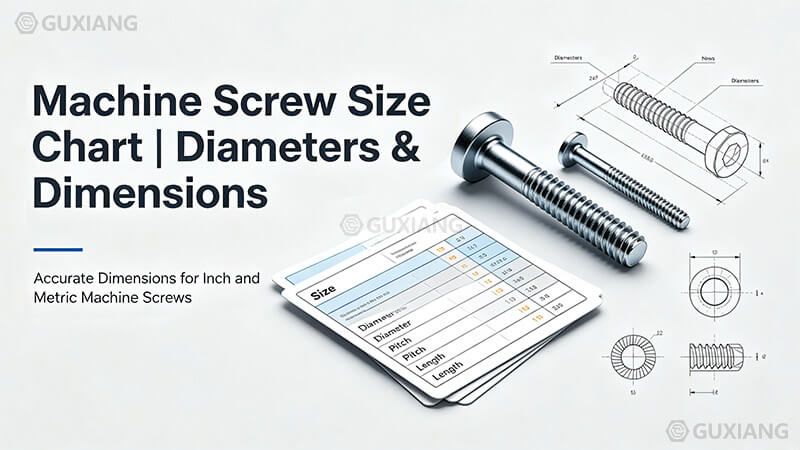
机械螺丝尺寸表|直径和尺寸
此综合机器螺钉尺寸表提供了美国机器螺钉从 #0 到 1/2 英寸的十进制直径、公制当量、最接近的分数尺寸和标准螺距。使用下面的交互式查找工具快速查找任何螺钉尺寸的完整尺寸数据,或浏览工程规格的完整参考表。
机器螺丝尺寸查找工具
从下拉列表中选择螺钉尺寸,查看其完整的尺寸规格,包括小数直径、公制当量、最接近的分数和标准螺距。
快速尺寸查找
整机螺杆直径表
The table below covers all standard US machine screw sizes from #0 to 1/2 inch. Numbered sizes (#0–#12) use the gauge system where the diameter equals 0.060" + (gauge number × 0.013"). Fractional sizes (1/4" and above) use direct inch measurements. Each entry includes the decimal diameter, metric equivalent, nearest standard fraction, and threads per inch (TPI) for both coarse (UNC) and fine (UNF) thread series.
| 尺寸 | 十进制直径(在) | 公制(毫米) | 最接近的分数 | TPI 粗粒 (UNC) | TPI 精细 (UNF) | 粗节距(毫米) | 细螺距(毫米) |
|---|---|---|---|---|---|---|---|
| 编号尺寸(仪表系统) | |||||||
| #0 | 0.0600 | 1.52 | 1/16" | 80 | — | 0.318 | — |
| #1 | 0.0730 | 1.85 | 5/64" | 64 | 72 | 0.397 | 0.353 |
| #2 | 0.0860 | 2.18 | 3/32" | 56 | 64 | 0.454 | 0.397 |
| #3 | 0.0990 | 2.51 | 7/64" | 48 | 56 | 0.529 | 0.454 |
| #4 | 0.1120 | 2.84 | 7/64" | 40 | 48 | 0.635 | 0.529 |
| #5 | 0.1250 | 3.18 | 1/8" | 40 | 44 | 0.635 | 0.577 |
| #6 | 0.1380 | 3.51 | 9/64" | 32 | 40 | 0.794 | 0.635 |
| #8 | 0.1640 | 4.17 | 5/32" | 32 | 36 | 0.794 | 0.706 |
| #10 | 0.1900年 | 4.83 | 3/16" | 24 | 32 | 1.058 | 0.794 |
| #12 | 0.2160 | 5.49 | 7/32" | 24 | 28 | 1.058 | 0.907 |
| 分数尺寸(直接英制测量) | |||||||
| 1/4" | 0.2500 | 6.35 | 1/4" | 20 | 28 | 1.270 | 0.907 |
| 5/16" | 0.3125 | 7.94 | 5/16" | 18 | 24 | 1.411 | 1.058 |
| 3/8" | 0.3750 | 9.53 | 3/8" | 16 | 24 | 1.588 | 1.058 |
| 7/16" | 0.4375 | 11.11 | 7/16" | 14 | 20 | 1.814 | 1.270 |
| 1/2" | 0.5000 | 12.70 | 1/2" | 13 | 20 | 1.954 | 1.270 |
了解机器螺丝尺寸
根据直径范围,机器螺钉尺寸遵循两种不同的命名约定。了解这两个系统对于正确选择紧固件以及英制和公制标准之间的交叉引用至关重要。
编号尺寸 (#0–#12):规格系统
编号的机器螺钉尺寸使用量规系统,其中标称直径(以英寸为单位)通过以下公式计算: Diameter = 0.060" + (gauge number × 0.013")。例如,#10 螺钉的标称直径为 0.060 + (10 × 0.013) = 0.190 英寸。该系统起源于用于线径测量的伯明翰线规(Stubs' Wire Gauge)。一般紧固应用中最常用的编号尺寸是#4、#6、#8、#10 和#12。
Fractional Sizes (1/4"–1/2")
1/4 英寸及以上尺寸直接由其分数英寸直径指定。这些与标准统一粗牙螺纹 (UNC) 和统一细牙螺纹 (UNF) 螺栓尺寸重叠。在此范围内,机器螺钉与 ASME B1.1 中定义的有头螺钉和六角螺栓具有相同的螺纹规格。
常见机器螺丝头类型和尺寸
机器螺钉有多种头部配置可供选择,每种配置都适合不同的安装和美观要求。下表显示了标准螺钉尺寸中最常见类型的典型头部尺寸。
盘头
低调的圆形顶部,带有平坦的支撑表面。最常见于钣金和电气应用。头部直径约为 1.9× 螺杆标称直径。
圆头(圆头)
高圆顶头适用于装饰或高夹应用。头部高度比盘头高,提供更深的驱动凹槽和更多的材料来抵抗凸轮脱离。
平头(沉头)
82° 夹角,适合齐平安装。头部直径约为标称直径的 1.9 倍。当安装后需要光滑、齐平的表面时,这是理想的选择。
六角头
用于扳手驱动的六面头。在机器螺钉头中提供最高的扭矩能力。常见于结构和重型机械组件。
钮扣头(插座)
带六角套筒驱动的薄型圆头。具有干净的外观和良好的扭矩能力。广泛用于机械防护罩和外壳。
桁架头
宽而低轮廓的头部具有更大的承载表面。用于需要考虑拉穿的金属板材应用。头部直径约为标称直径的 2.3 倍。
机械螺丝标准参考
机器螺钉尺寸和螺纹规格受多个关键标准的约束。了解哪个标准适用于您的应用可确保适当的配合和性能。
ASME B1.1
统一螺纹标准 — 定义了美国使用的 UNC、UNF 和 UNEF 螺纹系列的基本几何形状。涵盖中径公差、螺纹等级(外螺纹 1A/2A/3A,内螺纹 1B/2B/3B)。
ASME B18.6.3
机械螺钉 — 涵盖各种头部类型的机器螺钉的尺寸要求,包括一字螺钉、十字螺钉和组合驱动类型,尺寸为 #0 至 1 英寸。
ASME B18.3
Socket Head Cap Screws — defines dimensions for socket head, socket button head, and socket flat head cap screws. Applies to sizes 1/4" and above but includes smaller metric equivalents.
ISO 12474 / ISO 7045
国际公制当量 — ISO 7045(盘头)、ISO 7046(沉头)、ISO 7048(筒形头)。这些为可比较的英制机器螺钉尺寸提供了公制交叉参考。
如何选择合适的机器螺丝尺寸
选择清单
- 确定间隙孔径 — For a close fit, use the nominal screw diameter + 0.005"–0.010". For a free fit, add 0.015"–0.020". Refer to ANSI B27.5 for standard clearance hole tables.
- 识别螺纹系列 — UNC(粗)是通用紧固的默认值; UNF(细)提供更好的抗振性和更精细的张力调节。在薄材料中,细螺纹啮合更可靠。
- 计算最小螺纹啮合量 — 对于钢对钢,最小啮合等于 1× 公称直径。对于铝或黄铜螺纹孔,增加至 1.5×–2× 公称直径以补偿较低的剪切强度。
- 检查头类型兼容性 — 用于一般用途的盘头、用于齐平表面的平头、用于需要六角扳手驱动的有限空间的套筒头、用于存在拉穿风险的薄金属板的桁架头。
- 验证材料和电镀 — 标准机械螺钉通常为渗碳钢(自攻金属)或不锈钢(耐腐蚀)。镀锌提供基本保护;钝化不锈钢是户外或海洋环境的首选。
机械螺钉与螺栓:主要区别
While often used interchangeably in casual conversation, machine screws and bolts have distinct definitions in fastener terminology. Machine screws are designed to thread directly into a tapped hole or nut, typically have smaller diameters (#0 through about 1/2"), and are tightened by turning the screw head. Bolts are intended for use with a nut, generally have larger diameters (1/4" and above), and are tightened by holding the bolt head stationary while turning the nut. The boundary between the two is not always sharp — a 1/4"-20 fastener can be classified as either a machine screw or a hex bolt depending on its length and intended installation method.