





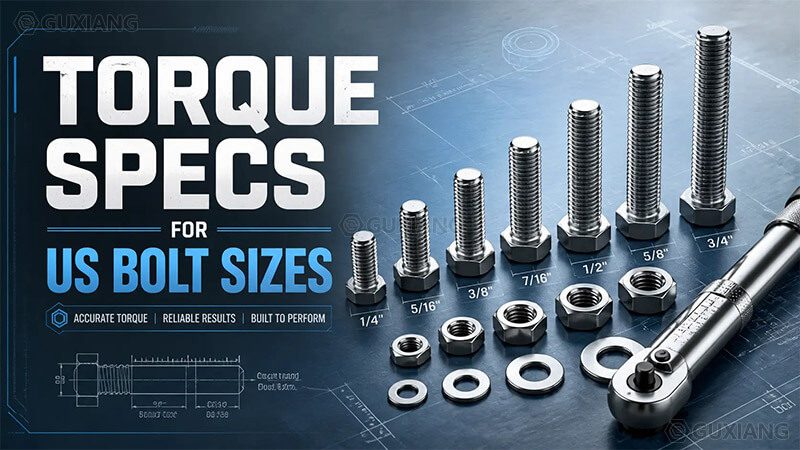
Every bolt size has a recommended torque range based on its diameter, thread pitch, and strength grade. Proper torque ensures consistent clamp force, prevents joint failure, and avoids thread damage. This chart provides baseline torque guidelines for common US bolt sizes from #1 to 2 inch across seven material grades, including both coarse (UNC) and fine (UNF) thread specifications. All values are in lb-ft for dry or slightly lubricated conditions.
Bolt Torque Lookup Tool
Select a bolt size to view recommended torque values across all material grades and thread types.
Quick Torque Lookup
Complete Bolt Torque Spec Chart
All torque values in lb-ft for dry, slightly lubricated bolts. Sizes #1–#10 are machine screw sizes; fractional sizes (1/4"–2") are standard bolt sizes. "Coarse" = UNC thread; "Fine" = UNF thread. A dash (—) indicates torque data not applicable for that size/grade combination.
| 尺寸 | 二年级 | 五年级 | 8年级 | 18-8 S/S | Bronze | 黄铜 | A2/A4 S/S | |||||||
|---|---|---|---|---|---|---|---|---|---|---|---|---|---|---|
| 粗糙 | Fine | 粗糙 | Fine | 粗糙 | Fine | 粗糙 | Fine | 粗糙 | Fine | 粗糙 | Fine | 粗糙 | Fine | |
| Machine Screw Sizes (#1 – #10) | ||||||||||||||
| #1 | — | — | — | — | — | — | 0.3 | 0.2 | 0.2 | 0.3 | — | — | — | — |
| #2 | — | — | — | — | — | — | 0.6 | 0.5 | 0.4 | 0.6 | — | — | — | — |
| #3 | — | — | — | — | — | — | 1.1 | 0.9 | 0.8 | 1.0 | — | — | — | — |
| #4 | — | — | — | — | — | — | 5.2 | 4.8 | 4.3 | 5.0 | — | — | — | — |
| #5 | — | — | — | — | — | — | 9.5 | 8.9 | 7.9 | 9.2 | — | — | — | — |
| #6 | — | — | — | — | — | — | 14.5 | 13.5 | 12.0 | 14.0 | — | — | — | — |
| #8 | — | — | — | — | — | — | 19.8 | 18.4 | 16.2 | 19.0 | — | — | — | — |
| #10 | — | — | — | — | — | — | 22.8 | 31.7 | 21.2 | 29.3 | 18.6 | 25.9 | 22.0 | 30.5 |
| Standard Bolt Sizes (1/4" – 2") | ||||||||||||||
| 1/4" | 4 | 4.7 | 6.3 | 7.3 | 9 | 10 | 6.3 | 7.8 | 5.7 | 7.3 | 5.1 | 6.4 | 6.5 | 8.0 |
| 5/16" | 8 | 9 | 13 | 14 | 18 | 20 | 11 | 11.8 | 10.3 | 10.9 | 8.9 | 9.7 | 11.5 | 12.2 |
| 3/8" | 15 | 17 | 23 | 26 | 33 | 37 | 20 | 22 | 18 | 20 | 16 | 18 | 21 | 23 |
| 7/16" | 24 | 27 | 37 | 41 | 52 | 58 | 31 | 33 | 29 | 31 | 26 | 27 | 32 | 34 |
| 1/2" | 37 | 41 | 57 | 64 | 80 | 90 | 43 | 45 | 40 | 42 | 35 | 37 | 44 | 46 |
| 9/16" | 53 | 59 | 82 | 91 | 115 | 129 | 57 | 63 | 53 | 58 | 47 | 51 | 59 | 65 |
| 5/8" | 73 | 83 | 112 | 128 | 159 | 180 | 93 | 104 | 86 | 96 | 76 | 85 | 96 | 107 |
| 3/4" | 125 | 138 | 200 | 223 | 282 | 315 | 128 | 124 | 104 | 102 | 118 | 115 | 132 | 128 |
| 7/8" | 129 | 144 | 322 | 355 | 454 | 501 | 194 | 193 | 178 | 178 | 159 | 158 | 200 | 199 |
| 1" | 188 | 210 | 483 | 541 | 682 | 764 | 287 | 289 | 265 | 240 | 235 | 212 | 296 | 298 |
| 1-1/8" | 258 | 288 | 660 | 738 | 932 | 1043 | 394 | 396 | 363 | 329 | 322 | 290 | 406 | 408 |
| 1-1/4" | 340 | 380 | 870 | 974 | 1229 | 1376 | 520 | 523 | 479 | 434 | 425 | 383 | 536 | 539 |
| 1-3/8" | 435 | 486 | 1113 | 1246 | 1572 | 1760 | 665 | 669 | 613 | 555 | 543 | 490 | 686 | 690 |
| 1-1/2" | 543 | 607 | 1389 | 1555 | 1962 | 2196 | 830 | 835 | 765 | 693 | 678 | 612 | 856 | 861 |
| 1-3/4" | 840 | 939 | 2149 | 2406 | 3036 | 3399 | 1285 | 1292 | 1184 | 1073 | 1050 | 948 | 1325 | 1332 |
| 2" | 1210 | 1353 | 3095 | 3465 | 4371 | 4894 | 1850 | 1860 | 1705 | 1545 | 1512 | 1364 | 1907 | 1918 |
Bolt Grade Reference
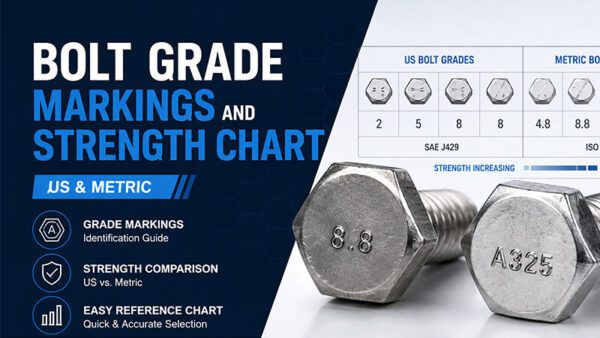
Understanding bolt grades is essential for selecting the correct torque specification. Each grade has distinct mechanical properties that determine how much preload the fastener can safely handle.
二年级
Low/medium carbon steel. Tensile strength: 57,000 psi (up to 3/8"), 55,000 psi (over 3/8"). General-purpose, non-critical applications. Identified by no head markings.
五年级
Medium carbon steel, quenched & tempered. Tensile strength: 120,000 psi (up to 3/4"), 105,000 psi (over 3/4"). Most common for automotive and machinery. Identified by 3 radial lines on head.
8年级
Alloy steel, quenched & tempered. Tensile strength: 150,000 psi (up to 1-1/2"), 130,000 psi (over 1-1/2"). High-strength structural applications. Identified by 6 radial lines on head.
18-8 / 304 Stainless
Austenitic stainless steel (AISI 304). Tensile strength: 85,000 psi. Good corrosion resistance for indoor and mild outdoor environments. Prone to galling without lubrication. No grade lines on head.
Lubrication Torque Adjustment Factors
How Lubrication Changes Torque
The torque values in the chart above are for dry or slightly lubricated conditions (friction coefficient approximately 0.14). When you apply lubricant, friction decreases and more of the applied torque converts to clamp force. Using the dry torque value on a lubricated bolt can cause over-tightening, yield, or thread failure.
| 状况 | Friction Coefficient | Torque Adjustment |
|---|---|---|
| Dry (as-charted) | approximately 0.14 | No adjustment — use chart values directly |
| Light oil / WD-40 | approximately 0.10 | Reduce torque by 15% |
| Motor oil / gear oil | approximately 0.08 | Reduce torque by 25% |
| Anti-seize compound | approximately 0.06 | Reduce torque by 30% |
| Molybdenum disulfide (MoS2) | approximately 0.05 | Reduce torque by 35% |
For critical joints, always measure preload directly with a load-inducing washer or strain gauge rather than relying on torque alone.
Tightening Best Practices
Multi-Bolt Joint Tightening Procedure
- Clean all threads — Remove dirt, rust, and old threadlocker. Damaged threads should be repaired with a tap or die before assembly.
- Lubricate consistently — Apply the same lubricant to all bolts in the joint. Mixed lubrication conditions cause uneven clamp load distribution.
- First pass: 30% of final torque — Tighten in a star or cross pattern to seat all components evenly and prevent warping.
- Second pass: 60% of final torque — Continue the star pattern. This further equalizes clamp load across the joint.
- Third pass: 100% of final torque — Complete the star pattern at full specification torque.
- Final circular pass — Go around the joint sequentially (not in star pattern) at 100% torque to verify uniformity. Mark each bolt with a paint pen after verification.