EN
EN  ZH
ZH 

A metal bolt fails when it yields or corrodes. A plastic fastener fails when it creeps, softens from heat, or embrittles under UV. The degradation mechanisms are entirely different, and the selection logic that works for steel — pick a grade, check the tensile strength, spec a coating — does not port over. Plastic fasteners are specified by polymer type, not alloy grade, and the critical engineering properties are thermal deflection temperature, chemical compatibility, moisture absorption, and creep modulus over time. A nylon screw that holds 10 MPa of clamp load on day one may hold less than 5 MPa after six months at 60°C in a humid engine compartment.
This guide covers the six polymer families used in fastener production, their mechanical and thermal properties, the four degradation mechanisms that limit service life, the automotive applications that consume the majority of plastic fastener production, and the selection criteria that prevent premature failure.
The automotive industry is the single largest consumer of plastic fasteners, accounting for an estimated 60–70% of global production volume. A modern passenger vehicle contains between 1,500 and 3,000 individual plastic fasteners — retaining trim panels, securing wiring harnesses, mounting sensors, attaching bumper covers, and holding interior components that were once riveted or screwed with metal.
The shift from metal to plastic in automotive assembly is driven by four factors that steel and aluminum cannot match simultaneously:
Weight reduction. Plastic fasteners weigh 60–80% less than their steel equivalents. A plastic push-pin that secures an interior door panel weighs approximately 0.8 grams. The steel screw and clip it replaces weighs 4–5 grams. Across 2,000 fasteners per vehicle, that difference accumulates to roughly 8 kilograms — material that contributes to curb weight, fuel consumption, and emissions compliance without adding structural value. For electric vehicle platforms where every kilogram of weight saved extends range by an estimated 1–3 km over the vehicle’s lifetime, plastic fastener weight reduction is no longer optional.
Electrical isolation. Steel fasteners in an engine bay create unintended ground paths and galvanic couples. A metal screw through a wiring harness bracket into a body panel can abrade wire insulation over thousands of thermal cycles and vibration hours, creating intermittent shorts that frustrate diagnostic technicians. Plastic fasteners are inherently insulative — nylon 6/6 has a dielectric strength of approximately 16–20 kV/mm — and the fastener itself cannot become part of an unintended electrical circuit. This matters in the high-voltage architectures of hybrid and electric vehicles, where a fastener-caused short is not a nuisance fault but a safety hazard.
Noise, vibration, and harshness (NVH) isolation. A metal-on-metal bolted joint transmits vibration energy efficiently through the structure. A plastic fastener — with its lower modulus (nylon 6/6: ~3 GPa vs steel: ~200 GPa) and higher damping — absorbs vibration energy and reduces cabin noise. Interior trim squeaks and rattles traced to metal clip retainers are among the most common warranty complaints in automotive quality databases. The fix, increasingly adopted by OEM design standards, is to eliminate the metal-to-metal interface entirely with plastic retention systems.
Galvanic immunity and cost avoidance. Steel fasteners in aluminum body panels create a classic galvanic couple — the steel is cathodic to aluminum, and the aluminum corrodes around the fastener hole. The countermeasure — coated steel fasteners, isolation washers, sealants — adds cost, assembly steps, and quality audit points. A plastic fastener eliminates the galvanic circuit entirely because it is non-conductive. The fastener material cost is higher than a zinc-plated steel screw (a nylon push-pin costs roughly $0.03–0.08 vs $0.01–0.03 for a steel screw in volume), but the installed cost — accounting for the eliminated corrosion countermeasures — is typically lower.
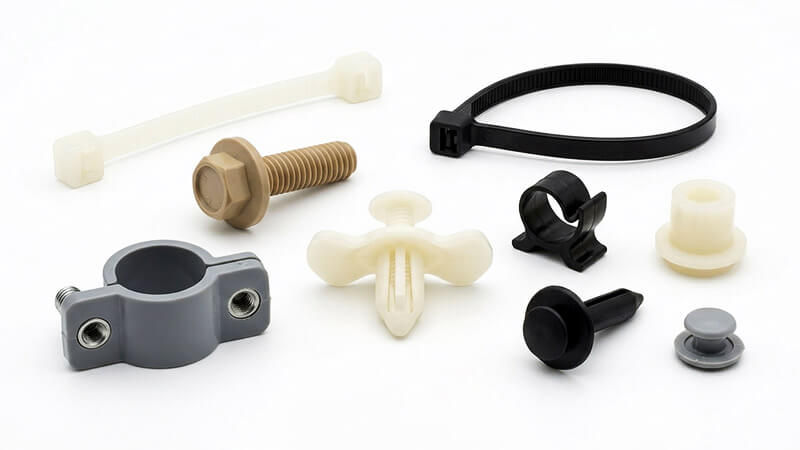
Plastic fasteners do not simply replicate metal fastener geometries in a different material. The manufacturing economics and material properties of polymers enable fastener designs that make no sense in metal. The five major categories:
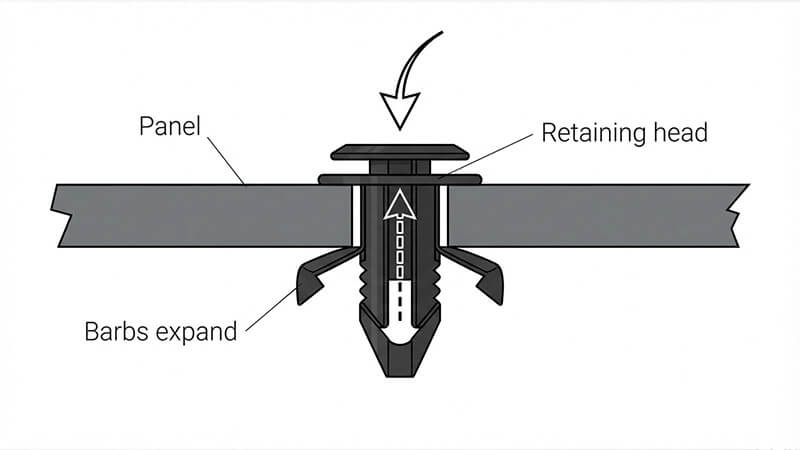
The push-pin is the highest-volume plastic fastener type in automotive production. A tapered or ribbed body with a retaining head is pressed through a pre-punched hole in the mating panel. Flexible fins or barbs expand behind the panel to resist pull-out. Installation is a single linear motion requiring no rotation, no torque control, and no access to the back side of the joint. Removal — when service is required — uses a forked prying tool that slips under the head and levers the pin out.
Push-pins serve non-structural retention: interior trim panels, door cards, dashboard fascias, wheel arch liners, and underbody splash shields. Pull-out strength for a typical automotive push-pin ranges from 50–200 N, enough to hold a trim panel against road vibration but not enough for load-bearing structural joints.
Snap rivets join two panels by expanding behind the second panel after the mandrel is pressed through. Unlike metal blind rivets that require a setting tool and permanently deform, many plastic snap rivets are reusable — the mandrel can be pushed back out with a pin punch to disassemble the joint. This reusability is a significant advantage for assemblies that must be serviced periodically, such as battery covers, fuse box lids, and inspection panels.
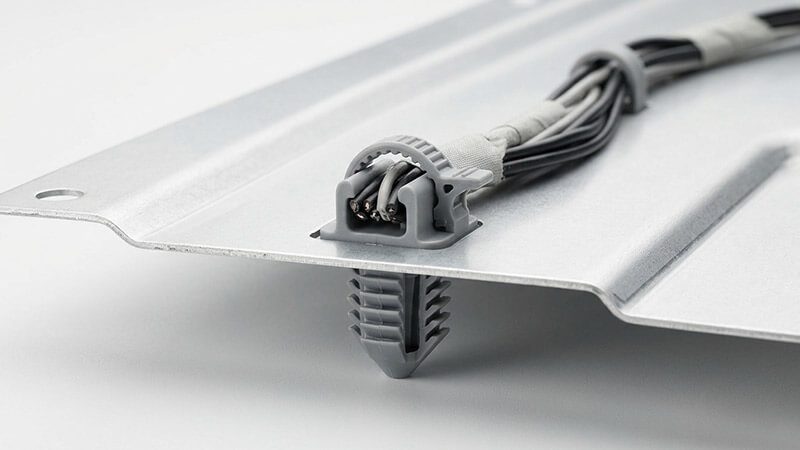
Wiring harness routing is the single largest application for plastic fasteners in a vehicle by part count. Cable clips (also called P-clips, fir-tree clips, or harness retainers) snap into pre-punched holes in the vehicle body and hold wire bundles, brake lines, fuel lines, and sensor cables in fixed routing paths. The critical specification parameter is the clip’s retention force in the mounting hole — a harness clip that vibrates loose releases a wiring bundle into a zone where it can chafe against metal edges, creating a latent electrical fault.
Plastic screws and nuts exist and work, but the design rules differ sharply from metal. A plastic screw thread cannot sustain the preload that a metal bolt achieves because the material creeps under sustained tension. The practical torque for a nylon M6 screw is typically 0.5–1.5 N·m — roughly 10–20% of the torque an equivalent steel screw would see. Threaded plastic fasteners are used where electrical isolation, chemical resistance, or weight reduction matters more than clamping force: mounting PCBs to plastic housings, securing sensors in corrosive environments, and fastening components inside chemical processing equipment.
Cable ties are technically fasteners — they provide a clamping function around a bundle — and are the highest-volume plastic fastening product by unit count. A single vehicle uses 50–200 cable ties for harness routing alone. The material is almost exclusively nylon 6/6, selected for its combination of tensile strength, flexibility, and heat resistance at engine-bay temperatures. Heat-stabilized nylon 6/6 cable ties (rated to 125°C continuous) are specified for under-hood applications, while standard nylon ties (rated to 85°C) serve interior and chassis routing.
A complete taxonomy of plastic fastener types — push-pins, snap rivets, clips, and screws — is available for specification and procurement work.
Plastic fastener selection begins with polymer selection, and polymer selection turns on four numbers: maximum continuous service temperature, tensile strength, chemical compatibility, and cost. The table below maps the six polymers that account for the vast majority of fastener production.
| Polymer | Tensile Strength (MPa) | HDT at 1.82 MPa (°C) | Continuous Use Temp (°C) | Water Absorption (24h) | Relative Cost | Key Property |
|---|---|---|---|---|---|---|
| Nylon 6/6 (PA66) | 75–85 (dry) / 55–65 (cond.) | 65–75 | 85–120 | 2.3–2.8% | 1.0 (baseline) | Best all-around strength/cost balance |
| PEEK | 95–110 | 155–165 | 240–260 | 0.10–0.15% | 40–60× | Extreme thermal and chemical performance |
| Polypropylene (PP) | 30–38 | 50–60 | 80–100 | < 0.01% | 0.4–0.6× | Best chemical resistance per dollar |
| Polycarbonate (PC) | 60–70 | 125–135 | 110–125 | 0.12–0.18% | 1.5–2.5× | High impact strength, transparent |
| PVC (Rigid) | 40–55 | 60–70 | 55–65 | 0.05–0.15% | 0.6–0.8× | Self-extinguishing, acid/alkali resistant |
| PTFE | 20–30 | 50–55 (unfilled) | 250–260 | < 0.01% | 15–25× | Near-universal chemical inertness, lowest friction |
Tensile strength per ASTM D638. HDT per ASTM D648 at 1.82 MPa. Continuous use temperature from polymer producer datasheets (UL 746B Relative Thermal Index where available). Water absorption per ASTM D570 (24h immersion). Relative cost based on raw material pricing at commodity volumes as of 2026.
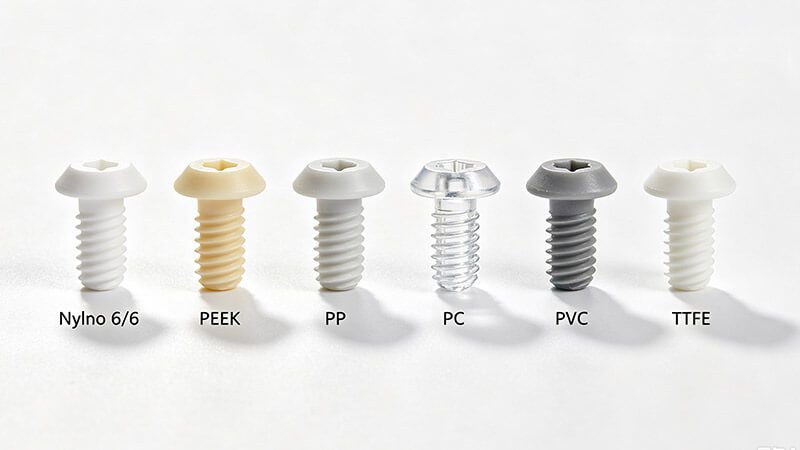
Nylon 6/6 accounts for an estimated 70–80% of all plastic fastener production. The reasons are straightforward: it is the lowest-cost polymer with sufficient strength and heat resistance for automotive interior and general industrial use, it injection-molds at high speed with excellent flow into thin sections, and its mechanical properties are well-characterized across decades of production data governed by ASTM D4066 nylon classification standards.
The critical design caveat for nylon fasteners is moisture conditioning. Nylon 6/6 absorbs 2.3–2.8% water by weight in 24 hours of immersion (ASTM D570) and up to 8–9% at saturation in humid environments. As moisture content rises, tensile strength drops — from approximately 80 MPa dry-as-molded to 55–60 MPa at 50% relative humidity equilibrium. The fastener also swells: a nylon 6/6 part gains approximately 0.6% dimensionally per 1% moisture absorption. This means a nylon screw in a wet environment will be weaker and slightly larger than the same screw in a dry environment. Designers account for this by using dry-as-molded dimensions for fit calculations and conditioned strength values for load calculations.
Heat-stabilized nylon 6/6 (with copper halide or other antioxidant additives) extends the continuous use temperature from 85°C to approximately 125°C, making it suitable for under-hood applications away from direct exhaust contact. Glass-fiber-reinforced nylon (PA66-GF30, 30% glass fiber by weight) raises tensile strength to approximately 160–180 MPa and HDT to 240–250°C, but the fiber reinforcement makes the material anisotropic — strength varies with flow direction during molding — and notch sensitivity increases.
PEEK (polyetheretherketone) is the high-performance polymer that engineers specify when nylon is not enough. Its continuous use temperature of 240–260°C puts it in the same thermal service range as some metals. Its tensile strength of 95–110 MPa rivals annealed mild steel on a strength-to-weight basis. Its chemical resistance covers almost everything short of concentrated sulfuric and nitric acids at elevated temperature. And its creep resistance — the property that most limits thermoplastic fasteners in sustained-load applications — is an order of magnitude better than nylon.
The limitation is cost. PEEK raw material costs approximately 40–60 times more than nylon 6/6 on a per-kilogram basis. A PEEK M6 screw costs $2–5 per piece, while a nylon equivalent costs $0.05–0.10. PEEK fasteners appear in aerospace engine components, semiconductor wafer handling equipment, oil and gas downhole tools, medical implant assemblies, and anywhere that a metal fastener would either corrode, conduct electricity, or add unacceptable weight.
Polypropylene fasteners are specified almost exclusively for chemical resistance. PP is attacked by very few substances at room temperature — concentrated oxidizing acids, chlorinated solvents, and some hydrocarbons at elevated temperature are the main exceptions. For acid storage tank fittings, laboratory equipment, battery box hardware, and chemical processing line components, PP fasteners offer corrosion resistance approaching PTFE at roughly 3–5% of the cost.
The trade-off: mechanical properties are poor. PP tensile strength of 30–38 MPa is the lowest of the six major polymer families. HDT below 60°C means PP fasteners cannot be used anywhere near a heat source. Creep resistance is poor — a PP screw under sustained load at elevated temperature relaxes to near-zero preload within hours. PP fasteners are for chemical compatibility and nothing else.
Polycarbonate fasteners fill a narrow niche: applications that need high impact resistance with visual clarity or electrical insulation. The Izod impact strength of polycarbonate (600–850 J/m, notched) is among the highest of any unfilled thermoplastic — a PC fastener will absorb an impact that shatters a nylon or PP part of the same geometry. This matters for protective equipment covers, electrical enclosure fasteners subject to rough handling, and transparent fasteners used in medical devices where visual inspection of the joint is required.
Rigid PVC fasteners serve two specialized roles: electrical enclosure hardware in applications where self-extinguishing behavior (UL 94 V-0 without additives) is mandatory, and chemical processing fasteners in acid and alkali service. PVC is inherently flame-retardant due to its chlorine content — it chars and self-extinguishes when the flame source is removed, without requiring additive flame retardants that can leach out over time.
PTFE fasteners are the last resort for chemical compatibility. When the process fluid dissolves nylon, embrittles polypropylene, and stress-cracks polycarbonate, PTFE survives. It is attacked by essentially nothing at room temperature except molten alkali metals and fluorine gas at elevated pressure. Its friction coefficient (0.05–0.10 against steel, the lowest of any solid) makes PTFE screws effective as low-friction bearings in their own right.
The mechanical penalty is severe: tensile strength of 20–30 MPa is one-third of nylon and one-fifth of PEEK. PTFE fasteners cannot carry significant structural loads. They are specified for their chemical passport, not their strength.
Plastic fasteners do not rust, but they degrade through four mechanisms that have no direct analog in metal fastener engineering. Understanding each is essential for service life prediction.
Creep is the slow, permanent deformation of a polymer under sustained load below its yield strength. It is a viscoelastic phenomenon — the polymer chains slide past one another over time, reducing the fastener’s clamping force until the joint loosens or the fastener fractures.
Creep is non-linear with temperature. A nylon 6/6 fastener at 23°C that retains 80% of its initial preload after 1,000 hours may retain only 30% at 80°C over the same period. For this reason, threaded plastic fasteners are almost never used in sustained-tension applications at elevated temperature. The practical rule: if a joint requires a minimum clamp load after 1,000 hours of service, and the service temperature exceeds 50% of the polymer’s HDT, metal fasteners with isolation should replace plastic, since polymer creep accelerates exponentially with temperature under the time-temperature superposition principle.
Creep data for plastics is typically presented as creep modulus (apparent modulus at a given time and temperature) or as creep rupture curves (stress vs time-to-failure). ISO 899 and ASTM D2990 define the standard test methods. Designers working with plastic fasteners in load-bearing applications consult these curves rather than the instantaneous tensile strength from a short-term test.
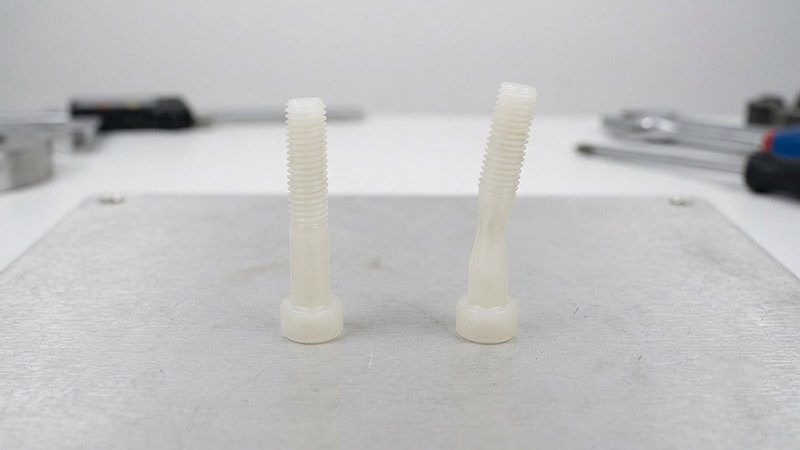
Every plastic has a Heat Deflection Temperature (HDT) measured per ASTM D648 at a specified stress (usually 1.82 MPa for engineering applications). This is not a melting point — it is a practical indicator: the temperature at which a standard test bar deflects 0.25 mm under load. A plastic fastener operating above its HDT loses dimensional stability and cannot maintain joint geometry.
Long-term thermal degradation occurs below the HDT through oxidative chain scission — polymer chains break at elevated temperature in the presence of oxygen, reducing molecular weight and embrittling the material. Heat-stabilized nylon grades include antioxidant additives that slow this process, extending service life by years at engine-bay temperatures. Non-stabilized nylon fasteners in under-hood applications can embrittle within 12–24 months.
UV radiation (290–400 nm wavelength) breaks polymer chains through photodegradation, causing surface chalking, micro-cracking, and loss of tensile strength. Nylon 6/6 is particularly UV-sensitive — unprotected nylon fasteners exposed to direct sunlight lose 30–50% of tensile strength within 12–24 months of outdoor exposure. UV-stabilized grades (with carbon black or hindered amine light stabilizers, HALS) extend outdoor service life to 5–10 years. Carbon black is the most effective and lowest-cost UV stabilizer for nylon, which is why most outdoor-rated plastic fasteners are black.
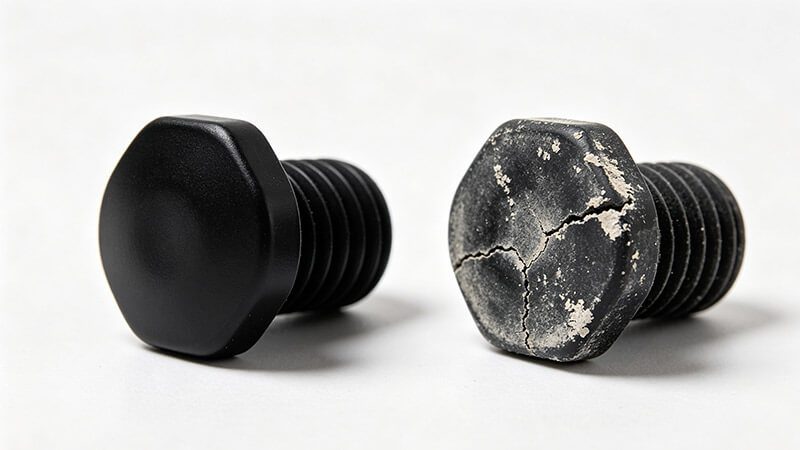
Chemical degradation of plastic fasteners falls into three categories: dissolution (the polymer dissolves in the chemical, as polystyrene dissolves in acetone), chemical reaction (the polymer is attacked and degraded, as nylon is hydrolyzed by strong acids), and environmental stress cracking (ESC — a combination of tensile stress and a chemical environment that causes brittle fracture at stress levels far below the material’s yield strength).
ESC is the most insidious because it occurs without visible chemical attack. A polycarbonate fastener under modest assembly stress in contact with a hydrocarbon-based grease can fracture spontaneously after weeks of exposure, while an unstressed PC sample in the same grease shows no degradation. The mechanism: the chemical penetrates micro-voids in the stressed polymer, plasticizes the polymer chains at the crack tip, and enables crack propagation at stresses that would be safe in air. ESC resistance must be verified for the specific polymer-chemical-stress combination — there is no universal compatibility chart.
A comprehensive plastic fastener chemical resistance reference covers over 50 chemical agents across all six polymer families.
Plastic fasteners create a unique service problem: they are engineered for one-way assembly. A push-pin goes in with a palm strike and stays in. Removing it 50,000 km later to replace a door speaker requires a specialized prying tool that the vehicle owner does not own.
The forked trim panel removal tool — a flat blade with a V-notch cut into the tip — is the universal plastic fastener removal instrument. The fork slides under the fastener head, levers against the panel surface, and extracts the pin without gouging the surrounding trim. Professional-grade tools are made of glass-fiber-reinforced nylon (the tool itself demonstrates the material it removes). Kits containing 5–11 different pry bar geometries cover push-pins, fir-tree clips, snap rivets, and wiring harness retainers across multiple vehicle brands.
The common failure mode in DIY removal: using a flat-blade screwdriver that mars the trim panel around the fastener head. The scratch is permanent and visible. The $8 trim tool kit is the cheapest bodywork insurance a vehicle owner can buy.
Threaded plastic fasteners demand torque control far more precise than metal fasteners. The torque-to-failure window is narrow: a nylon M6 screw strips its threads at roughly 1.5–2.0 N·m in a nylon nut. The recommended installation torque is typically 0.5–1.0 N·m — a range that most assembly tools built for metal fasteners cannot reliably target. Torque-limiting screwdrivers or electric drivers with precision torque control are effectively mandatory for production assembly of threaded plastic fasteners.
For push-pins and snap rivets, installation force is kept low enough for manual assembly — typically 30–80 N insertion force per pin. Automated assembly stations use pneumatic or servo-driven insertion tools with force monitoring to detect misaligned holes or missing receivers before the vehicle moves to the next station.
| Application Environment | Temperature Range | Chemical Exposure | Recommended Polymer | Why |
|---|---|---|---|---|
| Automotive interior trim | -30 to 80°C | None significant | Nylon 6/6 | Cost-optimal, sufficient strength, good creep at cabin temps |
| Under-hood (away from exhaust) | -40 to 125°C | Oil, coolant splash | Heat-stabilized Nylon 6/6 or GF-Nylon | Thermal range sufficient, chemical resistance adequate |
| Under-hood (near exhaust/turbo) | -40 to 200°C | Oil, fuel, brake fluid | PEEK | Only polymer with sustained thermal headroom |
| Battery pack / EV high-voltage | -40 to 85°C | Electrolyte vapor (Li-ion) | Nylon 6/6 or PP | Electrical insulation; verify ESC resistance to electrolyte |
| Chemical storage tank | 0 to 40°C | Concentrated acids | PP or PVC | PP for acid, PVC for acid+alkali; no metal corrosion risk |
| Laboratory / cleanroom | 15 to 30°C | Solvents, reagents | PTFE or PEEK | Universal chemical inertness |
| Outdoor architectural | -20 to 60°C | UV, rain | UV-stabilized Nylon 6/6 (carbon black) | UV-stabilized nylon achieves 5–10 year outdoor life |
| Food processing equipment | 0 to 100°C | Food acids, washdown chemicals | Nylon 6/6 (FDA compliant grades) or PEEK | FDA compliance, chemical resistance to cleaning agents |
| Electrical enclosure (indoor) | 0 to 60°C | None significant | Nylon 6/6 or PVC (if V-0 required) | Nylon for cost; PVC only if self-extinguishing is mandatory |
| Electrical enclosure (outdoor) | -20 to 80°C | UV, rain, possible chemical drift | UV-stabilized Nylon 6/6 or PC | PC for impact resistance + transparency if needed |
ASTM D4066 classifies nylon injection molding and extrusion materials, defining the nomenclature system that distinguishes nylon 6, nylon 6/6, nylon 6/10, and their reinforced and heat-stabilized variants. A fastener drawing that calls out “PA66 per ASTM D4066” communicates the base polymer, but does not specify the additive package — heat stabilization, UV stabilization, or glass fiber content must be stated separately, since ASTM D4066 defines only the base polymer classification.
ISO 1043 defines the standardized symbols and abbreviated terms for plastics — “PA66” for nylon 6/6, “PEEK” for polyetheretherketone, “PP” for polypropylene, and so on. These symbols, standardized under ISO 1043, appear on molded part markings and engineering drawings globally.
UL 94 is the standard for flammability of plastic materials, and the V-0 / V-1 / V-2 / HB ratings are the most commonly cited fire-safety requirement in electrical and electronic equipment standards. A plastic fastener inside an electrical enclosure in a product sold in North America or Europe almost always carries a UL 94 rating requirement written into the product’s safety certification documentation.
ASTM D638 defines tensile testing for plastics — the source of the tensile strength values cited in polymer datasheets. ASTM D648 defines the HDT test. ASTM D570 defines water absorption. Together, these three standards provide the mechanical and environmental property baseline for any plastic fastener material specification.
For a complete walkthrough of testing frameworks and specification requirements, refer to the plastic fastener standards reference.
Can plastic fasteners replace metal fasteners in structural applications?
No, with a narrow exception. Plastic fasteners do not have the tensile strength or creep resistance for structural joints where clamp load must be maintained over time. Carbon steel and stainless steel remain the only viable materials for load-bearing bolted connections. The exception: glass-fiber-reinforced nylon fasteners in low-load structural applications where electrical isolation and corrosion immunity are the primary requirements — PCB mounting, sensor brackets, and non-structural brackets in corrosive atmospheres. Consult creep rupture data for the specific polymer at the service temperature to verify that the required clamp load is maintained over the design life.
Why do my nylon screws keep loosening?
The most likely cause is creep relaxation, not vibration loosening. A nylon screw under sustained tension loses preload over time as the polymer chains rearrange under stress. The rate increases exponentially with temperature. Solutions: reduce the initial preload to a level the polymer can sustain based on creep modulus data; switch to a metal threaded insert in the plastic component, with a metal screw providing the clamp load; or redesign the joint so the plastic fastener functions as a retainer rather than a clamp — the fastener prevents the parts from separating but does not carry a compressive preload.
How do I identify what polymer a plastic fastener is made from?
Molded plastic fasteners are frequently marked with the ISO 1043 polymer symbol (PA66, PP, PC, etc.) and possibly a glass fiber content indicator (GF30 = 30% glass fiber). If unmarked, a burn test provides rough identification: nylon burns with a blue-yellow flame and smells of burnt wool or hair; PP burns with a blue flame and drips, smelling of candle wax; PVC is self-extinguishing and gives off acrid hydrogen chloride fumes (do not inhale); PC chars and self-extinguishes with a phenolic odor. For definitive identification, send a sample to a materials testing lab for FTIR analysis.
Are plastic fasteners suitable for outdoor use?
Only if UV-stabilized. Standard nylon 6/6 without UV stabilization loses significant tensile strength within 12–24 months of direct sunlight exposure. UV-stabilized nylon (typically containing carbon black at 2–3% loading) maintains mechanical properties for 5–10 years outdoors. Black plastic fasteners are almost always UV-stabilized; natural (off-white) and colored fasteners may not be unless the datasheet explicitly states UV stabilization. For critical outdoor applications, specify UV-stabilized material and verify with the supplier.
What is the temperature limit for nylon fasteners under the hood of a car?
Standard nylon 6/6: 85°C continuous, 120°C short-term. Heat-stabilized nylon 6/6: 125°C continuous, 150°C short-term. These limits apply to components away from direct exhaust contact. Fasteners within 200 mm of an exhaust manifold or turbocharger housing will see radiant and convective temperatures exceeding 200°C — PEEK is the only polymer viable in this zone. If in doubt, measure the actual temperature at the fastener location during worst-case vehicle operation (hill climb under load on a hot day) rather than relying on general guidelines.
MatWeb — Material Property Data. “Online Materials Information Resource.” https://www.matweb.com/
ASTM International. “ASTM D4066 — Standard Classification System for Nylon Injection and Extrusion Materials (PA).” https://www.astm.org/Standards/D4066.htm
Wikipedia. “Creep (deformation).” https://en.wikipedia.org/wiki/Creep_%28deformation%29
International Organization for Standardization. “ISO 1043-1:2011 — Plastics — Symbols and abbreviated terms — Part 1: Basic polymers and their special characteristics.” https://www.iso.org/standard/50584.html
Social Chat is free, download and try it now here!