EN
EN  ZH
ZH 

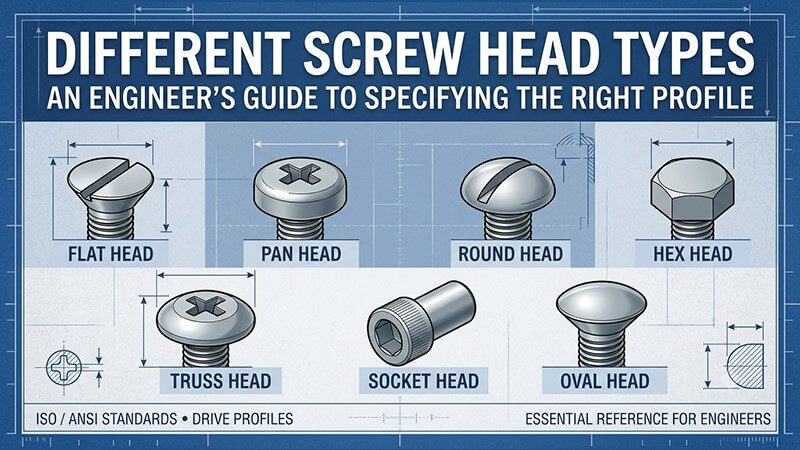
Screw head types are the external profiles of a fastener — such as pan, flat (countersunk), button, truss, hex, and socket cap — that determine flush fit, bearing area, torque capacity, and vibration resistance. The chart below compares 16 common types by profile, common drive, typical application, and governing DIN/ISO/ANSI standard.
If you only remember one thing from this page, make it this table. It is built to win the featured snippet for “screw head types chart” and to serve as a desk reference during design reviews. Each row pairs the head type with its profile class, the drives you will commonly see, a typical application, and the governing standard. Bookmark it.
| Head Type | Profile | Common Drive(s) | Typical Application | Standard (DIN/ISO/ANSI) |
|---|---|---|---|---|
| Pan | Non-countersunk | Phillips, Pozi, Torx, Slotted | General-purpose sheet metal, appliances | DIN 7985 / ISO 7045 / ASME B18.6.3 |
| Flat / Countersunk | Countersunk | Phillips, Torx, Slotted | Aerospace, surfaces needing flush fit | DIN 965 / ISO 7046 (90°); ASME B18.6.3 (82°) |
| Oval / Raised Countersunk | Countersunk | Phillips, Slotted | Decorative trim, cabinets | DIN 964 / ISO 7719 |
| Bugle | Countersunk | Phillips, Torx | Drywall, softwood self-setting | Proprietary (no universal std) |
| Button | Non-countersunk | Hex (Allen), Torx | Low-profile aesthetic, bicycle, furniture | ISO 7380-1 / DIN 7380 |
| Hex / Hex Cap | Non-countersunk | External wrench | Structural, high preload | DIN 933 / 931 / ASME B18.2.1 |
| Socket Cap (Allen) | Non-countersunk | Internal hex | Precision machinery, tight spaces | DIN 912 / ISO 4762 |
| Truss / Mushroom | Non-countersunk | Phillips, Torx | Thin sheet, pull-through resistance | Proprietary / DIN 7982 family |
| Flange / Hex Washer | Non-countersunk | External wrench, Torx | Vibration joints, integrated washer | DIN 6921 / ISO 4162 |
| Round | Non-countersunk | Slotted, Phillips | Traditional, restoration | ASME B18.6.3 |
| Fillister | Non-countersunk | Slotted | High-torque, deep slot | DIN 84 / ISO 1207 |
| Cheese | Non-countersunk | Slotted | Instruments, shallow headroom | DIN 84 family / ISO 1207 |
| Binding | Non-countersunk | Slotted, Phillips | Electrical terminals, wire clamp | ASME B18.6.3 |
| Carriage | Non-countersunk | External wrench (square neck) | Wood-to-metal, anti-spin | DIN 603 / ISO 8677 |
| Shoulder | Non-countersunk | Hex socket | Pivot, guide, spindle | DIN 7379 / ISO 7379 |
| Security (Pin-Torx, Tri-Wing) | Specialty | Tamper-resistant | Public equipment, anti-theft | Proprietary / ANSI |
Every screw head belongs to one of two macro-classes: countersunk (the head seats below or flush with the surface) or non-countersunk (the head protrudes). That single binary drives five joint behaviors, and understanding them is the difference between a joint that lasts and one that fails.
The different types of screw heads fall into four families — countersunk (flat, oval, bugle), non-countersunk (pan, button, truss, hex, socket cap), external-drive (hex, flange), and specialty (carriage, shoulder, security, grub). Each family trades flush fit for bearing area, torque capacity, or tamper resistance, so the right choice depends on what the joint must do.
The five behaviors this binary controls:
Load bearing — A countersunk head transfers clamp force through a conical seat, concentrating load at the rim; a pan or truss head clamps across a flat underside, spreading load over a wider footprint.
Clearance and snag — Flush heads let parts slide past each other and avoid catching on hands or moving components, critical on conveyor edges and walking surfaces.
Appearance — Consumer and architectural products often demand a clean, invisible fastener.
Assembly speed — Protruding heads drive faster because there is no countersink operation or depth control.
Vibration resistance — Covered in the application section below.
When engineers ask about different types of screw heads, they are really asking which of these five behaviors to prioritize. No head beats the rest across every joint — the right pick depends on what your joint actually has to do. A head that is perfect for a structural steel base plate (hex cap) is wrong for a thin aluminum enclosure (truss or button), and both are wrong for a flush aircraft skin (countersunk).
These countersunk screw head types — flat, oval, and bugle — share a conical seat but differ in dome and application. The defining parameter is the countersink angle: 82° under ASME B18.6.3 (inch/US series) versus 90° (and 100° for thin sheet) under DIN/ISO metric standards. Mixing an 82° screw with a 90° hole leaves the head proud and cracks the surrounding material; the angles are not interchangeable, a point we revisit in the standards section.
The workhorse of flush fastening. A flat head seats flush, leaving a smooth plane ideal for aerodynamic surfaces, walking surfaces, and moving-part interfaces. DIN 965 / ISO 7046 covers the metric slotted/Phillips version; DIN 7991 / ISO 10642 covers the metric socket (Allen) countersunk head. A “flat undercut” variant reduces the head thickness for thin materials. Weakness: low bearing area means poor pull-through resistance in soft substrates — the exact failure mode in our opening story. When the substrate is thin plywood or soft aluminum, a flat head will tear through long before a pan or truss head would.
An oval head is a countersunk head with a low decorative dome above the surface. It gives a flush underside with a finished top, common in cabinetry and vintage hardware (DIN 964 / ISO 7719). Choose it when appearance matters but you still need the head to disappear into the part from the front. The raised profile also gives slightly more bearing area than a pure flat head while keeping a refined look.
A bugle head has a curved, self-setting cone that distributes load without a countersink operation. It is the standard drywall screw head and works in softwood and plasterboard because the curve prevents over-driving and tearing. No universal standard governs it; dimensions are largely proprietary to manufacturers. The bugle’s advantage is that it self-sets to the correct depth, which is why drywall crews can drive hundreds per hour without pre-drilling.
Countersunk vs pan head is the classic flush-versus-protruding trade-off: a countersunk head sits flush but offers less bearing area, while a pan head protrudes yet clamps a wider footprint and resists pull-through better in thin material. This is the largest family and the one most often mis-specified. Protruding heads trade flush fit for bearing area, speed, and torque capacity. For most commercial products, a non-countersunk head is the safer default.
The general-purpose “workhorse.” A pan head has a low disc shape with a slightly rounded top and a flat bearing face. It is the default for appliances, sheet metal, and electronics because it clamps a wide area without sinking. DIN 7985 / ISO 7045 (metric) and ASME B18.6.3 (inch) cover it. The pan head vs flat head screw debate usually resolves in pan’s favor whenever the surface does not need to be flush — and most surfaces do not.
A button head is a low, wide, rounded dome — think of the screws on a bicycle stem or a laptop enclosure. It looks clean and resists snagging. ISO 7380-1 / DIN 7380 covers the socket button head. It is the aesthetic choice when you want a visible but unobtrusive fastener, and the socket variant carries far more torque than its low profile implies.
A traditional domed head with a slotted or Phillips drive, common in restoration and legacy assemblies (ASME B18.6.3). It offers good bearing area and a classic look but is being displaced by pan and button heads in new designs because slotted drives cam out under power tools.
The truss head is the hero of thin-sheet assembly. Its extra-wide, low-profile dome spreads clamp load across the largest footprint of any standard head, dramatically raising pull-through resistance. If you have ever torn a screw through thin gauge steel, you needed a truss head. It is the first choice for HVAC ductwork, electrical boxes, and any punched-and-folded enclosure.
Both are tall heads with deep slots for high torque. A fillister has a cylindrical side and a rounded top (DIN 84 / ISO 1207); a cheese head is a short cylinder with a flat top, named for its wheel-of-cheese silhouette. Both suit instruments and locations with shallow axial headroom but high tightening demand — the deep slot lets a flat-blade driver bite hard without stripping.
A binding head is a low, wide pan variant with a small undercut beneath the head, originally for clamping wire bundles and electrical terminals. It prevents the head from cutting insulation and is still specified in panel and terminal-block assemblies where a trapped conductor must not be nicked.
When torque is the priority, you leave internal drives behind and go external. These heads take a wrench or socket from the side and reach the highest preloads in the catalog.
A [hex cap screw](/hex-cap-screws) takes a wrench or socket from the side, delivering the highest achievable preload of any standard head. DIN 933 (full thread) / DIN 931 (partial thread) and ASME B18.2.1 govern hex cap screws. Hex cap screws are the structural default for steel frames, machinery bases, and any joint where preload defines the design. The partial-thread DIN 931 variant keeps the unthreaded shank in the shear plane for maximum strength.
A flange head integrates a built-in washer, widening the bearing face and resisting loosening under vibration. DIN 6921 / ISO 4162 covers serrated flange bolts. Specify flange heads where you want a washer captive and a joint that survives dynamic load — the serrations bite into the clamped surface and add a mechanical lock.
The socket cap head carries an internal hex and reaches high strength in a small envelope — DIN 912 / ISO 4762. It is the precision-machinery standard: maximum clamp in minimum radial space, with no side clearance needed for a wrench. Where pan head vs flat head screw is about flush fit, socket cap vs hex is about space and strength: socket cap fits where a wrench cannot swing.
These heads solve narrow problems: anti-spin, pivot, captive retention, or tamper resistance. They rarely appear in a general catalog but are decisive in their niches.
A carriage screw has a round head and a square neck that bites into wood or punched metal, preventing rotation during tightening (DIN 603 / ISO 8677). Classic for wood-to-metal and gate hardware, where you can tighten from one side only.
A shoulder screw has a precision ground shoulder beneath the head acting as a pivot, axle, or guide (DIN 7379 / ISO 7379). The head is usually a small hex socket; the shoulder — not the thread — carries the locating function. These are the unsung heroes of hinges, pulleys, and linear guides.
A captive screw is retained in a panel so it cannot drop into sensitive equipment — required in aerospace and medical devices. The head is often a slotted or hex socket with a retaining feature under the head that snaps into a threaded insert.
Pin-Torx, Tri-Wing, and Spanner heads defeat standard drivers to stop public tampering of enclosures and fixtures. They trade serviceability for theft and vandalism resistance — a deliberate penalty you accept on public infrastructure.
A grub screw is headless, driven by an internal hex or Torx, and used to lock collars, pulleys, and shafts by point pressure. There is no head profile to speak of — its job is pure clamping, not bearing.
heory is useless until it meets a real joint. Here is the field guide, with the measured numbers that settle arguments.
Thin gauge tears easily. Use truss for maximum pull-through area, hex washer/flange for vibration-prone panels, or pan for general closure. Avoid flat heads — they punch through. For sourced product, see our sheet metal screws range. In 0.8 mm steel, a truss head’s wide footprint can triple the pull-through load of a flat head of equal diameter.
Wood needs a head that sits flush or self-sets. Flat countersunk for face frames, bugle for drywall and softwood, raised/oval countersunk for visible trim. A mini-test from Prince Fastener measured a Pan #8 screw holding 18–22% more pull-through resistance in ½” plywood than a Flat head of the same size — useful when the wood is thin and the clamp must not break out. The pan head’s flat underside simply grabs more wood.
Maximum preload demands hex cap (wrench access) or socket cap (tight space). There is no substitute; internal-drive protruding heads cap out far below hex torque limits. A 12.9 socket cap in M10 reaches preloads that would twist the head off a pan screw.
Clean visible fasteners mean button, raised countersunk/oval, or socket cap with a finished cap. Avoid slotted round heads in consumer products unless the look is intentional — they read as dated and strip easily.
This is where our opening failure came from. For vibration, specify socket cap + thread-locking or flange head with serrations. A flush countersunk head in a vibrating joint is the wrong call unless the surface truly must be flush — and even then, add a locking element. The countersunk seat gives the screw nothing to grip against rotational slip.
Building a bill of materials for a vibration-sensitive product? Our engineering desk will recommend head, drive, and locking scheme together — Request a Quote.
| Application | First Choice | Backup | Avoid |
|---|---|---|---|
| Thin sheet metal | Truss | Hex washer | Flat / countersunk |
| Hardwood joinery | Bugle / Flat countersunk | Oval countersunk | Round |
| Structural steel | Hex cap | Socket cap | Pan |
| Aesthetic enclosure | Button | Socket cap | Slotted round |
| Vibrating machinery | Flange / Socket cap + Loctite | Nyloc nut | Plain countersunk |
Six criteria govern every head decision. Rank them for your joint, then apply the rules. Most spec errors happen because one criterion — usually appearance — silently outweighs the others.
Load & torque — How much preload must the head survive? High → hex or socket cap.
Flush / clearance — Must the surface be planar? Yes → countersunk.
Appearance — Is the fastener visible? Yes → button or raised countersunk.
Assembly speed — Manual, high-volume? Protruding heads drive faster.
Security / tamper — Public access? → Pin-Torx or Tri-Wing.
Material compatibility — Soft substrate? → wide-bearing truss or pan; hard steel? → hex/socket.
If you need a flush surface and no snag → choose countersunk (82° ASME / 90° DIN).
If the substrate is thin and you fear pull-through → choose truss.
If you need high torque and tight radial space → choose socket cap (Allen, DIN 912).
If you need maximum preload and easy field service → choose hex cap (DIN 933 / ASME B18.2.1).
If the joint sees vibration → choose flange or socket cap + thread locker.
If the equipment is publicly accessible → choose Pin-Torx / Tri-Wing security head.
If you need a pivot or guide axis → choose shoulder screw (ISO 7379).
| Head Type | DIN | ISO | ANSI / ASME | Notes |
|---|---|---|---|---|
| Socket Cap | DIN 912 | ISO 4762 | — | Internal hex, high strength |
| Hex Cap (full/partial) | DIN 933 / 931 | — | ASME B18.2.1 | Max preload |
| Countersunk (slotted/Ph) | DIN 965 | ISO 7046 | — | 90° metric |
| Countersunk (socket) | DIN 7991 | ISO 10642 | — | 90° socket countersunk |
| Pan | DIN 7985 | ISO 7045 | ASME B18.6.3 | 82° drive angle (inch) |
| Button (socket) | DIN 7380 | ISO 7380-1 | — | Flange: ISO 7380-2 |
| Flange / Hex Washer | DIN 6921 | ISO 4162 | — | Serrated variant |
| Carriage | DIN 603 | ISO 8677 | — | Square neck anti-spin |
| Shoulder | DIN 7379 | ISO 7379 | — | Precision shoulder |
| Round / Binding | — | — | ASME B18.6.3 | Inch series |
For the authoritative standards library, Engineers Edge maintains the full ISO/DIN/ANSI hardware specification index. The countersink angle convention is the trap: US drawings at 82° (ASME B18.6.3) will not seat in a 90° DIN hole. Always state the angle on the drawing, and confirm it with your supplier before the first production run.
Material quick notes: A2-70 / A4-70 stainless for corrosion resistance (A4 = marine grade), 4.8 / 8.8 / 10.9 / 12.9 carbon and alloy steel by property class (12.9 = highest strength, typical for socket caps), and brass/bronze for decorative or non-sparking service. Head profile and material are independent variables — you can get a socket cap in A4-70 or a pan head in 12.9. See our guide to stainless steel & carbon steel fasteners for grade selection and how class interacts with head geometry.
Q: Can an 82° countersunk screw be used in a 90° (or 100°) countersink hole? No. The 82° angle (ASME B18.6.3, inch series) and the 90°/100° angle (DIN/ISO metric) are not geometrically compatible. An 82° head in a 90° hole sits proud and concentrates stress at the rim, often cracking thin material. Always match the screw angle to the countersink angle called out on the drawing, and state the angle explicitly in your spec. See our countersink angle guide for the full comparison.
Q: Pan head vs flat head screw — which should I choose? Choose a flat (countersunk) head when the surface must be flush and snag-free — aerospace skins, walking surfaces, moving parts. Choose a pan head when you need a larger bearing face, faster assembly, or better pull-through resistance in thin or soft material. In ½” plywood, a Pan #8 held 18–22% more pull-through than a Flat head in measured tests, so pan wins whenever flush fit is not mandatory.
Q: Which screw head type resists vibration best? Socket cap (Allen) heads combined with thread-locking compound, or flange (serrated hex washer) heads, perform best under vibration because they maximize clamp load and add mechanical anti-loosening. A plain flush countersunk head is the weakest choice for a vibrating joint unless a locking element is added, because the conical seat offers little resistance to rotational slip.
Q: What is the difference between a countersunk and a non-countersunk head? A countersunk head seats flush with or below the surface through a conical seat; a non-countersunk head protrudes above the surface. Countersunk heads give a flush finish but less bearing area; non-countersunk heads (pan, button, truss, hex) give more clamping footprint and faster assembly. The choice hinges on whether the surface must be planar.
Q: Do head type and drive type need to be specified together? Yes. Head profile controls fit, load, and appearance; drive type controls how much torque you can apply before cam-out. A beautiful button head paired with a slotted drive will fail automated assembly. Specify them as a pair — see our screw drive types guide for drive selection and the torque data that justifies Torx over Phillips.
Social Chat is free, download and try it now here!