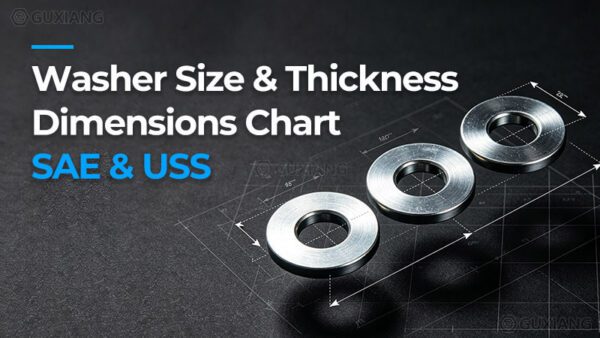






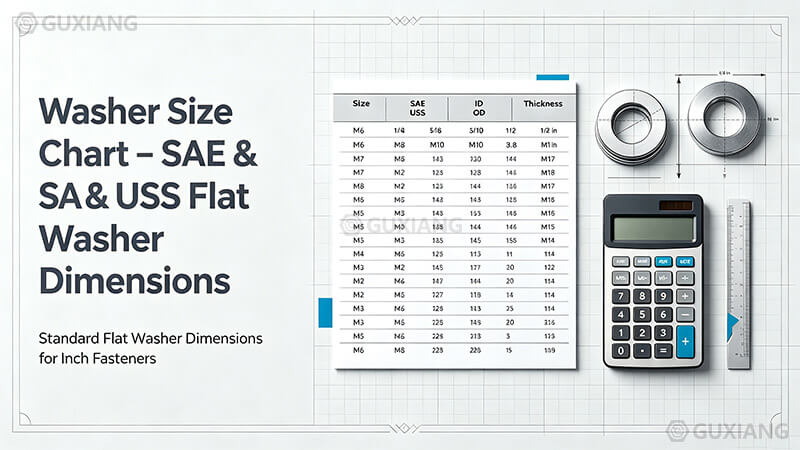
Schnellreferenz: Flaches Unterlegscheiben verteilt die Schraube-Last über einen größeren Bereich, schützt Oberflächen vor Beschädigungen und kompensiert übergroße Löcher. Dieses Diagramm deckt Norm Dimensionen für beide SAE (Gesellschaft der Automobil Ingenieure) und USS (Vereinigte Staaten Norm) flach Unterlegscheiben von 3/16" bis 3", mit innen Durchmesser, außerhalb Durchmesser und Dicke in Zoll und Millimeter.
Die Auswahl der richtigen Unterlegscheibe-Größe ist unerlässlich, um eine ordnungsgemäße Lastverteilung und eine sichere Befestigung zu gewährleisten. Die Verwendung des falschen Unterlegscheibe - eines mit einem falschen Innendurchmesser oder einem unzureichenden Außendurchmesser - kann zu Gelenkversagen, Oberflächenbeschädigung oder ungleichmäßiger Klemmkraftverteilung führen. Diese Seite bietet eine interaktives Größe Lookup Tool, vollständige abmessungstabellen für beide SAE- und USS-Standards und eine praktischer auswahlführer um Ihnen zu helfen, jedes Mal das richtige Unterlegscheibe zu wählen.
Unterlegscheibe Größe Lookup Tool
Finden Sie Unterlegscheibe Dimensionen von Schraube Größe
Inside Dia. (ID)
—
Außerhalb der Dia. (OD)
—
Dicke
—
USS Flachscheibe Größe
USS (United States Standard) Flachscheiben haben eine größere Außenseite Durchmesser relativ zur Schraubengröße im Vergleich zu SAE Scheiben. Sie werden häufig in Bauwesen, allgemeiner Fertigung und Anwendungen verwendet, in denen ein breiterer Lastverteilungsbereich benötigt wird. Die größere OD hilft, die Klemmkraft auf eine breitere Oberfläche zu verteilen, wodurch das Risiko einer Beschädigung des weichen Werkstoffe reduziert wird.
| Schraubengröße | ID (Zoll) | OD (Zoll) | Dicke (in) | ID (mm) | OD (mm) | Dicke (mm) |
|---|
SAE Flachscheibe Größe Chart
SAE-Flachscheiben (Society of Automobil Engineers) haben einen engeren Innendurchmesser Toleranz und einen proportional kleineren Außendurchmesser im Vergleich zu USS-Schraubenscheiben gleicher Größe. Sie sind die bevorzugte Wahl in Präzisionsanwendungen, Automobil-Baugruppen und Maschinen, bei denen Platzbeschränkungen oder enge Toleranz-Anpassungen erforderlich sind. SAE-Waschanlagen werden auch allgemein als AN960-Waschanlagen in Luft- und Raumfahrtanwendungen bezeichnet.
| Schraubengröße | ID (Zoll) | OD (Zoll) | Dicke (in) | ID (mm) | OD (mm) | Dicke (mm) |
|---|
SAE vs. USS Unterlegscheiben: Hauptunterschiede
Obwohl sowohl SAE als auch USS Unterlegscheiben denselben grundlegenden Zweck erfüllen - die Verteilung von Schraube Last und den Schutz von Oberflächen - unterscheiden sie sich in wichtigen dimensionalen Aspekten, die jede für bestimmte Anwendungen besser geeignet sind.
USS Unterlegscheiben
- Größere OD for the same screw size — wider load distribution
- Thicker in most sizes — better for heavy-duty use
- Looser ID tolerance — fits oversized holes
- Common in construction, structural steel, and general fabrication
- Often used with structural bolts and anchor bolts
SAE Washers
- Smaller OD — more compact, less material
- Thinner in most sizes — lighter weight assemblies
- Tighter ID tolerance — closer fit to the bolt shank
- Common in automotive, machinery, and precision assemblies
- Also specified as AN960 in aerospace applications
Key tip: For a given screw size, USS and SAE washers are nicht interchangeable. A USS washer for a 1/2" bolt has an OD of 1-3/32", while the SAE equivalent is only 7/8". Always verify which standard your application requires before ordering.
So wählen Sie die richtige Unterlegscheibe GrößeZ
Step-by-Step Selection Guide
Schritt 1: Identify the bolt or screw size (e.g., 3/8", M10). The washer's inner diameter must be slightly larger than the bolt's nominal diameter to slide freely over the shank.
Step 2: Determine the washer standard required by your application. Construction and structural drawings typically specify USS washers, while automotive and machinery specifications often call for SAE washers.
Step 3: Check the outside diameter. The washer OD must be large enough to distribute the clamp force without the bolt head or nut pulling through. For soft materials (wood, plastic, aluminum), prefer a larger OD (USS style).
Step 4: Select the appropriate thickness. Thicker washers handle higher loads and resist deformation, while thinner washers are suitable for light-duty and precision applications.
Step 5: Consider the material. Standard carbon steel washers work for most indoor applications. For outdoor or corrosive environments, specify stainless steel washers or hot-dip galvanized washers.
Häufig gestellte Fragen
The main difference is in the outside diameter and thickness. USS washers have a larger OD and are generally thicker, providing wider load distribution for construction and structural applications. SAE washers have a smaller OD, tighter ID tolerance, and are thinner, making them ideal for automotive, machinery, and precision assemblies where space is limited.
Match the washer to the bolt's nominal diameter. A 3/8" bolt requires a 3/8" washer. The washer's inner diameter (ID) should be slightly larger than the bolt shank to allow free sliding. Check the appropriate chart above — USS or SAE — depending on your application standard. For precision fastener joints, SAE washers provide a closer fit.
In some cases yes, but it depends on the application. USS washers have a larger OD, so they may not fit in tight spaces designed for SAE washers. The thicker profile can also affect the grip length calculation for the bolt. For critical joints, always follow the engineering specification. Substituting washer types without approval can affect joint integrity.
Flat washers serve four primary functions: (1) Distribute the bolt's clamp force over a wider area, preventing surface damage. (2) Compensate for oversized or slotted holes. (3) Provide a smooth bearing surface for the bolt head or nut to rotate against during tightening. (4) Act as a shim to fill gaps between the fastener and the workpiece.
Most standard flat washers are made from low-carbon steel (SAE Grade 1 or equivalent) with a plain, zinc-plated, or hot-dip galvanized finish. For corrosive environments, stainless steel (18-8 / 304 or 316) washers are specified. Brass and silicon bronze washers are used in marine and electrical applications. Material selection should match the bolt material to prevent galvanic corrosion.
AN960 is the military/aerospace designation for SAE-style flat washers per NAS (National Aerospace Standard) specifications. AN960 washers have the same dimensions as standard SAE flat washers but are manufactured to tighter tolerances and with material traceability requirements. They are widely used in aviation and aerospace applications where reliability is critical.
In most applications, the washer goes under the component that rotates during tightening — typically the nut. This prevents the rotating nut from damaging the workpiece surface. If both the bolt head and nut rotate, or if the joint uses soft material, place washers under both. For structural connections, follow the specification — some require washers under both the head and nut.
Multiply the inch value by 25.4 to get millimeters. For example, a 1/2" ID washer: 0.5 × 25.4 = 12.7 mm. The charts above include both imperial and metric values for every size. For a comprehensive inch-to-metric conversion tool, see our conversion chart.
A flat washer is a flat ring that distributes load and protects surfaces. A lock washer (split lock washer, toothed lock washer, etc.) is designed to prevent the fastener from loosening under vibration. Lock washers create spring tension or bite into the mating surface to resist rotation. Both types are often used together — flat washer first, then lock washer, then the nut.
Yes. A washer changes the friction surface under the bolt head or nut. With a washer present, the friction coefficient under the head is typically lower (especially with hardened or plated washers), meaning more of the applied torque converts to clamp force. When tightening to a specific torque value, the presence or absence of a washer can change the achieved preload by 10–20%. Always torque with the washer in place if it will be present in the final assembly.