





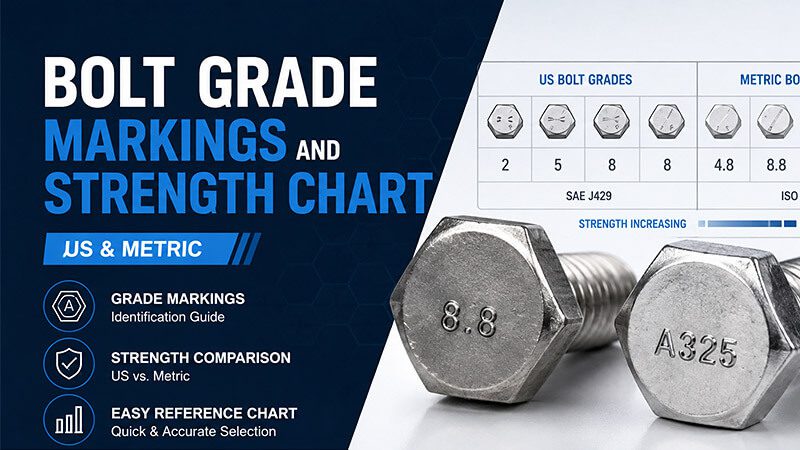
Identifying bolt grade and understanding strength ratings is essential for selecting the right fastener for any application. US (SAE) bolts use radial lines on the head to indicate grade, while metric bolts use a numerical class system. This chart provides head marking diagrams, mechanical properties, and a quick reference for both US and metric bolt grades.
Bolt Head Marking Diagrams
The number of radial lines on a US bolt head indicates its grade. More lines = higher strength. Metric bolts have a number stamped on the head indicating their class.
Low carbon steel
Medium carbon steel
Medium carbon alloy
8.8 / 10.9 / 12.9
Bolt Grade Lookup
| Material | |
| Größenauswahl | |
| Prüfkraft | |
| Min. Yield Strength | |
| Min. Tensile Strength |
Bolt Grade Strength Tables
Strength Terminology
US to Metric Grade Equivalents
While US and metric grades are not exact equivalents, these approximate conversions help when substituting between systems:
| US Grade | Tensile (psi) | Zugfestigkeit (MPa) | Closest Metric Class | Metric Tensile (MPa) |
|---|---|---|---|---|
| 2. Klasse | 60,000 – 74,000 | 414 – 510 | — | — |
| 5. Klasse | 120,000 | 828 | Klasse 8.8 | 800 – 830 |
| 8. Klasse | 150,000 | 1,034 | Klasse 10.9 | 1,040 |
| A325 | 120,000 | 828 | Klasse 8.8 | 800 – 830 |
Note: 1 MPa = 145 psi. Conversions are approximate. Always verify with manufacturer specifications for critical applications.
Understanding Bolt Grades
Why Bolt Grade Matters
Using the wrong bolt grade can lead to catastrophic failure. Grade determines how much load a bolt can safely carry. Higher grades use stronger materials and heat treatment processes, making them suitable for high-stress applications like automotive suspensions and structural connections.
Material & Heat Treatment
Grade 2 bolts are low carbon steel with no heat treatment. Grade 5 uses medium carbon steel that is quenched and tempered. Grade 8 uses medium carbon alloy steel with more aggressive heat treatment. The alloying elements and heat treatment process determine the final strength.
Stainless Steel Bolts
Stainless steel bolts (18-8/304 and 316) prioritize corrosion resistance over raw strength. Their tensile strength (65,000-150,000 psi) varies widely. They are ideal for outdoor, marine, and chemical environments where rust resistance is more important than maximum load capacity.
Reading Metric Class Numbers
Metric class numbers encode strength directly: the first digit × 100 = tensile strength in MPa, and the ratio of the two digits × tensile = yield strength. For example, Class 10.9: tensile = 10 × 100 = 1,000 MPa (actual 1,040), yield = 0.9 × 1,040 = 936 MPa (actual 940).
Bolt Selection Tips
Bewährte Verfahren
- Always match or exceed the specified bolt grade — never substitute a lower grade
- Check head markings before installation to verify the correct grade
- For structural applications, use only bolts marked with the required grade (A325, Grade 5, Grade 8)
- Stainless steel bolts should be used where corrosion resistance is needed, not for increased strength
- Metric and US bolts are not interchangeable — use the correct thread system
- When converting between systems, always round up to the next higher grade for safety
- Store bolts by grade to avoid mixing — a Grade 2 bolt in a Grade 8 application is dangerous
Häufig gestellte Fragen
US bolts use radial lines on the head to indicate grade: no markings = Grade 2 (low strength), 3 radial lines = Grade 5 (medium strength), 6 radial lines = Grade 8 (high strength). Metric bolts use a number stamped on the head: 8.8 = medium strength, 10.9 = high strength, 12.9 = very high strength. Stainless steel bolts may have no markings or vary by manufacturer.
For US bolts, Grade 8 is the strongest standard grade with 150,000 psi minimum tensile strength. For metric bolts, Class 12.9 is the strongest with 1,220 MPa minimum tensile strength. Both are made from alloy steel that has been quenched and tempered for maximum strength. Specialty fasteners can exceed these ratings.
Proof load is the maximum axial tensile load a bolt can withstand without permanent deformation — this is the practical working limit. Yield strength is the load at which the bolt begins to exhibit permanent (plastic) deformation. Tensile strength is the maximum load the bolt can withstand before breaking. For all grades: Tensile Strength > Yield Strength > Proof Load.
No, you should never substitute a lower grade bolt for a higher grade. Grade 8 bolts (150,000 psi tensile) are significantly stronger than Grade 5 (120,000 psi). Using a lower grade bolt in a critical application can result in bolt failure, equipment damage, or serious injury. Always match or exceed the specified grade.
In metric bolt classification, the first number (8) multiplied by 100 gives the tensile strength in MPa (800 MPa). The second number (8) represents the ratio of yield strength to tensile strength (0.8 × 800 = 640 MPa yield). So Class 8.8 = 800 MPa tensile, 640 MPa yield strength. Similarly, Class 10.9 = 1,040 MPa tensile, 940 MPa yield.
Standard 18-8/304 stainless steel bolts typically have 65,000-100,000 psi tensile strength, which is comparable to Grade 2 but less than Grade 5 (120,000 psi). However, stainless steel offers superior corrosion resistance. For high-strength stainless applications, look for 17-4 PH or 410 stainless which can reach Grade 8 equivalent strength levels.
A325 is a structural bolt specification for steel joints in construction. It is made from carbon or alloy steel (with or without boron) and has mechanical properties equivalent to Grade 5 (85,000 psi proof, 92,000 psi yield, 120,000 psi tensile). A325 bolts are available in 1/2" to 1-1/2" diameters and are commonly used in structural steel connections for buildings and bridges.
To convert psi to MPa, divide by 145 (1 MPa = 145 psi). For example, Grade 8 tensile strength of 150,000 psi ÷ 145 ≈ 1,034 MPa, which is close to Metric Class 10.9 (1,040 MPa). Grade 5 (120,000 psi) ≈ 828 MPa ≈ Class 8.8 (800-830 MPa). When converting between systems, always round up to the next higher grade for safety.