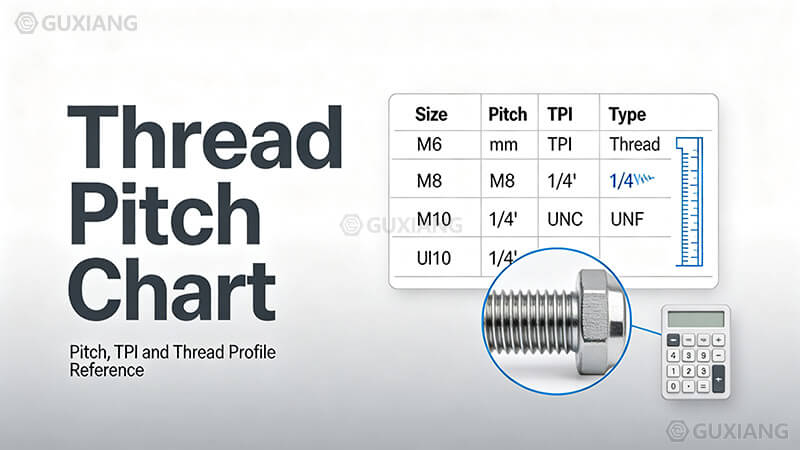
This comprehensive thread pitch chart covers UNC (Unified National Coarse), UNF (Unified National Fine), and 8UN (8 Threads per Inch Unified National) series for sizes #1 through 4 inch. Each entry includes threads per inch (TPI), pitch diameter, and tensile stress area — the three critical dimensions for thread selection, inspection, and engineering calculations. Use the interactive lookup tool or browse the complete data tables below.
Select a nominal size to view its thread data across all available series.
The diagram below illustrates the key dimensions referenced in the thread pitch tables. All Unified threads (UNC, UNF, 8UN) share the same 60-degree thread form angle but differ in pitch (threads per inch).
The Unified thread standard (ASME B1.1) defines three main thread series that share the same 60-degree thread form but differ in pitch:
UNC — Unified National Coarse
Fewer TPI, faster assembly, better resistance to cross-threading and galling. Default for general-purpose fastening. Available for all sizes #0 through 4".
UNF — Unified National Fine
More TPI, larger tensile stress area, finer adjustment. Used in thin materials, precision instruments, and vibration-prone applications. Available #1 through 1-1/2".
8UN — 8 Thread Series
Constant 8 TPI regardless of diameter. Used for large-diameter fasteners: anchor bolts, pressure vessels, pipe flanges. Available 5/8" through 4".
All dimensions in inches. TPI = Threads Per Inch. Pitch Diameter is the effective diameter at the thread engagement point. Tensile Stress Area is the effective cross-section for calculating maximum tensile load.
Was ist der Unterschied zwischen UNC und UNF Thread?
UNC (Unified National Coarse) und UNF (Unified National Fine) unterscheiden sich in Threads per Inch (TPI). UNC hat weniger Fäden pro Zoll, so dass es schneller zu montieren und widerstandsfähiger gegen Cross-Threading und Galling. UNF hat mehr Fäden pro Zoll, was eine größere Zugspannungsfläche und eine feinere Anpassungsfähigkeit bietet. Zum Beispiel hat ein 1/2-Zoll-Bolzen 13 TPI in UNC, aber 20 TPI in UNF. UNC ist der Standard für die Allzweckbefestigung; UNF wird in dünnwandigen Materialien, Präzisionsinstrumenten und Anwendungen bevorzugt, die Vibrationsbeständigkeit erfordern.
Wie berechne ich Pitch von TPI?
Pitch ist der Kehrwert von TPI (Threads per Inch). Die Formel lautet: Pitch (inches) = 1 / TPI. Zum Beispiel hat ein 1/2-13 UNC-Thread eine Tonhöhe von 1/13 = 0,0769 Zoll. Um in Millimeter umzurechnen, multiplizieren Sie mit 25.4: 0.0769 x 25.4 = 1.954 mm. Im metrischen System wird die Tonhöhe direkt in Millimetern ausgedrückt (z. B. M12 x 1,75 bedeutet 1,75 mm Tonhöhe). Bei Unified Threads ist die Steigung immer der Abstand von einem Fadenkamm zum nächsten, gemessen parallel zur Achse.
Was ist Zugspannungsfläche und warum ist es wichtig?
Tensile stress area (As) is the effective cross-sectional area of a threaded fastener that resists tensile load. It is calculated based on the average of the pitch diameter and minor diameter: As = 0.7854 x (D - 0.9382 x p)^2, where D is nominal diameter and p is pitch. This area is always smaller than the nominal (major) diameter area because the thread roots reduce the effective cross-section. Tensile stress area determines the maximum load a bolt can carry before failure: Maximum Load = Tensile Strength x Stress Area.
Was ist ein 8UN-Gewinde und wann wird es verwendet?
8UN (8 Threads per inch, Unified National) is a constant-pitch thread series with exactly 8 TPI regardless of diameter. It is available for sizes 5/8 inch and above. 8UN is commonly used in applications where a coarse, strong thread is needed on large-diameter fasteners, such as: anchor bolts, pressure vessel closures, pipe flanges, and heavy structural connections. The 8UN series provides a consistent thread geometry across all large sizes, simplifying tooling and inspection.
Was ist die Höhe einer [1 ]?
Das ist der Punkt, an dem die Rille gleich dem Grat ist. Es ist die wichtigste Dimension für Gewinde Fit und Austauschbarkeit. Für eine 1/2-13 UNC-Gewinde ist die Tonhöhe Durchmesser 0,4500 Zoll. Pitch Durchmesser wird mit einem Gewinde Mikrometer oder optischen Komparator gemessen und muss in die Toleranz Klasse (1A/2A/3A für externe Gewinde s, 1B/2B/3B für interne Gewinde s) fallen, die in ASME B1.1 angegeben sind.
Wie lese ich eine Gewinde-Bezeichnung wie 1/2-13 UNC-2A?
The designation 1/2-13 UNC-2A breaks down as follows: 1/2 is the nominal major diameter in inches, 13 is the threads per inch (TPI), UNC indicates the Unified National Coarse thread series, and 2A specifies the thread class for an external (bolt) thread. Thread classes: 1A is loose fit (easy assembly), 2A is standard commercial fit (most common), 3A is tight fit (maximum strength). For internal (nut) threads, the suffix letter is B instead of A.
Was ist das häufigste Gewindesteigung für einen 3/8 Zoll Schraube?
The most common thread for a 3/8 inch bolt is 3/8-16 UNC (16 threads per inch, coarse thread). This is the default choice for general-purpose applications. The fine thread alternative is 3/8-24 UNF (24 TPI), used when vibration resistance or finer adjustment is needed. The 3/8-16 UNC has a pitch diameter of 0.3344 inches and a tensile stress area of 0.0878 square inches.
Können UNC- und UNF-Threads ausgetauscht werden?
No, UNC and UNF threads cannot be interchanged. Although they share the same nominal diameter and 60-degree thread form, they have different TPI (threads per inch). A 1/2-13 UNC nut will not properly engage a 1/2-20 UNF bolt because the thread pitches are different (13 vs 20 TPI). Forcing them together will cross-thread and damage both components. Always match the TPI when selecting mating threads.
Was sind die Norm UNC-Gewinde Größen?
Standard UNC thread sizes per ASME B1.1 range from #0 (80 TPI) through 4 inch (4 TPI). The most commonly used sizes in industry are: #6-32, #8-32, #10-24, 1/4-20, 5/16-18, 3/8-16, 7/16-14, 1/2-13, 5/8-11, 3/4-10, 7/8-9, 1-8, 1-1/4-7, and 1-1/2-6. These sizes cover approximately 90 percent of general fastening applications.
How do I convert between inch thread pitch and metric thread pitch?
To convert inch TPI to metric pitch in millimeters: Metric Pitch (mm) = 25.4 / TPI. For example, 13 TPI converts to 25.4 / 13 = 1.954 mm pitch. To convert metric pitch to inch TPI: TPI = 25.4 / Metric Pitch (mm). For example, M12 x 1.75 converts to 25.4 / 1.75 = 14.5 TPI. Note that Unified and metric threads are not directly interchangeable even when pitches match, because the thread form dimensions and tolerances differ.