Metric Socket Head Cap Screws Size Table

metric-socket-head-cap-screws-size-table

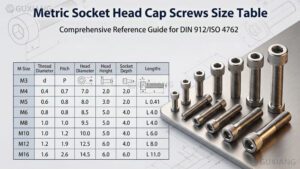
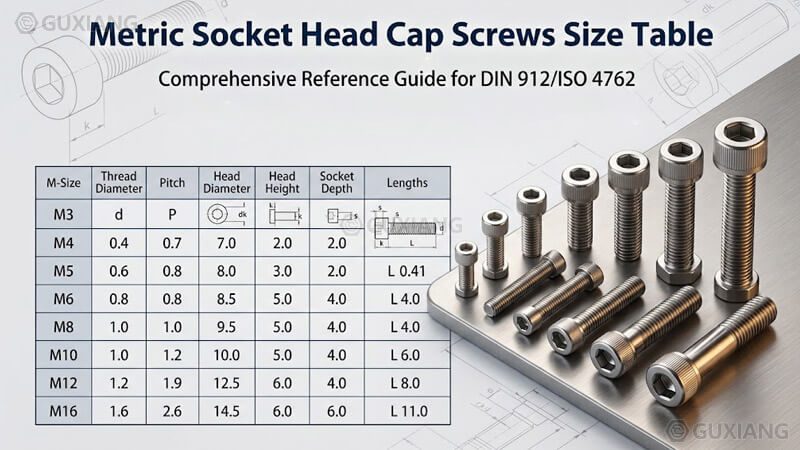
This comprehensive dimension table covers metric socket head cap screws (Allen head screws) from M1.6 to M48 per ISO 4762. Also known as Allen bolts or socket head cap screws (SHCS), these precision fasteners feature a cylindrical head with a recessed hexagonal socket drive, enabling high-torque application in confined spaces. Use the interactive lookup tool below for quick reference, or browse the full specification table for engineering data including body diameter, head diameter, head height, hex socket size, and key engagement depth.

Socket Head Cap Screw Dimension Lookup

Select a screw size to view its complete dimensional specifications.

Quick Size Lookup

Body Dia. D (mm)
Head Dia. A (mm)
Head Height H (mm)
Hex Socket J (mm)
Key Engage T (mm)
Chamfer S (mm)

Key Dimension Reference

The diagram below illustrates the key dimensions specified in ISO 4762 for metric socket head cap screws.

A (Head Dia.) H D J (Hex)
A = Head Diameter
H = Head Height
D = Body Diameter
J = Hex Socket Size

Complete Metric Socket Head Cap Screws Dimension Table

All dimensions in millimeters (mm). Data per ISO 4762. The size designation (e.g., M8 x 1.25) indicates the nominal thread diameter followed by the coarse thread pitch.

Size Pitch
(mm)
Body Dia. D
Max
Body Dia. D
Min
Head Dia. A
Max
Head Dia. A
Min
Head Height H
Max
Head Height H
Min
Chamfer S
Max
Hex Socket
J (mm)
Key Engage
T Min
Trans. Dia. B
Max
Small Sizes (M1.6 – M5)
M1.60.351.601.583.002.861.601.520.181.50.71.6
M20.402.001.983.803.652.001.860.201.51.02.0
M2.50.452.502.484.504.352.502.350.252.01.12.5
M30.503.002.985.505.323.002.820.302.51.33.0
M40.704.003.977.006.814.003.820.403.01.84.0
M50.805.004.978.508.295.004.820.504.02.35.0
Medium Sizes (M6 – M16)
M61.006.005.9610.009.786.005.820.605.02.56.0
M81.258.007.9613.0012.738.007.780.806.03.58.0
M101.5010.009.9516.0015.7310.009.781.008.04.410.0
M121.7512.0011.9518.0017.7312.0011.731.2010.05.312.0
M142.0014.0013.9321.0020.6714.0013.731.4012.06.214.0
M162.0016.0015.9324.0023.6716.0015.731.6014.07.116.0
Large Sizes (M20 – M48)
M202.5020.0019.9030.0029.6720.0019.482.0017.08.820.0
M243.0024.0023.9036.0035.3824.0023.482.4019.010.324.0
M303.5030.0029.9045.0044.3830.0029.483.0022.012.730.0
M364.0036.0035.8854.0053.1236.0035.383.6027.015.436.0
M424.5042.0041.8863.0062.1242.0041.384.2032.017.942.0
M485.0048.0047.8572.0071.1048.0047.354.8036.020.648.0

Understanding Socket Head Cap Screw Dimensions

Each dimension in the table serves a specific engineering purpose. Understanding what these measurements represent helps ensure proper fastener selection for your application.

Body Diameter (D)

The nominal thread diameter with max/min tolerances. This determines the tap drill size for the mating threaded hole. For example, M8 has a body diameter of 7.96–8.00 mm.

Head Diameter (A)

Approximately 1.5x the nominal diameter. This determines the minimum clearance hole diameter and the bearing surface area. An M8 screw has a head diameter of 12.73–13.00 mm.

Head Height (H)

Roughly equal to the nominal diameter. Provides the depth of the hex socket and determines the minimum vertical clearance needed. M8 head height is 7.78–8.00 mm.

Hex Socket (J)

The across-flats dimension of the internal hexagon. Determines which Allen key size is required. Always use the exact size to prevent socket rounding and stripped keys.

Key Engagement (T min)

Minimum depth the hex key must enter the socket for full torque transfer. Insufficient engagement is a leading cause of hex socket stripping during assembly.

Transition Diameter (B max)

The maximum diameter of the unthreaded body section below the head. Ensures the shoulder blends smoothly into the head without interference at the head-body junction.

Applicable Standards

Metric socket head cap screws are governed by several international standards. The correct standard depends on the application, material, and required performance class.

ISO 4762

Primary dimensional standard for metric socket head cap screws. Replaced DIN 912 in 2004. Covers M1.6 through M64 sizes with full tolerance specifications for all critical dimensions.

ISO 898-1

Mechanical properties standard — defines property classes (8.8, 10.9, 12.9) with corresponding tensile strength, yield strength, and hardness requirements for steel fasteners.

ISO 3506-1

Mechanical properties for stainless steel fasteners — covers A1 through A5 steel groups (corresponding to AISI 302, 304, 316, etc.) with property classes A2-50, A2-70, A4-50, A4-70.

DIN 912 (Superseded)

Former German standard for socket head cap screws, withdrawn in favor of ISO 4762. Minor dimensional differences exist for some sizes. New designs should specify ISO 4762.

Selection Guide

How to Specify a Metric Socket Head Cap Screw

  1. Identify the nominal size — Determine the required thread diameter (e.g., M8) based on the joint's load requirements. Use the body diameter data from the table above to calculate stress area.
  2. Select the thread pitch — Coarse pitch (standard) is the default for general assembly. Fine pitch variants provide better vibration resistance and finer preload adjustment but are more susceptible to galling.
  3. Determine the length — Length should provide at least 1x nominal diameter of thread engagement in the mating material for steel, 1.5x for aluminum, and 2x for softer materials. Standard lengths follow R20 series.
  4. Choose the property class — Class 12.9 for high-strength structural joints; Class 10.9 for general engineering; A2-70 or A4-70 stainless for corrosion resistance. The property class marking appears on the head of screws M5 and above.
  5. Specify surface treatment — Plain (black oxide) for indoor use; zinc flake coating for moderate corrosion protection; hot-dip galvanized for outdoor exposure; passivated stainless for chemical or marine environments.

Frequently Asked Questions

What is a metric socket head cap screw?
A metric socket head cap screw (SHCS) is a precision fastener with a cylindrical head and an internal hexagonal (Allen) socket drive. The head diameter is approximately 1.5 times the nominal thread diameter, and the head height is roughly equal to the nominal diameter. These fasteners are governed by ISO 4762 (formerly DIN 912) and are designed for high-torque applications in confined spaces where external wrench drive is not feasible.
What does the size designation M8 x 1.25 mean?
The designation M8 x 1.25 indicates a metric fastener with an 8 mm nominal thread diameter and a 1.25 mm thread pitch (the distance between adjacent threads). The M prefix denotes metric thread per ISO 68-1. Coarse thread series (e.g., M8 x 1.25) is the default; fine pitch variants (e.g., M8 x 1.0) are available for applications requiring higher vibration resistance or adjustment precision.
What is the difference between ISO 4762 and ISO 10644?
ISO 4762 specifies the dimensional requirements for metric socket head cap screws (the current standard, replacing DIN 912). ISO 10644 covers socket head cap screws with a flanged head, which adds an integrated washer face under the head for improved load distribution. The key difference is the flange: ISO 4762 has a plain cylindrical head bearing surface, while ISO 10644 includes a flange that eliminates the need for a separate washer and provides better clamp load retention on soft materials.
What is the hex socket size for an M6 socket head cap screw?
An M6 metric socket head cap screw uses a 5 mm hex socket (Allen key). The full mapping for common sizes is: M3 uses 2.5 mm, M4 uses 3 mm, M5 uses 4 mm, M6 uses 5 mm, M8 uses 6 mm, M10 uses 8 mm, M12 uses 10 mm, M16 uses 14 mm, and M20 uses 17 mm. Always use a correctly sized key to avoid rounding the socket.
What are the standard length sizes for metric socket head cap screws?
Standard lengths per ISO 4762 range from 2 mm (for very small sizes like M1.6) up to 200 mm (for M36 and M48). Preferred lengths follow an R20 series: 2, 2.5, 3, 4, 5, 6, 8, 10, 12, 16, 20, 25, 30, 35, 40, 45, 50, 55, 60, 65, 70, 80, 90, 100, 110, 120, 130, 140, 150, 160, 180, 200 mm. Not all lengths are available for every diameter; smaller sizes have shorter maximum lengths.
What material grades are available for metric socket head cap screws?
The most common material grades are: Class 12.9 (alloy steel, quenched and tempered, tensile strength 1220 MPa) for high-strength structural applications; Class 10.9 (alloy steel, tensile strength 1040 MPa) for general engineering; A2-70 stainless steel (AISI 304, tensile strength 700 MPa) for corrosion resistance; A4-70 stainless steel (AISI 316) for marine and chemical environments. Class 12.9 is the default for most industrial applications.
How do I determine the correct key engagement depth?
Key engagement depth (T min) is the minimum depth the hex key must enter the socket to achieve full torque without stripping. Per ISO 4762, values range from 0.7 mm (M1.6) to 20.6 mm (M48). As a rule of thumb, the key should engage at least 75% of the head height. If the screw is used in a deep counterbore, verify that the key can fully seat before applying torque.
What is the difference between a socket head cap screw and a button head screw?
Socket head cap screws (ISO 4762) have a cylindrical head with a height approximately equal to the nominal diameter, providing maximum head strength and torque capacity. Button head screws (ISO 7380) have a low-profile, domed head roughly half the height of a cap screw, offering a sleeker appearance but lower torque capability. Use cap screws for structural and high-torque joints; use button heads where appearance, low profile, or clearance above the joint is the priority.
What torque values should I use for metric socket head cap screws?
Recommended torque depends on size, grade, and lubrication. For Class 12.9 dry screws: M3 approximately 1.25 N-m, M4 approximately 3 N-m, M5 approximately 6 N-m, M6 approximately 10 N-m, M8 approximately 25 N-m, M10 approximately 50 N-m, M12 approximately 85 N-m. These values assume a friction coefficient of approximately 0.14. Always refer to the fastener manufacturer's specifications and apply torque in a star pattern for multi-bolt joints.
Can metric socket head cap screws be reused?
Reuse depends on the application class and condition. For non-critical joints, Class 10.9 and 12.9 screws can generally be reused if the threads are undamaged, the hex socket is not rounded, and no plastic deformation is visible. For safety-critical applications (aerospace, structural steel per EN 1090), many standards require replacement after a single use because the preload may have caused yield-level stress in the fastener. Stainless steel screws (A2/A4) are more prone to galling and should be inspected carefully before reuse.
Disclaimer: The data provided in this metric socket head cap screw size table is for general reference purposes only. Dimensions and tolerances may vary by manufacturer and applicable standards revision. Always verify critical dimensions against ISO 4762, ISO 898-1, or the original equipment manufacturer's specifications before procurement or installation. GUXIANG does not guarantee the accuracy or completeness of this data and assumes no liability for errors or omissions.

Related Engineering Resources

Table of Contents

Send Your Inquiry
Share: