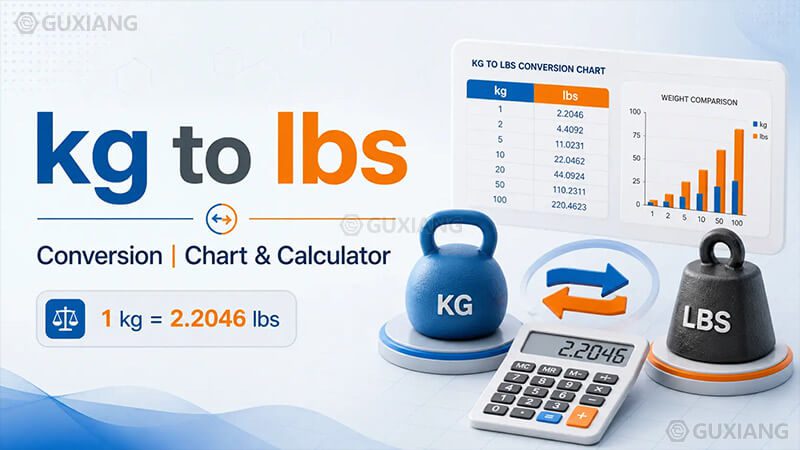
Convert kilograms to pounds instantly with the calculator below, or use the comprehensive conversion chart for quick reference. Covers values from 0.1 kg to 1,000 kg with decimal pounds and pounds-and-ounces results.
Kilograms to Pounds Calculator
⇄
Pounds + Ounces
—
Grams
—
Ounces
—
Metric Tons
—
Conversion Formula
1 kg = 2.20462 lbs
1 lb = 0.453592 kg
Multiply kg by 2.20462 to get lbs | Multiply lbs by 0.453592 to get kg
Common Conversions at a Glance
1 kg
↓
2.205 lbs
5 kg
↓
11.023 lbs
10 kg
↓
22.046 lbs
25 kg
↓
55.116 lbs
50 kg
↓
110.231 lbs
100 kg
↓
220.462 lbs
Complete kg to lbs Conversion Chart
This table provides precise kilogram-to-pound conversions for values commonly encountered in manufacturing, shipping, and industrial applications. Each entry shows the decimal pounds value and the equivalent in pounds and ounces for practical use.
Kilograms (kg)
Decimal Pounds (lbs)
Pounds & Ounces
Kilograms (kg)
Decimal Pounds (lbs)
Pounds & Ounces
Understanding the Units
⚖️
Kilogram (kg)
The base unit of mass in the International System of Units (SI). Defined by the Planck constant since 2019. Used worldwide in science, industry, and everyday commerce.
🏋️
Pound (lb)
A unit of mass in the imperial and US customary systems. The international avoirdupois pound is defined as exactly 0.45359237 kilograms. Primarily used in the United States.
🔧
When Conversion Matters
In manufacturing and fastener supply, weight specs may be listed in kg (metric suppliers) or lbs (US suppliers). Accurate conversion ensures correct material ordering, shipping costs, and load calculations.
📦
Ounces (oz)
1 pound = 16 ounces. For smaller weights, the pounds-and-ounces format is more practical than decimal pounds. Example: 5.75 lbs = 5 lbs 12 oz.
Quick Mental Conversion Tips
The "double and add 10%" rule. To convert kg to lbs mentally: double the kg value, then add 10%. For example, 40 kg → 80 → 80 + 8 = 88 lbs (actual: 88.18 lbs). Accurate within ~0.2%.
Remember key benchmarks. 1 kg ≈ 2.2 lbs, 10 kg ≈ 22 lbs, 50 kg ≈ 110 lbs, 100 kg ≈ 220 lbs. These anchors help you estimate quickly.
Reverse conversion trick. To convert lbs to kg: divide by 2.2 (or halve, then subtract ~10%). For example, 176 lbs → 176 ÷ 2.2 = 80 kg.
For precision work, use the exact factor. The exact conversion is 1 kg = 2.2046226218 lbs. Use the full factor for engineering calculations where rounding errors matter.
Verify with the calculator above. For any value, enter it in the calculator for an instant, precise conversion with multiple unit outputs (lbs, oz, grams, metric tons).
Frequently Asked Questions
Multiply the kilogram value by 2.20462. For example, 75 kg × 2.20462 = 165.35 lbs. The exact conversion factor is 1 kg = 2.2046226218 lbs (international avoirdupois pound). For quick mental math, double the kg value and add 10%.
1 kilogram equals exactly 2.2046226218 pounds (avoirdupois). For most practical purposes, this is rounded to 2.205 lbs. In pounds and ounces, 1 kg = 2 lbs 3.27 oz.
Multiply the pound value by 0.453592 (or divide by 2.20462). For example, 150 lbs × 0.453592 = 68.04 kg. A quick mental shortcut: halve the lbs value, then subtract about 10%.
Kilogram (kg) is the SI base unit of mass, used worldwide. Pound (lb) is an imperial/US customary unit, primarily used in the United States. 1 kg = 2.205 lbs. The kilogram is defined by the Planck constant; the pound is defined as exactly 0.45359237 kg.
50 kilograms equals 110.231 pounds (50 × 2.20462 = 110.231). In pounds and ounces, this is 110 lbs 3.7 oz. This is a common body weight reference — a 50 kg person weighs approximately 110 lbs.
100 pounds equals 45.359 kilograms (100 × 0.453592 = 45.359 kg). This is useful when converting body weight, shipping weights, or material specifications from US customary to metric units.
Most countries adopted the metric system (SI) during the 19th and 20th centuries for standardization in trade and science. The United States, Liberia, and Myanmar still primarily use the imperial/US customary system. In international trade and manufacturing, both systems coexist, making conversion essential.
First convert kg to decimal lbs (multiply by 2.20462). The whole number is the pounds. Take the decimal portion and multiply by 16 to get ounces. For example, 3.5 kg = 7.716 lbs = 7 lbs + 0.716 × 16 = 7 lbs 11.5 oz.
Since 2019, the kilogram is defined by fixing the Planck constant (h) at exactly 6.62607015 × 10⁻³⁴ J·s. This replaced the previous definition based on the International Prototype of the Kilogram (a platinum-iridium cylinder stored in France). The new definition ensures the kilogram is stable and reproducible anywhere.
Kilogram is technically a unit of mass, not weight. Mass is the amount of matter in an object and doesn't change with location. Weight is a force (measured in Newtons) that depends on gravity. However, in everyday usage, "weight" and "mass" are often used interchangeably, and scales calibrated for Earth's gravity display kg as a "weight" reading.
Disclaimer: The conversion data provided on this page is for general reference purposes only. While we strive for accuracy, conversion results should be verified against authoritative standards (NIST, BIPM) for critical engineering, scientific, or commercial applications. GUXIANG does not guarantee the accuracy or completeness of this data and assumes no liability for errors or omissions.
 ZH
ZH  EN
EN