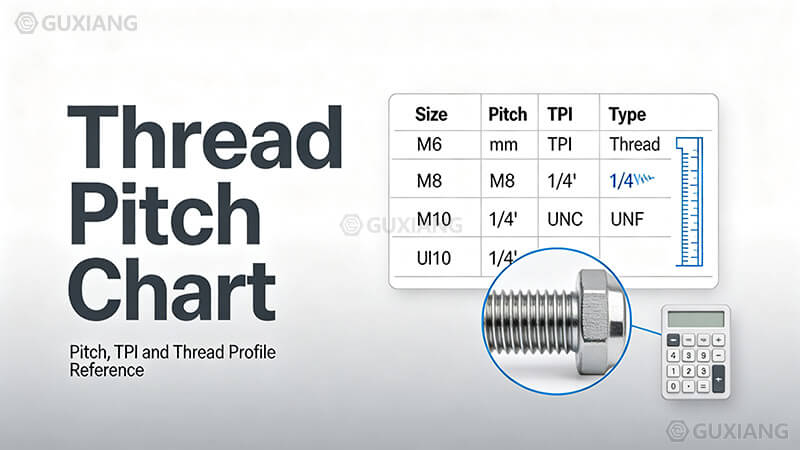
This comprehensive thread pitch chart covers UNC (Unified National Coarse), UNF (Unified National Fine), and 8UN (8 Threads per Inch Unified National) series for sizes #1 through 4 inch. Each entry includes threads per inch (TPI), pitch diameter, and tensile stress area — the three critical dimensions for thread selection, inspection, and engineering calculations. Use the interactive lookup tool or browse the complete data tables below.
Select a nominal size to view its thread data across all available series.
The diagram below illustrates the key dimensions referenced in the thread pitch tables. All Unified threads (UNC, UNF, 8UN) share the same 60-degree thread form angle but differ in pitch (threads per inch).
The Unified thread standard (ASME B1.1) defines three main thread series that share the same 60-degree thread form but differ in pitch:
UNC — Unified National Coarse
Fewer TPI, faster assembly, better resistance to cross-threading and galling. Default for general-purpose fastening. Available for all sizes #0 through 4".
UNF — Unified National Fine
More TPI, larger tensile stress area, finer adjustment. Used in thin materials, precision instruments, and vibration-prone applications. Available #1 through 1-1/2".
8UN — 8 Thread Series
Constant 8 TPI regardless of diameter. Used for large-diameter fasteners: anchor bolts, pressure vessels, pipe flanges. Available 5/8" through 4".
All dimensions in inches. TPI = Threads Per Inch. Pitch Diameter is the effective diameter at the thread engagement point. Tensile Stress Area is the effective cross-section for calculating maximum tensile load.
What is the difference between UNC and UNF thread?
UNC (Unified National Coarse) and UNF (Unified National Fine) differ in threads per inch (TPI). UNC has fewer threads per inch, making it faster to assemble and more resistant to cross-threading and galling. UNF has more threads per inch, providing a larger tensile stress area and finer adjustment capability. For example, a 1/2 inch bolt has 13 TPI in UNC but 20 TPI in UNF. UNC is the default for general-purpose fastening; UNF is preferred in thin-walled materials, precision instruments, and applications requiring vibration resistance.
How do I calculate pitch from TPI?
Pitch is the reciprocal of TPI (threads per inch). The formula is: Pitch (inches) = 1 / TPI. For example, a 1/2-13 UNC thread has a pitch of 1/13 = 0.0769 inches. To convert to millimeters, multiply by 25.4: 0.0769 x 25.4 = 1.954 mm. In the metric system, pitch is expressed directly in millimeters (e.g., M12 x 1.75 means 1.75 mm pitch). For Unified threads, the pitch is always the distance from one thread crest to the next, measured parallel to the axis.
What is tensile stress area and why does it matter?
Tensile stress area (As) is the effective cross-sectional area of a threaded fastener that resists tensile load. It is calculated based on the average of the pitch diameter and minor diameter: As = 0.7854 x (D - 0.9382 x p)^2, where D is nominal diameter and p is pitch. This area is always smaller than the nominal (major) diameter area because the thread roots reduce the effective cross-section. Tensile stress area determines the maximum load a bolt can carry before failure: Maximum Load = Tensile Strength x Stress Area.
What is 8UN thread and when is it used?
8UN (8 Threads per inch, Unified National) is a constant-pitch thread series with exactly 8 TPI regardless of diameter. It is available for sizes 5/8 inch and above. 8UN is commonly used in applications where a coarse, strong thread is needed on large-diameter fasteners, such as: anchor bolts, pressure vessel closures, pipe flanges, and heavy structural connections. The 8UN series provides a consistent thread geometry across all large sizes, simplifying tooling and inspection.
What is the pitch diameter of a thread?
Pitch diameter is the diameter of an imaginary cylinder that passes through the thread at the point where the thread groove width equals the thread ridge width. It is the most critical dimension for thread fit and interchangeability. For a 1/2-13 UNC thread, the pitch diameter is 0.4500 inches. Pitch diameter is measured with a thread micrometer or optical comparator and must fall within the tolerance class (1A/2A/3A for external threads, 1B/2B/3B for internal threads) specified in ASME B1.1.
How do I read a thread designation like 1/2-13 UNC-2A?
The designation 1/2-13 UNC-2A breaks down as follows: 1/2 is the nominal major diameter in inches, 13 is the threads per inch (TPI), UNC indicates the Unified National Coarse thread series, and 2A specifies the thread class for an external (bolt) thread. Thread classes: 1A is loose fit (easy assembly), 2A is standard commercial fit (most common), 3A is tight fit (maximum strength). For internal (nut) threads, the suffix letter is B instead of A.
What is the most common thread pitch for a 3/8 inch bolt?
The most common thread for a 3/8 inch bolt is 3/8-16 UNC (16 threads per inch, coarse thread). This is the default choice for general-purpose applications. The fine thread alternative is 3/8-24 UNF (24 TPI), used when vibration resistance or finer adjustment is needed. The 3/8-16 UNC has a pitch diameter of 0.3344 inches and a tensile stress area of 0.0878 square inches.
Can UNC and UNF threads be interchanged?
No, UNC and UNF threads cannot be interchanged. Although they share the same nominal diameter and 60-degree thread form, they have different TPI (threads per inch). A 1/2-13 UNC nut will not properly engage a 1/2-20 UNF bolt because the thread pitches are different (13 vs 20 TPI). Forcing them together will cross-thread and damage both components. Always match the TPI when selecting mating threads.
What are the standard UNC thread sizes?
Standard UNC thread sizes per ASME B1.1 range from #0 (80 TPI) through 4 inch (4 TPI). The most commonly used sizes in industry are: #6-32, #8-32, #10-24, 1/4-20, 5/16-18, 3/8-16, 7/16-14, 1/2-13, 5/8-11, 3/4-10, 7/8-9, 1-8, 1-1/4-7, and 1-1/2-6. These sizes cover approximately 90 percent of general fastening applications.
How do I convert between inch thread pitch and metric thread pitch?
To convert inch TPI to metric pitch in millimeters: Metric Pitch (mm) = 25.4 / TPI. For example, 13 TPI converts to 25.4 / 13 = 1.954 mm pitch. To convert metric pitch to inch TPI: TPI = 25.4 / Metric Pitch (mm). For example, M12 x 1.75 converts to 25.4 / 1.75 = 14.5 TPI. Note that Unified and metric threads are not directly interchangeable even when pitches match, because the thread form dimensions and tolerances differ.
 ZH
ZH  EN
EN