





金属螺栓在产生或腐蚀时会失效。塑料紧接器在蠕动后会失效,从热中会软化,或者在紫外线下会软化. 降解机理完全不同,对钢材有效的选择逻辑——选取分级,检查抗拉强度,外观涂装——并不靠岸. 塑料紧接剂按聚合物类型指定,不是合金等级,关键工程性质是热变形量温度,化学相容性,水分吸收,并随时间推移而有蠕动模具. 尼龙螺丝在一日持有10个MPa的夹紧力,半年后在60°C的湿润发动机舱内可能持有不到5个MPa.
本指南涵盖紧固件生产中使用的6个聚合物家族,它们的机械和热特性,限制使用寿命的四种降解机制,消耗了大部分塑料紧固件Z的汽车应用,以及防止过早故障的选择标准.
为何汽车满足了塑料紧固件0的多数
汽车工业是塑料紧固件的单一最大消费者,估计占全球产量的60–70%. 一辆现代客车包含在 1,500和3,000个人塑料紧固件 保留剪接面板、固定接线管、安装传感器、接接接保险杠盖并持有曾经被拉动或被金属搅拌过的内饰.
汽车组装中由金属向塑料的转变是由钢和铝无法同时匹配的四个因素所驱动的: 金属与铝Z在金属与汽车组装中的相接性
减重. 塑料紧固件的重量比它们的等效钢低60-80%. 塑料推杆能保证室内门面板的重量约为0.8克. 取而代之的钢螺丝和夹子重为4-5克. 在每辆汽车2 000个紧固件之间,这种差异累积到大约8公斤——有助于减少重量、燃料消耗和排放的材料合规Z而不增加结构值。对于每节省一公斤重量的电动车辆平台而言,在车辆寿命期间估计可延长1至3公里,因此,减少塑料紧身车重量已不再是可选的.
电气隔离. 引擎舱的钢铁紧固件制造出意想不到的地道和花花公子. 金属螺丝通过电线吊带插入体面板,可以使电线隔热超过上千个热循环和振动时数,产生间歇性短裤来挫败诊断技术人员. 塑料紧固件本质上是含入入入入入入入入入入入入入入入入入入入入入入入入入入入入入入入入入入入入入入入入入入入入入入入入入入入入入入入入入入入入入入入入入入入入入入入入入入入入入入入入入入入入入入入入入入入入入入入入入入入入入入入入入入入入入入入入入入入入入入入入入入入入入入入入入入入入入入入入入入入入入入入入入入入入入入入入入入入入入入入入入入入入入入入入入入入入入入入入入入入入入入入入入入入入入入入入入入入入入入入入入入出出出出出出出出出出出出出出出出出出出出出出出出出出出出出出出出出出出出出出出出出这在混合动力和电动车辆的高压结构中很重要,其中紧固件造成的短路不是麻烦故障,而是安全隐患.
噪音、震动和严酷的隔离. 金属上螺栓接合的金属通过结构高效地传递振动能. A 塑料紧固件-用下相模(尼龙 6/6:~3 GPa vs 钢:~200 GPa)和高相坝平)吸收振动能并减少机舱噪音. 汽车质量数据库中最常见的保修投诉是追踪到金属夹片留存器的内饰叫声和响尾蛇。越来越多地被OEM设计标准所采纳的固定装置是完全去除与塑料保留系统的金属对金属接口.
Galvanic豁免和避免费用. 铝体面板中的"钢"紧固件创造出一对经典的"银相"——钢是铝的阴极,而"铝"的腐蚀环绕了紧固件洞. 反制措施——涂有钢的紧固件,隔离洗涤器,密封器——增加了成本,组装步骤和质量审计点. 塑料紧固件完全因为无导电而消除了伽梵电路. 紧固件Z ZH2ZZ的成本高于镀锌钢螺钉(一尼龙推杆成本大约为$0.03-0.08对$0.01-0.03钢螺钉的体积),但所安装的成本——计入已消除的腐蚀对策——通常较低.
Plastic Fastener Types: Beyond the Screw-Nut Paradigm
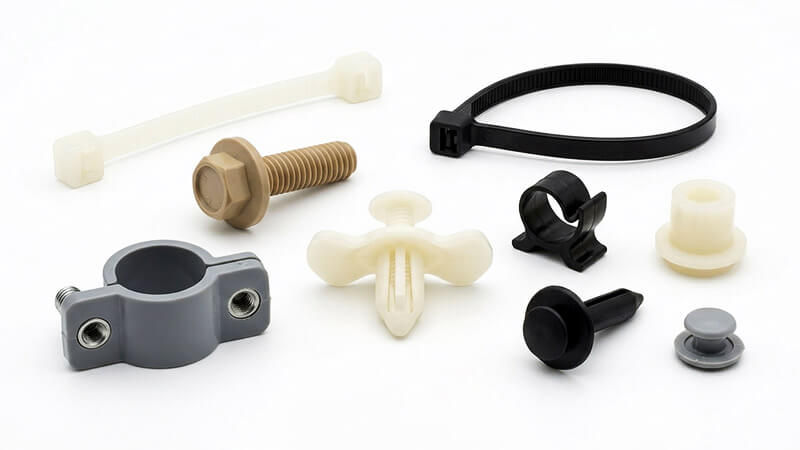
Plastic fasteners do not simply replicate metal fastener geometries in a different material. The manufacturing economics and material properties of polymers enable fastener designs that make no sense in metal. The five major categories:
Push-Pin / Push-Type Fasteners
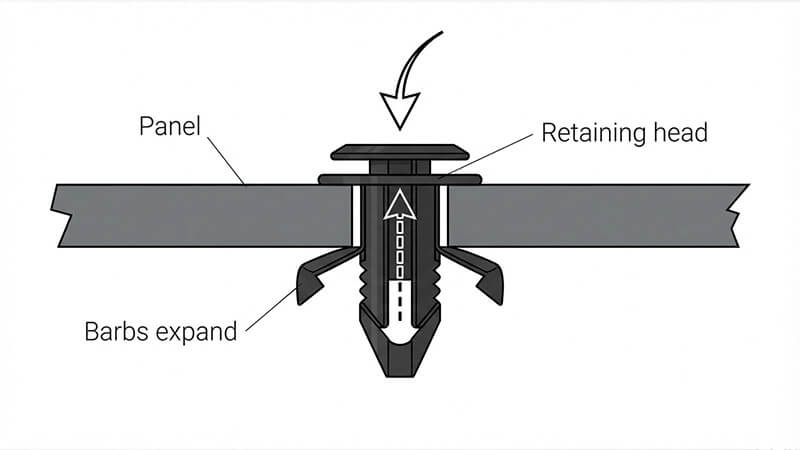
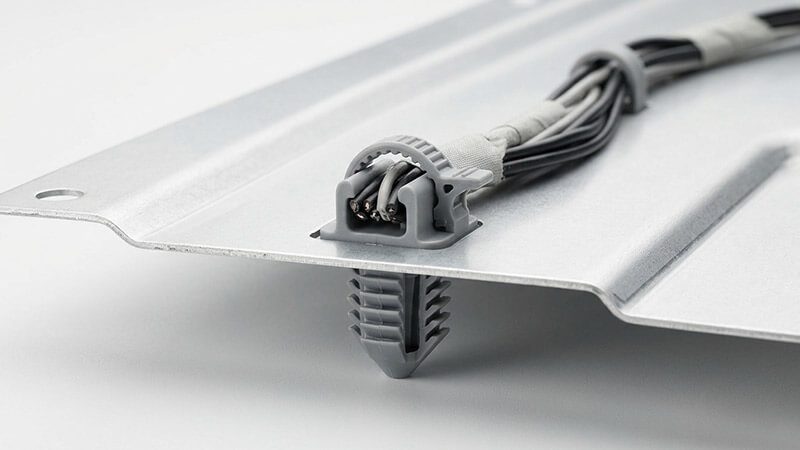
The push-pin is the highest-volume plastic fastener type in automotive production. A tapered or ribbed body with a retaining head is pressed through a pre-punched hole in the mating panel. Flexible fins or barbs expand behind the panel to resist pull-out. Installation is a single linear motion requiring no rotation, no torque control, and no access to the back side of the joint. Removal — when service is required — uses a forked prying tool that slips under the head and levers the pin out.
Push-pins serve non-structural retention: interior trim panels, door cards, dashboard fascias, wheel arch liners, and underbody splash shields. Pull-out strength for a typical automotive push-pin ranges from 50–200 N, enough to hold a trim panel against road vibration but not enough for load-bearing structural joints.
Snap Rivets
Snap rivets join two panels by expanding behind the second panel after the mandrel is pressed through. Unlike metal blind rivets that require a setting tool and permanently deform, many plastic snap rivets are reusable — the mandrel can be pushed back out with a pin punch to disassemble the joint. This reusability is a significant advantage for assemblies that must be serviced periodically, such as battery covers, fuse box lids, and inspection panels.
Cable Clips and Harness Retainers
Wiring harness routing is the single largest application for plastic fasteners in a vehicle by part count. Cable clips (also called P-clips, fir-tree clips, or harness retainers) snap into pre-punched holes in the vehicle body and hold wire bundles, brake lines, fuel lines, and sensor cables in fixed routing paths. The critical specification parameter is the clip’s retention force in the mounting hole — a harness clip that vibrates loose releases a wiring bundle into a zone where it can chafe against metal edges, creating a latent electrical fault.
Threaded Plastic Fasteners (Screws, Bolts, Nuts)
Plastic screws and nuts exist and work, but the design rules differ sharply from metal. A plastic screw thread cannot sustain the preload that a metal bolt achieves because the material creeps under sustained tension. The practical torque for a nylon M6 screw is typically 0.5–1.5 N·m — roughly 10–20% of the torque an equivalent steel screw would see. Threaded plastic fasteners are used where electrical isolation, chemical resistance, or weight reduction matters more than clamping force: mounting PCBs to plastic housings, securing sensors in corrosive environments, and fastening components inside chemical processing equipment.
Cable Ties (Zip Ties)
Cable ties are technically fasteners — they provide a clamping function around a bundle — and are the highest-volume plastic fastening product by unit count. A single vehicle uses 50–200 cable ties for harness routing alone. The material is almost exclusively nylon 6/6, selected for its combination of tensile strength, flexibility, and heat resistance at engine-bay temperatures. Heat-stabilized nylon 6/6 cable ties (rated to 125°C continuous) are specified for under-hood applications, while standard nylon ties (rated to 85°C) serve interior and chassis routing.
A complete taxonomy of plastic fastener types — push-pins, snap rivets, clips, and screws — is available for specification and procurement work.
Polymer Families: A Material Properties Matrix
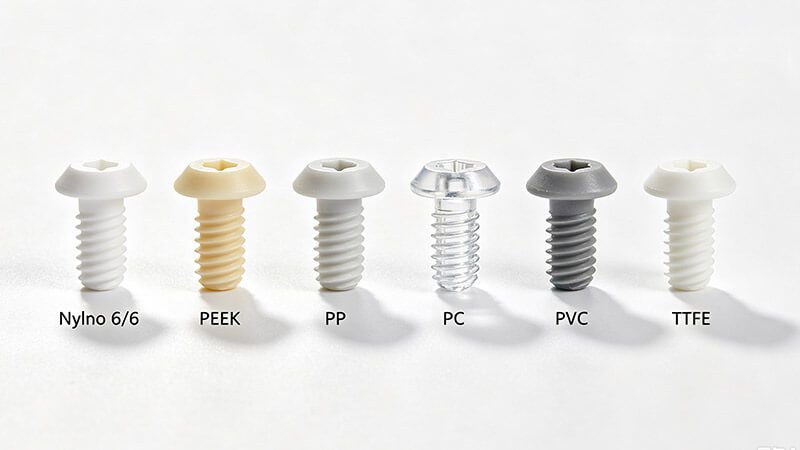
Plastic fastener selection begins with polymer selection, and polymer selection turns on four numbers: maximum continuous service temperature, tensile strength, chemical compatibility, and cost. The table below maps the six polymers that account for the vast majority of fastener production.
| Polymer | 抗拉强度(MPa) | HDT at 1.82 MPa (°C) | Continuous Use Temp (°C) | Water Absorption (24h) | 相对成本 | Key Property |
|---|---|---|---|---|---|---|
| 尼龙 6/6(第66页) | 75–85 (干)/ 55–65 (电话) | 65–75 | 85–120 | 2.3–2.8% | 1.0(基线) | 最佳全方位兵力/费用平衡 |
| PEEK | 95–110 | 155–165 | 240–260 | 0.10–0.15% | 40–60× | 极端热能和化学性能 |
| 聚丙烯(PP) | 30–38 | 50–60 | 80–100 | < 0.01% 号 | 0.4–0.6× | 每美元最佳化学耐药性 |
| 聚碳酸酯(PC) | 60–70 | 125–135 | 110–125 | 0.12–0.18% | 1.5–2.5× | 高影响强度,透明 |
| 聚氯乙烯(Rigid) | 40–55 | 60–70 | 55–65 | 0.05–0.15% | 0.6–0.8× | 自脱脂、抗酸/抗碱 |
| PTFE | 20–30 | 50-55 (未填) | 250–260 | < 0.01% 号 | 15–25× | 近普遍化学惰性、最低摩擦 |
抗拉强度每ASTM D638. ASTM D648的HDT在1.82 MPa. 从聚合物生产者数据表(UL 746B 相对热能指数)中持续使用温度. ASTM D570(24小时浸入)水吸收. 从2026年起,按商品量的原始材质定价计算的相对成本.
尼龙 6/6(PA66):工作马
Nylon 6/6估计占了所有塑料紧固件的70-80%。原因很简单:它是具有足够强度和耐热性的汽车内部和一般工业用途的最小的聚合物,它高速地注入多发性极强的薄块,其机械特性在数十年的生产数据中得到很好的描述 ASTM D4066 尼龙分类标准.
尼龙紧固件的关键设计警告是水分调节. Nylon 6/6在被浸入24小时(ASTM D570)后按重量吸收了2.3-2.8%水,在潮湿环境中饱和时可吸收到8-9%. 随着水分含量的上升,抗拉强度下降——在50%相对湿度平衡时,从大约80兆帕干燥后降至55-60兆帕. 紧固件也膨胀:一尼龙6/6部分在1%水分吸收后,得到约0.6%维度. 这意味着湿环境中的尼龙螺会比干燥环境中的同一种螺丝更弱并稍大. 设计者通过使用干-现成维度进行适中计算和负载计算附条件强度值来对此进行说明.
热稳定尼龙6/6(有卤化铜或其他抗氧化剂添加剂)将持续使用温度从85°C延长至约125°C,使其适合从直接排出联系到下体应用. 玻璃纤维-再生尼龙(PA66-GF30,30%玻璃纤维按重量计算)将抗拉强度提升到约160–180 MPa,而HDT提升到240–250°C,但纤维加固使材质异构-强度随发模过程中的出行方向而变化-并增加了口感.
PEEK: 当成本是次要到性能时
PEEK(polyetherketone)是工程师所指明的尼龙不够时的高性能聚合物. 其持续使用温度为240-260°C,使其与一些金属处于相同的热服务范围. 它的抗拉强度为95–110MPa,在强度到重量的基础上与扁平相匹敌. 其化学耐受性几乎覆盖了高温下浓缩的硫酸和硝酸所缺的一切. 而它的蠕动阻力——在持续负载应用中最能限制热塑性紧固件的特性——比起尼龙来说,其数量级更好.
限制是费用。 PEEK的原材料每公斤成本比尼龙6/6多出约40-60倍. 一台PEEK M6螺钉每件成本为$2–5,而尼龙等价为$0.05–0.10. PEEK 紧固件出现在航空航天发动机组件中,半导体瓦费处理设备,油气下洞工具,医疗植入组件,以及任何金属接合器会腐蚀,进行供电,或者增加不可接受的重量的地方.
聚丙烯(PP):预算中的化学品耐受性
聚丙烯紧固件几乎完全用于化学耐受性。 PP在室温下受到极少数物质的攻击——集中氧化酸,氯化溶剂,高温下的一些烃类是主要例外. 对于酸性贮存罐配件、实验室的设备、电池箱五金件和化学加工线组件,PP 紧固件提供了约3-5%成本接近PTFE的防腐蚀性能.
取舍:机械属性贫. PP 抗拉强度为30–38 MPa,是六大聚合物家族中最低的. 60°C以下的HDT是指PP 紧固件在靠近热源的地方不能被使用. 克里普阻力差——一种PP 螺钉在高温下持续负载,在数小时内放松到接近0预负载. PP 紧固件是用于化学相容性的,没有其他用途.
聚碳酸酯:影响强度和清晰度
聚碳酸酯紧固件填补了狭长的优势:需要具有视觉清晰度或电绝缘性的高撞击阻力的应用. 聚碳酸酯的Izod撞击强度(600-850焦耳/米,注)是任何未填充的热塑性物质中最高的——一个PC收紧器会吸收一个撞击来粉碎一个尼龙或同几何部分的PP. 保护性设备覆盖物、受粗糙处理的电气封装紧固件以及医疗器械中使用的透明紧固件Z,其中需要视同的检验Z.
PVC:自我延长和具有成本效益
硬性聚氯乙烯紧固件有两个专门的作用:在自灭行为(UL 94 V-0无添加剂)是强制性的应用中,电气封接五金件Z,在酸和碱服务中,化学加工紧固件. 聚氯乙烯由于其含氯量而具有内在的阻燃剂——在取出火焰源时,它具有燃烧和自灭作用,而不需要添加性阻燃剂,这种阻燃剂可以随时间推移而出.
PTFE:近乎普遍化学惰性
PTFE 紧固件是化学相容性的最后手段. 当过程液溶解出尼龙,浸出聚丙烯和应力-裂缝聚碳酸酯后,PTFE活取. 它在室温下基本上没有受到任何攻击,只有高压下熔化的碱金属和氟气除外。其摩擦系数(0.05–0.10对钢,是任何固体中最低的)使得PTFE 螺钉本身作为低冷冻轴承有效.
机械处罚是严厉的:抗拉强度为20–30 MPa为尼龙的三分之一和PEEK的五分之一. PTFE 紧固件不能携带显著的结构负载. 他们被指定为化学护照,而不是体能.
失败机制: 塑料如何降解
塑料没有生锈,但是它们通过金属紧固件工程中没有直接模拟的四种机制来降解. 了解每个人对服务寿命预测至关重要.
克里普 (冷流)
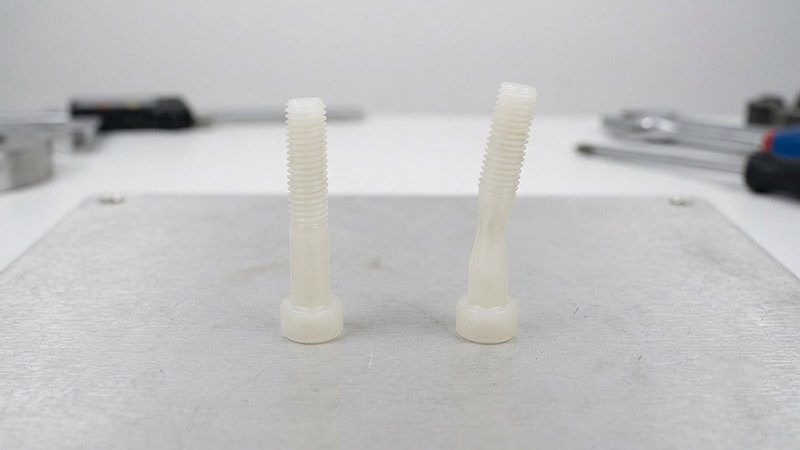
克里普(Creep)是指在持续载荷下于屈服强度下的聚合物缓慢而永久地变形. 它是一种粘性现象——聚合物链随时间推移而相向地滑走,使紧固件的夹力降低到关节松动或紧固件断裂.
爬行是非线性的有温度。位于23°C的尼龙6/6 紧固件在1000小时后保留了80%的初始预装可在同一期间仅保留了80°C的30%. 因此,线状塑料紧固件几乎从未在高温下用于持续加分应用。实用规则:如果一个联合体在服务了1000小时后至少需要夹紧力,而且服务温度超过聚合物HDT的50%, 金属紧固件 以隔离取代塑料,因为聚合物 蠕动会随着温度的指数加速 在时间温度叠加原则下.
塑料的爬行数据通常以爬行模具(在特定时间和温度下显出模具)或爬行分解曲线(压力与出错)的形式呈现。 ISO 899和ASTM D2990定义了标准测试方法. 在负载应用中与塑料Z紧固件合作的设计者参考了这些曲线,而不是短期测试中即时抗拉强度.
Thermal Degradation and Heat Deflection
Every plastic has a Heat Deflection Temperature (HDT) measured per ASTM D648 at a specified stress (usually 1.82 MPa for engineering applications). This is not a melting point — it is a practical indicator: the temperature at which a standard test bar deflects 0.25 mm under load. A plastic fastener operating above its HDT loses dimensional stability and cannot maintain joint geometry.
Long-term thermal degradation occurs below the HDT through oxidative chain scission — polymer chains break at elevated temperature in the presence of oxygen, reducing molecular weight and embrittling the material. Heat-stabilized nylon grades include antioxidant additives that slow this process, extending service life by years at engine-bay temperatures. Non-stabilized nylon fasteners in under-hood applications can embrittle within 12–24 months.
紫外线降解
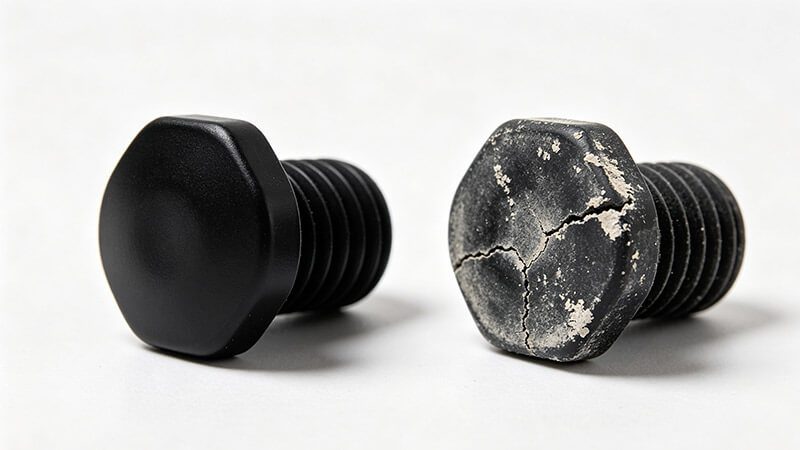
UV radiation (290–400 nm wavelength) breaks polymer chains through photodegradation, causing surface chalking, micro-cracking, and loss of tensile strength. Nylon 6/6 is particularly UV-sensitive — unprotected nylon fasteners exposed to direct sunlight lose 30–50% of tensile strength within 12–24 months of outdoor exposure. UV-stabilized grades (with carbon black or hindered amine light stabilizers, HALS) extend outdoor service life to 5–10 years. Carbon black is the most effective and lowest-cost UV stabilizer for nylon, which is why most outdoor-rated plastic fasteners are black.
Chemical Attack and Environmental Stress Cracking
Chemical degradation of plastic fasteners falls into three categories: dissolution (the polymer dissolves in the chemical, as polystyrene dissolves in acetone), chemical reaction (the polymer is attacked and degraded, as nylon is hydrolyzed by strong acids), and environmental stress cracking (ESC — a combination of tensile stress and a chemical environment that causes brittle fracture at stress levels far below the material’s yield strength).
ESC is the most insidious because it occurs without visible chemical attack. A polycarbonate fastener under modest assembly stress in contact with a hydrocarbon-based grease can fracture spontaneously after weeks of exposure, while an unstressed PC sample in the same grease shows no degradation. The mechanism: the chemical penetrates micro-voids in the stressed polymer, plasticizes the polymer chains at the crack tip, and enables crack propagation at stresses that would be safe in air. ESC resistance must be verified for the specific polymer-chemical-stress combination — there is no universal compatibility chart.
A comprehensive plastic fastener chemical resistance reference covers over 50 chemical agents across all six polymer families.
Installation and Removal: Tools and Techniques
Plastic fasteners create a unique service problem: they are engineered for one-way assembly. A push-pin goes in with a palm strike and stays in. Removing it 50,000 km later to replace a door speaker requires a specialized prying tool that the vehicle owner does not own.
Removal Tools
The forked trim panel removal tool — a flat blade with a V-notch cut into the tip — is the universal plastic fastener removal instrument. The fork slides under the fastener head, levers against the panel surface, and extracts the pin without gouging the surrounding trim. Professional-grade tools are made of glass-fiber-reinforced nylon (the tool itself demonstrates the material it removes). Kits containing 5–11 different pry bar geometries cover push-pins, fir-tree clips, snap rivets, and wiring harness retainers across multiple vehicle brands.
The common failure mode in DIY removal: using a flat-blade screwdriver that mars the trim panel around the fastener head. The scratch is permanent and visible. The $8 trim tool kit is the cheapest bodywork insurance a vehicle owner can buy.
Installation: Torque Considerations
Threaded plastic fasteners demand torque control far more precise than 金属紧固件. 扭矩到故障的窗口是窄的:一尼龙M6螺丝把它的线条从一尼龙坚果中约1.5-2.0 N~m. 建议的安装扭矩一般为0.5-1.0 N-m-大多数为金属紧固件所建的组装工具无法可靠地瞄准这个范围. 装有精度扭矩控制的托克限制螺丝机或电动驱动器,对于用线状塑料紧固件组装的生产实际上具有强制性.
对于推杆和相接力,安装力保持在足够低的水平,可以进行手动装配——一般为每接针30-80N接入力. 自动装配站使用有强制监测功能的充气或伺服驱动的插入工具,在车辆移动到下个站前检测出误接孔或缺失的接收器.
选择指南: 将聚合物匹配到应用
| 应用环境 | 温度范围 | 化学物质暴露 | 建议的聚合物 | 为什么 |
|---|---|---|---|---|
| 汽车内部修剪 | -30至80°C | 无重大 | 尼龙6/6 | 成本最佳,足够强壮,在客舱临时工上不错 |
| 下层(排出排出) | -40至125°C | 油,冷却剂喷出 | 热稳定式尼龙 6/6或GF-尼龙 | 足够高的热能范围、足够的化学耐受性 |
| 下层(靠近废气/涡轮) | -40至200°C | 石油、燃料、制动液 | PEEK | 仅有有持续热室的聚合物 |
| 电池包/EV高压 | -40至85°C | 电解气(离子) | 尼龙 6/6或PP 键 | 电绝缘;验证ESC对电解质的耐受性 |
| 化学储存罐 | 0至40°C (中文(简体) ) | 聚酸盐 | 聚氯乙烯或聚氯乙烯 | PP 对于酸,PVC对于酸+碱;没有金属腐蚀风险 |
| 实验室/清洁室 | 15-30°C (中文(简体) ) | 溶剂、试剂 | PTFE 或 PEEK | 通用化学惰性 |
| 户外建筑 | -20至60°C | 紫外线、雨 | 尼龙 6/6(碳黑色) | 紫外线稳定尼龙实现5-10年室外生活 |
| 食品加工设备 | 0至100°C | 食物酸、冲洗化学品 | 尼龙 6/6(FDA达标等级)或PEEK | FDA 合规对清洁剂的化学抗药性 |
| 电气附件(室内) | 0至60°C | 无重大 | 尼龙 6/6或聚氯乙烯(如果需要V-0) | 尼龙成本; PVC 仅限自定义强制使用 |
| 电网(室外) | -20至80°C | 紫外线、雨和可能的化学漂移 | 尼龙 6/6或个人计算机 | 防撞击PC+ 必要时的透明度 |
标准和规格
ASTM D4066 将尼龙注射模具和挤压材料分类,定义了区分尼龙6,尼龙6/6,尼龙6/10及其强化和热稳定变体的术语系统. 紧固件绘制出“PA66 / ASTM D4066”表示基聚合物,但没有具体说明添加剂包——热稳定、紫外稳定或玻璃纤维含量,必须单独说明,因为 ASTM D4066 仅定义基聚合物分类.
ISO 1043 (韩语) 定义了塑料的标准化符号和缩写术语——尼龙 6/6的“PA66”,聚醚酮的“PEEK”,聚丙烯的“PP”等。这些符号,标准化于 ISO 1043 (韩语), 在模版部分标识和工程图纸上出现.
UL 94 是塑料材料的可燃性标准,而V-0/V-1/V-2/HB评级是电气和电子设备标准中最常被引用的消防安全要求。在北美或欧洲销售的产品中的电器封口内装有塑料粘接器,几乎总是在产品的安全性认证文件中写上UL 94评级要求.
ASTM D638 (英语) 定义塑料的抗拉强度测试——聚合物数据表所引用的抗拉强度值的来源. ASTM D648定义了HDT测试. ASTM D570定义了水吸收. 这三个标准共同为任何塑料紧固件材料提供了机械和环境属性基线.
关于测试框架和规格要求的完整走通,请参见: 塑料标准参考.
常见问题解答
能够替换塑料0 ZZ 金属紧固件 在结构应用程序中?
不,除了一个狭义的例外。塑料紧接器没有抗拉强度或结构关节的蠕动阻力,必须长期维持钳口负荷。碳钢和不锈钢仍然是负载螺栓连接的唯一可行材料。例外:低载结构应用中的玻璃-纤维-再加固尼龙紧固剂,其中电阻和腐蚀免疫是主要要求——多氯联苯起重、传感器括号和腐蚀大气层中非结构括号。咨询特定聚合物在服务温度下的蠕动分解数据,以核实所需的夹口负荷在设计寿命期间保持不变.
为什么我的尼龙一直放轻松?
最可能的原因是蠕动放松,而不是振动放松. 随着聚合物链在压力下重排,持续张力下的尼龙螺丝会随着时间而失去预装. 速度随温度而呈指数增长. 解决方案:将初始预装量降低到一个水平,聚合物可以根据蠕动模组数据维持;在塑料组件中切换为金属螺纹嵌件,由金属螺丝提供夹紧力;或重新设计接头,使塑料紧固件作为保留器而不是夹子的功能——紧固件防止部件分离,但不携带压缩预装.
我如何辨别塑料的聚合物是用什么制成的?
Molded 塑料紧固件常被标记为ISO 1043聚合物符号(PA66,PP,PC等)并可能有一个玻璃纤维含量指标(GF30 = 30%玻璃纤维). 如果未加标记,烧伤试验提供粗糙的识别:尼龙用蓝黄色火焰烧伤并有被烧焦的羊毛或发臭;PP用蓝色火焰和滴入来烧伤并有蜡烛的香味;PVC是自灭的并放出干燥的氯化氢烟雾(不吸入);PC Chars和自灭的有芬克味的. 为了确定身份,将样品送到材料测试实验室进行FTIR分析.
适合室外使用吗?
只有紫外线稳定标准尼龙6/6没有紫外线稳定,在直接被阳光照射后12至24个月内就损失了显著的抗拉强度. 紫外稳定尼龙(通常在2–3%装载时含有碳黑)在室外维持了5–10年的机械特性. 黑色塑料的紧固件几乎总是紫外线稳定;自然(外白)和有色的紧固件可能不会是,除非数据表明确说明紫外线稳定. 对于关键的室外应用,请指定紫外稳定材料并与供应商核实.
尼龙紧固件汽车引擎盖下的温度限制是多少?
标准尼龙6/6:连续85°C,短期120°C. 加热稳定尼龙6/6:持续125°C,短期150°C. 这些限制适用于远离直接排气接触的部件。在排气多管或涡轮增压器外壳200毫米范围内的紧固件会看到光和对流温度超过200°C——PEEK是这个区唯一可行的聚合物. 如果有疑问,则在最坏的车辆操作期间(热天时在荷载下爬坡)测量紧固件地点的实际温度,而不是依赖一般准则.
参考文献
MatWeb — 材质属性数据。 “在线材料信息资源” https://www.matweb.com/
ASTM 国际. “ASTM D4066——尼龙注射和喷出材料(PA)的标准分类系统。” https://www.astm.org/Standards/D4066.htm
维基百科. “变形(变形)” https://en.wikipedia.org/wiki/Creep_%28deformation%29
国际标准化组织. “ISO 1043-1:2011 – 塑料-符号和缩略语- 第1部分:基本聚合物及其特性。” https://www.iso.org/standard/50584.html