ZH
ZH  EN
EN 

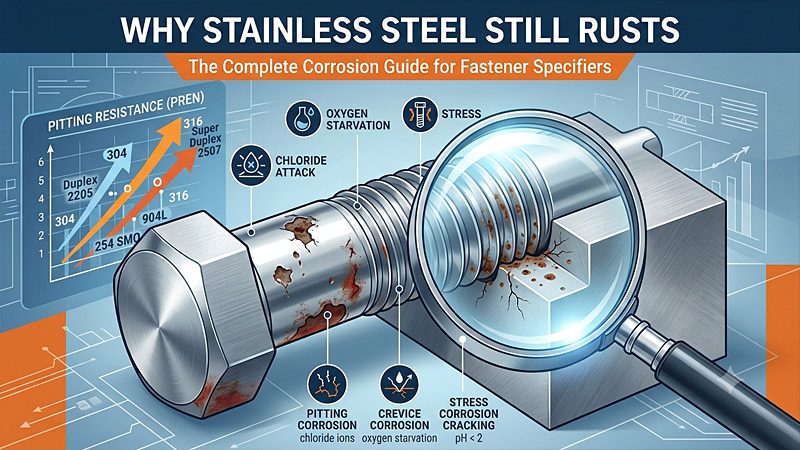
Stainless steel resists corrosion through a chromium oxide passive film — an invisible, self-healing layer 1 to 5 nanometers thick that separates reactive iron from the surrounding environment. But that film can be defeated. Chloride ions penetrate it at microscopic defect sites. Oxygen starvation inside a thread crevice prevents the film from reforming. The wrong neighboring metal turns the fastener into a galvanic anode. Tensile stress in hot chloride service triggers cracking. When one of these conditions is present, stainless steel corrodes. The only question is how fast.
This guide covers the six corrosion mechanisms, the alloy grades that resist each, and the specification practices that prevent failures before they start.
Stainless steel does not resist corrosion because it is chemically inert. It resists corrosion because it forms a passive layer — a film of chromium oxide (Cr₂O₃) approximately 1 to 5 nanometers thick — that separates the reactive iron in the alloy from the surrounding environment. This film is invisible, self-healing in the presence of oxygen, and is the sole reason stainless steel earns its name.
The mechanism requires two conditions to function. First, the alloy must contain at least 10.5% chromium by mass — this is the metallurgical threshold at which a continuous Cr₂O₃ passive film can form across the entire surface. Commercial stainless steels used in fastener production contain 12% to 28% chromium, well above this minimum. Second, the surface must have access to oxygen. The passive film is not a permanent coating applied once and left alone. It is a dynamic equilibrium layer that continuously reacts with atmospheric or dissolved oxygen. If the surface is scratched, fresh chromium atoms at the scratch site immediately oxidize and re-form the film, provided oxygen is present.
This self-healing property is why stainless steel outperforms coated carbon steel. A scratch through zinc plating exposes bare steel and initiates rust at the breach. A scratch through the passive layer on stainless steel repairs itself in seconds. But the repair requires oxygen. Take away the oxygen, and the mechanism stops working.
The passive layer fails when any of three conditions are met:
Chloride attack. Chloride ions (Cl⁻) — present in seawater, road de-icing salts, coastal atmospheres, and many industrial chemicals — penetrate the passive film at microscopic defect sites. Once a chloride ion displaces an oxygen atom in the Cr₂O₃ lattice, the film cannot re-form at that site, and localized corrosion begins. This is the mechanism behind pitting and crevice corrosion, the two most common failure modes for stainless steel fasteners in marine environments.
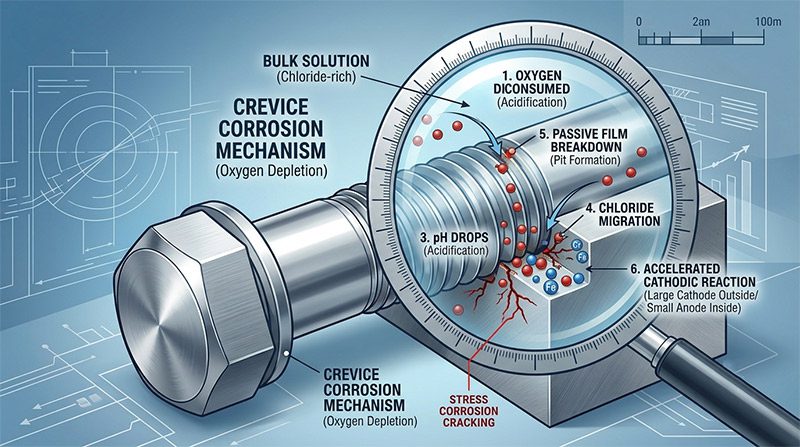
Oxygen depletion. In a tight crevice — the thread contact zone between a bolt and nut, the underside of a washer, a fastener head seated against a gasket — the surrounding bulk solution may be oxygen-rich, but the stagnant fluid trapped inside the crevice becomes oxygen-depleted within hours. Without oxygen, the passive film inside the crevice cannot repair itself. The metal inside the crevice becomes active (corroding) while the metal outside remains passive (protected), creating an electrochemical cell that drives rapid localized attack. A 316 stainless bolt that lasts decades in open seawater can fail within 18 months if installed in a stagnant crevice geometry.
Galvanic coupling. When stainless steel is electrically connected to a more noble metal — graphite, titanium, or even stainless steel in its passive state coupled to stainless steel in its active state — in the presence of an electrolyte, electrons flow from the less noble surface to the more noble surface. The less noble metal corrodes. A 304 stainless fastener in a copper busbar connection is the less noble partner in that couple. A carbon steel washer under a stainless bolt head is the sacrificial anode. The stainless survives; the carbon steel dissolves.
The Pitting Resistance Equivalent Number (PREN) is the primary engineering metric for comparing stainless steel grades on their resistance to chloride-induced pitting. The formula derives from decades of empirical corrosion testing and is now standard in alloy specification:
PREN = %Cr + 3.3 × %Mo + 16 × %NWhere %Cr, %Mo, and %N are the weight percentages of chromium, molybdenum, and nitrogen in the alloy.
The coefficients reflect each element’s relative contribution to pitting resistance. Molybdenum is 3.3 times more effective than chromium at resisting chloride attack. Nitrogen is 16 times more effective. This is why 316 — with its 2–3% molybdenum — has measurably better pitting resistance than 304, and why super-austenitic grades like 254 SMO with 6% molybdenum and 0.2% nitrogen can survive in seawater environments that would destroy 316 within months.
The PREN threshold that matters for fastener selection: a PREN above 32 is generally considered adequate for sustained seawater immersion. Below 32, the material is at risk of pitting corrosion in chloride-bearing environments. Below 24, the material should be restricted to freshwater, indoor atmospheric, or mildly corrosive chemical service.
| Alloy | Typical Cr% | Typical Mo% | Typical N% | PREN | Seawater Pitting Risk |
|---|---|---|---|---|---|
| 304 (A2) | 18.2 | 0 | 0.08 | 19.5 | High — do not use in chloride |
| 316 (A4) | 16.8 | 2.1 | 0.05 | 24.5 | Moderate — marginal for immersion |
| 316L (A4L) | 16.8 | 2.1 | 0.05 | 24.5 | Same as 316; lower C for welding |
| 410 (martensitic) | 12.3 | 0 | 0 | 12.3 | Very high — indoor or dry only |
| Duplex 2205 | 22.0 | 3.2 | 0.16 | 35.1 | Low — acceptable for seawater |
| Super Duplex 2507 | 25.0 | 4.0 | 0.27 | 42.5 | Very low — offshore standard |
| 904L | 20.5 | 4.3 | 0.06 | 35.7 | Low — chemical/marine rated |
| 254 SMO | 20.0 | 6.1 | 0.20 | 43.3 | Very low — seawater pump standard |
PREN values calculated from nominal alloy composition ranges per ASTM A240/A240M and manufacturer datasheets. Actual PREN varies within alloy specification tolerances.
The PREN gap between 304 (PREN ~19.5) and 316 (PREN ~24.5) explains the most common stainless steel fastener failure pattern: a customer specifies 304 for a coastal deck because “it’s stainless steel, right?” and the fasteners show rust spotting within the first wet season. The 5-point PREN difference is the margin between a material that can survive intermittent freshwater wetting and one that can tolerate light chloride exposure.
Pitting is the most common stainless steel corrosion failure mode and the most insidious — a fastener can lose 50% of its load-bearing cross-section while the visible surface looks almost intact. The mechanism starts when chloride ions breach the passive film at a microscopic inclusion site (manganese sulfide inclusions are the most common initiation points in 304 and 316). Once the film is breached at a single point, the exposed metal becomes anodic while the surrounding passive surface remains cathodic. The area ratio — a tiny anode feeding current to a large cathode — drives extremely rapid localized metal dissolution into the pit.
The pit then becomes autocatalytic. As metal ions dissolve inside the pit, they hydrolyze to form metal hydroxides and release hydrogen ions, dropping the pH inside the pit to values as low as 1–2. The acidic pit solution prevents repassivation. Simultaneously, chloride ions migrate into the pit to maintain charge neutrality, further concentrating the aggressive species in the already-active site. The pit deepens while the surrounding surface stays pristine. A 316 bolt in warm seawater at 30°C can develop through-wall pits in less than 12 months, while a 304 bolt in the same conditions can fail in under 6 months.
| Grade | Critical Pitting Temperature in 6% FeCl₃ (°C) | Seawater Pitting Risk |
|---|---|---|
| 304 | < 0 | Severe at all practical temperatures |
| 316 | 15–20 | Moderate — marginal for warm seawater |
| 2205 | 50–55 | Low — acceptable for most seawater |
| 2507 | > 80 | Very low — offshore standard |
CPT data per ASTM G48 Method A. Values vary with surface finish and specific alloy heat.
Pitting prevention strategy: select a grade with PREN above 32 for seawater or above 40 for warm seawater and offshore service. For 316 fasteners in marginal chloride exposure, specify electropolished surface finish — electropolishing removes surface inclusions that act as pit initiation sites and enriches the surface chromium concentration.
Crevice corrosion is the fastener industry’s most underdiagnosed failure mode. It occurs in the same chloride-bearing environments as pitting, but the initiation mechanism is different: oxygen depletion inside the confined geometry of the crevice, not a random film breach. The bolt thread engaged with a nut, the underside of a flat washer, the fastener head seated against a coated surface — these are all crevice geometries.
Once oxygen inside the crevice is consumed by the normal passive film maintenance reaction and cannot be replenished from the bulk solution (because the crevice gap restricts fluid exchange), the metal inside the crevice becomes active. The large cathodic area outside the crevice — the exposed bolt head, the shank, the surrounding structure — drives anodic dissolution inside the crevice. The chemistry becomes autocatalytic in exactly the same way as pitting: falling pH, chloride migration, accelerating attack.
The practical consequence for fastener specification: a bolted joint in a marine environment has crevice corrosion risk at every thread engagement, every washer interface, and every head-to-flange contact surface. Joint design matters as much as alloy selection. A flange joint with a gasket that creates a tight seal around the bolt hole creates a textbook crevice — the bolt shank inside the hole sees stagnant seawater while the exposed head sees flowing, oxygenated seawater. Specifying 316 instead of 304 for that joint shifts the PREN from 19.5 to 24.5, but the crevice geometry still drives the corrosion. Moving to duplex 2205 (PREN ~35) or redesigning the joint to eliminate the crevice is the real solution.
Intergranular corrosion is a metallurgical failure mode triggered by heat — specifically, the heat of welding, hot forming, or improper heat treatment. When stainless steel is held in the temperature range of 425°C to 870°C (800°F to 1600°F) for sufficient time, chromium atoms in the alloy migrate to grain boundaries and react with carbon to form chromium carbide (Cr₂₃C₆) precipitates. This process, called sensitization, depletes the chromium content in the narrow zone adjacent to each grain boundary to below the 10.5% threshold required for passivation. The grain interiors remain corrosion-resistant. The grain boundaries become vulnerable to selective attack.
In an aggressive environment, intergranular corrosion attacks these chromium-depleted grain boundaries preferentially. The fastener loses strength through grain boundary decohesion — the grains themselves are intact, but the boundaries holding them together dissolve. A sensitized 304 bolt in a mildly acidic industrial atmosphere can suffer intergranular attack within months of installation, while an identical non-sensitized bolt in the same environment shows no corrosion.
Prevention is straightforward and material-specified. For welded assemblies: use low-carbon grades (304L, 316L) with carbon content below 0.03%, which do not form enough chromium carbide to cause sensitization during normal welding cycles. For applications requiring full carbon grades: specify solution-annealed material and verify that post-weld heat treatment or controlled cooling rates are part of the fabrication procedure. ASTM A967 describes passivation treatments that can restore surface chromium after fabrication — but it cannot reverse sensitization once the grain boundaries are depleted.
Galvanic corrosion occurs when two dissimilar metals are electrically connected in the presence of an electrolyte. The more active (less noble) metal corrodes preferentially, while the more noble metal is protected. The driving force is the potential difference between the two metals on the galvanic series — the larger the potential gap, the faster the corrosion of the anode.
In seawater at 25°C, approximate potentials versus a saturated calomel electrode (SCE):
| Metal / Alloy | Potential vs SCE (Volts) | Role in Fastener Couple |
|---|---|---|
| Carbon steel | -0.60 to -0.70 | Anode — will corrode aggressively |
| Aluminum 6061 | -0.75 to -0.85 | Anode — severe corrosion risk |
| 304 / 316 SS (active state) | -0.45 to -0.55 | Anode — corrodes if active |
| 304 / 316 SS (passive state) | -0.05 to +0.10 | Cathode — drives corrosion of less noble metals |
| Copper / Brass | -0.30 to -0.40 | Cathode vs carbon steel; anode vs passive SS |
| Titanium | +0.05 to +0.15 | Cathode — drives corrosion of almost everything |
| Graphite | +0.20 to +0.30 | Strong cathode — maximum galvanic risk |
Potentials per ASTM G82 and corrosion engineering reference data. Actual potentials vary with temperature, flow rate, and water chemistry.
The most expensive galvanic mistake in fastener specification is pairing stainless steel fasteners with carbon steel structural members. The carbon steel — with its more negative potential — becomes the anode and corrodes at an accelerated rate, while the stainless fastener remains intact. The visible result is rust staining around the fastener hole, which the uninformed interpret as “the stainless fastener is rusting.” In reality, the carbon steel is corroding, and its rust products are staining the stainless surface.
Equally destructive: carbon steel fasteners in a stainless steel assembly. The small carbon steel bolt in a large stainless steel tank acts as a tiny anode feeding current to an enormous cathode — the area ratio alone drives corrosion rates that can consume the bolt within weeks.
Galvanic prevention for fasteners follows three rules. First, match fastener material to the structure material wherever possible — stainless fasteners with stainless structures, carbon steel fasteners with carbon steel structures. Second, when dissimilar metals cannot be avoided, isolate them electrically with non-conductive washers, bushings, or coatings that break the metallic current path. Third, if a sacrificial relationship is intentional (zinc-plated steel fasteners protecting a stainless assembly), size the anode with enough mass to provide the design service life.
Stress corrosion cracking is the most dangerous stainless steel failure mode because it occurs without warning — no visible rust, no measurable cross-section loss, no gradual degradation. A fastener under tensile stress in a chloride-bearing environment at elevated temperature can fracture suddenly at a load well below its rated tensile strength. The mechanism requires three simultaneous conditions: a susceptible alloy (austenitic stainless steels, especially 304 and 316, are highly susceptible), tensile stress (applied load plus residual stress from cold working), and a corrosive environment (chloride-bearing water above approximately 60°C).
The cracking propagates along grain boundaries or through grains in a branching pattern visible under metallographic examination. The fracture surface shows brittle characteristics even though the alloy is ductile under normal tensile loading. This is why SCC failures catch engineers off guard — all the standard mechanical property data says the fastener should hold, and the corrosion rate data shows negligible general metal loss. The two degradation mechanisms are not independent, and their combination produces a failure mode that neither predicts alone.
In practice, SCC is a known risk for 304 and 316 fasteners in chlorinated water above 60°C (swimming pool environments, industrial hot water systems, steam condensate lines with chloride contamination). Duplex stainless steels (2205, 2507) are significantly more resistant to chloride SCC than austenitic grades because of their mixed ferrite-austenite microstructure. For critical applications in hot chloride service, duplex or super-austenitic grades (904L, 254 SMO) are the standard engineering recommendation, not 316.
Uniform corrosion — the rusting pattern most people picture — is the least common failure mode for stainless steel fasteners in normal service but becomes relevant in strongly acidic or alkaline environments. Hydrochloric acid, sulfuric acid at certain concentrations and temperatures, and hot caustic solutions can dissolve the passive film uniformly and attack the underlying metal at a steady rate. Unlike pitting or crevice corrosion, which are localized, uniform corrosion thins the entire exposed surface evenly.
Stainless steel fastener selection for chemical service requires consulting iso-corrosion curves — charts published by alloy producers that map corrosion rate (typically in mm/year or mils/year) as a function of acid concentration and temperature. A 316 fastener may show excellent resistance to 10% sulfuric acid at 25°C (corrosion rate < 0.1 mm/year) but catastrophic attack in 50% sulfuric acid at 80°C (> 5 mm/year). There is no universal stainless steel grade for chemical service. Each acid and concentration range has a different optimal alloy.
| Grade | EN / ISO Designation | PREN | Tensile (MPa, CW) | Chloride Resistance | Weldability | Magnetic | Best Application |
|---|---|---|---|---|---|---|---|
| 304 | A2-70 / A2-80 | 19.5 | 700–860 | Poor — freshwater only | Good (304L preferred) | No | Indoor, general industrial, food equipment |
| 316 | A4-70 / A4-80 | 24.5 | 585–760 | Moderate — light coastal | Good (316L preferred) | No | Coastal atmospheric, chemical plant, food processing |
| 316L | A4L | 24.5 | 558–760 | Same as 316 | Excellent | No | Welded assemblies, as-welded service |
| 410 | — | 12.3 | ~700 (Q&T) | Very poor — indoor only | Poor | Yes | Indoor hardware, low-cost cutlery screws |
| 17-4 PH | — | ~16 | 1,070–1,310 | Poor — indoor or dry | Fair | Yes | High-strength aerospace, pump shafts |
| 2205 | — | 35.1 | ~800 | Good — seawater immersion | Good | Yes | Marine, offshore, chemical tankers |
| 2507 | — | 42.5 | ~900 | Excellent — offshore | Fair | Yes | Subsea, desalination, deepwater |
| 904L | — | 35.7 | ~650 | Excellent — chemical/marine | Good | No | Sulfuric acid, pollution control, seawater cooling |
Tensile values per ASTM F593-24 for cold-worked (CW) condition fasteners up to specified diameter ranges. Actual strength varies with diameter and manufacturer. 17-4 PH values for Condition H900 (precipitation hardened).
The overwhelming majority of stainless steel fasteners sold globally are 304 or 316. Together, they account for an estimated 85–90% of stainless fastener production volume. The reasons are economic and practical: both grades are widely available in bar and wire form, both cold-head and roll-thread efficiently, both are stocked by every major distributor, and both cost a fraction of duplex or super-austenitic alternatives.
But this dominance creates a specification hazard. Engineers and buyers default to “stainless steel” meaning 304, and “marine grade” meaning 316, without verifying whether these grades are actually suitable for the specific environment. A 316 bolt in warm tropical seawater with a crevice geometry is an engineered failure — the grade’s PREN of 24.5 cannot survive sustained chloride attack in a stagnant crevice. The correct specification for that application is duplex 2205 or super-austenitic 904L. The cost difference is roughly 2–3×, but the alternative is fastener replacement — often requiring equipment shutdown, confined-space entry, or dry-docking — at 100× the hardware cost.
ASTM F593-24 is the primary North American standard for stainless steel bolts, hex cap screws, and studs. It specifies chemical composition, mechanical properties, and the condition (cold-worked, solution-annealed, carbide-solution-treated) for each grade. Importantly, F593 does not specify corrosion resistance directly — it specifies the alloy chemistry, and corrosion resistance follows from chemistry. A bolt marked “F593 Alloy 304 Condition CW” is guaranteed to have 18–20% chromium and 8–10.5% nickel, but the standard does not warrant that it will not rust in a given environment.
ISO 3506-1:2020 is the international counterpart, covering mechanical properties of corrosion-resistant stainless steel fasteners. It uses the A2/A4/A5 designation system (A2 = 304 family, A4 = 316 family, A5 = 316L family) with property classes (50, 70, 80 for cold-worked tensile grades). ISO 3506-6 adds guidance on material selection for specific corrosion environments, making it more useful than ASTM F593 for corrosion-conscious specification.
ASTM G48 is the standard test method for pitting and crevice corrosion resistance of stainless steels using ferric chloride solution. The Critical Pitting Temperature (CPT) and Critical Crevice Corrosion Temperature (CCCT) values that alloy producers publish are determined by ASTM G48. These numbers are the most practical laboratory predictors of real-world chloride corrosion performance for fasteners.
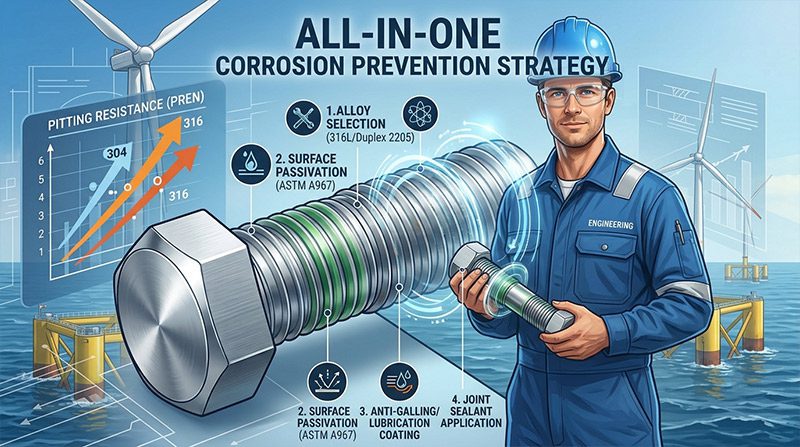
Corrosion prevention for stainless steel fasteners operates on three levels, and the most effective solutions address all three simultaneously.
The alloy grade must match the environment. This sounds obvious but is the most frequently violated rule in stainless fastener specification. The PREN thresholds provide a quantitative decision framework:
| Environment | Minimum PREN | Recommended Grade |
|---|---|---|
| Indoor, dry, non-corrosive | > 12 | 304, 410 |
| Outdoor, rural/urban, occasional rain | > 18 | 304 |
| Outdoor, coastal (atmospheric only) | > 24 | 316 |
| Outdoor, de-icing salt exposure | > 24 | 316 (inspect annually) |
| Seawater splash zone | > 32 | 2205, 904L |
| Seawater immersion, warm (> 25°C) | > 40 | 2507, 254 SMO |
| Chemical plant, acid service | Consult iso-corrosion curves | Application-specific |
| Welded assembly, as-welded service | — | Low-carbon (-L) grades |
All stainless steel fasteners arrive from the manufacturer with a passive layer formed during production. But fabrication steps — machining, cold heading, thread rolling, deburring — can embed iron particles from tooling into the stainless surface. These iron contaminants rust, producing the brown surface staining often misdiagnosed as “stainless steel rusting.”
Chemical passivation per ASTM A967 removes free iron from the surface and enriches the chromium-to-iron ratio in the passive film. It is not a coating — it is a surface cleaning and oxide-enrichment process. Passivated 304 fasteners show measurably better corrosion resistance in salt spray testing (ASTM B117) than non-passivated equivalents, because the surface is free of the iron contamination that initiates rust staining.
Electropolishing goes further: it removes a thin layer of metal (typically 5–40 μm) from the surface, eliminating embedded contaminants, surface inclusions, and microscopic peaks that act as pit initiation sites. The resulting surface is smoother (Ra < 0.5 μm achievable), chromium-enriched, and more resistant to both pitting initiation and bacterial adhesion. For 316 fasteners in marginal chloride service, electropolishing can extend service life by a factor of 1.5–2× in cyclic salt spray testing, based on manufacturer-published corrosion data.
The best alloy in the world cannot compensate for a joint design that creates crevices, traps water, or couples dissimilar metals. Design principles for corrosion-resistant bolted joints:
Eliminate water traps. Countersunk fasteners in outdoor horizontal surfaces collect standing water. Use hex head or button head fasteners instead, or provide drain paths.
Isolate dissimilar metals. Use nylon or PTFE washers, bushings, or gaskets to break the electrical path between stainless fasteners and carbon steel, aluminum, or copper alloy structures.
Minimize crevice severity. In marine bolted joints, specify a joint sealant (polysulfide or polyurethane) applied to the thread engagement zone and under the washer to exclude seawater from the crevice. This is standard practice in naval shipbuilding and extends fastener life dramatically.
Control assembly torque. Over-torqued fasteners in chloride service create higher sustained tensile stress, increasing SCC risk. Torque to the manufacturer specification for the alloy and diameter. Do not use carbon steel torque values for stainless fasteners — stainless has a lower proof stress and galls at lower torque.
Why did my 304 stainless steel bolts rust after only three months outdoors near the ocean?
The chloride concentration in coastal atmospheres — typically 5–50 mg/m²/day of chloride deposition within 1 km of the shoreline — exceeds what 304 (PREN ~19.5) can withstand without pitting. The passive film is breached by chloride ions, and once pitting initiates, the autocatalytic pit chemistry prevents repassivation. The solution is to specify 316 (PREN ~24.5) for atmospheric coastal exposure or duplex 2205 (PREN ~35) for splash zone and immersion service.
Can stainless steel rust from just water alone?
In pure water with negligible chloride content (< 10 ppm), properly passivated 304 or 316 stainless steel will not corrode at ambient temperature. However, tap water, well water, and rainwater all contain dissolved salts and chlorides. Water quality matters more than the presence of water. If the water is chlorinated (municipal supply) or naturally saline (coastal well water), the chloride content drives pitting and crevice corrosion.
Is 316 stainless steel truly marine grade?
“Marine grade” is a marketing term, not an engineering designation. 316 can survive atmospheric coastal exposure and intermittent seawater splash, but it is not reliably corrosion-resistant in warm seawater immersion or in crevice geometries. For sustained seawater immersion, duplex 2205 (PREN ~35) or super-austenitic 904L (PREN ~36) are the appropriate engineering choices. The term “marine grade” applied to 316 should be understood as “suitable for above-deck marine atmospheric service,” not “suitable for below-waterline immersion.”
How do I prevent galling when assembling stainless steel fasteners?
Galling — cold welding between the thread surfaces under pressure — is a mechanical problem, not a corrosion problem, but it frequently appears alongside corrosion discussions because it affects stainless fastener reliability. Prevention: use a nickel-based anti-seize compound, reduce assembly speed (power tools accelerate galling), specify different alloys for the bolt and nut (304 bolt with 316 nut reduces galling tendency), and ensure threads are clean and undamaged before assembly. Rolled threads gall less than cut threads because of the smoother surface finish.
What does the rust staining around my stainless steel fasteners indicate?
Brown staining around stainless fasteners in a carbon steel structure typically indicates galvanic corrosion of the carbon steel — not the stainless. The carbon steel is the anode and is corroding. The stainless fastener is the cathode and is intact, but the rust products from the carbon steel are staining the stainless surface. Clean the staining and verify that the fastener itself is not pitted or losing material. If the structure is carbon steel, the correct long-term solution is to isolate the stainless fasteners with non-conductive washers or to switch to carbon steel fasteners with appropriate corrosion protection.
Social Chat is free, download and try it now here!